-
Auteur :
 Antoine C.
- Dec 29, 2025
How to Successfully Pass Your TCF Canada Test: Complete Strategic Master Guide to Immigration Success
- Blog
- /
- Article
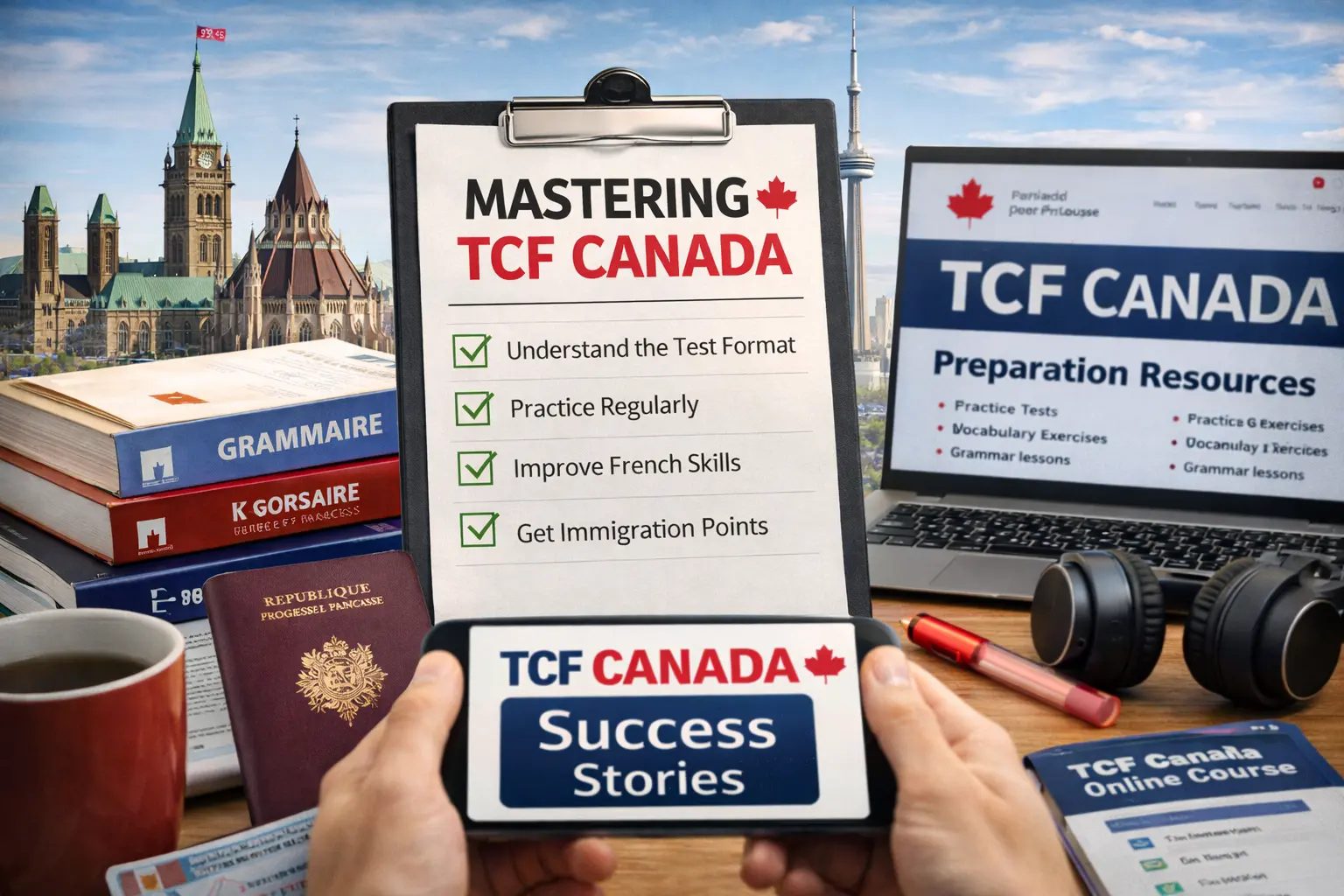
Successfully passing the TCF Canada examination with competitive scores opening Canadian immigration pathways represents far more than simply achieving minimum passing marks on a standardized language test—it requires comprehensive strategic preparation, systematic skill development, intelligent resource allocation, psychological resilience, and unwavering commitment extending over weeks or months of dedicated focused effort. This complete master guide provides you with a comprehensive proven roadmap synthesizing best practices from hundreds of successful candidates, combining official guidance with practical field-tested strategies, and offering detailed actionable methodologies to systematically maximize your examination success probability regardless of your current baseline French proficiency level, available preparation time, financial resources, or learning style preferences. Whether you're an elementary beginner starting from A2 level requiring 12-18 months foundation building, an intermediate learner at B1-B2 requiring 3-6 months strategic refinement, or an advanced speaker at C1 requiring 1-3 months perfection and format mastery, this guide provides customized strategic pathways adapted to your specific profile and immigration objectives ensuring optimal preparation efficiency and maximum score outcomes.
Step 1: Deep Understanding of TCF Canada Test Format, Structure, and Evaluation Criteria
Why Format Mastery Matters as Much as Language Proficiency
The TCF Canada examination, administered officially by France Éducation international (FEI) and recognized by Immigration, Refugees and Citizenship Canada (IRCC) for all economic immigration programs including Express Entry Federal Skilled Worker, Canadian Experience Class, Provincial Nominee Programs, and Quebec immigration, consists of 4 mandatory independent components systematically assessing your comprehensive French language proficiency across receptive skills (listening and reading comprehension) and productive skills (speaking and writing expression). Understanding not just what the test contains but precisely how it's structured, how evaluators score responses, what specific competencies each task assesses, and how scoring converts to crucial NCLC (Niveaux de compétence linguistique canadiens) levels determining your Express Entry Comprehensive Ranking System points represents absolutely foundational knowledge essential for strategic preparation rather than blind effort.
Complete TCF Canada Examination Architecture and Detailed Breakdown:
| Competency Component | Number of Questions/Tasks | Total Duration | Score Range | NCLC Levels Assessed | Format and Structure Details |
|---|---|---|---|---|---|
| Listening Comprehension (Compréhension orale) | 29 multiple-choice questions (4 options each) organized in progressive difficulty | Approximately 25 minutes total (audio plays once only - no repetition!) | 0-699 points converting to NCLC 4-10 | NCLC 4 (basic) through NCLC 10 (native-like); Most candidates target NCLC 7-9 (B2-C1) | Short dialogues (2-3 exchanges), medium conversations (interviews, discussions), long monologues (presentations, announcements); Questions assess main idea, specific details, inference, speaker attitudes, functional understanding |
| Reading Comprehension (Compréhension écrite) | 29 multiple-choice questions (4 options each) based on 6-8 authentic texts varying length and difficulty | 45 minutes total (self-paced time management critical) | 0-699 points converting to NCLC 4-10 | NCLC 4 (basic) through NCLC 10 (native-like); Most candidates target NCLC 7-9 (B2-C1) | Short practical texts (ads, notices, messages), medium informational texts (articles, reports), long complex texts (essays, analyses); Questions assess literal comprehension, inference, vocabulary in context, text organization, author purpose/tone |
| Speaking Expression (Expression orale) | 3 progressive speaking tasks increasing difficulty: Task 1 (personal questions), Task 2 (problem-solving), Task 3 (viewpoint defense) | Approximately 12 minutes total (2 minutes prep + 10 minutes recording); Computer-recorded with no human interlocutor | 0-699 points converting to NCLC 4-10 | NCLC 4 (basic survival) through NCLC 10 (sophisticated native-like); Most candidates target NCLC 7-9 (B2-C1) | Task 1 (2 min): Respond to 2 personal questions about yourself, experiences, preferences; Task 2 (4 min): Solve practical problem presenting options and recommendation; Task 3 (4 min): Defend position on controversial topic with arguments; Evaluated on linguistic competence (grammar, vocabulary, pronunciation), sociolinguistic competence (register, coherence), pragmatic competence (task completion, argumentation) |
| Writing Expression (Expression écrite) | 3 progressive writing tasks increasing formality and complexity: Task 1 (informal message), Task 2 (formal letter), Task 3 (opinion essay) | 60 minutes total for all 3 tasks (self-managed time allocation strategy essential); Handwritten on paper or typed on computer depending on test center | 0-699 points converting to NCLC 4-10 | NCLC 4 (basic) through NCLC 10 (sophisticated); Most candidates target NCLC 7-9 (B2-C1) | Task 1 (60-80 words, ~15 min): Informal message to friend/family about personal situation; Task 2 (100-125 words, ~20 min): Formal administrative/professional letter with complaint or request; Task 3 (minimum 200 words, ~25 min): Opinion essay defending position on societal topic with structured argumentation; Evaluated on adequacy to task requirements, linguistic competence (grammar, vocabulary, spelling, syntax), coherence/cohesion (logical organization, connectors, paragraph structure) |
Critical Scoring and NCLC Conversion Understanding
Each of the four competency components receives independent score from 0-699 points (not percentages!) that converts through official conversion table to specific NCLC level from 4 (minimum basic survival) through 10 (native-like sophisticated performance). These NCLC levels then determine your Express Entry French language points according to established formula where higher NCLC levels provide exponentially more CRS points creating enormous competitive advantages.
Express Entry French Language Points by NCLC Level (First Official Language):
- NCLC 10+ (C2): 32 points per competency × 4 = 128 total maximum points
- NCLC 9 (C1): 29 points per competency × 4 = 116 total points
- NCLC 8 (B2+): 23 points per competency × 4 = 92 total points
- NCLC 7 (B2): 17 points per competency × 4 = 68 total points (minimum competitive threshold)
- NCLC 6 or below: 0 points (insufficient for Express Entry eligibility)
Critical Strategic Insight: Improving from NCLC 7 to NCLC 8 adds 24 CRS points; NCLC 8 to NCLC 9 adds 24 more points; NCLC 9 to NCLC 10 adds 12 points. Additionally, achieving NCLC 7+ in French as second official language (with English CLB 5+) provides bonus 15-50 additional points for bilingualism creating massive competitive advantage!
Step 2: Setting Realistic Achievable SMART Goals Based on Immigration Requirements and Current Level
Why Goal Clarity Determines Preparation Strategy and Timeline
For Canadian immigration purposes through Express Entry or Provincial Nominee Programs, candidates must strategically aim for minimum NCLC 7 level (equivalent to European B2) in all four competencies representing the crucial threshold for basic Express Entry competitiveness, though achieving NCLC 8-9 (B2+ to C1) dramatically maximizes your total CRS points potentially adding 24-48 points creating substantial competitive advantage and significantly improving Invitation to Apply probability especially for candidates lacking Canadian work experience, Canadian education credentials, or provincial nomination adding 600 points.
Complete NCLC Level Target Selection Framework:
| Target NCLC Level | European Framework Equivalent | Express Entry Points (All 4 Competencies) | Recommended Candidate Profiles | Typical Preparation Timeline from Baseline |
|---|---|---|---|---|
| NCLC 7 (Minimum Competitive) | Solid B2 (Upper Intermediate) | 68 total points; Minimum for Express Entry competitiveness | Candidates with strong other factors (Canadian experience, education, age); Provincial programs accepting NCLC 7 minimum; Budget/time constraints limiting higher pursuit | From A2: 12-18 months; From B1: 6-9 months; From B2: 2-4 months format mastery |
| NCLC 8 (Competitive Advantage) | Strong B2+ (Advanced Intermediate approaching C1) | 92 total points (+24 vs NCLC 7); Competitive threshold for federal draws | Most candidates pursuing optimal balance effort/reward; Those qualifying for French-priority draws; Candidates compensating for weaker English or missing Canadian factors | From A2: 15-24 months; From B1: 9-12 months; From B2: 4-6 months; From C1: 2-3 months |
| NCLC 9 (Highly Competitive) | C1 (Advanced - Autonomous user) | 116 total points (+24 vs NCLC 8); Near-maximum optimization; French-draw guaranteed with decent CRS | Ambitious candidates pursuing maximum points; Those with adequate time/resources; Candidates needing compensation for age/lacking Canadian experience; French-priority draw strategies | From B1: 12-18 months; From B2: 6-9 months; From C1: 3-6 months perfection |
| NCLC 10 (Maximum Excellence) | C2 (Mastery - Near-native proficiency) | 128 total maximum points (+12 vs NCLC 9); Absolute ceiling | Perfectionists; Native/heritage speakers; Those with extensive French education; Diminishing returns vs NCLC 9 for most candidates | Generally requires C1+ baseline; 6-12 months perfection strategies; Often requires immersion or heritage advantage |
SMART Goal Framework Application to TCF Canada:
Transform Vague Aspiration into Concrete Actionable SMART Goal:
Vague Goal (Ineffective): "I want to do well on TCF Canada and improve my French."
SMART Goal (Effective): "I will achieve minimum NCLC 8 in all four TCF Canada competencies (Listening 500+, Reading 500+, Writing 500+, Speaking 500+) by October 15th, 2025 through systematic preparation investing 15 hours weekly over 6 months including: (1) Daily 30-minute listening practice with Canadian media; (2) Weekly writing practice with tutor feedback; (3) Bi-weekly speaking sessions with conversation partner; (4) Monthly full practice tests tracking progress; enabling me to reach 480+ CRS score qualifying for Express Entry French-priority draws."
SMART Criteria Breakdown:
- Specific: NCLC 8 all competencies, defined score thresholds, specific test date
- Measurable: Quantified scores (500+), time investment (15 hours weekly), progress tracking (monthly tests)
- Achievable: Realistic 6-month timeline, reasonable 15 hours weekly commitment, appropriate NCLC 8 target for profile
- Relevant: Directly linked to immigration objective (480+ CRS, French-priority draws qualification)
- Time-bound: Clear deadline (October 15th, 2025), interim milestones (monthly progress tests)
Step 3: Strategic Preparation Techniques for Each of Four Competency Sections
Section A: Listening Comprehension Mastery - From Passive Hearing to Active Strategic Understanding
Listening comprehension represents one of most challenging TCF Canada competencies for non-immersed learners because unlike reading where you control pace, listening occurs in real-time requiring simultaneous processing of rapid native speech, diverse accents including Quebec French specificities, background noise in recordings, and complex vocabulary without visual support or ability to review, all while answering multiple-choice questions testing main ideas, specific details, inference, speaker attitudes, and functional understanding under strict time pressure with audio playing only once without repetition creating high-stakes pressure.
Seven-Stage Progressive Listening Development Strategy:
Stage 1: Passive Immersion Building Auditory Foundation (Weeks 1-4 for beginners; Ongoing for all levels)
- Activity: Immerse yourself systematically in French media consuming 60-90 minutes daily: radio broadcasts (France Inter, Radio-Canada), podcasts on diverse topics, video content (YouTube, news channels), background exposure during commute/exercise/housework
- Objective: Familiarize ears with natural French speech rhythms, intonation patterns, common vocabulary, pronunciation variations without pressure to understand 100%—building auditory foundation and comfort
- Best Sources: RFI Journal en français facile (simplified news perfect for beginners), France Inter morning shows, Radio-Canada Première authentic Quebec content, YouTube channels like innerFrench, francaisavecpierre
Stage 2: Accent Diversification - Quebec French Priority (Weeks 3-8; Critical for TCF Canada)
- Activity: Develop specific familiarity with various Francophone accents particularly Canadian/Quebec French which appears frequently in TCF Canada and differs significantly from European French in pronunciation, vocabulary, expressions, and speaking speed
- Quebec French Exposure Sources: ICI Radio-Canada Première authentic Quebec radio, Télé-Québec television programs, Quebec podcasts ("Plus on est de fous plus on lit", "Moteur de recherche"), Quebec films and series on Tou.tv streaming platform
- Other Accent Exposure: Belgian French (RTBF), Swiss French (RTS), African French (various countries), maintaining diversity while prioritizing Quebec given test context
Stage 3: Active Listening with Strategic Note-Taking (Weeks 5-12; Essential TCF skill)
- Activity: Practice active focused listening with systematic note-taking techniques capturing key information: main topics, specific details (numbers, dates, names), speaker opinions/attitudes, logical connections, while listening to 3-5 minute audio segments
- Note-Taking Framework: Use abbreviations (govt=government, pb=problem, nb=nombre), symbols (↑=increase, →=therefore, ≠=different), key words only (no complete sentences), organize by categories (Who/What/When/Where/Why), leave space for uncertain information to complete if mentioned again
- Practice Sources: TCF practice tests, DELF B2/C1 listening exercises, authentic podcasts with transcripts available for verification
Stages 4-7: (Question prediction techniques, inference training, speed comprehension, and TCF-specific format mastery - detailed in specialized Listening Comprehension guide)
Section B: Reading Comprehension Excellence - Speed, Accuracy, and Strategic Text Navigation
Reading comprehension tests your ability to understand authentic French written texts varying from short practical documents (advertisements, notices, emails) through medium informational texts (newspaper articles, reports, explanatory texts) to long complex texts (opinion essays, literary excerpts, academic analyses) while answering 29 multiple-choice questions in just 45 minutes requiring strategic time management balancing speed and accuracy under pressure.
Five-Pillar Reading Development Methodology:
| Development Pillar | Core Activities and Techniques | Time Investment | Progress Indicators |
|---|---|---|---|
| Pillar 1: Regular Diverse Reading Habit | Engage daily with varied French press, blogs, online forums, literary excerpts building vocabulary breadth and reading stamina; Sources: Le Monde, La Presse, Le Devoir (Canadian), L'actualité magazine, French Wikipedia, Reddit r/france | Minimum 30 minutes daily; Optimal 60+ minutes | Vocabulary recognition increasing; Reading feeling less effortful; Can sustain 45+ minute focused reading; Comprehension 70%+ on unfamiliar topics |
| Pillar 2: Speed Reading Development | Improve reading speed without sacrificing comprehension through timed reading exercises gradually increasing pace; Techniques: Eliminate subvocalization (silent pronunciation), expand eye span reading groups of words, reduce regression (re-reading), use pointer/finger guiding eyes | 15-20 minutes daily speed drills | Reading speed 250+ words/minute (NCLC 7-8) up to 300+ wpm (NCLC 9-10); Can complete 45-minute TCF reading section comfortably with 5+ minutes remaining |
| Pillar 3: Skimming and Scanning Mastery | Skimming (rapid overview for gist in 30-60 seconds): Read title, first paragraph, topic sentences each paragraph, conclusion; Scanning (targeted search for specific info): Use questions as guide, look for keywords, numbers, names, dates, use text organization clues | Practice with every text; 2-3 minutes per text before deep reading | Can determine text main idea in under 60 seconds; Can locate specific information in 30-45 seconds; Efficient question-driven reading avoiding unnecessary deep reading |
| Pillar 4: Vocabulary in Context | Develop ability to infer unknown word meanings from context clues rather than panicking or wasting time; Techniques: Analyze word parts (prefixes, roots, suffixes), examine surrounding sentences, consider logical fit, use process of elimination in multiple choice | Ongoing skill during all reading | Can infer 60-70% of unknown word meanings accurately; Comfortable encountering 5-10% unfamiliar vocabulary without comprehension breakdown |
| Pillar 5: Strategic Time Management | Allocate time proportionally to question difficulty and text length; Strategy: Quick texts (ads, notices) 1-1.5 min each; Medium texts (articles) 3-4 min each; Long texts (essays) 5-7 min each; Reserve 3-5 min final review uncertain answers | Practice with timed tests weekly | Completing practice tests within 45 minutes consistently; Less than 2-3 questions left blank due to time; Can adjust pace mid-test recognizing time status |
Section C: Speaking Skills Development - From Hesitant Expression to Confident Fluent Articulation
Speaking competency often represents greatest psychological challenge for non-immersed learners due to real-time performance pressure, permanent recording with no revision possibility, psychological anxiety about pronunciation and errors, and lack of conversation partner practice in monolingual environments, yet systematic preparation using proven frameworks and consistent practice absolutely can produce NCLC 7-9 performance even for initially hesitant speakers.
Six-Dimension Speaking Excellence Framework:
Dimension 1: Daily Speaking Practice Habit (Non-Negotiable Foundation)
- Solo Practice: Speak French daily minimum 15-20 minutes even entirely alone: describe your day aloud, summarize articles you read, give opinions on current events, practice TCF task responses, record yourself for self-evaluation
- Conversation Partners: Find language exchange partners (HelloTalk, Tandem apps), join online conversation clubs (Virtual Language Café), hire tutors for structured conversation (iTalki, Preply), attend local French conversation meetups
- Progressive Challenge: Start with 2-3 minute monologues on simple familiar topics; progress to 5-10 minute complex topics; eventually practice spontaneous responses with 30-second preparation like actual TCF
Dimension 2: Strategic Framework Mastery for Each Task Type
- Task 1 Framework - SALP (Personal Questions): Situation (context), Action (what you did), Learning (what you learned), Personal reflection (feelings, significance)
- Task 2 Framework - SCORE (Problem-Solving): Situation (problem context), Complications (challenges), Options (2-3 possible solutions), Recommendation (chosen solution with justification), Expected outcome (anticipated results)
- Task 3 Framework - PEEL (Opinion Defense): Point (clear position statement), Evidence (2-3 supporting arguments), Explanation (develop each argument with examples), Link back (restate position reinforcing stance)
Dimension 3-6: (Logical connectors mastery, pronunciation refinement, error recovery strategies, recording self-analysis - detailed in specialized Speaking guide)
Section D: Writing Skills Enhancement - Clarity, Correctness, and Sophisticated Expression
Writing competency requires producing three progressively complex texts in 60 total minutes—informal message (60-80 words, ~15 min), formal letter (100-125 words, ~20 min), opinion essay (200+ words, ~25 min)—each evaluated rigorously on adequacy to task requirements, linguistic competence (grammar, vocabulary, spelling, syntax), and coherence/cohesion (logical organization, connectors, paragraph structure) requiring systematic preparation balancing speed and quality.
Eight-Stage Writing Mastery Progression:
Stage 1: Format Template Internalization (Week 1-2)
- Memorize standard opening/closing formulas for each text type: Informal (Cher/Chère + name, Amitiés/Bises); Formal (Madame/Monsieur, Je vous prie d'agréer...); Essay (Introduction-Body-Conclusion structure)
- Learn conventional organization patterns for each task ensuring you never face blank page panic
Stage 2: Grammar Accuracy Priority Remediation (Ongoing throughout preparation)
- Identify your 5-10 most frequent recurring grammar errors through practice writing analysis
- Target remediation with focused exercises: verb conjugation drills (especially subjunctive, conditional), agreement rules (adjective, past participle), preposition usage, article selection
- Create personal error checklist reviewing every writing before submission
Stage 3: Sophisticated Vocabulary Acquisition Beyond Basic
- Build formal register vocabulary essential for Tasks 2-3: administrative terms, professional expressions, opinion/argumentation vocabulary
- Learn transition words and logical connectors for each function: addition (de plus, en outre), contrast (cependant, néanmoins), cause (car, étant donné que), consequence (par conséquent, ainsi), example (par exemple, notamment)
- Practice synonym variation avoiding repetition: Use "cependant, toutefois, néanmoins, pourtant" instead of repeating "mais"
Stages 4-8: (Structured paragraph writing, coherence/cohesion techniques, time management practice, spelling/accent mastery, professional feedback integration - detailed in specialized Writing guide)
Step 4: Common Critical Mistakes to Systematically Avoid
Ten Most Frequent Candidate Errors Sabotaging Success:
| Critical Mistake | Why It Sabotages Success | Strategic Correction |
|---|---|---|
| ❌ Poor Time Management During Test | Running out of time leaving questions unanswered; Spending excessive time on difficult questions; Rushing final tasks producing errors | ✅ Practice strict timed conditions weekly; Allocate time proportionally to task value/difficulty; Use watch monitoring pace; Accept uncertainty moving forward rather than obsessing |
| ❌ Using Overly Complex Lengthy Sentences | Increases grammar error probability; Reduces clarity and comprehension; Evaluators penalize errors more than reward complexity if correctness suffers | ✅ Use clear, correct, moderately complex sentences (15-20 words average); Demonstrate sophistication through vocabulary and organization, not convoluted syntax; Prioritize accuracy over impressive complexity |
| ❌ Neglecting Oral Practice Focusing Only Written | Speaking requires different skill (spontaneous real-time production vs. edited writing); Cannot develop speaking fluency through writing practice alone; Psychological anxiety compounds lack of practice | ✅ Allocate 30-40% preparation time to speaking; Daily oral practice minimum 15 minutes; Record yourself weekly; Find conversation partners; Seek professional feedback |
| ❌ Underestimating Canadian Vocabulary/Cultural References | TCF Canada specifically includes Canadian French terms, Quebec expressions, Canadian cultural/political references unfamiliar to European French learners; Missing this vocabulary causes comprehension failures | ✅ Systematically study Canadian French specifics; Consume Quebec media daily; Learn administrative/political vocabulary; Master 200+ Canadian expressions; Understand Canadian values/institutions |
| ❌ Insufficient Practice Test Simulation | Test format mastery requires repeated exposure; Time pressure management needs practice; Psychological stress requires habituation; Strategic frameworks must become automatic | ✅ Complete minimum 6-8 full timed practice tests; Weekly partial tests of weak sections; Simulate actual test conditions (timing, no pauses, environment); Analyze every error systematically |
| ❌ Perfectionist Paralysis or Resignation to Mediocrity | Perfectionists waste time on impossible goals causing stress; Resigned candidates don't push capabilities settling for minimum when better achievable | ✅ Set realistic SMART goals based on baseline and timeline; Accept minor imperfections as normal; Push beyond comfort zone but avoid unrealistic expectations; Focus on progressive improvement |
Step 5: Essential Curated Resources for Maximum Preparation Efficiency
Official Materials (Highest Priority - Foundation of Preparation):
✓ TCF Canada Official Manual (France Éducation international) - €45-60
Complete format explanation; Sample questions; Evaluation criteria; Purchase immediately as foundation
✓ Official Practice Tests (FEI or authorized centers) - €15-25 each
Authentic test simulations; Buy minimum 3-4 tests; Use strategically spaced throughout preparation
✓ Free Sample Materials (TCF Canada official website)
Limited but authentic samples; Download immediately for format familiarization
Digital Resources and Applications (Flexibility and Supplementation):
- TV5MONDE Apprendre (Free) - Comprehensive French A1-C2; Excellent quality; Not TCF-specific but builds foundation
- RFI Savoirs - Journal en français facile (Free) - Perfect listening practice; Graded difficulty; Authentic journalism
- Frantastique/Gymglish (€30-50/month) - AI personalized daily lessons; Quality content; Expensive but effective
- Anki Flashcards (Free desktop, $25 iOS) - Spaced repetition vocabulary; Create custom decks; Evidence-based memorization
- Speechling (Free basic, $20/month premium) - Pronunciation practice; Native speaker recordings; AI feedback
Canadian Media (Essential Cultural and Linguistic Immersion):
| Media Type | Top Recommendations | Usage Strategy |
|---|---|---|
| Radio/Podcasts | ICI Radio-Canada Première; Moteur de recherche; Plus on est de fous plus on lit; Voir dire | Daily 30-60 min during commute/exercise; Focus on Quebec accent familiarity |
| News Websites | Radio-Canada.ca; La Presse+; Le Devoir; TVA Nouvelles | Daily 20-30 min reading; Current events vocabulary; Canadian issues knowledge |
| TV/Streaming | Tou.tv (Radio-Canada); Télé-Québec; Quebec films and series | Weekly 2-3 hours entertainment with learning; Cultural understanding; Listening practice |
Step 6: Strategic Preparation Timeline - 6-Week Intensive Plan
Complete Week-by-Week Structured Progression:
| Week | Primary Focus Areas | Daily Activities (15-20 hours weekly total) | Milestone Objectives |
|---|---|---|---|
| Week 1-2: Foundation Assessment & Grammar Review | Diagnostic baseline; Vocabulary building; Comprehensive grammar review; Format familiarization | Take diagnostic practice test; Study official manual; Review grammar fundamentals (verb tenses, agreement, syntax); Build vocabulary 50+ words daily; Begin media immersion; Identify weak areas | Accurate baseline established; Grammar gaps identified; 500+ new vocabulary; Format understood; Realistic goals set |
| Week 3-4: Intensive Speaking & Writing Practice | Productive skills intensive development; Framework mastery; Regular tutor feedback | Daily 30 min speaking practice (record self); Write 2-3 TCF tasks daily with self-correction; Study logical connectors; Practice all frameworks (SALP, SCORE, PEEL); Find conversation partner; Hire tutor 2-3 sessions | Frameworks internalized becoming automatic; Writing speed improving; Speaking confidence building; Tutor feedback integrated; 1000+ vocabulary total |
| Week 5: Full Timed Practice Tests Under Realistic Conditions | Test simulation; Time management; Stress inoculation; Strategy refinement | Complete 3 full timed practice tests (Monday, Wednesday, Friday); Analyze every error systematically; Adjust strategies based on results; Focus remaining time on identified weaknesses; Maintain media immersion | Test format completely familiar; Time management effective; Strategies validated or adjusted; Weak areas clearly identified for Week 6 focus |
| Week 6: Targeted Review, Mental Preparation, Strategic Refinement | Weak area remediation; Confidence building; Mental/physical preparation; Final refinements | Focus 70% time on weakest competency identified; Review error patterns; Final vocabulary push; Practice breathing/stress techniques; Prepare test day logistics; Reduce intensity final 2 days avoiding burnout; Light review; Mental preparation; Ensure proper rest | Weak areas improved; Confidence high; Test day plan clear; Mentally and physically prepared; Logistics organized; Ready for examination |
Important Timeline Caveat: This 6-week intensive plan assumes B1-B2 baseline French proficiency. Beginners at A2 level require 12-18 months. B2+ candidates may achieve NCLC 8-9 in 6 weeks. C1 speakers need 2-4 weeks format mastery only. Adjust timeline to your actual baseline!
Step 7: Test Day Success Strategies - Maximizing Performance When It Counts
Complete 48-Hour Pre-Test Protocol:
Day Before Test (D-1):
- Morning: Light review of frameworks, vocabulary flashcards, logical connectors; No new material; No intense study
- Afternoon: Prepare test day materials (ID, confirmation, pens, water); Plan route to test center; Confirm transportation; Verify everything organized
- Evening: Light dinner 7:00 PM; No alcohol, minimal caffeine; Relaxation activities (reading, bath, music); Bed by 10:00 PM ensuring 8+ hours sleep
- Mental State: Confidence affirmations; Trust preparation; Release perfectionism; Accept minor uncertainties as normal
Test Day Morning:
- Wake: 2.5-3 hours before test; Gentle stretching; 5 minutes breathing exercises (4-4-6 cardiac coherence)
- Breakfast: 2-2.5 hours before test; Complex carbs + protein (oatmeal + eggs + fruit); Moderate coffee if habitual; Hydrate well
- Departure: Arrive 30 minutes early minimum; Account for unexpected delays; Bring backup transportation money
- At Center: Bathroom before test; Final breathing exercises; Light stretching; Affirm confidence; Enter with calm positive mindset
During Examination - Section-by-Section Tactical Execution:
- Listening: Maximum concentration; Note-taking ready; First reading of questions before audio; Trust first instinct; No question obsessing
- Reading: Time monitoring every 10 minutes; Skim before deep reading; Strategic question-driven approach; No perfectionism
- Writing: Time allocation strict (15-20-25 min); Brief planning each task; Write clearly; Reserve 5 min final review
- Speaking: Breathing before each task; Framework application; Natural expression; Error recovery without panic; Completion priority
Conclusion: Your Path to TCF Canada Success and Canadian Immigration Dreams
Success in the TCF Canada examination depends fundamentally on five interconnected pillars: (1) Consistent methodical preparation over adequate timeline rather than last-minute cramming; (2) Targeted strategic practice focusing on your specific weaknesses and test format requirements; (3) Effective intelligent time management balancing speed and accuracy under pressure; (4) Psychological resilience and stress management maintaining confidence despite difficulties; (5) Dedication to systematic improvement through regular practice, feedback integration, and progressive refinement. With genuine commitment, realistic planning, disciplined implementation, and the comprehensive strategic approach detailed in this master guide, achieving competitive NCLC 7-9 levels producing 68-116 Express Entry French points is absolutely within reach for every motivated candidate regardless of starting level or background.
Remember this fundamental truth: TCF Canada represents not merely bureaucratic obstacle to endure grudgingly but rather genuine gateway opportunity opening doors to extraordinary new life in Canada—one of world's most prosperous, safe, multicultural, opportunity-rich nations valuing diversity, rewarding merit, and welcoming skilled immigrants. Your examination success directly enables:
- Permanent residence in Canada with pathway to citizenship
- Professional opportunities and career advancement in bilingual Canadian market
- Access to world-class healthcare and education systems
- Safe stable environment for your family
- Multicultural society celebrating diversity and inclusion
- Quality of life consistently ranked among world's highest
Your Canadian dream begins with TCF Canada preparation starting today. Take the first step with confidence—you're capable of this success!
* * *
Laissez un commentaire
Votreadresse email ne sera pas publie. Les champs obligatoires sont marque avec *


0 Commentaires
aucun commentaire
Soyez le premier a partager votre avis !