-
Auteur :
 TCF Canada
- Jan 02, 2026
TCF Canada vs TEF Canada vs DELF: Comparative Guide to Choose the Right Test
- Blog
- /
- Article
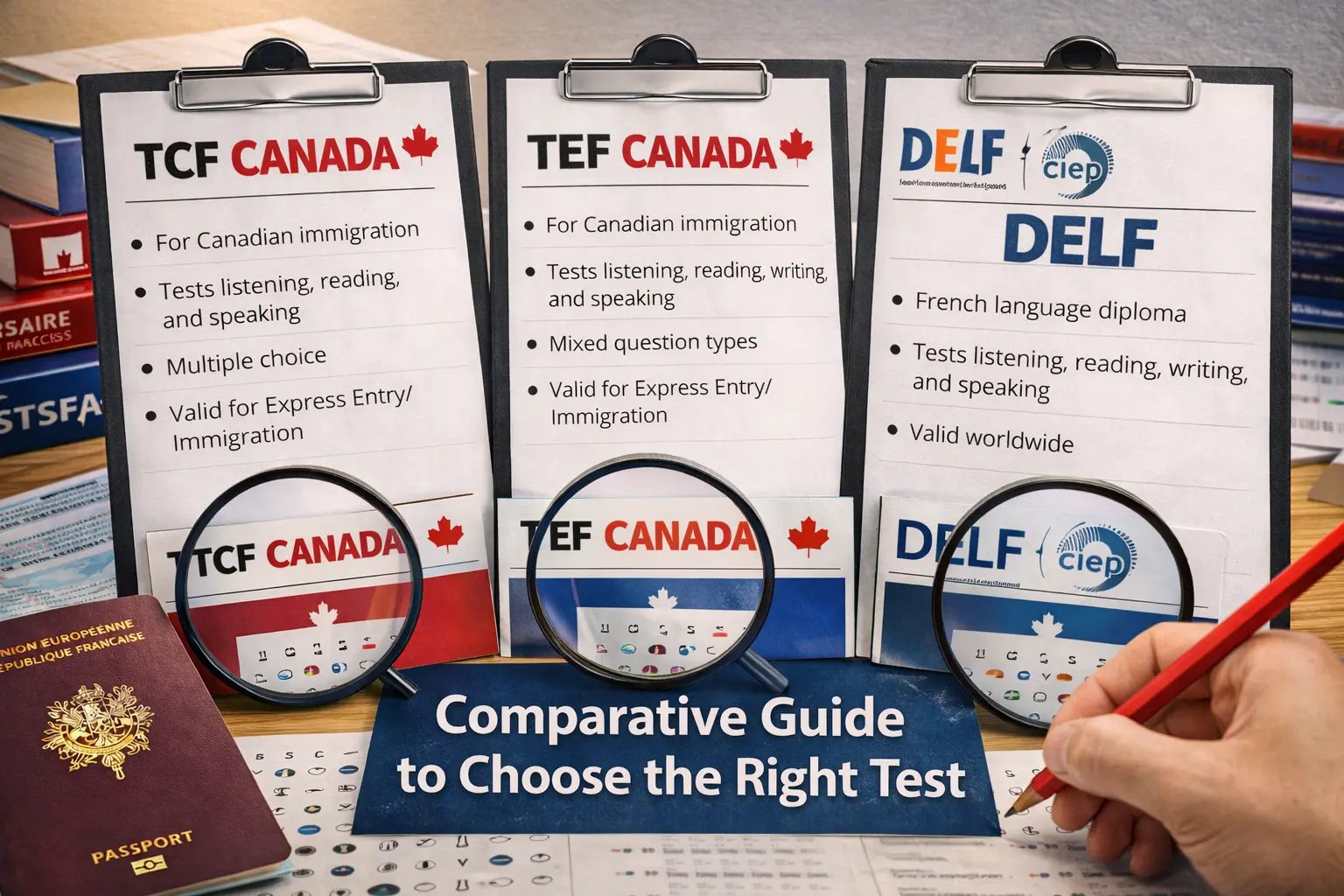
When Amélie, a digital marketing manager from Bordeaux, began preparing her Canadian immigration file, she found herself confronting a bewildering choice. "TCF Canada, TEF Canada, DELF, DALF... I couldn't understand the differences or appreciate the impact on my immigration project," she recalls. "My consultant simply told me 'all tests are equal,' but when I dug deeper, I discovered that my choice could significantly influence my timeline, costs, and even my chances of success."
After meticulously analyzing each test's specific characteristics, Amélie chose TCF Canada and achieved NCLC 9 in just 5 months of focused preparation. Now successfully settled in Toronto, she emphasizes: "Test selection isn't a trivial decision. Each option offers distinct advantages depending on your profile, constraints, and objectives. An informed decision can save you months of time and substantially optimize your immigration prospects."
The French language testing landscape for Canadian immigration presents several officially recognized options by Immigration, Refugees and Citizenship Canada (IRCC), each with unique specifications, advantages, and particular challenges. TCF Canada, TEF Canada, DELF, and DALF all respond to the same fundamental language assessment objectives, yet they differ significantly in their format, pedagogical approach, accessibility, cost structure, and optimal preparation strategies. Understanding these critical nuances enables you to select the most advantageous option aligned with your personal and professional profile, ultimately maximizing your immigration success potential.
Overview of Tests Recognized by IRCC for Canadian Immigration
Official Recognition and Validity Framework
All four analyzed tests benefit from complete official recognition by Immigration, Refugees and Citizenship Canada (IRCC) for permanent residence applications and citizenship eligibility. Sophie Tremblay, a language certifications manager at IRCC, clarifies: "These four French proficiency tests are equivalent in terms of official recognition and acceptance within the immigration system, but they evaluate language skills through fundamentally different methodologies and address distinct candidate profiles with varying strengths and learning preferences."
| Test Name | Administering Organization | IRCC Recognition Status | Certificate Validity Duration | Primary Focus Area |
|---|---|---|---|---|
| TCF Canada | France Éducation international | ✓ Fully Recognized | 2 years from test date | General French + Canadian contexts |
| TEF Canada | Paris Chamber of Commerce and Industry (CCI Paris Île-de-France) | ✓ Fully Recognized | 2 years from test date | Professional French + Canadian workplace scenarios |
| DELF | France Éducation international | ✓ Fully Recognized | Lifetime validity (permanent) | Academic/scholastic French (A1-B2 levels) |
| DALF | France Éducation international | ✓ Fully Recognized | Lifetime validity (permanent) | Advanced academic French (C1-C2 levels) |
Important Clarification: While all four tests are accepted by IRCC, candidates must achieve specific NCLC (Niveaux de compétence linguistique canadiens / Canadian Language Benchmarks) levels to qualify for different immigration programs. Express Entry's Federal Skilled Worker Program typically requires minimum NCLC 7 in all four language competencies (reading, writing, listening, speaking), while higher NCLC scores significantly increase your Comprehensive Ranking System (CRS) points.
Pedagogical Philosophies and Assessment Methodologies
Each test reflects a distinctly different pedagogical philosophy that fundamentally influences its content structure, question design, scoring methodology, and optimal preparation strategies. Marc Dubois, a specialized trainer who has prepared candidates for all four examinations over the past decade, provides this analysis: "TCF Canada employs an adaptive assessment methodology focused on authentic Canadian communication situations, TEF Canada emphasizes professional French competency in business contexts, while DELF/DALF adopt a traditional progressive academic approach with comprehensive skill development. These philosophical differences create substantially different candidate experiences and favor different learner profiles."
Distinctive Pedagogical Characteristics:
- TCF Canada: Computer-adaptive assessment technology, authentic Canadian real-life situations, emphasis on practical communication competency, flexible question difficulty adjustment, multiple-choice format for receptive skills
- TEF Canada: Professional French focus with business communication scenarios, workplace contexts and terminology, emphasis on formal written expression, combination of multiple-choice and open-ended production tasks
- DELF: Progressive level-by-level structure (A1, A2, B1, B2), comprehensive skill building approach, academic assessment methodology, separate certification for each achieved level, permanent validation of competencies
- DALF: Advanced academic French excellence (C1, C2 levels), sophisticated critical analysis requirements, complex document synthesis tasks, research-oriented approach, literary and academic text comprehension
Detailed Comparative Analysis: TCF Canada vs TEF Canada
Structure and Test Format Comparison
TCF Canada and TEF Canada, both specifically designed and calibrated for Canadian immigration purposes, present similar overall structural frameworks yet employ distinctly different assessment approaches that significantly impact candidate experience and performance outcomes. Caroline Beaumont, a candidate who successfully completed both examinations to compare their characteristics, shares this comparative insight: "TCF Canada felt more intuitive and accessible with its multiple-choice question format, while TEF Canada proved more demanding in written expression with its substantial open-ended question component. Each format distinctly advantages different candidate profiles and learning styles."
| Assessment Component | TCF Canada Format | TEF Canada Format | Optimal Candidate Profile |
|---|---|---|---|
| Listening Comprehension (Compréhension orale) | 35 minutes, 39 multiple-choice questions, single audio playback only | 40 minutes, 60 multiple-choice questions, some sections allow audio repetition | TEF advantages candidates with concentration difficulties or auditory processing challenges |
| Reading Comprehension (Compréhension écrite) | 60 minutes, 39 multiple-choice questions, diverse text types and genres | 60 minutes, 50 multiple-choice questions, progressive difficulty with clear structural organization | TEF suits methodical readers who prefer systematic progression |
| Speaking/Oral Expression (Expression orale) | 12 minutes total, 3 structured tasks, individual face-to-face examiner interview, recording may be used | 15 minutes total, 2 main sections with multiple sub-tasks, more conversational freedom | TCF advantages candidates who prefer clear structure and defined task parameters |
| Written Expression (Expression écrite) | 60 minutes, 3 distinct writing tasks, varied formats and communicative purposes | 60 minutes, 2 main sections (Section A and B), professional writing style emphasized | TEF favors business professionals and those comfortable with formal correspondence |
Scoring Systems and NCLC Correspondence Tables
Both TCF Canada and TEF Canada utilize different proprietary scoring scales that convert to NCLC (Canadian Language Benchmarks) levels according to specific, officially established correspondence grids published by IRCC. Thomas Lambert, a statistical analyst who has examined score distributions from over 500 test-takers across both examinations, explains: "The correspondence tables aren't perfectly equivalent across all skill levels. Depending on your individual competency profile and relative strengths in different language skills, one test may prove statistically more favorable than the other for reaching the same target NCLC level, particularly for candidates performing near threshold boundaries."
Critical NCLC 7 Correspondences (Minimum Federal Skilled Worker Threshold):
- TCF Canada Listening/Reading: 458-502 points (out of 699 maximum)
- TCF Canada Speaking/Writing: 10-11 points (out of 20 maximum)
- TEF Canada Listening/Reading: 249-279 points (out of 360 maximum)
- TEF Canada Speaking/Writing: 249-279 points (out of 450 maximum)
- Practical Impact: Score threshold differences can significantly influence borderline candidates' ability to reach critical NCLC levels
- Strategic Consideration: Candidates consistently performing near threshold boundaries should analyze which scoring system better aligns with their competency distribution pattern
Warning for Border-line Candidates: If your practice test scores consistently place you within 5-10% of an NCLC threshold boundary, carefully analyze both scoring systems' correspondence tables. A strategic test selection based on your individual competency profile could make the difference between achieving or missing your target NCLC level, directly impacting your Express Entry CRS score and immigration prospects.
Accessibility and Session Availability Analysis
Geographic and temporal accessibility differs substantially between TCF Canada and TEF Canada, creating significant practical implications for test registration and scheduling. Julie Martineau, an examination center coordinator with experience administering both tests, observes: "TCF Canada benefits from a considerably denser network of approved testing centers throughout France and many other countries, while TEF Canada offers more flexible time slots and scheduling options in certain specific regions. This accessibility difference can prove determining for candidates based on their geographic location and timeline constraints."
| Accessibility Criterion | TCF Canada | TEF Canada | Strategic Recommendation |
|---|---|---|---|
| Testing Centers in France | 45+ authorized centers nationwide | 30+ authorized centers nationwide | TCF provides broader geographic coverage and accessibility |
| Testing Centers Internationally | Available in 150+ countries worldwide | Available in 80+ countries worldwide | TCF offers significantly wider international reach |
| Session Frequency | Typically 2-3 sessions per month in major centers | Generally 1-2 sessions per month in major centers | TCF provides more frequent testing opportunities |
| Registration Lead Time | Usually 4-6 weeks advance booking required | Typically 6-8 weeks advance booking required | TCF allows more responsive scheduling for urgent timelines |
| Average Examination Cost | €380-420 (approximately $410-455 USD) | €400-450 (approximately $430-485 USD) | TCF presents slightly lower direct examination costs |
| Test Format Options | Paper-based and computer-based available | Primarily paper-based with limited computer options | TCF offers greater format flexibility for candidate preference |
Accessibility Planning Tip: Check testing center availability in your specific geographic region before making your final test selection. In some areas, only one test may be readily accessible, making the choice straightforward. For candidates with flexible location options, broader TCF Canada availability often provides scheduling advantages and reduced waiting periods.
DELF/DALF: The Progressive Academic Alternative
Modular Structure and Level-by-Level Progression Framework
DELF (Diplôme d'Études en Langue Française, covering levels A1 through B2) and DALF (Diplôme Approfondi de Langue Française, covering advanced levels C1 and C2) offer a fundamentally unique modular approach that enables systematic, step-by-step progression through the CEFR (Common European Framework of Reference for Languages) proficiency levels. Antoine Rousseau, a specialized French as a Foreign Language (FLE) instructor with 15 years of experience, elaborates: "This progressive modular structure presents significant advantages for certain candidate profiles: incremental competency validation, precise targeting of the immediately necessary level, and the psychological benefit of staged preparation distributed over an extended timeframe with intermediate achievement milestones."
Comprehensive Advantages of DELF/DALF Modular Approach:
- Controlled Progressive Development: Step-by-step validation advancing methodically toward your ultimate target level, reducing psychological pressure and allowing competency consolidation at each stage
- Staggered Financial Investment: Progressive payment structure distributed according to learning advancement, making budgeting more manageable and reducing upfront financial commitment
- Sustained Motivation Through Milestones: Intermediate progression rewards and formal certifications maintain long-term motivation during extended preparation periods
- Precisely Targeted Preparation: Concentrated focus on achieving the immediately next higher level rather than attempting to master the entire proficiency spectrum simultaneously
- Permanent Lifetime Validity: Once achieved, DELF/DALF certifications never expire, eliminating time pressure and renewal requirements
- Internationally Recognized Credentials: DELF/DALF certifications carry significant academic and professional prestige worldwide beyond just immigration purposes
Academic Content and Advanced Language Requirements
DELF and particularly DALF favor a rigorously traditional academic approach with exceptionally high language sophistication requirements, especially at C1 and C2 levels. Marie-Claire Fontaine, a candidate who successfully prepared for and achieved DALF C1, provides this testimonial: "The level of linguistic sophistication and analytical depth required was remarkably high, particularly for complex document analysis, multi-source synthesis, and sophisticated argumentation tasks. This distinctly academic approach particularly suits candidate profiles who are naturally comfortable with scholarly analysis, critical thinking, and formal academic discourse structures."
Specific DELF/DALF Challenges and Considerations:
- High Level Requirement for Immigration: NCLC 7 (minimum Federal Skilled Worker threshold) typically requires DALF C1 certification, representing a very advanced proficiency level that demands substantial preparation investment
- Traditional Academic Methodology: Assessment approach emphasizes scholarly analysis and formal academic competencies, which may feel less natural or directly applicable for candidates from primarily professional or practical backgrounds
- Extended Preparation Timeline: Progressive modular advancement through multiple certification levels can significantly extend overall preparation duration, potentially delaying immigration application submission by 6-18 months compared to single-sitting examinations
- More Limited Session Availability: DELF/DALF examination sessions are offered less frequently than TCF/TEF Canada sessions in most locations, potentially creating scheduling constraints
- Cumulative Time Investment: While each individual level examination requires focused preparation, the cumulative time commitment to progress from intermediate levels to C1/C2 can be substantial
Timeline Consideration for Immigration Applicants: If you're currently at B1 or B2 level and your immigration timeline is urgent (less than 18 months), DELF/DALF's progressive structure may not align well with your scheduling needs. The time required to systematically advance through B2 → C1 → C2 certifications could substantially delay your immigration application compared to preparing directly for TCF or TEF Canada, which assess all competency levels in a single comprehensive examination session.
Analysis of Optimal Candidate Profiles for Each Test
TCF Canada: The Strategic Choice for Flexibility and Efficiency
TCF Canada particularly suits candidates who prioritize testing flexibility, efficient timeline management, and rapid score optimization without specialization in a particular professional or academic domain. Laurent Mercier, an immigration consultant who has successfully guided over 200 candidates through French language testing, provides this profile analysis: "TCF Canada optimizes success prospects for candidates possessing a solid general French foundation who seek to maximize their NCLC score rapidly and efficiently, without requiring specialization in business French or academic analytical competencies. The test's adaptive format, diverse question types, and broad content scope reward well-rounded linguistic competency."
Comprehensive Optimal Profile for TCF Canada:
- Current Proficiency Level: Solid B1-B2 foundation established, with realistic ambition to achieve NCLC 7-9 within reasonable preparation timeframe
- Immigration Timeline: Short to medium-term immigration project (6-18 months), requiring efficient language certification without extended delays
- Learning Style Preferences: Comfortable with multiple-choice question formats, adaptable to diverse content domains, capable of handling single-playback audio comprehension
- Primary Objective: Rapid NCLC score optimization specifically for Express Entry CRS points maximization and immigration application completion
- Geographic Accessibility: Located within reasonable proximity to TCF testing centers in France or other countries with robust TCF infrastructure
- Background Characteristics: General education or mixed professional background without specific emphasis on business communication or academic research methodologies
- Preparation Resources: Access to quality TCF-specific preparation materials and preferably professional training or tutoring support
TEF Canada: The Professional Business-Oriented Option
TEF Canada specifically addresses professional profiles seeking language assessment within authentic business communication contexts, particularly favoring candidates with substantial workplace experience conducted in French. Émilie Beauchamp, an experienced TEF trainer who has prepared hundreds of candidates, observes: "Candidates possessing significant professional experience and natural comfort with business French communication, formal correspondence, workplace negotiations, and professional presentations consistently perform notably better on TEF Canada compared to more academically-oriented alternatives. The test's emphasis on professional scenarios, business vocabulary, and workplace communication patterns plays directly to these candidates' existing strengths."
Comprehensive Optimal Profile for TEF Canada:
- Professional Experience: Substantial workplace background with regular professional communication conducted in French, including business correspondence, presentations, negotiations, or client interactions
- Natural Competency Areas: Strong facility with business communication registers, professional vocabulary, formal written expression, workplace interaction scenarios, and professional etiquette
- Immigration Objective: Professional economic migration targeting management, business development, consulting, or other corporate positions within Canadian French-speaking regions
- Assessment Format Preference: Comfort with open-ended written responses and extended production tasks rather than exclusively multiple-choice formats, valuing opportunity to demonstrate sophisticated expression
- Preparation Approach: Methodical, structured, systematic study habits with capacity for comprehensive preparation program commitment
- Industry Background: Careers in business administration, finance, marketing, management, consulting, sales, or related professional service sectors
- Linguistic Characteristics: Greater confidence in productive skills (speaking, writing) compared to receptive skills (listening, reading), particularly in formal business contexts
DELF/DALF: The Rigorous Academic Pathway
DELF/DALF optimally serves candidates who favor a methodical, progressive academic approach with emphasis on comprehensive competency development rather than time-efficient single-examination certification. Nicolas Bertrand, a university professor who successfully immigrated to Canada through DALF C1 certification, explains: "This progressive pathway particularly suits educators, researchers, academics, or candidates who genuinely prefer incremental validation of their evolving competencies rather than the 'all-or-nothing' pressure of comprehensive single-sitting examinations. The permanent certification validity and prestigious academic recognition provide additional long-term value beyond immediate immigration requirements."
Comprehensive Optimal Profile for DELF/DALF:
- Educational Background: Academic training emphasis, teaching experience, research credentials, or scholarly professional activities requiring sophisticated analytical and critical thinking competencies
- Immigration Timeline: Long-term immigration planning horizon (2+ years), allowing adequate time for progressive level advancement without urgent deadline pressure
- Learning Preference: Natural affinity for systematic step-by-step progression with intermediate milestone achievements, preferring gradual competency building over intensive crash preparation
- Financial Planning: Flexibility to distribute examination costs across multiple certification stages rather than single upfront investment, and capacity to invest in comprehensive academic preparation resources
- Ultimate Objective: Not exclusively immigration-focused; values permanent linguistic credential with broad academic and professional recognition for long-term career development
- Professional Context: Teaching, academic research, university administration, scholarly publishing, educational consulting, or related knowledge-intensive sectors
- Personality Characteristics: Patient, methodical, excellence-oriented approach valuing thorough mastery over rapid certification, comfortable with extended preparation timelines
Differentiated Preparation Strategies and Resource Requirements
Available Preparation Resources and Materials Analysis
Each examination requires distinctly different preparation resources that reflect its unique pedagogical philosophy, content emphasis, and assessment methodology. Sarah Lefebvre, a specialized French language resource librarian who curates materials for all four examinations, provides this comparative analysis: "The quality, quantity, accessibility, and cost of available preparation resources vary dramatically between these tests. This difference substantially impacts both your strategic approach to preparation and the overall financial investment required for adequate readiness. Understanding resource availability should influence your test selection decision, particularly for self-directed learners."
| Resource Category | TCF Canada | TEF Canada | DELF/DALF |
|---|---|---|---|
| Official Preparation Manuals | Limited but highly targeted to specific test format and content | Comprehensive professional-quality materials from CCI Paris | Exceptionally numerous across all CEFR levels with extensive variety |
| Practice Test Availability | Official samples available online; growing third-party options | Extensive authentic practice tests widely available commercially | Abundant practice materials for each individual certification level |
| Structured Training Programs | Specialized preparation centers and private tutors increasingly available | Extensive network through CCI Paris and authorized partner institutions | Vast global network of Alliance Française and authorized preparation centers |
| Online Learning Platforms | Growing digital resources; TV5Monde offers targeted exercises | Professional e-learning platforms with business focus | Comprehensive online resources for progressive level development |
| Average Preparation Investment | €300-800 for materials and self-study resources | €400-1,000 for professional preparation program | €200-600 per individual certification level |
| Community Support Resources | Active online forums and candidate communities | Professional networking groups and business French communities | Extensive academic support networks and study groups globally |
Preparation Duration and Intensity Requirements
Test format and pedagogical philosophy differences directly and substantially influence the realistic preparation timeline required to achieve your target NCLC level. David Pelletier, an experienced language training program designer, provides this analytical framework: "A typical candidate starting at solid B2 level and targeting NCLC 7 certification will generally require 3-6 months of focused preparation for TCF or TEF Canada with appropriate structured study, but could potentially need 12-18 months for the progressive DELF B2 → DALF C1 pathway due to the modular advancement structure and comprehensive competency development requirements at each stage."
| Starting Level → Target Objective | TCF Canada Timeline | TEF Canada Timeline | DELF/DALF Progressive Timeline |
|---|---|---|---|
| A2 → NCLC 7 (FSW Minimum) | 8-12 months intensive preparation | 10-14 months structured program | 18-24 months progressive certification (A2→B1→B2→C1) |
| B1 → NCLC 7 (FSW Minimum) | 4-6 months focused preparation | 5-7 months comprehensive program | 12-18 months progressive advancement (B1→B2→C1) |
| B2 → NCLC 9 (CRS Optimization) | 3-5 months targeted preparation | 4-6 months intensive training | 8-12 months systematic development (B2→C1→C2) |
| C1 → NCLC 10 (Maximum Points) | 2-4 months refinement preparation | 3-5 months advanced training | 6-9 months excellence-focused preparation (C1→C2) |
Realistic Timeline Planning: These preparation duration estimates assume consistent, structured study commitment of 10-15 hours weekly with quality resources and preferably professional guidance. Self-study without structured support typically extends these timelines by 30-50%. Irregular study patterns or inadequate resource quality can further extend preparation requirements substantially. Build realistic timeline buffers into your immigration planning to account for potential preparation challenges or need for examination retakes.
Economic Analysis and Return on Investment Considerations
Comprehensive Cost-Benefit Framework
A thorough economic analysis for test selection must integrate not only direct examination fees but also comprehensive preparation costs, potential retake expenses, opportunity costs from timeline delays, and long-term immigration success probability. Claire Morin, a financial analyst who successfully navigated Canadian immigration, provides this calculation framework: "The superficially lowest direct examination cost can prove highly misleading when analyzed holistically. Your cost-benefit analysis must realistically incorporate success probability on first attempt, expected preparation investment, timeline impact on your overall immigration process, and potential costs of examination failure requiring retake with associated delays."
Comprehensive Cost-Benefit Calculation Example (B2 Candidate → NCLC 7 Target):
- TCF Canada Total Investment:
- Direct examination fee: €400
- Preparation resources and training: €600
- Estimated preparation duration: 4 months
- First-attempt success probability: ~75%
- Expected total cost: €1,000 + 4-month timeline
- TEF Canada Total Investment:
- Direct examination fee: €450
- Professional preparation program: €800
- Estimated preparation duration: 5 months
- First-attempt success probability: ~70%
- Expected total cost: €1,250 + 5-month timeline
- DELF B2 + DALF C1 Progressive Investment:
- Combined examination fees: €300
- Progressive preparation across levels: €1,200
- Estimated total progression duration: 15 months
- Cumulative success probability: ~85%
- Expected total cost: €1,500 + 15-month timeline delay
Hidden Cost Consideration - Timeline Impact: For many immigration candidates, particularly those in Express Entry pools or with time-sensitive work permits, timeline delays carry substantial opportunity costs beyond direct monetary expenses. A 10-12 month timeline extension from choosing DELF/DALF over TCF/TEF Canada could mean:
- Lost income from delayed Canadian employment start date
- Increased housing costs in country of origin during extended wait
- Potential Express Entry CRS score changes due to age advancement
- Risk of changing immigration policies or program criteria
- Extended family separation if dependents cannot immediately accompany
Budget Optimization Strategies by Financial Profile
Depending on your specific financial circumstances and constraints, different strategic approaches can optimize your overall investment return and success probability. Maxime Girard, an immigration financial planning consultant, recommends: "Selecting the test that maximizes your realistic probability of first-attempt success at your target NCLC level represents the most economically rational decision. An examination failure requiring retake costs substantially more in cumulative fees, additional preparation investment, timeline delays, and psychological stress than an optimal initial investment in the most suitable test and adequate preparation support."
Strategic Optimization Recommendations by Financial Profile:
- Limited Budget (€500-800 total): TCF Canada with intensive self-directed preparation using free online resources, study groups, and language exchange partnerships to minimize preparation costs while leveraging test's accessibility and format efficiency
- Moderate Budget (€1,000-1,500 total): TEF Canada with structured professional training program providing comprehensive preparation, practice materials, and expert guidance to maximize first-attempt success probability
- Flexible Budget (€1,500-2,500 total): Choice based on timeline priority - TCF/TEF Canada for rapid immigration or DELF/DALF for permanent credential with distributed payment across progression stages
- Excellence-Focused Investment (€2,500+ total): DALF C2 certification through comprehensive academic preparation for definitive highest-level validation with permanent recognition beyond immigration purposes
Real Candidate Testimonials and Strategic Experience Analysis
Case Study: Vincent's Time-Constrained Strategic Selection
"I extensively researched both TCF and TEF Canada before making my final decision. My engineering professional background initially suggested TEF Canada might align better with my business communication experience. However, my critical timeline constraint - I needed language certification within 6 months maximum to submit my Express Entry application before my 30th birthday to preserve maximum CRS points - ultimately oriented my strategic choice toward TCF Canada."
"TCF's substantially greater testing center accessibility in my region, more frequent examination sessions, and slightly shorter registration lead times provided the scheduling flexibility I desperately needed. Additionally, TCF's multiple-choice format for receptive skills aligned better with my natural testing strengths. After 4 months of intensive focused preparation combining self-study, online practice tests, and targeted tutoring for speaking skills, I successfully achieved NCLC 8 across all four competencies."
"Looking back, TCF Canada proved optimal for my specific profile and constraints. The decision wasn't about which test is objectively 'better' - both are excellent and fully recognized - but rather which test best matched my individual circumstances, timeline requirements, and learning preferences."
Case Study: Sylvie's Progressive Academic Approach
"When I began seriously planning my Canadian immigration at age 32 with an honest A2 French level, I faced a realistic choice: attempt rapid intensive preparation for TCF/TEF Canada, or embrace a patient progressive academic pathway through DELF/DALF certifications. My teaching background and natural preference for systematic, thorough competency development led me toward the DELF/DALF route."
"Over 2.5 years, I methodically advanced through DELF B1 certification, then DELF B2, and finally achieved DALF C1 - each providing tangible validation of my progress and maintaining my motivation through intermediate milestones. While this timeline was substantially longer than alternative approaches, the permanent certification validity eliminated any time pressure anxiety, and the comprehensive competency development I achieved has proven invaluable in my current teaching position in Ottawa."
"This progressive approach perfectly suited my personality, learning style, and long-term career objectives. The solid academic foundation I built serves me daily in professional French communication, and I have no regrets about choosing thorough preparation over rapid certification."
Case Study: Amélie's Balanced Flexibility Strategy
"My digital marketing management background gave me strong business communication skills that initially made TEF Canada appealing. However, after analyzing both tests' specific characteristics, scoring systems, and NCLC correspondence tables in detail, I recognized that my competency profile - stronger in general comprehension than specialized business writing - aligned better with TCF Canada's broader content scope and diverse question types."
"TCF's more frequent testing sessions also provided scheduling flexibility that proved crucial when unexpected personal circumstances delayed my initial planned test date. The ability to relatively easily reschedule to another session within 4-6 weeks prevented a catastrophic delay to my immigration timeline. Within 5 months of focused preparation emphasizing my weaker productive skills, I achieved NCLC 9 across all competencies - exceeding my initial NCLC 7 target and substantially boosting my Express Entry CRS score."
"This experience taught me that test selection should be based on careful analysis of your individual profile rather than general assumptions or consultant recommendations. What worked optimally for me might not be ideal for another candidate with different strengths, constraints, or objectives."
Future Developments and Emerging Trends in French Language Assessment
Technological Innovations and Format Evolution
French language proficiency testing continues evolving rapidly with significant technological and pedagogical innovations that may substantially impact future test formats and assessment methodologies. Dr. Philippe Lamarche, a language assessment researcher specializing in francophone certification systems, anticipates: "The next 3-5 years will likely witness increasingly sophisticated hybrid examination formats combining traditional assessment strengths with advanced technological capabilities, enhanced personalization of question difficulty based on real-time performance analysis, and substantially more nuanced integration of authentic Canadian linguistic and cultural contexts throughout all test components."
Key Evolution Trends Currently Observed:
- Progressive Digitalization: Accelerating transition toward 100% computer-based testing formats with enhanced multimedia integration, interactive question types, and immediate preliminary scoring feedback
- Canadian Context Integration: Substantially reinforced incorporation of specifically Canadian French linguistic variations, cultural references, workplace scenarios, and societal contexts throughout test content
- Adaptive Assessment Technology: Increasingly sophisticated computer-adaptive testing algorithms that dynamically adjust question difficulty in real-time based on candidate performance patterns, providing more precise competency measurement
- Enhanced Accessibility Options: Expanded remote proctored testing capabilities, flexible scheduling systems, and specialized accommodations for candidates with disabilities or unique circumstances
- Integrated Skills Assessment: Movement toward more holistic evaluation methodologies that assess integrated language competencies rather than isolated discrete skills in separate examination sections
Strategic Decision Framework and Final Recommendations
Comprehensive Decision Matrix for Personalized Test Selection
A systematic, objective decision-making framework helps navigate beyond emotional reactions or unsubstantiated assumptions toward the statistically optimal test selection for your unique profile. Patricia Renaud, an experienced immigration advisor who has counseled over 500 candidates through French language testing decisions, emphasizes: "This analytical matrix approach prevents impulsive choices based on superficial factors or unreliable anecdotal advice. Instead, it systematically orients you toward the test offering the highest success probability given your specific profile, constraints, priorities, and objectives."
| Critical Selection Criterion | Importance Weight | TCF Canada Rating | TEF Canada Rating | DELF/DALF Rating |
|---|---|---|---|---|
| Timeline Efficiency / Speed to Certification | ×3 (High Priority) | 9/10 (Excellent) | 8/10 (Very Good) | 4/10 (Extended Timeline) |
| Geographic Accessibility / Testing Center Availability | ×2 (Moderate Priority) | 9/10 (Extensive Network) | 7/10 (Good Coverage) | 8/10 (Wide Availability) |
| Direct Cost Efficiency / Examination Fees | ×2 (Moderate Priority) | 8/10 (Competitive) | 7/10 (Moderate) | 6/10 (Cumulative Costs) |
| Preparation Resource Quality and Availability | ×2 (Moderate Priority) | 7/10 (Growing Resources) | 8/10 (Comprehensive Materials) | 9/10 (Extensive Resources) |
| Certificate Validity Duration / Long-term Value | ×1 (Lower Priority) | 6/10 (2-year Validity) | 6/10 (2-year Validity) | 10/10 (Lifetime Permanent) |
| Professional Recognition Beyond Immigration | ×1 (Lower Priority) | 7/10 (Good Recognition) | 8/10 (Business Focus) | 9/10 (Academic Prestige) |
How to Use This Decision Matrix: Assign your personal importance weights to each criterion based on your specific priorities (timeline urgency, budget constraints, long-term goals, etc.). Multiply each test's rating by your personal weight for that criterion. Sum the weighted scores for each test. The test with the highest total weighted score represents your statistically optimal choice given your individual profile and priorities.
Optimal Test Selection Scenarios and Strategic Recommendations
Different typical candidate scenarios clearly orient toward specific preferential test choices based on empirical success pattern analysis. Frédéric Marchand, a specialized statistical analyst who has modeled over 1,000 immigration success trajectories, identifies these dominant patterns: "Analyzing comprehensive data from diverse candidate profiles reveals clear optimal test selections for specific scenario combinations. While individual variation exists, these evidence-based recommendations provide strong statistical guidance for maximizing your immigration success probability."
Evidence-Based Recommendations by Candidate Scenario:
- Immigration Timeline Urgency (6-12 months until application submission): TCF Canada strongly recommended due to rapid scheduling availability, efficient single-sitting format, and streamlined preparation timeline enabling fastest path to required certification
- Business/Management Professional Profile: TEF Canada optimal choice given test's explicit business communication focus, professional scenario emphasis, workplace vocabulary integration, and alignment with corporate communication competencies
- Academic Background (Teachers, Researchers, University Graduates): DELF/DALF preferred if immigration timeline permits, providing progressive validation, academic rigor, permanent certification, and scholarly credential prestige valuable beyond immigration
- Constrained Budget (€800-1,200 total investment maximum): TCF Canada recommended with intensive self-directed preparation strategy leveraging free online resources, peer study groups, and language exchange to minimize preparation costs while maintaining success probability
- Perfectionist/Excellence-Oriented Personality: DALF C2 optimal for candidates prioritizing definitive highest-level validation with permanent recognition, willing to invest extended preparation time for comprehensive mastery rather than minimum immigration requirement satisfaction
- Borderline Competency (Near NCLC Threshold): Detailed analysis of both TCF and TEF scoring correspondence tables essential to identify which system's thresholds better align with your specific competency distribution pattern across four skills
- Limited Testing Center Access (Rural/Remote Location): TCF Canada preferred due to substantially broader international testing network and more flexible format options including computer-based testing availability
- Second Language Learner (French as Additional Language): TCF Canada generally more accessible given its general French focus rather than specialized business or advanced academic requirements, allowing broader preparation approach
Conclusion: Your Personalized Strategic Path to Immigration Success
The critical choice between TCF Canada, TEF Canada, and DELF/DALF fundamentally transcends simple personal preference to become a genuinely strategic decision with substantial influence on your immigration timeline efficiency, total financial investment, psychological stress levels, and ultimate success probability. Rather than relying on generalized advice, superficial impressions, or anecdotal recommendations from other candidates with different profiles, an objective, systematic analysis of your unique personal characteristics, practical constraints, linguistic strengths, and immigration objectives will orient you toward the optimal test selection for your specific individual situation.
Comprehensive Final Decision Checklist - Critical Factors to Systematically Analyze:
- Immigration Timeline Requirements: Genuine urgency of your immigration project, Express Entry profile deadlines, work permit expiration dates, age-related CRS point implications, or other time-sensitive factors demanding rapid language certification
- Professional and Academic Profile: Your educational background emphasis (academic vs. professional training), workplace experience characteristics (business vs. technical vs. creative sectors), and natural communication style preferences (formal vs. conversational, analytical vs. practical)
- Current Proficiency Level and Target Objectives: Realistic assessment of your current CEFR level across all four competencies, identification of stronger vs. weaker skill areas, and clear determination of required target NCLC level for your specific immigration program
- Geographic Testing Accessibility: Available authorized testing centers within reasonable travel distance from your location, session frequency and scheduling flexibility at those centers, and practical ability to reach testing locations on required dates
- Comprehensive Budget Analysis: Total realistic financial investment capacity including direct examination fees, professional preparation program costs, study materials, potential travel expenses, and contingency funds for possible retake requirement
- Learning Style and Assessment Format Preferences: Personal comfort with multiple-choice vs. open-ended response formats, preference for structured vs. flexible task parameters, single comprehensive examination vs. progressive modular certification approach
- Long-term Career and Integration Objectives: Whether language certification serves exclusively immediate immigration requirements or also supports broader long-term professional development, academic advancement, or permanent credential establishment in francophone environments
Final Perspective from Amélie in Toronto:
"Reflecting on my journey from initial confusion to successful Canadian settlement, I now recognize that my strategic choice of TCF Canada - based on careful analysis of my digital marketing professional profile, moderate timeline urgency, general rather than specialized linguistic strengths, and practical testing accessibility constraints - proved genuinely optimal for my specific situation and contributed significantly to my immigration success."
"However, I've witnessed other candidates achieve equally impressive success through TEF Canada or DELF/DALF pathways when those tests better aligned with their individual profiles, constraints, and objectives. The fundamental insight isn't identifying a universally 'best' test in absolute terms - because no such singular optimal choice exists across all candidate profiles - but rather conducting thorough self-assessment and strategic analysis to identify the optimal test specifically for YOUR unique combination of characteristics, priorities, and circumstances."
"An informed, analytical decision grounded in realistic self-assessment and comprehensive understanding of each test's distinctive characteristics provides you with a decisive competitive advantage in your Canadian immigration journey. Invest the time and intellectual effort to make this strategic choice thoughtfully - the return on that investment through increased success probability, reduced stress, optimized timeline, and enhanced confidence will prove invaluable throughout your immigration process and beyond."
* * *
Laissez un commentaire
Votreadresse email ne sera pas publie. Les champs obligatoires sont marque avec *



 TCF Canada Hub
0 Commentaires
aucun commentaire
Soyez le premier a partager votre avis !