-
Auteur :
 Antoine C.
- May 13, 2026
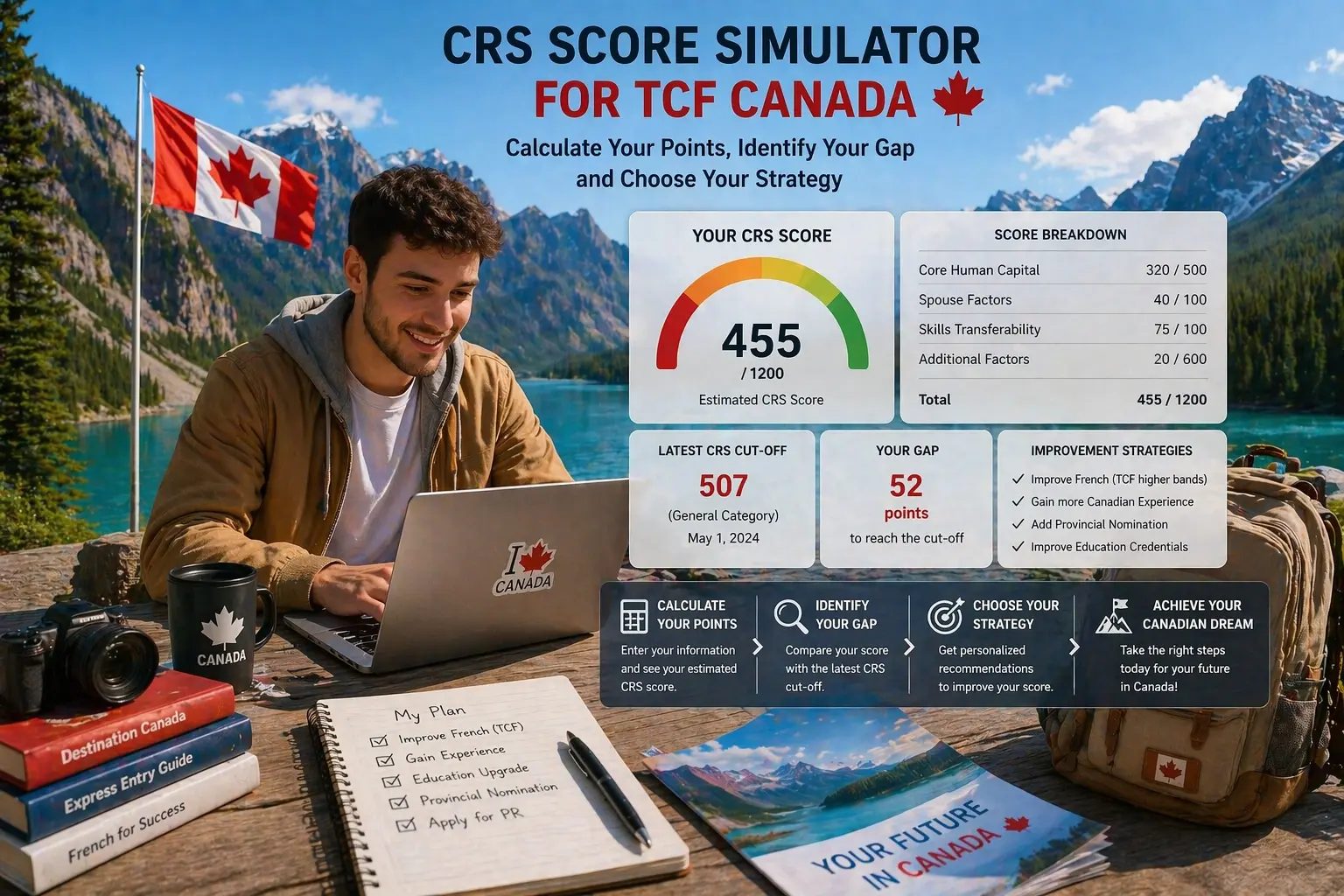
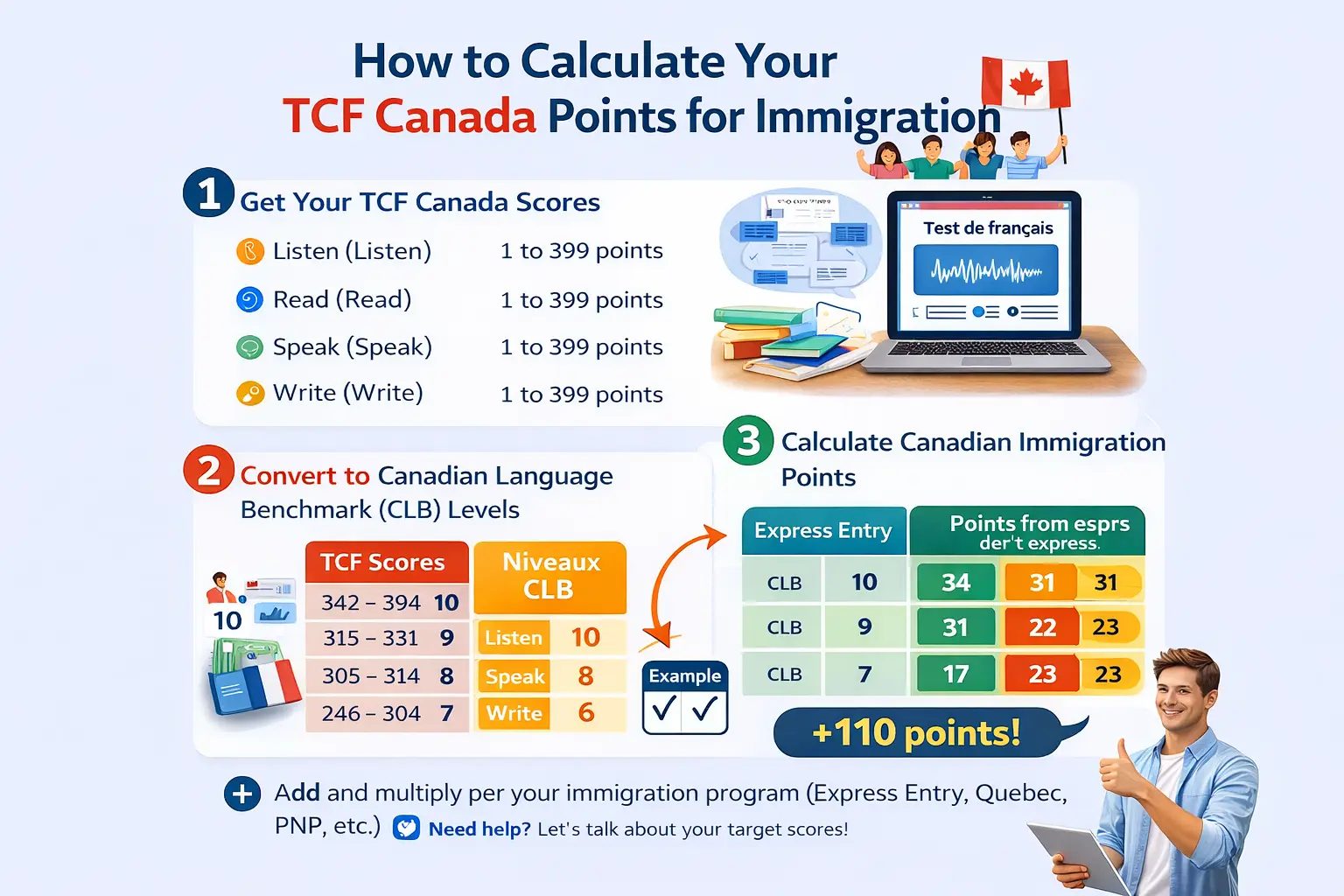
The decision to take — or retake — the TCF Canada should be preceded by rigorous calculation: how many CRS points do you currently have? How many do you need for an ITA in your most accessible pathway? And what improvement in NCLC scores is needed to close that gap? Our article on how to calculate your TCF Canada immigration points explains the foundational mechanics. This article builds on it with four concrete profile case studies and a step-by-step CRS modelling process.
The CRS System: Full Mechanics for Francophone Candidates
| CRS Category | Max Points (single) | Max Points (with spouse) | TCF Canada Impact |
|---|---|---|---|
| Core human capital (age, education, experience, language) | 460 | 460 | Direct — language sub-score |
| Spouse or common-law partner factors | — | 40 | Yes — if spouse takes TCF Canada |
| Skill transferability | 100 | 100 | Indirect — interacts with language score |
| Additional factors (PNP, Canadian study, sibling in Canada) | 600 | 600 | No |
Exact Linguistic CRS Points by NCLC Level
| Skill | NCLC 7 | NCLC 8 | NCLC 9 | NCLC 10+ |
|---|---|---|---|---|
| Each of the 4 skills — base points | 6 | 6 | 6 | 6 |
| NCLC 9+ bonus per skill | 0 | 0 | +1 | +1 |
| Total per skill at each level | 6 | 6 | 7 | 7 |
| Total for all 4 skills | 24 | 24 | 28 | 28 |
The practical difference: Moving from NCLC 7 to NCLC 9 in all four skills adds 4 CRS points (from 24 to 28). In Francophone category draws with thresholds in the 361–393 range, 4 points can mean the difference between receiving an ITA and waiting several additional months for a lower-threshold draw. In general draws, 4 points rarely determines success alone — but they contribute to a cumulative profile improvement. The real value of NCLC 9 for Francophone candidates is eligibility, not raw points.
Four Profile Case Studies with Full CRS Modelling
Profile 1 — Yasmine: IT Engineer, 28, Bachelor's, Single, Current NCLC 7
Current CRS estimate:
- Age (28): 110 points
- Bachelor's degree (WES evaluated): 120 points
- 3 years foreign software engineering experience: 50 points
- NCLC 7 in all 4 French skills: 24 points
- Estimated total: ~304 points
Gap analysis: General draw threshold (April 2026): ~490–520 points. Gap: ~186–216 points. Francophone draw threshold (2024–2025 average): ~380 points. Gap: ~76 points.
Optimal strategy: (1) Retake TCF Canada targeting NCLC 9 (+4 points). (2) Investigate Ontario OINP Tech Draws — active in software engineering with lower CRS requirements than general draws. (3) If eligible for Working Holiday, accumulate 12 months of Canadian experience for the CCE bonus (+40 to +80 points). See our Priority Employment Sectors guide for the tech sector pathway detail.
Profile 2 — Hamid: Nurse, 34, Bachelor's, Married (non-candidate spouse), Current NCLC 8
Key strategic question: Should the spouse be included in the application?
If the spouse has no qualifying education, no TCF Canada score and no work experience, including them reduces the principal applicant's core human capital points without offset. Excluding the spouse and filing as a single applicant typically generates a higher CRS in this profile. However, if the spouse takes the TCF Canada and achieves even NCLC 7 in all skills, the bilingualism bonus can add up to 20 CRS points — potentially making inclusion worthwhile. Model both scenarios before deciding.
Healthcare-specific advice: Ontario, New Brunswick, Nova Scotia and Manitoba all have active healthcare-specific PNP streams with lower CRS thresholds. A provincial healthcare nomination adds 600 CRS points — effectively guaranteeing an ITA regardless of base score. For the complete healthcare immigration playbook, see our TCF Canada for Families 2026 article.
Profile 3 — Émilie: French FSL Teacher, 29, Master's, Single, Current NCLC 9
Current CRS estimate: ~371 points (age 105 + Master's 135 + 5 years experience 53 + NCLC 9×4 28 + transferability ~50)
Strategic position: Well positioned for Francophone category draws and Ontario/New Brunswick Francophone PNPs. Attempting NCLC 10 adds 0 additional raw CRS points (same calculation as NCLC 9) — effort is better invested in completing the dossier and monitoring active PNP streams. See our New Provincial Pathways 2026 article for active FSL teacher-specific provincial opportunities.
Profile 4 — Dr. Mounia: Physician, 43, Doctorate, Single, Current NCLC 7
Current CRS estimate: ~242 points — the age penalty is the dominant constraint.
Urgent two-lever strategy:
Lever 1: Retake the TCF Canada immediately targeting NCLC 9. Every month of delay costs non-recoverable age points — after 45, the penalty steepens further. At 43, each year without an ITA costs approximately 15 CRS age points.
Lever 2: Target a provincial healthcare PNP nomination simultaneously. Ontario OINP, Nova Scotia Nominee Program and New Brunswick PNP all have physician-specific healthcare streams with provincial demand that makes nominations available even to older candidates. A nomination adds 600 points — the only way to overcome the age penalty at 43+. Full analysis at TCF Canada After 40–45: Late-Stage Immigration Strategies.
Official CRS Simulation Tools
Recommended calculators — in order of reliability:
- IRCC Official CRS Calculator at canada.ca — most accurate, updated when the points grid changes
- CanadaVisa.com CRS Calculator — more visual, includes comparison to recent draw thresholds by category
- Immigration.ca Score Calculator — detailed interface with complete category-by-category breakdown
NCLC conversion tool: Always use the official France Éducation International conversion table for TCF Canada — third-party tables sometimes contain errors that produce significant CRS miscalculations.



0 Commentaires
aucun commentaire
Soyez le premier a partager votre avis !