-
Auteur :
 Antoine C.
- Jan 05, 2026
Decoding Your TCF Canada Results: Analysis and Improvement Guide
- Blog
- /
- Article
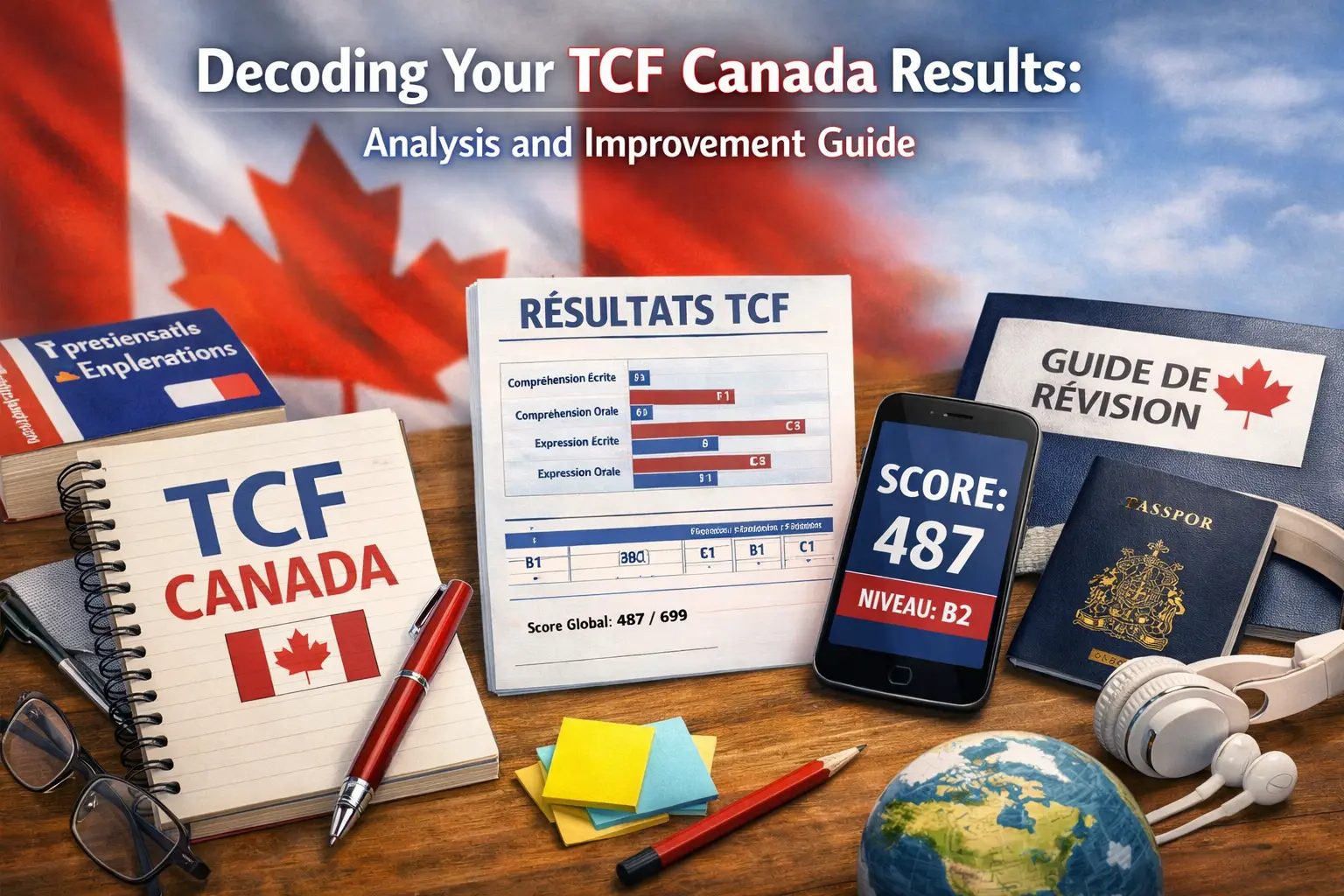
The moment of truth has arrived: you've just received your TCF Canada results. Between relief and potential disappointment, a crucial question emerges: how do you precisely interpret these scores and, most importantly, how do you transform them into an effective action plan that accelerates your Canadian immigration journey?
This comprehensive 2026 guide provides complete analysis of your results and helps you build a personalized, data-driven improvement strategy that maximizes your Express Entry Comprehensive Ranking System (CRS) points and dramatically increases your immigration success probability.
What You'll Master in This Complete Guide
- Decode your score report with precision across dual scoring systems (raw scores + NCLC levels)
- Convert scores to CRS points accurately for Express Entry optimization
- Diagnose competency-specific strengths and weaknesses with granular analysis
- Identify your profile type among 4 common patterns with targeted strategies
- Make data-driven retake decisions based on objective criteria and ROI analysis
- Build 3-phase improvement plans that deliver measurable, reproducible results
- Track progress systematically with reliable indicators and adaptive methodologies
- Navigate 2026 immigration context including updated competitive thresholds
Complete Anatomy of Your TCF Canada Score Report
Thomas, a Paris-based web developer who successfully relocated to Montreal in 2025, vividly remembers his first encounter with his TCF Canada score report: "I received my results by email late at night and immediately opened the PDF with trembling hands. What I saw was overwhelming—so many numbers, abbreviations, conversion tables, and technical terminology. I spent nearly two hours cross-referencing online resources before finally understanding whether I had achieved my immigration targets!"
This common experience highlights a critical reality: TCF Canada score reports, while comprehensive and detailed, require systematic interpretation to extract actionable insights for your immigration strategy.
Understanding Your Score Report Structure
Your official TCF Canada score report contains several crucial sections that warrant careful analysis:
Example Score Report - Candidate "Emma Dubois" (Test Date: March 2026)
- Personal Information: Full name, date of birth, unique candidate identification number
- Test Session Details: Test date (crucial for 2-year validity tracking), test center location, session identifier
- Raw Scores:
- Listening Comprehension (LC): 485/699 points
- Reading Comprehension (RC): 520/699 points
- Speaking Expression (S): 13/20 points
- Written Expression (W): 11/20 points
- NCLC Level Conversions:
- LC: NCLC 7 | RC: NCLC 8 | S: NCLC 8 | W: NCLC 6
- CEFR Equivalences (European Framework):
- LC: B2 | RC: B2 | S: B2 | W: B1
- Validity Period: Valid until March 2028 (exactly 2 years from test date)
- Official Stamp and Signatures: France Éducation International authentication
Critical 2026 Validity Reminder:
TCF Canada results remain valid for exactly 2 years from your test date for Canadian immigration purposes. As of 2026, IRCC (Immigration, Refugees and Citizenship Canada) strictly enforces this validity period. Your results must be valid at the time of:
- Express Entry profile creation/update
- Provincial nomination application submission
- Permanent residence application filing
- Final processing and decision
Always maintain a minimum 6-month validity buffer to account for processing delays.
Decoding the Dual Scoring Systems
TCF Canada employs two parallel scoring systems that frequently create confusion among candidates. Understanding both systems is absolutely essential for strategic immigration planning:
System 1: Raw Scores (Technical Measurement)
For comprehension competencies (Listening and Reading), scores range from 0 to 699 points. For expression competencies (Speaking and Writing), scores range from 0 to 20 points.
These raw scores aren't directly comparable between competencies because they use different scales. A score of 500/699 in Reading Comprehension cannot be directly compared to 12/20 in Speaking Expression without conversion to NCLC levels.
System 2: NCLC Levels (Canadian Language Benchmarks)
Each raw score is systematically converted to an NCLC (Niveaux de compétence linguistique canadiens / Canadian Language Benchmarks) level ranging from 1 to 12. This conversion allows direct comparison between all four competencies and enables precise calculation of Express Entry CRS points.
| Competency | Raw Score Range | Min NCLC (Immigration) | Competitive NCLC | Excellent NCLC |
|---|---|---|---|---|
| Listening Comprehension | 0-699 points | NCLC 5 (331 pts) | NCLC 7 (398 pts) | NCLC 9 (503 pts) |
| Reading Comprehension | 0-699 points | NCLC 5 (248 pts) | NCLC 7 (375 pts) | NCLC 9 (453 pts) |
| Speaking Expression | 0-20 points | NCLC 5 (5 pts) | NCLC 7 (10 pts) | NCLC 9 (14 pts) |
| Written Expression | 0-20 points | NCLC 5 (5 pts) | NCLC 7 (10 pts) | NCLC 9 (14 pts) |
Understanding NCLC Thresholds:
- NCLC 5: Minimum threshold for most federal immigration programs (Federal Skilled Worker, Canadian Experience Class)
- NCLC 7: Competitive baseline for Express Entry; sufficient for many Provincial Nominee Programs
- NCLC 9: Highly competitive level providing maximum CRS points boost; preferred for French-language category draws
- NCLC 10+: Near-native proficiency; maximum point allocation across all programs
Precise Score Conversion to Express Entry CRS Points
Marie-Laure, a Lyon-based HR manager who successfully immigrated to Ottawa in 2025, shares her initial strategic error: "I naively believed that achieving NCLC 7 in all four competencies gave me maximum possible language points. When I discovered that improving from NCLC 7 to NCLC 9 across all competencies would bring me an additional 48 CRS points, it completely revolutionized my preparation strategy and immigration timeline expectations!"
This revelation underscores a critical reality: understanding the precise CRS point allocation for each NCLC level is absolutely essential for strategic test preparation and immigration planning.
Detailed CRS Points Scale for Principal Applicant (First Official Language - 2026)
| NCLC Level | Listening Points | Reading Points | Speaking Points | Writing Points | Total Possible |
|---|---|---|---|---|---|
| Below 4 | 0 | 0 | 0 | 0 | 0 points |
| 4-5 | 6 | 6 | 6 | 6 | 24 points |
| 6 | 8 | 8 | 8 | 8 | 32 points |
| 7 | 16 | 16 | 16 | 16 | 64 points |
| 8 | 20 | 20 | 20 | 20 | 80 points |
| 9 | 28 | 28 | 28 | 28 | 112 points |
| 10+ | 32 | 32 | 32 | 32 | 128 points (maximum) |
Practical CRS Calculation Example:
Emma's Current Results: LC: NCLC 7 | RC: NCLC 8 | S: NCLC 8 | W: NCLC 6
CRS Points Calculation:
- Listening (NCLC 7): 16 points
- Reading (NCLC 8): 20 points
- Speaking (NCLC 8): 20 points
- Writing (NCLC 6): 8 points
- Total First Language Points: 64 CRS points
Improvement Scenario Analysis:
- If Emma improves Writing from NCLC 6 → NCLC 7: +8 points (new total: 72 points)
- If Emma improves all competencies to NCLC 9: +48 points (new total: 112 points)
- If Emma achieves NCLC 10 across all competencies: +64 points (new total: 128 points - maximum possible)
Understanding Critical NCLC Thresholds for 2026 Express Entry
The 2026 Express Entry landscape presents evolved competitive dynamics that make understanding these thresholds more critical than ever:
NCLC 7
Competitive Baseline
64 CRS Points
Federal Minimum
64 CRS Points
Federal Minimum
NCLC 8
Strong Performance
80 CRS Points
Improved Prospects
80 CRS Points
Improved Prospects
NCLC 9
Highly Competitive
112 CRS Points
Excellent Advantage
112 CRS Points
Excellent Advantage
48
Point Gain Potential
NCLC 7 → NCLC 9
Game-Changing Boost
NCLC 7 → NCLC 9
Game-Changing Boost
Strategic Impact of Couple/Spouse Bonuses (2026 Update)
Pierre and Sylvie, a Bordeaux-based couple who successfully immigrated to Vancouver in early 2026, implemented an optimized family language strategy: "We discovered that if one spouse reached NCLC 7+ in all four competencies, the other spouse could obtain substantial bonus CRS points even with modest NCLC 5-6 levels. We strategically concentrated our preparation efforts and financial resources on Sylvie, who had the better initial French proficiency, which proved far more efficient than trying to maximize both profiles simultaneously."
Optimized Couple Strategy Framework 2026
Principal Applicant Strategy:
- Target NCLC 8-9 across all four competencies to maximize base language points (80-112 points)
- Prioritize consistent performance across all competencies over single competency excellence
- Allocate majority of preparation time and tutoring budget to principal applicant
Accompanying Spouse Strategy:
- NCLC 5+ in all four competencies sufficient to obtain 20 bonus CRS points
- NCLC 7+ in all four competencies provides maximum spouse points (up to 20 additional points)
- Focus on achieving minimum thresholds rather than excellence if resources are limited
ROI Analysis:
- Often more cost-effective to invest in spouse achieving NCLC 5-7 threshold than principal applicant pursuing marginal NCLC 9→10 improvements
- Combined approach can yield 100+ total language CRS points for couples
- Strategic couple preparation can reduce overall immigration timeline by 6-12 months
In-Depth Diagnosis of Your Strengths and Weaknesses
Effective analysis of your TCF Canada results extends far beyond simply noting your global NCLC levels. Each competency's performance reveals valuable diagnostic information about your linguistic profile and identifies high-priority improvement areas that can dramatically accelerate your immigration timeline.
Granular Competency-by-Competency Analysis
Karim, a Tunisian engineer who successfully relocated to Calgary in 2025, details his systematic self-diagnosis methodology: "I created a comprehensive Excel spreadsheet meticulously tracking my detailed performance across all four competencies. For each section, I identified problematic sub-skills using practice test feedback, error pattern analysis, timing breakdowns, and comparative performance data. This rigorous, data-driven approach allowed me to target my limited preparation time with surgical precision on highest-ROI improvement areas."
Listening Comprehension: Decoding Your Performance Profile
Score 450/699 (NCLC 7) - Typical Diagnostic Profile:
- Demonstrated Strengths:
- Solid global comprehension of main ideas and themes
- Good performance on short dialogues with clear, standard French
- Adequate understanding of common everyday vocabulary
- Satisfactory comprehension of simple narrative sequences
- Identified Weaknesses:
- Significant difficulties with numbers, dates, times, and numerical data
- Challenges with Quebec and regional French accents (Acadian, African francophone)
- Struggles with rapid speech flow and native conversation speed
- Poor performance on long, complex exchanges with multiple speakers
- Difficulty extracting implicit information and subtle nuances
- Strategic Improvement Focus:
- Intensive training on numbers/dates/times recognition and transcription
- Extensive exposure to Quebec media (Radio-Canada, ICI Première, RDI)
- Progressive speed adaptation exercises (slow→normal→fast playback)
- Long-form podcast listening for stamina and concentration development
- Timeline Impact: With targeted 2-hour daily training, potential to reach NCLC 8-9 within 2-3 months
Listening Comprehension Performance Breakdown by Score Range
| Score Range | NCLC Level | Typical Performance Profile | Primary Weaknesses | Recommended Improvement Strategy |
|---|---|---|---|---|
| 300-397 | NCLC 5-6 | Partial, inconsistent comprehension; limited vocabulary; frequent detail confusion; struggles with context | Basic vocabulary gaps; accent unfamiliarity; slow processing speed; limited working memory capacity | Foundation building; extensive listening volume (2+ hours daily); Quebec accent immersion; basic vocabulary expansion (500+ words) |
| 398-502 | NCLC 7 | Satisfactory general comprehension but noticeable gaps on precise details, numbers, and nuances | Numbers/dates accuracy; implicit meaning extraction; rapid speech comprehension; background noise interference | Targeted training on weak areas; strategic practice with varied accents; note-taking skill development; speed building exercises |
| 503-600 | NCLC 8-9 | Excellent general comprehension with strong detail retention; minor difficulties only on subtle nuances and complex argumentation | Advanced idiomatic expressions; cultural references; complex argumentation structure; highly specialized vocabulary | Refinement and sophistication; advanced vocabulary acquisition; cultural context deepening; complex discourse analysis |
| 600+ | NCLC 10+ | Near-native comprehension; no significant difficulties across all contexts and discourse types | Minimal; occasional highly specialized technical vocabulary in unfamiliar domains | Maintenance only with light practice; shift focus to weaker competencies for maximum CRS optimization |
Reading Comprehension: Identifying Your Blockages and Opportunities
Fatima, an Arabic literature teacher who successfully relocated to Montreal in 2025, shares her revealing analytical discovery: "My score of 380/699 (NCLC 6) masked a complex, nuanced reality. I excelled on literary texts, abstract philosophical passages, and complex sentence structures but struggled catastrophically with Canadian administrative documents, professional workplace terminology, and culturally-specific content referencing Canadian systems. My academic French education had prepared me excellently for university-level texts but left me completely unprepared for practical TCF Canada requirements focused on functional, real-world comprehension."
Common Reading Comprehension Strategic Errors:
- Detail Over-Investment: Spending excessive time on minute details at the expense of global comprehension and strategic time management—attempting to understand every single word rather than grasping main ideas
- Critical Vocabulary Gaps: Missing Canadian administrative, professional, and Quebec-specific terminology essential for contextual understanding (dépanneur, RAMQ, cégep, accommodation raisonnable)
- Time Management Failures: Allocating disproportionate time to certain difficult passages, leaving insufficient time for easier questions that could guarantee points
- Question Type Confusion: Struggling to distinguish between implicit vs. explicit information, inference vs. stated facts, opinion vs. objective information
- Strategic Approach Errors: Reading entire texts linearly before consulting questions instead of strategic skimming followed by targeted reading based on question requirements
- Trap Answer Susceptibility: Falling for common distractor patterns in multiple-choice options without systematic elimination strategies
Speaking Expression: Understanding Your Evaluation Profile
Speaking evaluation operates on a 0-20 point scale distributed across three distinct task types, making each individual point extraordinarily valuable for CRS optimization. Understanding your specific performance breakdown across tasks is essential for targeted, efficient improvement.
| Score Range (/20) | NCLC Level | General Profile Description | Priority Improvement Areas |
|---|---|---|---|
| 5-9 | NCLC 5-6 | Hesitant expression, frequent errors | Fluency, basic grammar, vocabulary |
| 10-13 | NCLC 7 | Effective but perfectible communication | Precision, connectors, time management |
| 14-17 | NCLC 8-9 | Clear and well-structured expression | Nuances, lexical richness, spontaneity |
| 18-20 | NCLC 10+ | Natural and sophisticated expression | Stylistic perfection |
Written Expression: Decrypting the Four Evaluation Criteria
Laurent, a Marseille-based professional journalist with 15+ years of writing experience, recounts his surprising initial TCF Canada result: "Despite decades of professional French writing, I only obtained 9/20 (NCLC 6) on my first attempt. The shocking revelation? I hadn't respected TCF Canada's specific codes and requirements. My texts were stylistically excellent but unsuited to test instructions regarding register, format, and task-specific requirements."
Writing evaluates four main criteria:
- Task respect (25%): Text type adequacy, register, length
- Sociolinguistic correction (25%): Adaptation to recipient and context
- Lexicon (25%): Richness, precision, vocabulary appropriation
- Morphosyntax (25%): Grammar, conjugation, sentence construction
Targeted Improvement Strategies by Profile Type
Each results profile requires a specific approach. Here are proven strategies according to your situation.
"Imbalanced Strong Oral" Profile (LC/S > RC/W)
Typical example: Alexandra - LC: NCLC 8, S: NCLC 9, RC: NCLC 6, W: NCLC 5
Alexandra, Paris tour guide, explains: "My profession gave me excellent oral ease, but I had never worked on academic writing. My writing gaps cost me 24 points in Express Entry!"
3-month improvement plan:
- Weeks 1-4: Fundamental grammar review (tenses, agreements, syntax)
- Weeks 5-8: Mastery of TCF text types (letter, article, report)
- Weeks 9-12: Intensive training with professional correction
"Imbalanced Strong Written" Profile (RC/W > LC/S)
Typical example: Mohamed - RC: NCLC 9, W: NCLC 8, LC: NCLC 6, S: NCLC 5
Mohamed, Algerian translator, testifies: "My years of study in French had given me excellent written level, but I panicked as soon as I had to speak. Spontaneous oral was my nightmare."
Progressive desensitization method:
- Step 1: Personal recordings 10 min/day (familiar situations)
- Step 2: Phone conversations with natives (French customer services)
- Step 3: Online conversation clubs (gradual progression)
- Step 4: Timed TCF simulations (real conditions)
"Homogeneous Average" Profile (All competencies NCLC 6-7)
Typical example: David - All competencies NCLC 7 (64 Express Entry points)
David, Nantes accountant: "Correct level everywhere, but no excellence. I had to strategically choose which competency to focus my efforts on to optimize my points."
Optimized ROI strategy: Identify competencies closest to next level. Moving one competency from NCLC 7 to NCLC 8 brings 4 points, from NCLC 7 to NCLC 9 brings 12 points.
"Excellence with One Weakness" Profile
Typical example: Sabrina - NCLC 9 in comprehension, NCLC 8 in speaking, but only NCLC 5 in writing
Sabrina, Toulouse architect: "This single weakness dragged down my overall score. I invested 100% of my preparation time on writing. In 6 intensive weeks with a specialized coach, I went from NCLC 5 to NCLC 8. Gain: 12 points."
Making the Critical Retake Decision
After receiving your results, one of the most important strategic decisions is whether to retake the test or accept your current scores.
Systematic Decision Framework
Christophe, IT consultant, systematized this decision process:
| Criterion | Retake Recommended | Accept Score |
|---|---|---|
| Gap with objective | < 20 Express Entry points | > 30 Express Entry points |
| Available time | > 3 months before deadline | < 2 months before deadline |
| Remaining budget | Sufficient for 2+ attempts | Just for 1 attempt |
| Failure cause | Precise technical gaps | Insufficient general level |
| Motivation | High and lasting | Fatigue or discouragement |
Optimal Timing to Retake
Nina, Marseille psychologist, shares her temporal strategy: "After analyzing my results, I identified I needed 4 months to fill my writing gaps. I scheduled my second attempt exactly 4 months and 1 week after the first. Neither too early, nor too late."
Recommended delays according to improvement scope:
- Minor improvement (1 NCLC level): 6-8 weeks
- Moderate improvement (2 NCLC levels): 3-4 months
- Major improvement (3+ NCLC levels): 6-12 months
Implementing Your 3-Phase Improvement Plan
Based on experience of dozens of candidates who improved their scores, this method effectively structures the period between two attempts:
Phase 1 - Diagnosis and Repair (25% of time)
Objective: Identify and fill fundamental gaps revealed by your results.
Concrete actions:
- Detailed analysis of committed errors (if available)
- In-depth level test to confirm weaknesses
- Targeted review of problematic grammatical/lexical points
- Correction of misunderstandings about test format
Phase 2 - Development and Perfection (50% of time)
Objective: Develop skills identified as priorities to reach your objectives.
Concrete actions:
- Daily training on targeted competencies
- Immersion in content adapted to your target level
- Intensive TCF format practice with timing
- Specialized Canada/immigration vocabulary expansion
Phase 3 - Optimization and Consolidation (25% of time)
Objective: Optimize performance and guarantee reproducibility on test day.
Concrete actions:
- Complete practice tests in real conditions
- Strategy adjustment according to simulation results
- Psychological preparation and stress management
- Maintenance review to avoid regression
Progress Monitoring and Measurement
Reliable Progression Indicators
Éric, Lyon engineer, developed a precise tracking system: "I tracked 5 weekly metrics: practice test scores, average response time, success percentage by question type, self-assessed stress level, and subjective confidence. This data allowed me to adjust my preparation in real time."
Recommended tracking dashboard:
- Quantitative: Practice test scores, time per question, success rate by type
- Qualitative: Confidence level, stress management, strategy automation
- Trends: Evolution over 4 rolling weeks, plateau identification
- Predictive: Estimation of probable score at official test
Warning Signals and Adjustments
Certain signals should alert you to need for strategy adjustment:
- Stagnation: No improvement over 3 consecutive weeks
- Regression: Performance drop despite training
- Imbalance: One competency improvement at expense of others
- Exhaustion: Motivation and concentration drop
Special Cases and Complex Situations
Managing Repeated Failures
Paul, Nantes mechanic, failed three times before succeeding: "After the third failure, I completely changed approach. I stopped focusing on my strengths and invested 100% of my time on my weakest competency. Result: fourth attempt successful."
Anti-repeated failure strategy: After 2 failures, mandatory 2-month pause minimum for complete method review. Often, the problem isn't level but strategy.
Optimization for Rushed Candidates
When time presses, like for Véronique who had to retake in 6 weeks: "I applied the 80/20 rule: identify the 20% of efforts that would bring 80% improvement. For me, it was time management in reading comprehension and answer structure in speaking."
Your Post-Results Strategic Roadmap
Analysis of your TCF Canada results isn't an end in itself, but the beginning of an optimized strategy. Whether your scores are encouraging or disappointing, they contain all necessary information to build your personalized improvement plan.
Immediate post-results actions:
- Precisely calculate your current Express Entry points
- Identify gap with your immigration objective
- Analyze competency by competency your strengths/weaknesses
- Decide to retake or accept according to objective criteria
- Build your 3-phase improvement plan
- Set up your progress tracking system
"My first TCF results were disappointing, but they provided me the exact roadmap to succeed. The apparent failure transformed into a winning strategy. Six months later, I achieved NCLC 8-9 across all competencies and successfully immigrated to Vancouver."
2026 Immigration Context and Language Requirements
The Canadian immigration landscape continues evolving in 2026, making strategic TCF Canada preparation more critical than ever.
Key 2026 Changes Impacting TCF Canada Candidates
2026 Express Entry Evolution:
- Increased Competition: Express Entry pool continues growing, requiring higher CRS scores for invitations in most categories
- Category-Based Selection: Specific French-language proficiency draws providing advantages for strong TCF Canada performers
- Provincial Nomination Focus: Many provinces prioritizing French proficiency for nomination programs
- Points Premium: Gap between NCLC 7 and NCLC 9 (48 CRS points) increasingly determinant of invitation probability
- Timeline Pressure: Average Express Entry processing maintaining 6-month standard, making test validity timing critical
Conclusion: From Results Analysis to Immigration Success
Your TCF Canada results represent far more than numerical scores—they are a comprehensive diagnostic blueprint revealing your current capabilities, improvement potential, and optimal pathway to Canadian immigration success.
Final Success Framework: The Results-to-Immigration Pipeline
1. Precise Understanding: Decode your scores across both raw and NCLC systems; understand exact CRS point implications
2. Honest Assessment: Acknowledge strengths and weaknesses without self-deception; accept current reality as starting point
3. Strategic Prioritization: Focus effort where ROI is highest; avoid diffused preparation
4. Targeted Action: Implement proven methodologies specific to your profile type
5. Consistent Measurement: Track progress objectively; adjust strategy based on data
6. Persistent Optimization: Continuously refine approach until achieving target scores
Essential 2026 Takeaways
- Results reveal opportunity, not limitation: Current scores represent present state, not permanent ceiling
- NCLC 7 vs NCLC 9 matters enormously: 48 CRS points can mean difference between invitation and indefinite waiting
- Profile-specific strategies outperform generic approaches: Identify your profile and apply targeted methodology
- Time investment must match improvement scope: Realistic timelines prevent premature retakes
- Professional support accelerates progress: Consider tutoring for persistent weaknesses
- Consistency trumps occasional brilliance: Reliable NCLC 7 beats inconsistent performance
- Test strategy equals language proficiency: Format mastery can improve scores 15-25%
- 2026 competition requires proactive excellence: Target competitive advantage levels
128
Maximum CRS Points
First Language
First Language
48
Point Difference
NCLC 7 vs 9
NCLC 7 vs 9
2 years
Test Validity
Period
Period
6 months
Average Processing
Express Entry
Express Entry
* * *
Laissez un commentaire
Votreadresse email ne sera pas publie. Les champs obligatoires sont marque avec *





0 Commentaires
aucun commentaire
Soyez le premier a partager votre avis !