-
Auteur :
 Antoine C.
- May 11, 2026
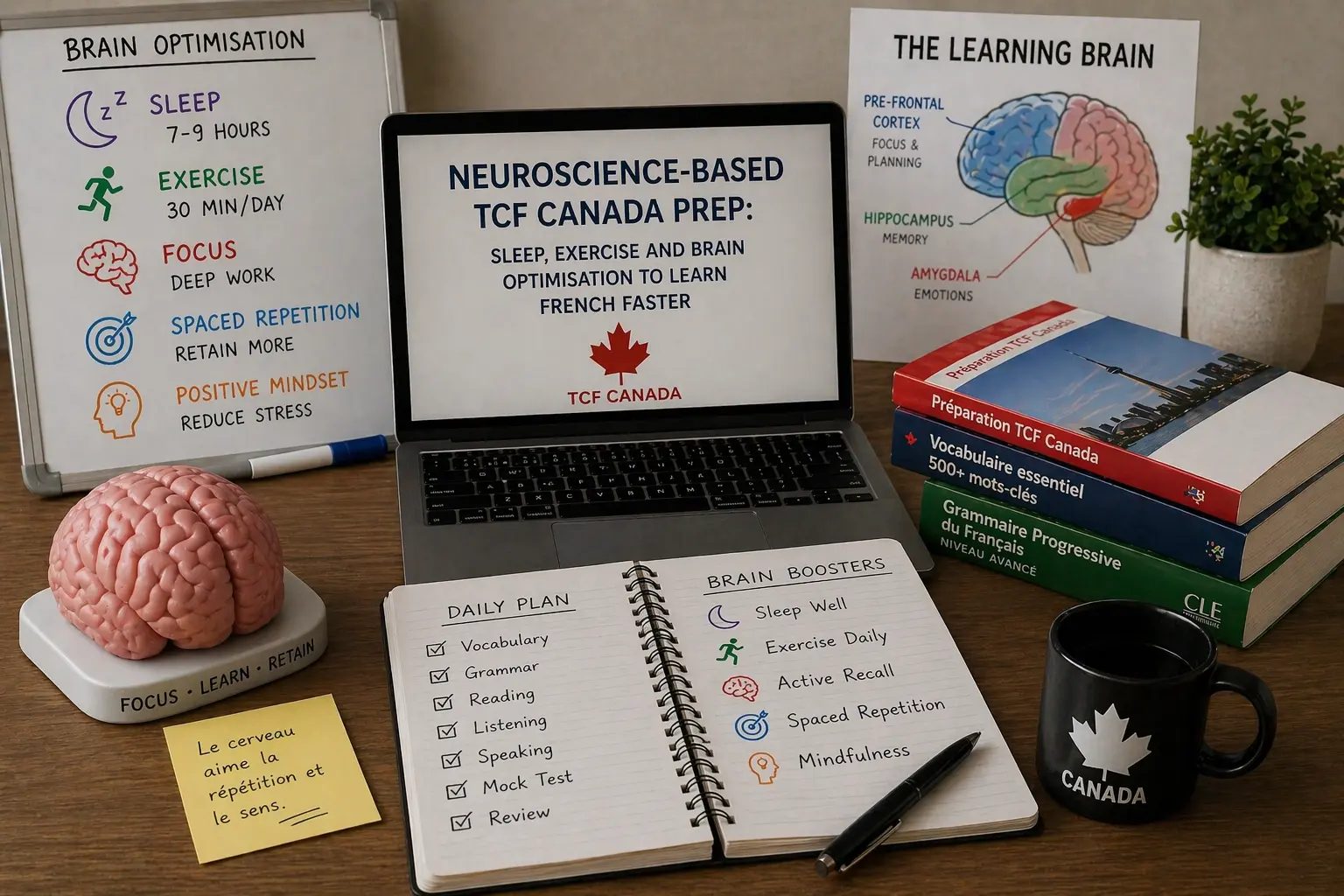
Most TCF Canada preparation guides tell you what to study. This article tells you how to prepare your brain to absorb and retain what you study — a dimension that dramatically affects the efficiency of every study hour and that very few candidates systematically optimise. The difference between a candidate who progresses one NCLC level in 6 weeks and one who needs 12 weeks is often not the quality of their resources or the number of hours studied. It is the biological efficiency of their learning environment.
This topic is distinct from the psychological stress management covered in our TCF Canada Candidate Psychology article and the mental health framework in our Mental Health and TCF Canada Preparation guide. We focus here on the neuroscience of language acquisition itself — the biological mechanisms that determine how efficiently your brain stores and retrieves French language information.
The Neuroscience of Language Learning: Core Mechanisms
How the Brain Stores New Language
Language learning simultaneously activates multiple specialised neural networks: Broca's area (language production and syntactic processing), Wernicke's area (language comprehension and semantic retrieval), the prefrontal cortex (working memory and executive function), and the hippocampus (declarative memory consolidation). Synaptic plasticity — the brain's capacity to form and strengthen connections between neurons — is the biological substrate of all learning. It operates optimally only under specific biological conditions that most candidates unknowingly undermine through poor sleep, erratic study schedules and chronic stress.
The 90-minute learning window: Research on ultradian rhythms shows that sustained cognitive performance operates in approximately 90-minute cycles. Beyond 90 minutes of focused study, synaptic plasticity decreases significantly — each additional minute becomes less efficient than the previous one. Two 90-minute sessions separated by a 10-minute break are neurologically more effective than a single 3-hour session. This is not a productivity opinion — it reflects the brain's biological consolidation requirement between learning episodes.
Sleep: The Most Powerful Learning Tool You Already Have
Sleep is not passive recovery — it is an active language processing phase. During slow-wave sleep (N3 stage), the brain consolidates the day's declarative learning: vocabulary and grammar rules processed during daytime study are transferred from hippocampal short-term storage into cortical long-term memory networks. During REM sleep, procedural automatisms — the speaking fluency patterns practised during oral exercises — are integrated into motor programmes that later activate without conscious effort.
| Sleep Stage | Primary Language Learning Role | Practical Optimisation |
|---|---|---|
| Light sleep (N1–N2) | Sorting and indexing new information for consolidation | 7–9 hours total sleep (non-negotiable) |
| Slow-wave sleep (N3) | Declarative consolidation — vocabulary, grammar rules | Dominant in the first half of the night |
| REM sleep | Procedural integration — speaking automatisms and fluency | Dominant in the final hour before waking |
The pre-sleep review technique — the single highest-return 30 minutes of your day: In the 30 minutes before sleep, review your 10 most difficult vocabulary items or your most problematic grammar point. Don't attempt new material — only items already partially learned. The sleeping brain processes these items during slow-wave sleep, improving their consolidation by 20 to 40% compared to reviewing the same items the following morning. This window is consistently underexploited by TCF Canada candidates and is completely free.
Nutrition and Cognitive Performance for Language Learning
Key Nutrients That Directly Support Memory Formation
| Nutrient | Role in Language Learning | Optimal Food Sources |
|---|---|---|
| Omega-3 fatty acids (DHA) | Neuronal membrane fluidity, working memory capacity | Sardines, mackerel, walnuts, flaxseeds, chia seeds |
| Magnesium | Synaptic plasticity, stress regulation, sleep quality | Dark chocolate, almonds, spinach, black beans, avocado |
| Iron | Cerebral oxygen delivery, concentration sustainability | Red meat, lentils, tofu, pumpkin seeds, dried apricots |
| Polyphenols (flavonoids) | Neuronal protection, hippocampal neuroplasticity | Blueberries, green tea, dark cocoa (70%+), red berries |
| Vitamin B12 | Myelin sheath maintenance, nerve signal conduction | Eggs, dairy, fish, fortified plant milks |
Blood Sugar Stability: The Cognitive Crash Prevention Strategy
The brain consumes approximately 20% of total body energy despite representing only 2% of body weight. Rapid blood sugar spikes followed by crashes — common after high-glycaemic meals — create cognitive "fog" windows during which vocabulary retention and working memory performance both decline measurably. Stabilising blood sugar through moderate glycaemic index foods and consistent meal timing prevents the mid-afternoon crash that destroys study session quality for many candidates.
Practical daily nutrition protocol for intensive TCF Canada preparation:
- Morning (before Session 1): Oats + nuts + berries + green tea — stable energy release over 3 hours
- Mid-morning snack: Almonds + one square of 70% dark chocolate (magnesium + flavonoids)
- Lunch: Oily fish or legumes + leafy greens + olive oil — anti-inflammatory base
- Before Session 2: Wait 45–60 minutes after eating (digestion temporarily reduces cerebral blood flow)
- Evening: Light, early dinner to preserve sleep quality + pre-sleep vocabulary review
Hydration: The Free Cognitive Enhancer Most Candidates Ignore
Even mild dehydration of just 2% of body weight — barely enough to feel thirsty — reduces cognitive performance by 10 to 15%. Since the brain is approximately 75% water, optimal hydration is one of the most accessible cognitive performance levers available. Drink 500ml on waking (rehydration after the sleep fast), then approximately 250ml every 45 to 60 minutes during study sessions and on exam day. This single habit is consistently underestimated in its cognitive impact.
Evidence-Based Training Protocols
Spaced Repetition via Anki: Why 20 Minutes Beats 2 Hours
The SM-2 algorithm underlying Anki calculates the precise moment just before the brain is about to forget each word and schedules a review at that exact interval — exploiting the spacing effect, one of the most robustly documented findings in cognitive psychology. Twenty minutes of daily Anki review produces statistically superior long-term retention to two hours of traditional self-testing for the same vocabulary set over a four-week period. The advantage compounds over time: the gap between the two methods is larger at 8 weeks than at 4 weeks.
Aerobic Exercise and BDNF: The Neuroplasticity Window
Thirty minutes of moderate aerobic exercise — brisk walking, running, cycling, swimming — elevates Brain-Derived Neurotrophic Factor (BDNF), a protein often described as "fertiliser for the brain." BDNF promotes the formation of new synaptic connections in the hippocampus and prefrontal cortex — the two regions most active during language learning. Studies consistently show that language learning performed within 2 hours of aerobic exercise is retained approximately 20% better than equivalent learning without prior exercise. Schedule your workout 1 to 2 hours before your most intensive study session, 4 to 5 times per week.
The neuroplasticity window in practice: If your most intensive TCF Canada study session runs from 10am to 11:30am, schedule a 30-minute walk or jog from 8am to 8:30am. The BDNF elevation peaks approximately 60 to 90 minutes after exercise and persists for 2 to 3 hours — positioning your study session inside the peak neuroplasticity window without any additional time cost beyond the exercise itself.
Mindfulness Meditation and Working Memory
Ten minutes of daily mindfulness meditation — seated, focused on breath, observing thoughts without engaging them — reduces baseline cortisol levels by 15 to 20% in research participants practising consistently for 3 weeks or more. Lower cortisol directly improves working memory capacity — the cognitive resource most critically taxed by TCF Canada listening comprehension, which requires holding audio information in working memory while simultaneously reading multiple-choice questions. The working memory benefit of regular mindfulness practice is directly measurable in TCF Canada listening performance outcomes.
Complete weekly cognitive optimisation protocol:
- 7+ hours of sleep — unconditional, every night
- 30-minute pre-sleep review of 10 priority vocabulary items or 1 grammar point
- 20 minutes of Anki every morning before any other activity
- 30-minute aerobic exercise 4–5 times per week, 1–2 hours before main study session
- 10 minutes of mindfulness meditation every morning after Anki
- All study sessions capped at 90 minutes with mandatory 10-minute breaks
- 500ml water on waking + 250ml every 45–60 minutes during study
- Moderate glycaemic index foods at all pre-study meals
"I was spending 4 hours a day studying with mediocre results. A doctor friend told me I was wasting time — long sessions without sleep prioritisation and exercise were destroying the consolidation I needed. I cut to two 90-minute sessions, added a 6am run, fixed my sleep at 7.5 hours and started pre-sleep review. My progress in the following 3 weeks exceeded the previous 6 weeks combined. I didn't study more — I studied better." — Karim, civil engineer from Algiers, NCLC 9 in 10 weeks





0 Commentaires
aucun commentaire
Soyez le premier a partager votre avis !