-
Auteur :
 Antoine C.
- Mar 07, 2026
Artificial Intelligence and TCF Canada 2026: How to Use AI to Supercharge Your Prep (Ethically)
- Blog
- /
- Article
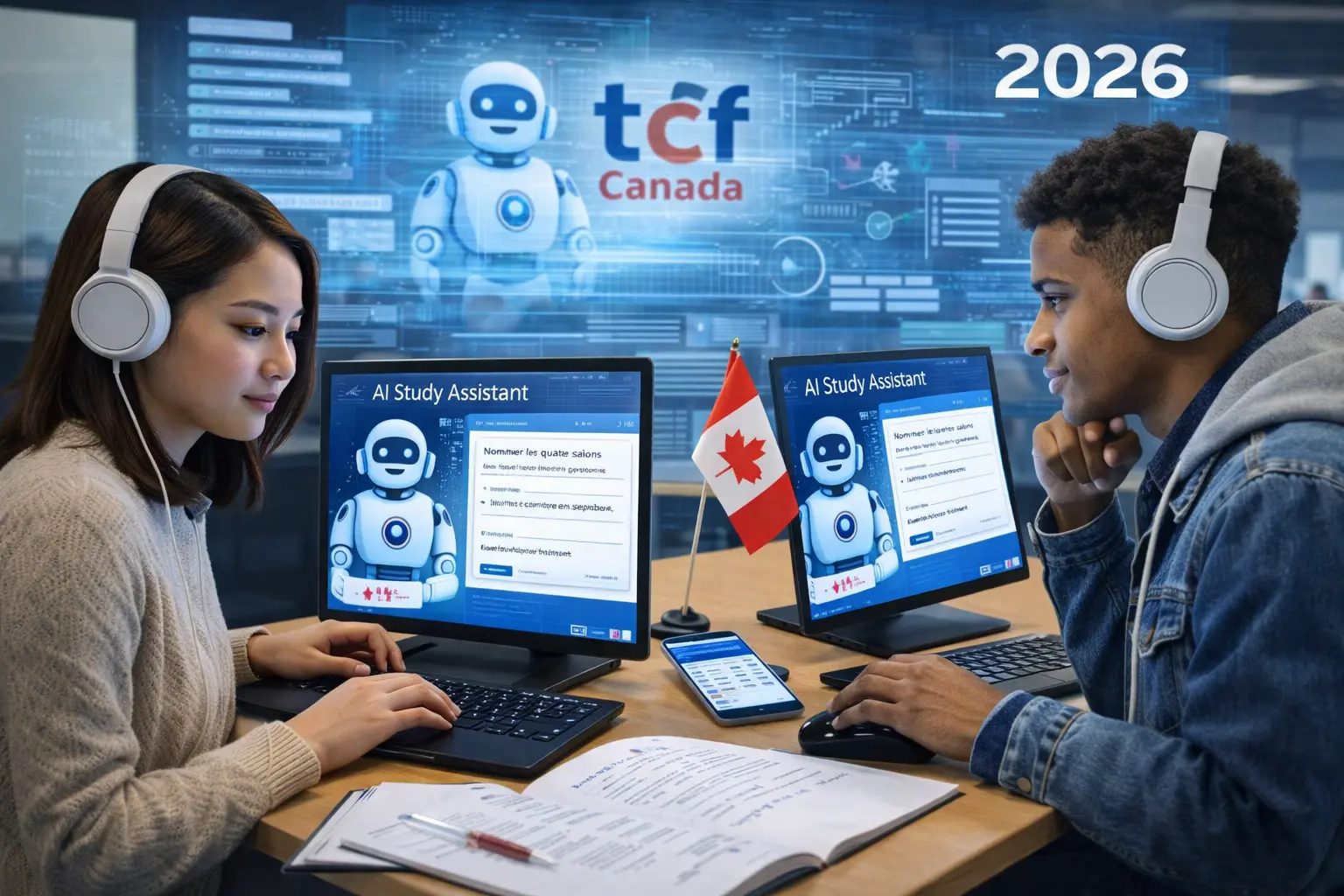
Artificial Intelligence and TCF Canada 2026: How to Use AI to Supercharge Your Prep (Ethically)
In April 2025, Salma, a 29-year-old UX designer in Rabat with a solid B1 level, decided to take the TCF Canada. Like most candidates, she started “the classic way”: a workbook, YouTube lessons, and two evening classes per week. She was disciplined—about 10 to 12 hours of study weekly—yet after months, her mock tests kept circling the same range: NCLC 6–7. The problem wasn’t effort; it was efficiency. Her writing sounded repetitive, her listening collapsed when Canadian accents appeared, and her speaking felt memorized rather than natural.
Everything changed when she began using AI as a training partner, not as a shortcut. Instead of only “doing exercises,” she started doing feedback loops: write → get corrections in seconds → rewrite; speak → transcribe → diagnose weak points; listen → test herself → analyze mistakes. Within two months of consistent AI-assisted practice, she could track measurable improvements: fewer grammar errors, faster reading speed, clearer oral structure, and a stronger Canadian French vocabulary. The key wasn’t magic—it was the combination of volume + personalization + instant correction.
2026 Update: TCF Canada preparation in 2026 is increasingly digital-first: candidates practice on screens, time themselves precisely, and rely on rapid iteration. Used ethically, AI makes each hour of study more productive by turning practice into a continuous improvement cycle.
The AI Language-Learning Shift: Why 2026 Is Not Like 2023
Generative AI evolved fast. The biggest change for exam preparation is not “better answers,” but better coaching. Traditional apps often follow a fixed path; modern AI tools can adapt in real time—adjusting difficulty, changing topics, and explaining mistakes in the exact context of your sentence. In TCF terms, that means you can train the same skill from multiple angles: grammar accuracy, lexical variety, structure, timing, and Canadian context.
Essential Ethics Reminder: Using AI to prepare (practice, feedback, simulations, vocabulary building) is legitimate. Using AI during the official exam (phone, hidden prompts, earbud coaching, external help) is fraud and can lead to serious consequences. This article is strictly about ethical preparation.
What AI Gives You (That Traditional Prep Struggles To Match)
| Dimension | Traditional Approach | AI-Assisted Approach | Practical Advantage |
|---|---|---|---|
| Availability | Fixed class hours, limited teacher time | 24/7 practice and correction | More frequent micro-sessions |
| Personalization | Same lesson for 10–20 learners | Content adapts instantly to your errors and level | Less wasted time on what you already know |
| Feedback speed | Corrections arrive days later | Corrections arrive in seconds | Rewrite and improve immediately |
| Accent exposure | Often one accent (frequently France) | French varieties: Quebec, Acadian, African, Belgian, Swiss | Listening becomes more “exam-proof” |
| Practice volume | Mostly weekly sessions | Daily structured drills become realistic | More repetitions = more automaticity |
| Cost | Private tutoring can be expensive | Many tools offer low-cost or free tiers | Better ROI if used consistently |
| Psychological safety | Fear of judgment in class | No shame: repeat 30 times if needed | More speaking practice for anxious learners |
The 5 AI Tool Families for TCF Canada (2026)
In practice, you don’t need “every tool.” You need a small stack that covers the four skills and supports repetition. Here are the five categories that matter most.
Category 1: General AI Tutors (ChatGPT, Claude, Gemini)
Best for: writing correction, grammar explanations, vocabulary expansion, exam strategy, mock interviews
- Rewrite your argumentative text with stronger connectors and richer vocabulary
- Generate realistic practice prompts for writing and speaking
- Explain your mistakes with targeted mini-lessons (not generic grammar pages)
- Simulate oral examiner follow-up questions to build spontaneity
Category 2: Text-to-Speech (TTS) Voices
Best for: listening immersion, accent training, speed control
- Convert Canadian news paragraphs into audio with a Quebec-style voice
- Create custom listening quizzes from texts you choose
- Progress from slower speech (0.85x) to fast speech (1.15x)
Category 3: Speech-to-Text (STT) Transcription
Best for: speaking diagnostics, pronunciation checks, fluency measurement
- Record your answer, transcribe it, and find repeated words or broken structures
- Spot grammar issues that appear when you speak quickly
- Train clarity: if the transcription “mishears” you often, your articulation may be unstable
Category 4: AI Content Builders (Flashcards, quizzes, mock tests)
Best for: vocabulary automation, reading/listening question creation, spaced repetition
- Generate themed flashcards (immigration, healthcare, education, environment)
- Turn any article into a mini TCF-style reading test
- Build weekly mock tests and track performance
Category 5: Translation & Paraphrase Tools
Best for: avoiding repetition, register control (formal vs informal), nuance comparison
- Create synonym banks (“in addition” variations, concession phrases, etc.)
- Compare European vs Canadian wording (where appropriate)
- Learn alternate formulations without copying them mechanically
Practical Workflows: AI Training by TCF Skill
Workflow 1: Listening Comprehension (CO) — Build “Accent Immunity”
Goal: Move from NCLC 6–7 to NCLC 8–9 in 8–12 Weeks (With 45–60 min/day)
Weeks 1–3: Daily Immersion + Micro-Testing
- (12 min) Canadian text → TTS audio → 2 listens
- Choose a 250–450 word Canadian news excerpt
- Generate audio with a Canadian French voice
- Listen once normally, once while noting keywords
- (18 min) “One-listen” quiz simulation
- Ask your AI tutor to create 5 TCF-style MCQs from the audio
- Listen only once (exam rule), answer, then review errors
- (15 min) Error pattern review
- Classify mistakes: numbers/dates? negation? speaker intention? inference?
- Create a short “weakness drill” for tomorrow
Weeks 4–8: Speed + Variety + Realistic Timing
- (20 min) Mixed voices and topics
- Rotate voices and speaking speed (0.9x → 1.0x → 1.1x)
- Train with announcements, dialogues, short reports, opinions
- (20 min) Mini mock test (10–12 questions)
- Run it in one block: no pausing, no rewinding
- Score, then rewrite a “listening rule” (e.g., “Always confirm who does what”)
Recommended related reading: TCF Canada Listening Comprehension: Strategies for Success
Workflow 2: Written Expression (EE) — Increase Variety Without Sounding “Artificial”
Goal: Reach NCLC 9 by training structure + connectors + rewriting cycles
Phase A (Weeks 1–2): Build templates and connector banks
- (15 min) Model analysis
- Ask your AI tutor for a high-scoring response and extract its structure
- Create a personal list of 20 connectors grouped by function (addition, contrast, cause, nuance)
- (15 min) “Upgrade rewrite” training
- Take an older B1 text and request an improved version with tracked changes
- Rewrite a fresh version yourself using the same techniques
Phase B (Weeks 3–8): Daily timed writing + instant correction loop
- (30 min) Timed task practice
- Alternate tasks: informal message, formal complaint, argumentative text
- Use strict timing to build exam endurance
- (15 min) AI correction with a scoring grid
- Ask for scores by criteria: instruction respect, lexical richness, grammar, cohesion, spelling, argument quality
- Rewrite only the weakest paragraph (high impact, low time)
Recommended related reading: TCF Canada Writing: 7 Master Structures That Guarantee NCLC 9
Workflow 3: Speaking (EO) — Train Follow-Up Questions and Spontaneity
Goal: Speak naturally under pressure (not memorized, not robotic)
Weeks 1–4: Short daily simulations + transcription feedback
- (12 min) One main question + 2 follow-ups
- AI plays examiner and challenges you to develop details
- You answer out loud (record yourself)
- (10 min) Transcribe and diagnose
- Check repetition (“like”, “and”, “because”), weak verb tenses, missing connectors
- Create a “repair list” for tomorrow: 5 better expressions, 3 connectors, 2 examples
- (8 min) Re-record the same answer once
- Second attempt should be cleaner, more structured, more confident
Weeks 5–10: Full mock speaking sessions (weekly) + human partner (monthly)
- (Weekly) 15–18 min mock test recording
- 3 tasks + follow-up questions
- Transcribe, score yourself, fix the top 2 weaknesses
- (Monthly) Real conversation with a human
- Use AI to generate realistic examiner questions and topic lists
- Human feedback confirms what AI might miss (intonation, naturalness)
Recommended related reading: Mastering TCF Canada Speaking: 15 Proven Techniques
Workflow 4: Reading Comprehension (CE) — Faster Reading, Better Inference
Goal: Read strategically (not word-by-word), answer quickly, avoid traps
- (20 min) Article → AI-generated questions
- Read once, then answer without rereading
- Review wrong answers: vocabulary gap, inference error, time management?
- (10 min) Canadian vocabulary extraction
- Build a mini glossary and turn it into spaced-repetition flashcards
- (10 min) Timed speed reading
- Aim for gradual improvement (e.g., 160 → 220 words/min)
Recommended related reading: TCF Canada Reading Comprehension: Strategic Reading for Top Scores
Limits and Safety Rules: 7 Mistakes That Slow You Down
Mistake #1: Letting AI do everything
- Risk: You become dependent and panic on exam day.
- Fix: Use a 70/30 rule: try alone first, then verify with AI.
Mistake #2: Trusting AI outputs without checking
- Risk: Small inaccuracies (especially cultural details) can mislead you.
- Fix: Cross-check important facts with reliable Canadian sources.
Mistake #3: Ignoring human interaction
- Risk: You miss real conversational unpredictability.
- Fix: Keep a hybrid plan: AI daily + humans weekly/monthly.
Mistake #4: Over-polishing until you sound unnatural
- Risk: Your writing becomes “too perfect” compared to your real level.
- Fix: Use AI to learn alternatives, then write in your own voice.
Mistake #5: Underestimating time training
- Risk: Great language, poor timing = incomplete tasks.
- Fix: Every week: one timed simulation per skill.
Mistake #6: Buying too many tools
- Risk: You pay a lot and use little.
- Fix: Start with a minimal stack, upgrade only when you hit a real bottleneck.
Mistake #7: Not updating your approach
- Risk: You follow old habits while your weaknesses stay the same.
- Fix: Every Sunday, analyze results and adjust next week’s drills.
Budget-Friendly AI Stacks (Simple and Effective)
| Monthly Budget | Recommended Stack | What You Can Do Well | Main Limit |
|---|---|---|---|
| $0 | • Free AI tutor tier • Free STT options • Flashcards free plan • Context dictionaries | • Basic corrections • Speaking self-review • Vocabulary building | • Less advanced feedback depth |
| $20–$30 | • One premium AI tutor plan • Basic TTS plan | • Strong writing feedback • Better mock tests • Faster progress tracking | • Still needs a human check sometimes |
| $50–$70 | • Premium AI tutor • Better TTS voices • Optional translation/paraphrase tool • 1–2 human sessions/month | • Full skill coverage • More realistic accent training • Balanced hybrid feedback | • Diminishing returns beyond this point |
12-Week Action Plan (Simple Routine That Actually Works)
Week 1: Setup + First Baseline Scores
- Create a document to store your best prompts and weekly scores
- Do a baseline mini-test in each skill (short and timed)
- Pick 2 priority weaknesses (example: listening inference + writing repetition)
Weeks 2–11: Daily 60-Min Routine (Sustainable)
| Time | Activity | Focus | Duration |
|---|---|---|---|
| Morning | Listening drill | Accent + one-listen quizzes | 20 min |
| Midday | Flashcards | Vocabulary + connectors | 10 min |
| Evening | Writing OR Speaking (alternate days) | Timed production + correction loop | 30 min |
| Weekend | 1 full mock skill test | Timing + analysis | 60–90 min |
Week 12: Final Simulation + Targeted Fix
- Run a full four-skill simulation week (spread across 2–3 days)
- Identify your two weakest skills and dedicate 80% of the last 10 days to them
- Stop learning new “fancy vocabulary” and focus on stable accuracy under time pressure
FAQ (Quick Answers)
Q1: Is using AI to prepare considered cheating?
A: No. Using AI for training and feedback is like using a tutor or a grammar checker. The line is simple: AI during preparation is fine; AI during the official exam is not.
Q2: Do I need paid tools to succeed?
A: Not always. Many candidates progress with free tools if they are consistent. Paid plans mainly help with deeper feedback, better voice quality, and faster iteration.
Q3: Can AI replace a human teacher?
A: It can replace some tasks (fast correction, unlimited drills), but not everything (human spontaneity, subtle pronunciation coaching, real conversational flow). The best plan is hybrid.
Conclusion: AI Is a Multiplier—Not a Shortcut
In 2026, the smartest TCF Canada preparation is not “AI versus traditional study.” It’s effort + feedback loops. AI doesn’t replace your work. It makes your work more precise: fewer blind spots, faster corrections, more targeted practice, and better measurement of progress. If you treat AI like a coach—then practice seriously—you can accelerate toward strong NCLC scores while staying authentic and exam-ready.
Your 3 Immediate Actions:
- Today: Write one short task response and get a correction (15 minutes)
- This week: Start a 60-minute daily routine and track one score per skill
- This month: Complete one timed mock test and run a post-mortem analysis
* * *
Frequently Asked Questions
No. Using AI for preparation—such as getting corrections, generating mock questions, improving vocabulary, or simulating speaking tasks—is completely legitimate. The rule is simple: AI is allowed during preparation, but using AI or any external assistance during the official TCF Canada exam is strictly prohibited.
Yes, if used correctly. AI accelerates progress by providing instant feedback, personalized corrections, structured rewrites, accent exposure, and unlimited simulations. The key is active learning: write first, speak first, attempt answers independently—then use AI for diagnosis and improvement.
AI can replace many repetitive tasks (grammar correction, mock questions, vocabulary drills), but it cannot fully replace human interaction. Real conversations help with spontaneity, intonation, and natural flow. The most effective preparation strategy is hybrid: AI for daily practice + occasional human feedback.
Laissez un commentaire
Votreadresse email ne sera pas publie. Les champs obligatoires sont marque avec *



0 Commentaires
aucun commentaire
Soyez le premier a partager votre avis !