-
Auteur :
 Antoine C.
- May 08, 2026
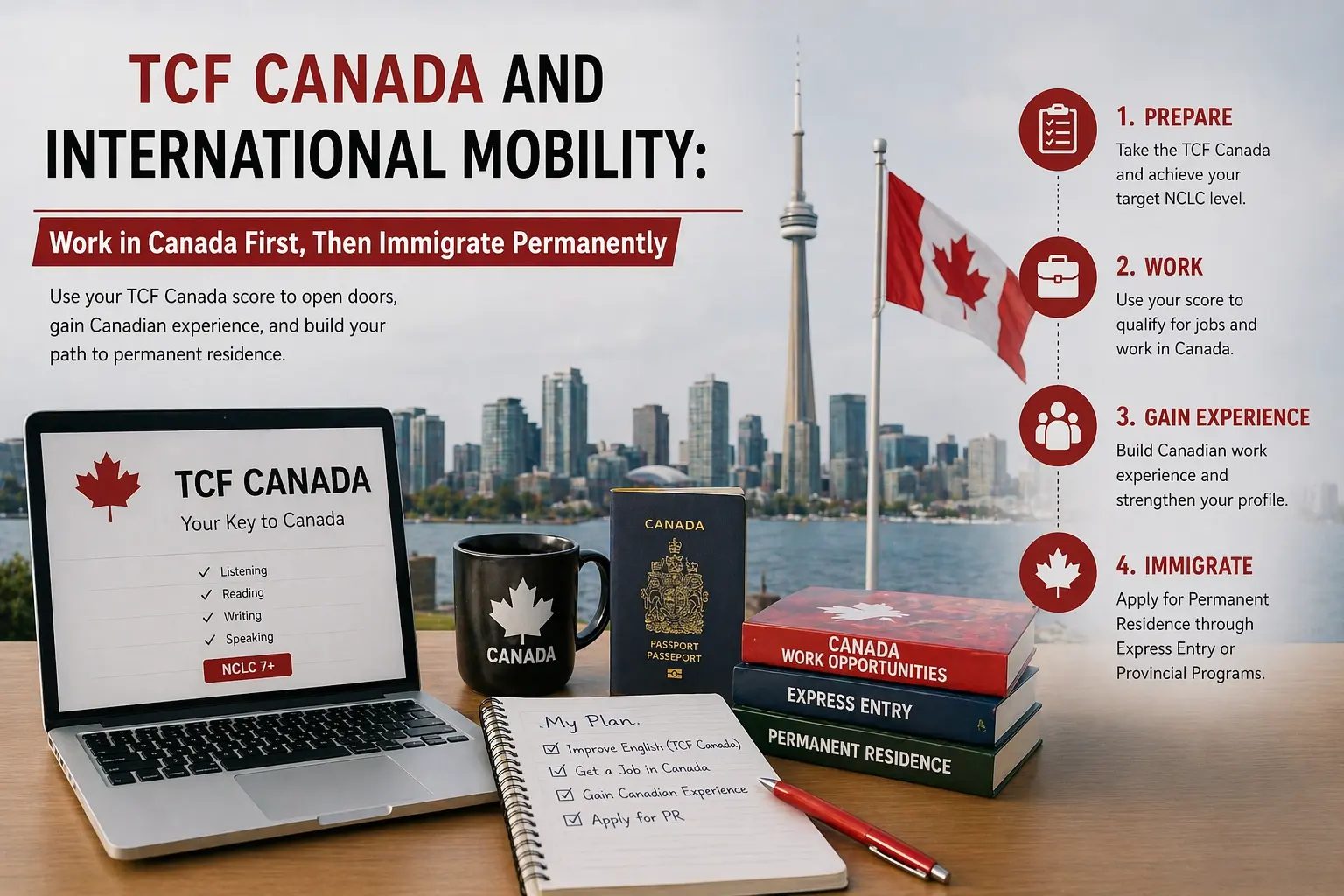
Canadian permanent residence is not always a single leap. For many candidates, a deliberate two-stage strategy — work temporarily in Canada first, then apply for permanent residence with a dramatically strengthened CRS profile — is the fastest realistic route. The TCF Canada plays a central role from the very beginning of this approach: linguistic CRS points accumulate the moment you create your Express Entry profile, regardless of whether you are inside or outside Canada when you do so.
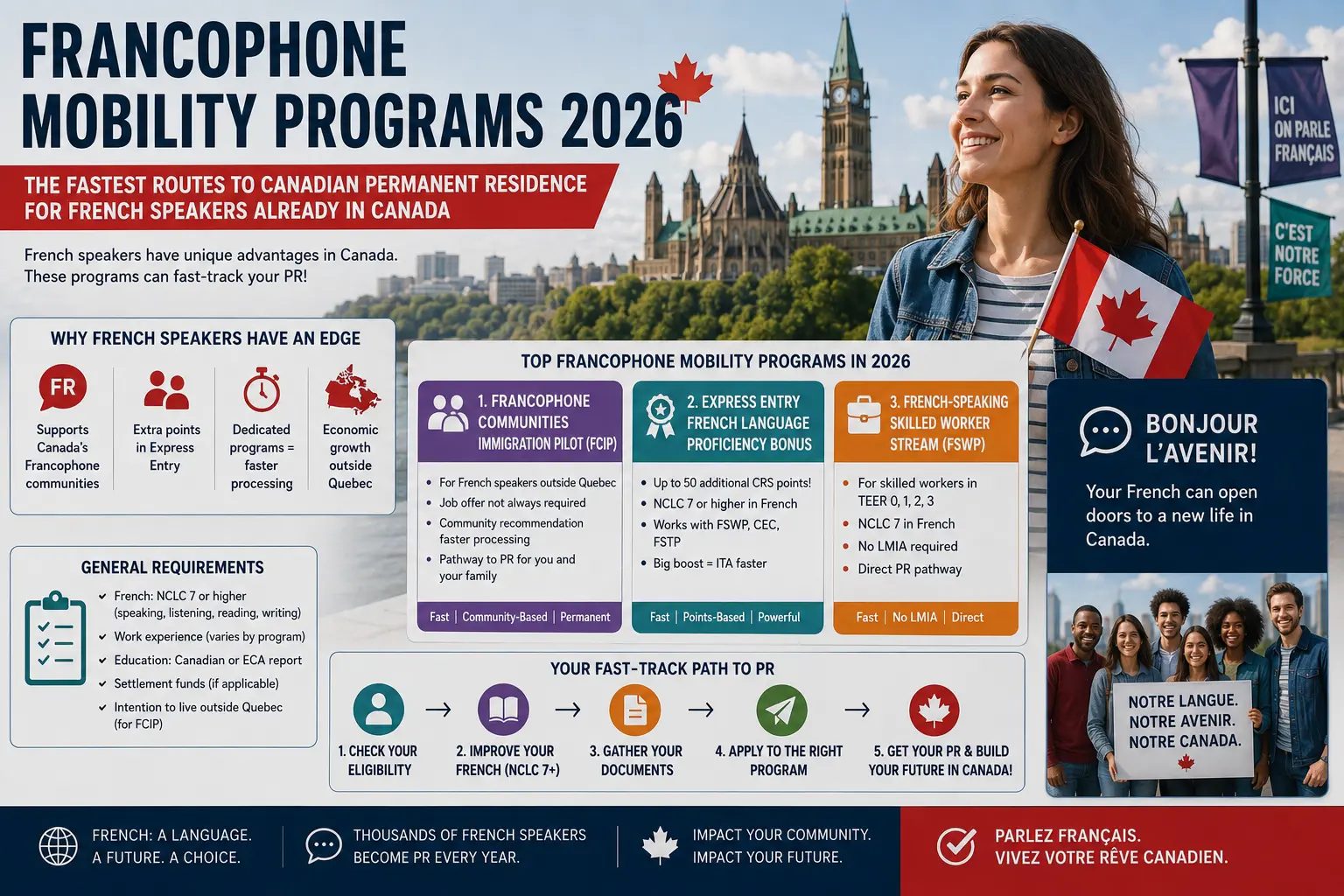
This article extends the strategic analysis in our Francophone Mobility Programs 2026 guide and our article on the Canadian immigration system and Express Entry language points with a concrete, staged action plan for candidates considering the two-stage route.
The core logic of the two-stage strategy: A TCF Canada score of NCLC 9 before departure generates maximum linguistic CRS points from day one. After 12 months of Canadian Classified Experience (CCE) in a skilled occupation, those base points gain 40 to 80 additional CRS points from the experience bonus. The combination positions most Francophone candidates well within Francophone category draw thresholds — often without needing a Provincial Nominee nomination at all.
The Four Temporary Entry Pathways into Canada
Pathway 1 — International Experience Canada (IEC) Working Holiday
The Working Holiday category allows eligible young adults (18 to 35 years old) to work freely for any Canadian employer for 12 to 24 months. It is the most powerful single tool for accumulating Canadian Classified Experience before a permanent residence application because it imposes no employer restriction — you can change jobs, provinces and even professions during the permit.
| Country | Maximum Age | Duration | Annual Quota | Notes |
|---|---|---|---|---|
| France | 35 years | 12 months | Yes — applies online | Most popular program — can be renewed once in some cases |
| Belgium | 30 years | 12 months | Yes — limited places | Annual quota fills quickly — apply on opening day |
| Morocco | Not eligible | — | — | Use PMF or Express Entry instead |
| Algeria | Not eligible | — | — | Use PMF or Express Entry instead |
| Tunisia | Not eligible | — | — | Use PMF or Express Entry instead |
| Senegal | Not eligible | — | — | Use PMF or Express Entry instead |
For North African and Senegalese candidates: The Working Holiday is unavailable to you. Your primary temporary entry pathways are the Francophone Mobility Program (PMF) — which requires a Canadian job offer but no LMIA — or LMIA-based work permits requiring an employer sponsor. Both require TCF Canada scores, and the PMF has specific NCLC minimum requirements. Target Express Entry Francophone category draws as the most direct route — the CRS threshold gap makes a temporary work phase less critical than for candidates from countries with higher general draw CRS scores.
Pathway 2 — The Francophone Mobility Program (PMF)
The PMF allows qualified Francophone workers to obtain a Canadian work permit without the Labour Market Impact Assessment (LMIA) that normally requires an employer to prove no Canadian worker is available. This dramatically shortens the timeline compared to LMIA-based permits — processing can be as fast as 4 to 6 weeks once the job offer is confirmed.
PMF eligibility requirements:
- Minimum NCLC 5 in all four TCF Canada skills (entry threshold — not optimal)
- NCLC 7 recommended for skilled occupations to strengthen employer applications
- A confirmed job offer from a Canadian employer in an eligible NOC occupation
- The occupation must appear on IRCC's current PMF eligible NOC code list
- Intention to settle outside Québec (Québec has its own immigration system)
Pathway 3 — Academic Exchange and Professional Internship Programmes
For candidates still in higher education or recently graduated, French-Canadian academic exchange programmes provide a temporary immersion and experience pathway. Campus France and the OFQJ (Franco-Quebec Office for Youth) facilitate professional internships of 3 to 6 months for French nationals aged 18 to 35. These do not generate Canadian Classified Experience for CRS purposes but develop language skills and Canadian professional networks that facilitate subsequent permanent residence applications.
Pathway 4 — Traditional LMIA-Based Work Permits
The removal of CRS points for arranged employment analysed in our Express Entry 2026: Job Offer Points Elimination article does not eliminate the value of LMIA-based permits for the two-stage strategy. A Canadian employer sponsoring your work permit gives you Canadian work experience — the CRS component that remains fully intact and still generates 40 to 80 bonus points after 12 qualifying months.
How TCF Canada Integrates into the Two-Stage Strategy
| Stage | Action | TCF Canada Impact | Timeline |
|---|---|---|---|
| Before departure | Take TCF Canada — target NCLC 9 | Maximum linguistic CRS points from profile creation | 3–6 months pre-departure |
| Arrival in Canada | Create Express Entry profile immediately | Active in pool with TCF linguistic points scored | Day of arrival or before |
| Months 1–12 | Work in skilled NOC 0/1/2/3 occupation | Accumulate Canadian experience for CRS bonus | Full first year |
| Month 12+ | Update Express Entry profile with CCE | +40 to +80 CRS points from experience bonus | After 12 qualifying months |
| Month 15–20 | Receive ITA — submit PR application | TCF Canada must still be within 24-month validity | Depends on draw timing |
Critical validity planning: If you take your TCF Canada 3 months before departure and spend 18 months in Canada before submitting your PR application, your TCF Canada will be 21 months old at submission — still within the 24-month validity window, but with little margin. Plan specifically: calculate your anticipated submission date before scheduling your TCF Canada, and if needed, schedule a retake during the Canadian work period to refresh your score. Full analysis at TCF Canada Validity and Immigration Timeline Impact.
CRS Impact Modelling: Three Candidate Profiles
Profile A — French national, 27, software developer, Working Holiday eligible
Before Working Holiday (TCF Canada NCLC 9 in all 4 skills):
- Age (27): 110 CRS points
- Bachelor's degree (ECA evaluated): 120 points
- 3 years foreign experience: 50 points
- Language (NCLC 9 × 4): 28 points
- Estimated total: ~308 points — below most general draw thresholds
After 12 months of Canadian software development experience:
- CCE bonus (NOC 1 occupation, 1 year): +73 points
- Transferability bonus: +25 points
- Revised estimated total: ~406 points — above recent Francophone draw thresholds
Profile B — Moroccan nurse, 32, PMF via French hospital group
Strategy: Obtain a Canadian job offer through a healthcare group operating in Ontario under the PMF. Arrive with NCLC 8 in all four skills. After 12 months of hospital nursing experience (NOC 3012 — nursing level 1), recalculate CRS with CCE bonus. Target Ontario OINP healthcare stream PNP nomination as a parallel track — provincial healthcare demand is at critical levels and PNP nominations generate 600 CRS points, effectively guaranteeing an ITA. See our Priority Employment Sectors 2026 guide.
"My plan was simple: take TCF Canada two weeks before leaving on my Working Holiday, create my Express Entry profile on arrival, then update it after 12 months of Canadian tech experience. I got NCLC 9 in all four skills. After 15 months, my CRS was 487 and I received my ITA in a Francophone draw. The timing worked perfectly because I had planned the TCF Canada as step one — not as an afterthought after I was already living in Canada." — Guillaume, web developer from Lyon, permanent resident in Vancouver
For Candidates Who Cannot Access the Working Holiday
If your nationality makes the Working Holiday unavailable and the PMF is not accessible without a job offer already in hand, the single most effective strategy remains: maximise your TCF Canada score from your home country and target Francophone category draws directly. Our analysis of TCF Canada retake strategies shows that the investment in moving from NCLC 7 to NCLC 9 — while generating only 4 additional raw CRS points — dramatically changes positioning within Francophone draw pools by placing you among the highest-ranked Francophone profiles.
Combine this with a WES credential evaluation, complete dossier preparation, and patient monitoring of draw thresholds using the tools described in our Credential Equivalency 2026 guide.




0 Commentaires
aucun commentaire
Soyez le premier a partager votre avis !