-
Auteur :
 Antoine C.
- Jan 04, 2026
TCF Canada Writing: Methodology and High-Performance Writing Techniques
- Blog
- /
- Article
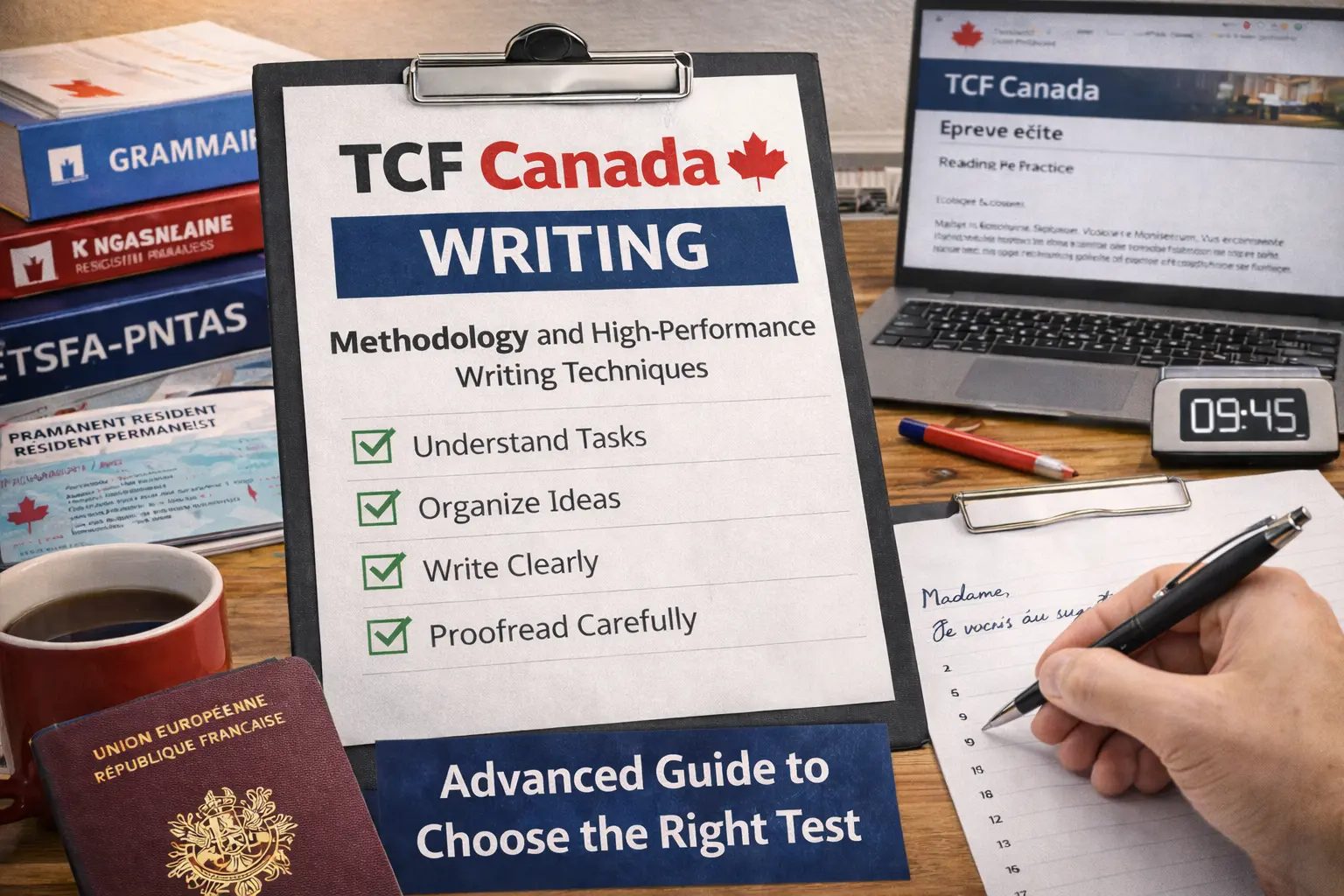
When Amélie Dubois, a 32-year-old digital marketing manager from Bordeaux, first confronted the TCF Canada written expression test (Expression écrite), she experienced a profound sense of professional disorientation despite years of daily professional writing experience. "I wrote comprehensive daily reports, polished presentations, and sophisticated professional emails throughout my career," she recalls candidly. "Yet when facing TCF Canada's highly specific task instructions, with their unforgiving time constraints, rigidly imposed formats, and particular evaluation criteria grounded in Canadian French conventions, I realized with dismay that I needed to completely deconstruct and rebuild my entire writing approach from foundational principles."
After five months of intensive, methodical preparation guided by specialized coaching and systematic practice, Amélie triumphantly obtained 17/20 in written expression (achieving NCLC 9—the second-highest competency level), directly securing the maximum possible 32 Canadian Language Benchmark (CLB) points for this critical competency in her Express Entry Comprehensive Ranking System (CRS) calculation. This exceptional score substantially elevated her overall immigration profile, demonstrating that TCF Canada writing mastery yields direct, quantifiable immigration advantages.
TCF Canada written expression frequently represents the most technically demanding and strategically complex test component for candidates across all proficiency levels. This rigorous 60-minute examination evaluates your ability to write effectively in authentic Canadian life situations, respecting precise linguistic conventions, cultural codes, and communication norms specific to Canadian French. Unlike traditional academic essay writing emphasizing creativity, personal style, and literary expression, TCF Canada writing demands absolute mastery of professional textual genres, skillful adaptation to Canadian sociocultural context, and exceptional writing efficiency executed under severe time constraint with zero tolerance for strategic errors.
Comprehensive Test Architecture: Deep Understanding as Foundation for Excellence
TCF Canada written expression consists of three fundamentally distinct writing tasks, each systematically evaluating specific writing competencies through different textual genres, communication purposes, and audience expectations. Pierre Lavoie, a senior sales engineer who dramatically progressed from NCLC 6 to NCLC 9 through strategic preparation, explains his initial critical error and subsequent revelation: "My catastrophic first-attempt mistake was treating all three writing tasks identically—applying the same generic writing approach regardless of task-specific requirements. In reality, each task possesses distinctive codes, genre conventions, examiner expectations, and specific performance traps. Genuinely understanding this architectural differentiation and developing task-appropriate strategic responses allowed me to completely transform my writing approach and optimize performance across all three components."
Critical Time Allocation Framework (60 Minutes Total):
| Task Component | Word Count Requirement | Optimal Time Investment | Planning Time | Writing Time | Review Time |
|---|---|---|---|---|---|
| Task 1: Personal Message | 60-120 words | 15 minutes total | 2 minutes | 10 minutes | 3 minutes |
| Task 2: Informative Article | 120-150 words | 25 minutes total | 4 minutes | 17 minutes | 4 minutes |
| Task 3: Argumentative Text | 120-180 words | 20 minutes total | 3 minutes | 13 minutes | 4 minutes |
Critical Time Management Warning: The single most common catastrophic error causing otherwise qualified candidates to fail written expression: inadequate time allocation resulting in incomplete Task 3 or completely missing verification phase. Examiners systematically assign "A1 not achieved" scores to incomplete responses regardless of quality of completed portions. Practice rigorous time discipline throughout all preparation to internalize optimal pacing and ensure consistent task completion within strict limits.
Task 1 Deep Analysis: Personal Message Writing (60-120 words, 15 minutes)
Task Objectives and Evaluation Framework
This opening task simulates authentic everyday communication scenarios requiring writing an email or personal message within familiar Canadian contexts. Sophie Tremblay, a reconverted science teacher now successfully established in Montreal's educational system, describes her refined strategic approach: "Task 1 fundamentally evaluates your practical ability to communicate effectively and appropriately in informal familiar situations typical of daily Canadian life. The primary challenge isn't demonstrating sophisticated linguistic complexity or impressive vocabulary—it's achieving communicative relevance, message clarity, appropriate register selection, and skillful adaptation to Canadian informal communication conventions."
| Evaluation Aspect | Specific Assessment Criteria | Common Scenario Examples | Primary Performance Trap | Defensive Strategy |
|---|---|---|---|---|
| Register Appropriateness | Skillful adaptation to informal communication context while maintaining respect | Email to close friend, message to family member, note to neighbor | Excessively formal academic register destroying natural communication tone | Use conversational vocabulary, contractions, friendly tone markers |
| Communicative Function | Message effectively accomplishes stated communication purpose | Extending invitation, making request, providing explanation, expressing gratitude | Unclear primary objective leaving recipient confused about required response | State purpose explicitly in opening, provide necessary details, include clear call-to-action |
| Textual Organization | Clear, logical structure following email/message conventions | Appropriate greeting, coherent body paragraphs, suitable closing formula | Chaotic structure lacking organizational logic or conventional elements | Follow standard format: greeting → context → main message → closing |
| Length Precision | Respects 60-120 word count parameters | Concise yet complete message delivering all required information | Insufficient content (<60 words) or excessive verbosity (>120 words) | Practice writing exactly 90-word messages for optimal safety margin |
| Canadian Cultural Context | Demonstrates awareness of Canadian social communication norms | Appropriate politeness level, cultural references, social conventions | Imposing European French formality inappropriate for Canadian context | Study Canadian French expressions, informal markers, cultural communication patterns |
Task 1 Proven Success Template - The SAFE Structure:
S - Salutation (Appropriate Greeting)
- Informal context: "Salut Marie!" / "Bonjour Jean," / "Cher ami,"
- Semi-formal context: "Bonjour Madame Tremblay," / "Cher voisin,"
- Adapt formality to specified relationship in task instructions
A - Amorce (Context Establishment - 1-2 sentences)
- Brief reference to shared context or previous communication
- Establishes reason for writing: "J'espère que tu vas bien. Je t'écris pour..."
- Creates natural conversational bridge to main message
F - Fond du message (Core Message Content - 3-4 sentences)
- Clearly state primary purpose/request/information
- Provide necessary specific details (dates, times, locations, requirements)
- Include relevant context or justification if appropriate
- Maintain friendly, conversational tone throughout
E - Expression finale (Closing Formula and Sign-off)
- Anticipate response or next steps: "J'attends ta réponse avec impatience."
- Appropriate closing expression: "Amicalement," / "À bientôt," / "Bien à toi,"
- Sender identification (first name typically sufficient for informal context)
Model Task 1 Response (95 words) - Invitation Context:
Salut Caroline,
J'espère que tu vas bien! Je t'écris pour t'inviter à mon anniversaire samedi prochain, le 15 mars, chez moi à partir de 19h. Ce sera une soirée décontractée avec quelques amis proches. On préparera un barbecue si le temps le permet, et j'ai prévu des jeux de société pour la soirée. N'hésite pas à apporter un invité si tu le souhaites! Peux-tu me confirmer ta présence d'ici jeudi?
J'espère vraiment que tu pourras venir!
Amicalement,
Thomas
Task 2 Deep Analysis: Informative Article Writing (120-150 words, 25 minutes)
Task Objectives and Genre Expectations
The second task requires composing an informative article intended for Canadian general public readership on contemporary or social topics of broad interest. Marc Pelletier, a Parisian sales professional now successfully established in Calgary's competitive business environment, shares his refined strategic approach: "Task 2 rigorously tests your ability to structure factual information coherently, adopt journalistic tone appropriately adapted to Canadian media context, and present complex information objectively yet engagingly for diverse readers. The challenge lies in balancing informative completeness with accessible presentation while respecting strict length constraints."
Task 2 Assessment Priorities (Ranked by Examiner Emphasis):
- 1. Information Organization and Clarity: Logical structure enabling reader comprehension without confusion (30% weight)
- 2. Content Relevance and Completeness: Article addresses topic thoroughly within length constraints (25% weight)
- 3. Register Appropriateness: Journalistic tone suitable for general public without excessive formality or informality (20% weight)
- 4. Linguistic Accuracy: Grammar, vocabulary, syntax demonstrating B2-C1 proficiency (15% weight)
- 5. Canadian Context Integration: Relevant Canadian perspective, examples, or framing (10% weight)
Task 2 High-Performance Template - The STEEL Article Structure:
S - Strong Opening (Attention-Capturing Hook - 1-2 sentences, ~20 words)
- Statistical Hook: "67% des employés canadiens souhaitent maintenir le télétravail après la pandémie."
- Factual Statement: "Le coût du logement au Canada a augmenté de 30% en cinq ans."
- Provocative Question: "Comment les villes canadiennes peuvent-elles réduire leur empreinte carbone?"
- Current Event Reference: "Depuis janvier 2025, une nouvelle loi environnementale transforme l'industrie."
T - Topic Context (Situational Framework - 2 sentences, ~25 words)
- Provide essential background for understanding topic significance
- Establish current situation or problem requiring discussion
- Bridge from opening hook to detailed analysis
- Example: "Cette transformation du travail révolutionne les entreprises à travers le pays. Les employeurs et employés doivent s'adapter à cette nouvelle réalité."
E - Essential Information (Core Content Development - 2-3 key points, ~60 words)
- Present 2-3 clearly distinct main points with logical organization
- Each point receives 2-3 sentences of development
- Use transitional phrases between points: "D'abord," "Ensuite," "De plus,"
- Maintain factual objectivity while ensuring reader engagement
- Structure: Point 1 (most important) → Point 2 (supporting) → Point 3 (additional perspective)
E - Examples and Illustrations (Concrete Evidence - 1-2 examples, ~25 words)
- Provide practical, relatable examples illustrating abstract concepts
- Ground theoretical discussion in tangible Canadian reality
- Example formats: "Par exemple, les économies de transport..." / "Selon une étude récente..." / "De nombreux Canadiens témoignent..."
L - Link/Conclusion (Synthetic Perspective - 1-2 sentences, ~20 words)
- Synthesize main points into coherent conclusion
- Provide Canadian-specific angle or future perspective
- Avoid introducing completely new information
- Example: "Le télétravail redéfinit ainsi les codes professionnels modernes au Canada, créant de nouvelles opportunités pour tous."
Marc's Real Task 2 Success Story (Score: 19/20):
"I received this topic: 'Write an article about the advantages of remote work for a business magazine.' Using the STEEL structure, I crafted:
Opening: '67% des employés canadiens souhaitent maintenir le télétravail post-pandémie.' Context: 'Cette transformation du travail révolutionne les entreprises à travers le pays.' Key Points: Flexibility in schedule management, increased productivity through reduced distractions, improved work-life balance enabling family time. Examples: Substantial transportation cost savings, reduced commuting stress improving mental health. Synthesis: 'Le télétravail redéfinit les codes professionnels modernes au Canada.'
Total: 147 words. The examiner specifically praised my clear organization and Canadian workplace context integration."
Task 3 Deep Analysis: Argumentative Text Writing (120-180 words, 20 minutes)
Task Objectives and Argumentative Requirements
The third and final task evaluates your ability to defend a clear position or viewpoint in a structured, convincing, and intellectually mature manner on social, cultural, or ethical topics. Thomas Beaumont, a Lyon architect now practicing successfully in Toronto's competitive market, highlights this task's distinctive complexity: "Task 3 doesn't settle for superficial personal opinion expression—it demands solid, well-reasoned argumentation supported by relevant examples, logical progression of ideas, consideration of opposing viewpoints, and thoughtful integration of Canadian sociocultural context in your analytical reflection."
Common Task 3 Critical Errors Causing Failure:
- Purely Personal Opinion Without Argumentation: "I think X is good because I like it" (insufficient reasoning)
- One-Sided Analysis Ignoring Complexity: Failing to acknowledge alternative perspectives or limitations
- Lack of Concrete Examples: Abstract generalizations without specific illustrative support
- Weak or Absent Conclusion: Ending abruptly without synthesizing arguments
- Inappropriate Register: Excessively colloquial language or overly academic jargon
The 7 Master Structures of Argumentation: Strategic Frameworks for Task 3 Excellence
Structure #1: Classical Dialectical Progression (Thesis-Antithesis-Synthesis)
The most academically respected structure demonstrating intellectual maturity and analytical balance. Julien Moreau, a philosophy teacher now established in Quebec City's education system, explains its enduring effectiveness: "This time-honored structure reassures examiners because it demonstrates rigorously organized, genuinely nuanced thinking that reveals intellectual maturity, critical thinking capacity, and balanced judgment—all highly valued competencies in Canadian academic and professional contexts."
Dialectical Structure Template (150-170 words optimal):
Introduction (20-25 words)
- Present topic and its contemporary relevance
- Announce your intention to examine multiple perspectives
- Example: "La question de l'interdiction des voitures en centre-ville suscite des débats passionnés au Canada. Examinons les arguments de chaque côté."
Thesis - Arguments Supporting Position (50-60 words)
- Present 2-3 strong arguments favoring the proposition
- Support each with brief concrete example or evidence
- Connectors: "D'abord," "En premier lieu," "Tout d'abord"
Antithesis - Opposing Perspective (40-50 words)
- Acknowledge legitimate counterarguments or limitations
- Demonstrate intellectual fairness and critical thinking
- Transition: "Cependant," "Néanmoins," "Toutefois"
Synthesis - Nuanced Position (40-50 words)
- Propose balanced conclusion reconciling perspectives
- Suggest practical middle-ground solution if appropriate
- Connectors: "En définitive," "Ainsi," "Il apparaît donc que"
Julien's Successful Dialectical Response (Score: 18/20):
"For the topic 'Should cars be banned from city centers?' I structured: Introduction: Topic presentation and debate announcement. Thesis: Arguments for prohibition—air pollution reduction improving public health, noise reduction enhancing quality of life, pedestrian safety improvement. Antithesis: Economic concerns for businesses, mobility challenges for elderly/disabled residents, insufficient public transportation alternatives in many cities. Synthesis: Nuanced position advocating gradual implementation of extensive pedestrian zones combined with substantial public transportation investment rather than absolute prohibition."
Structure #2: The Argumentative Staircase (Progressive Intensity)
Strategic progression from weakest to strongest argument creating powerful persuasive crescendo. Patricia Levesque, a sales professional now thriving in Vancouver's competitive market, testifies to its rhetorical effectiveness: "This structure generates persuasive momentum through carefully orchestrated intensification, leaving readers with your most compelling argument as final lasting impression—psychologically very effective for maximum persuasive impact."
Argumentative Staircase Template (140-160 words optimal):
Introduction + Position Statement (25 words)
- Present topic and clearly state your position immediately
- Example: "L'éducation bilingue devrait être obligatoire dans toutes les écoles canadiennes pour plusieurs raisons importantes."
Argument 1 - Foundation Level (30-35 words)
- Valid but less compelling opening argument
- Connector: "Premièrement," "D'abord,"
Argument 2 - Intermediate Level (35-40 words)
- Stronger, more substantial supporting argument
- Connector: "Deuxièmement," "De plus,"
Argument 3 - Peak Level (40-45 words)
- Most powerful, emotionally/logically compelling argument
- Include strongest example or evidence here
- Connector: "Enfin, et surtout," "Plus important encore,"
Conclusion - Reinforcement (25-30 words)
- Briefly synthesize and reinforce position with confidence
- Example: "Ces arguments démontrent clairement que l'éducation bilingue constitue un investissement essentiel pour l'avenir du Canada."
Structure #3: Problem-Solution-Evaluation Framework
Exceptionally effective for societal topics requiring constructive analysis and practical recommendations. Amélie Rousseau, a social worker now successfully practicing in Edmonton, explains its particular Canadian relevance: "This structure demonstrates your ability to analyze complex societal challenges critically and propose practical, implementable solutions—analytical and problem-solving competencies highly valued throughout Canadian professional and civic culture."
Problem-Solution-Evaluation Template (150-175 words optimal):
Problem Analysis (50-60 words)
- Clearly define the societal problem or challenge
- Explain its significance and impact on affected populations
- Provide specific data or examples illustrating severity
- Example: "Le manque de logements abordables au Canada constitue une crise majeure. Les prix ont augmenté de 40% en cinq ans, rendant l'accession à la propriété impossible pour les jeunes familles."
Solution Proposal (60-70 words)
- Present 2-3 concrete, realistic solutions to address problem
- Explain implementation mechanisms briefly
- Support with successful precedents if possible
- Connectors: "Pour résoudre ce problème," "Plusieurs solutions existent," "Il conviendrait de"
Critical Evaluation (40-50 words)
- Assess proposed solutions' feasibility and potential effectiveness
- Acknowledge limitations or challenges honestly
- Conclude with balanced, realistic perspective
- Example: "Bien que ces solutions nécessitent des investissements importants et une volonté politique forte, elles demeurent réalisables et essentielles pour garantir l'équité sociale au Canada."
Structure #4: Comparative Analysis (Two Perspectives)
Systematically weighing two distinct approaches or viewpoints with balanced analysis. Effective for topics presenting clear alternatives requiring comparative evaluation.
Comparative Analysis Template (140-165 words optimal):
Introduction + Framework (20-25 words)
- Present topic requiring comparison between two approaches
- Announce analytical framework: "Deux approches méritent d'être comparées..."
Perspective A Analysis (45-55 words)
- Present first approach with advantages and supporting evidence
- Maintain objective analytical tone
Perspective B Analysis (45-55 words)
- Present alternative approach with its distinct advantages
- Use comparative connectors: "En revanche," "Par contre," "À l'inverse"
Synthesis + Personal Position (30-40 words)
- Determine which approach proves more appropriate or propose integration
- Justify your conclusion with clear reasoning
Structure #5: Chronological Evolution Analysis
Examining topic through temporal lens, particularly effective for technological, social, or cultural evolution topics.
Chronological Evolution Template (145-170 words optimal):
Historical Context (30-40 words)
- Establish situation in past for contrast foundation
Current Situation (50-60 words)
- Describe present state with specific contemporary examples
Future Implications (40-50 words)
- Project logical future developments or consequences
Evaluative Conclusion (25-30 words)
- Assess whether evolution represents progress or challenge
Structure #6: Cause-Effect Analysis
Systematically exploring causal relationships, ideal for analytical topics requiring understanding of complex phenomena origins and consequences.
Cause-Effect Template (150-170 words optimal):
Phenomenon Introduction (20-25 words)
- Present observable phenomenon or situation requiring explanation
Causal Analysis (60-70 words)
- Identify and explain 2-3 primary causes or contributing factors
- Connectors: "Cette situation s'explique par," "Plusieurs facteurs contribuent à"
Effect/Consequence Analysis (50-60 words)
- Examine resulting effects or implications
- Consider both short-term and long-term consequences
Synthesis (20-25 words)
- Connect causes and effects in coherent analytical conclusion
Structure #7: Multi-Stakeholder Perspective
Examining topic from different stakeholder viewpoints, demonstrating sophisticated understanding of issue complexity and multiple legitimate perspectives.
Multi-Stakeholder Template (155-180 words optimal):
Issue Introduction (25 words)
- Present topic affecting multiple groups differently
Stakeholder Group 1 Perspective (40-50 words)
- Analyze from first affected group's viewpoint with their concerns
Stakeholder Group 2 Perspective (40-50 words)
- Present second group's distinct concerns or interests
Stakeholder Group 3 Perspective (30-40 words, optional)
- Additional perspective if relevant
Balanced Synthesis (20-30 words)
- Propose solution respecting multiple legitimate interests
Strategic Vocabulary Mastery: The Difference Between NCLC 7 and NCLC 9
Advanced Logical Connectors for Sophisticated Discourse
Laurent Dubois, a professional linguist now established in Calgary, emphasizes connector sophistication as critical performance differentiator: "The observable distinction between NCLC 7 and NCLC 9 writing frequently lies in the richness, precision, and variety of logical connectors employed. Basic connectors produce competent but unremarkable writing; advanced connectors demonstrate genuine linguistic sophistication that examiners reward with top-tier scores."
| Logical Function | NCLC 7 Standard Connectors | NCLC 9 Expert Connectors | Usage Context Example |
|---|---|---|---|
| Addition / Enumeration | et, aussi, de plus, également | en outre, par ailleurs, qui plus est, de surcroît, au surplus | "En outre, cette mesure présente des avantages économiques substantiels." |
| Opposition / Contrast | mais, cependant, pourtant | néanmoins, toutefois, en revanche, or, pour autant | "Néanmoins, certaines réserves doivent être émises quant à cette approche." |
| Cause / Explanation | parce que, car, puisque | étant donné que, du fait que, dans la mesure où, compte tenu de | "Dans la mesure où les ressources demeurent limitées, des choix s'imposent." |
| Consequence / Result | donc, alors, ainsi | par conséquent, de ce fait, c'est pourquoi, il en résulte que | "Par conséquent, il apparaît nécessaire de repenser notre stratégie." |
| Concession | même si, malgré, bien que | quoique, encore que, en dépit de, nonobstant, quand bien même | "Quoique cette solution comporte des limites, elle demeure la plus réaliste." |
| Illustration / Example | par exemple, comme | notamment, en particulier, à titre d'illustration, ainsi, tel que | "Plusieurs secteurs sont concernés, notamment l'éducation et la santé." |
| Emphasis / Reinforcement | vraiment, très | effectivement, en effet, de fait, assurément, indubitablement | "Cette approche se révèle effectivement la plus prometteuse." |
| Temporal Progression | d'abord, ensuite, puis, enfin | en premier lieu, subséquemment, ultérieurement, finalement | "En premier lieu, analysons les causes historiques de cette situation." |
| Conclusion / Synthesis | en conclusion, pour finir | en définitive, somme toute, au bout du compte, en fin de compte, en dernière analyse | "En définitive, cette réforme apparaît à la fois nécessaire et réalisable." |
Strategic Connector Usage Principles:
- Variety is Essential: Avoid repetitive use of same connector—demonstrate range through strategic variation
- Precision Matters: Select connector precisely matching intended logical relationship rather than generic option
- Natural Integration: Connectors should flow naturally within sentences, not feel artificially inserted
- Strategic Distribution: Use advanced connectors particularly in Task 2 and Task 3 where sophistication is weighted more heavily
- Balance Required: Don't overuse advanced connectors to point of artificiality—strategic placement yields maximum impact
Advanced Vocabulary for Argumentative Writing
High-Impact Verbs for Argumentation (NCLC 9 Level):
- Expressing Opinion/Position: estimer, considérer, juger, prétendre, soutenir, affirmer, avancer, préconiser
- Analyzing: examiner, analyser, décortiquer, scruter, approfondir, évaluer, jauger
- Demonstrating: démontrer, prouver, établir, attester, témoigner de, illustrer, révéler
- Contrasting: opposer, contrebalancer, nuancer, tempérer, relativiser
- Concluding: conclure, déduire, inférer, en venir à, aboutir à
Sophisticated Nouns for Complex Ideas:
- Analysis Concepts: enjeu, portée, implications, ramifications, retombées, incidence
- Argumentation: démonstration, raisonnement, argumentation, réflexion, analyse, perspective
- Problems/Challenges: problématique, défi, obstacle, entrave, contrainte, difficulté
- Solutions: solution, remède, alternative, option, mesure, disposition, initiative
Qualifying Adjectives for Nuanced Expression:
- Positive Evaluation: pertinent, judicieux, approprié, opportun, bénéfique, avantageux, profitable
- Negative Evaluation: problématique, discutable, contestable, préjudiciable, dommageable
- Neutral Analysis: significatif, notable, substantiel, considérable, appréciable
Common Critical Errors and Defensive Strategies
Error Category 1: Register Inconsistency
Manifestation: Mixing informal conversational language with formal academic register within same text, creating jarring stylistic inconsistency.
Example: "La problématique du changement climatique est super importante et il faut vraiment qu'on fasse quelque chose rapidement avant que ce soit trop tard." (Mixing formal "problématique" with colloquial "super," "vraiment," "il faut qu'on")
Defense: Establish appropriate register at outset and maintain rigorously throughout. Task 1 permits informal markers; Tasks 2-3 require consistent semi-formal journalistic/analytical register.
Error Category 2: Insufficient Development and Superficiality
Manifestation: Stating arguments without development, examples, or supporting evidence—producing skeletal text lacking substantive content.
Example: "L'éducation est importante. Elle aide les gens. Tout le monde devrait avoir accès à l'éducation. C'est bon pour la société."
Defense: For every claim, provide: (1) brief explanation WHY, (2) concrete example or evidence, (3) connection to broader argument. Minimum 2-3 sentences per main point.
Error Category 3: Weak or Non-Existent Introduction/Conclusion
Manifestation: Abruptly beginning argumentation without context establishment or ending without synthesis, leaving text feeling incomplete.
Defense: Always dedicate 15-20 words to introduction (context + position/framework) and 20-25 words to conclusion (synthesis + final perspective). These frame your argumentation professionally.
Error Category 4: Excessive Length or Insufficient Content
Manifestation: Writing 200+ words exceeding limits or barely reaching 100 words with insufficient development.
Defense: Practice writing to exact targets: Task 1 = 90 words, Task 2 = 135 words, Task 3 = 155 words. Count during practice until internal calibration develops.
Spectacular Success Transformations: Candidate Testimonials
Lucie's Remarkable Journey: 11/20 to 19/20 in 4 Months
Lucie's Systematic Transformation Method:
- Daily Writing Discipline: Composed one complete 3-task practice test daily for 90 consecutive days without exception, maintaining strict time limits
- Comparative Model Analysis: After each practice, studied high-scoring model responses, identifying specific techniques and vocabulary creating excellence
- Professional Feedback Integration: Weekly coaching sessions with specialized corrector who provided detailed error analysis and strategic improvement recommendations
- Advanced Connector Mastery: Systematically memorized and practiced integrating 50 advanced logical connectors until usage became natural and automatic
- Structured Template Internalization: Mastered 3-4 proven structural templates for each task type, eliminating planning uncertainty and accelerating execution
"My genuine breakthrough? Fundamentally understanding that TCF Canada writing constitutes a rigorously technical exercise governed by explicit rules and conventions, NOT a creative writing showcase valuing originality or personal style. Once I completely adopted this performance-oriented mentality, abandoning romantic notions of 'creative expression' in favor of systematic strategic execution, everything became dramatically simpler and more controllable. I stopped attempting to be interesting or original; I focused exclusively on being clear, correct, well-structured, and efficient. The transformation was revolutionary."
François's Strategic Efficiency Approach
"My liberating realization: I stopped desperately seeking originality, creativity, or stylistic innovation in my writing. Instead, I focused laser-like on execution efficiency, structural clarity, and systematic application of proven success formulas. These structural templates aren't creative straitjackets limiting expression—they're battle-tested success formulas that reliably generate high scores when properly executed."
"I treated TCF writing like engineering: identify optimal design, execute with precision, verify quality. This engineering mindset eliminated anxiety, accelerated production, and consistently generated scores in 16-18/20 range—exactly what I needed for NCLC 9 and maximum Express Entry points."
Amélie's Complete Transformation
"Despite years of professional writing experience in marketing, I initially approached TCF writing with completely inappropriate expectations and strategies. I failed my first attempt (12/20) because I wrote as I would for my professional context—creative, persuasive, stylistically varied, somewhat informal."
"My transformation required completely deconstructing my professional writing habits and rebuilding from scratch according to TCF-specific requirements. I learned to: (1) Write within rigid structural templates rather than organic development, (2) Prioritize clarity over creativity, (3) Respect formal register conventions, (4) Manage time ruthlessly, (5) Target exact word counts, (6) Use advanced connectors systematically."
"This complete strategic reconstruction, supported by intensive coaching and daily practice, elevated my score from disappointing 12/20 to excellent 17/20—achieving NCLC 9 and securing maximum CLB points for written expression in Express Entry. The investment proved absolutely essential for immigration success."
Comprehensive 8-Week Training Program for Written Expression Mastery
Systematic Preparation Timeline:
Weeks 1-2: Foundation and Template Mastery
- Days 1-7: Study all task requirements, evaluation criteria, structural templates. Practice one complete 3-task test daily without time limit, focusing on structure internalization.
- Days 8-14: Continue daily complete tests, gradually introducing time constraints (start 90 min, reduce to 75 min). Begin systematic error tracking by category.
- Focus: Perfect structural execution before emphasizing speed.
Weeks 3-4: Vocabulary Expansion and Register Control
- Daily Practice: One complete timed test (70 minutes) with deliberate integration of advanced connectors and vocabulary.
- Vocabulary Building: Memorize 10 new advanced connectors weekly, practice immediate integration.
- Register Exercises: Rewrite same content in different registers to develop register control.
Weeks 5-6: Speed Optimization and Efficiency
- Daily Practice: Two complete timed tests daily at 60 minutes strict limit.
- Time Analysis: Track minutes spent per task, identify efficiency bottlenecks.
- Speed Techniques: Practice rapid outlining (2 min max per task), accelerated writing, streamlined revision.
Weeks 7-8: Refinement and Exam Simulation
- Full Simulations: Three full tests weekly under authentic exam conditions (quiet room, no resources, strict timing).
- Professional Evaluation: Submit best texts to qualified evaluator for detailed feedback.
- Final Refinement: Address remaining systematic errors, perfect verification protocols.
Essential Resources for TCF Canada Writing Preparation
Recommended Preparation Materials:
Official Resources (Highest Priority)
- France Éducation international Official Guide: TCF Canada preparation manual with authentic sample tasks and evaluation criteria
- Official Practice Tests: Available on FEI website, essential for format familiarization
Professional Coaching and Correction Services
- Specialized TCF Coaches: Weekly sessions with experienced corrector providing detailed feedback (budget €40-80/hour)
- Online Platforms: Preply, Italki offering TCF-specialized French teachers
Self-Study Materials
- Preparation Manuals: Hachette "Réussir le TCF," CLE International series
- Connector Reference Guides: Advanced connector lists with usage examples
- Model Response Collections: High-scoring sample responses for analysis
Final Test Day Recommendations
Pre-Test Preparation (24 Hours Before):
- Review your mastered structural templates briefly
- Skim advanced connector list for memory refresh
- Complete one light practice test to activate writing mode
- Ensure adequate sleep and arrive well-rested
- Bring reliable watch for time management
During Test Execution:
- Read ALL task instructions carefully before writing anything
- Invest 2-4 minutes planning each task using your templates
- Monitor time continuously: checkpoint at 15 min, 40 min, 55 min
- Reserve minimum 10 minutes for comprehensive verification phase
- Check: word counts, structural completeness, spelling, agreement, connector variety
- If time short, prioritize completing all three tasks over perfecting one
Conclusion: Your Path to Written Expression Excellence
TCF Canada written expression mastery fundamentally requires abandoning intuitive, creative writing approaches in favor of systematic, strategic execution of proven structural formulas. Success depends not on writing talent, creativity, or stylistic brilliance, but rather on: (1) Perfect understanding of task-specific requirements, (2) Mastery of appropriate structural templates, (3) Strategic vocabulary and connector deployment, (4) Rigorous time management discipline, (5) Consistent practice developing automatic execution.
As François powerfully summarizes from his Calgary engineering practice: "I stopped seeking originality and started prioritizing efficiency. These structural templates aren't creative limitations—they're success formulas refined through thousands of high-scoring responses. Master the formulas, execute with precision, verify systematically, and high scores follow predictably. TCF writing rewards method over inspiration, structure over spontaneity, strategic discipline over creative expression."
Remember: NCLC 7 demonstrates competency; NCLC 9 proves strategic mastery.
The difference isn't writing talent—it's methodological excellence.
The difference isn't writing talent—it's methodological excellence.
* * *
Laissez un commentaire
Votreadresse email ne sera pas publie. Les champs obligatoires sont marque avec *




0 Commentaires
aucun commentaire
Soyez le premier a partager votre avis !