-
Auteur :
 Antoine C.
- Jan 06, 2026
Mastering TCF Canada Speaking: 15 Proven Techniques from Top Scorers (18-20/20)
- Blog
- /
- Article
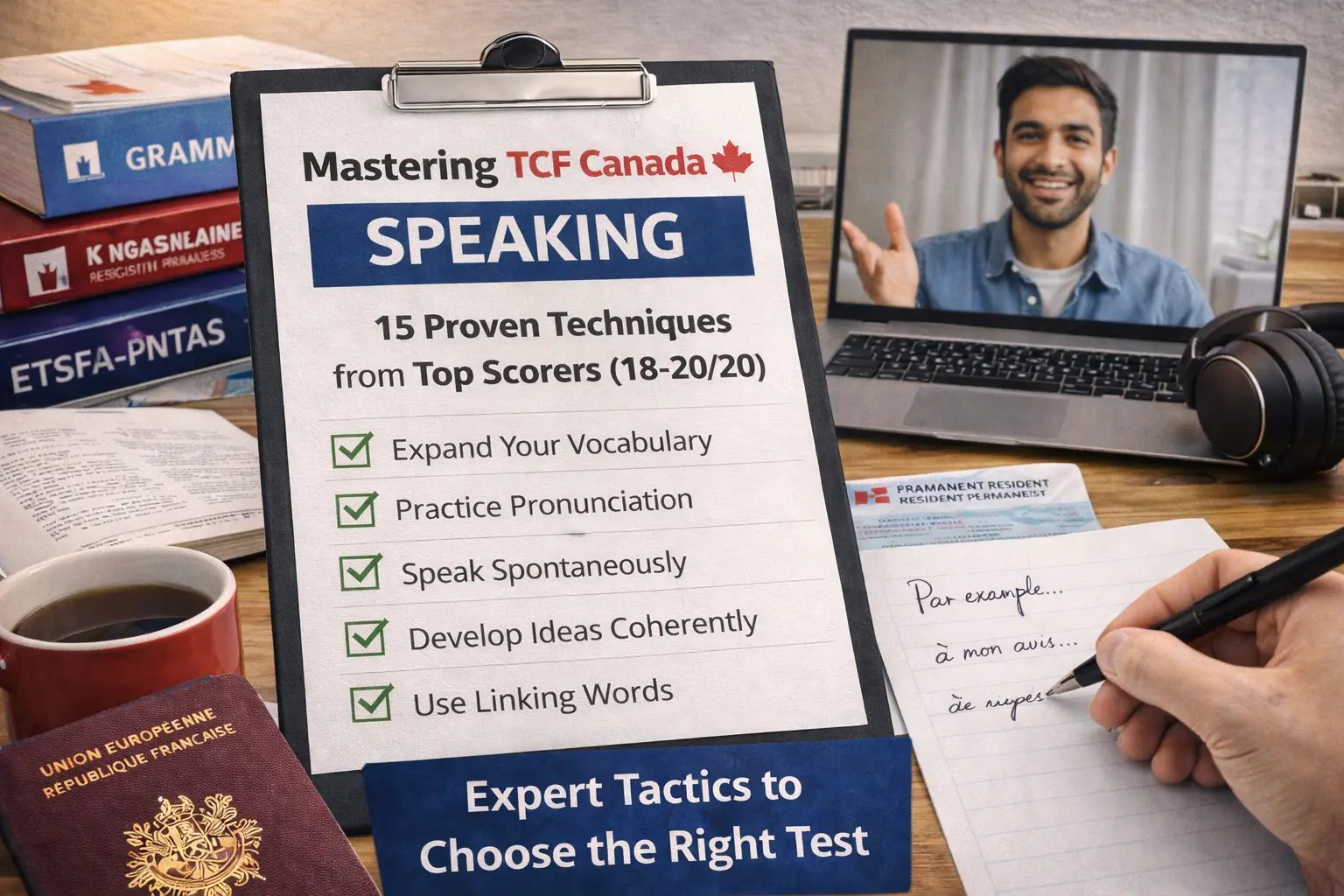
Mastering TCF Canada Speaking: 15 Proven Techniques from Top Scorers (18-20/20)
When Fabien, a 32-year-old sales professional, discovered his speaking score of 19/20 on the TCF Canada, his mind immediately went back to his catastrophic first attempt six months earlier: 11/20, equivalent to NCLC 6. "The difference between these two scores? 24 precious Express Entry points," he explains from Toronto where he now lives. "But more importantly, I understood that speaking skills aren't developed like other test components—they require a completely different approach."
Want to understand exactly how language scores can impact your immigration profile? Use the official CRS criteria as your reference here, and for a clear improvement roadmap, see Decoding Your TCF Canada Results: Analysis and Improvement Guide.
The TCF Canada speaking section terrifies many candidates, yet it's often the area where progress can be most spectacular. By analyzing strategies from 200+ candidates who achieved 18-20/20, clear patterns emerge. These tested and proven techniques can transform your oral performance dramatically.
Complete Breakdown of the 3 Tasks: What Examiners Really Evaluate
If you want the full context (all sections, timings, and how the test fits your immigration goals), keep this reference open: Complete TCF Canada Ultimate Guide 2026.
Task 1: The Guided Interview (2 minutes) - The Deceptive Simplicity Trap
Marine, an FLE teacher now working with Immigration Canada offices, explains: "Many candidates neglect this task thinking it's easy. Fatal mistake. This is where crucial first impressions are formed that influence the entire evaluation."
Typical questions analyzed:
- "Tell me about your family" (Trap: staying superficial)
- "Describe your city" (Trap: reciting a tourist guide)
- "What are your hobbies?" (Trap: listing without depth)
Fabien's winning response approach:
"My family is my anchor and my motivation. We are four: my parents who transmitted this curiosity for different cultures, my sister who's a doctor and inspires me with her dedication, and myself. This family cohesion actually explains why Canada attracts me: its values of solidarity resonate with our upbringing and the principles I was raised with."
Technique #1: The Adapted STAR Method
Situation-Task-Action-Result, personalized version. Céline, a psychologist now in Montreal, shares: "Instead of just saying 'I like reading,' I explained: 'Reading shaped who I am (Situation), especially when I discovered positive psychology (Task), which led me to change careers (Action), and today I help families in difficulty (Result).' This narrative approach creates connection and demonstrates depth."
If you're still building confidence and natural flow in Task 1, this complementary guide can help: Strategies for Speaking: Speak with Confidence at TCF Canada.
Task 2: Interactive Exercise (5min30) - The Evaluation Core
This task simulates real situations: convincing, negotiating, solving problems. Thomas, an IT professional, testifies: "I understood the examiner wasn't looking for the perfect solution, but my ability to argue logically and diplomatically while adapting to unexpected elements."
Lucie's real scenario (Score: 19/20):
"You want to organize a birthday party for your colleague, but your boss prefers a professional event. Negotiate a compromise."
Technique #2: The PREP Structure (Point-Reason-Example-Point)
Lucie's structured response:
- Point: "I understand your professional concern and share your vision completely."
- Reason: "However, valuing our colleagues strengthens team spirit and ultimately boosts productivity."
- Example: "Last year, our celebration created cohesion that translated into 15% of projects delivered ahead of schedule."
- Point: "What if we combined both with a cocktail after the official presentation?"
For the official framing of the TCF Canada and what it certifies, consult France Éducation international: TCF Canada (official page).
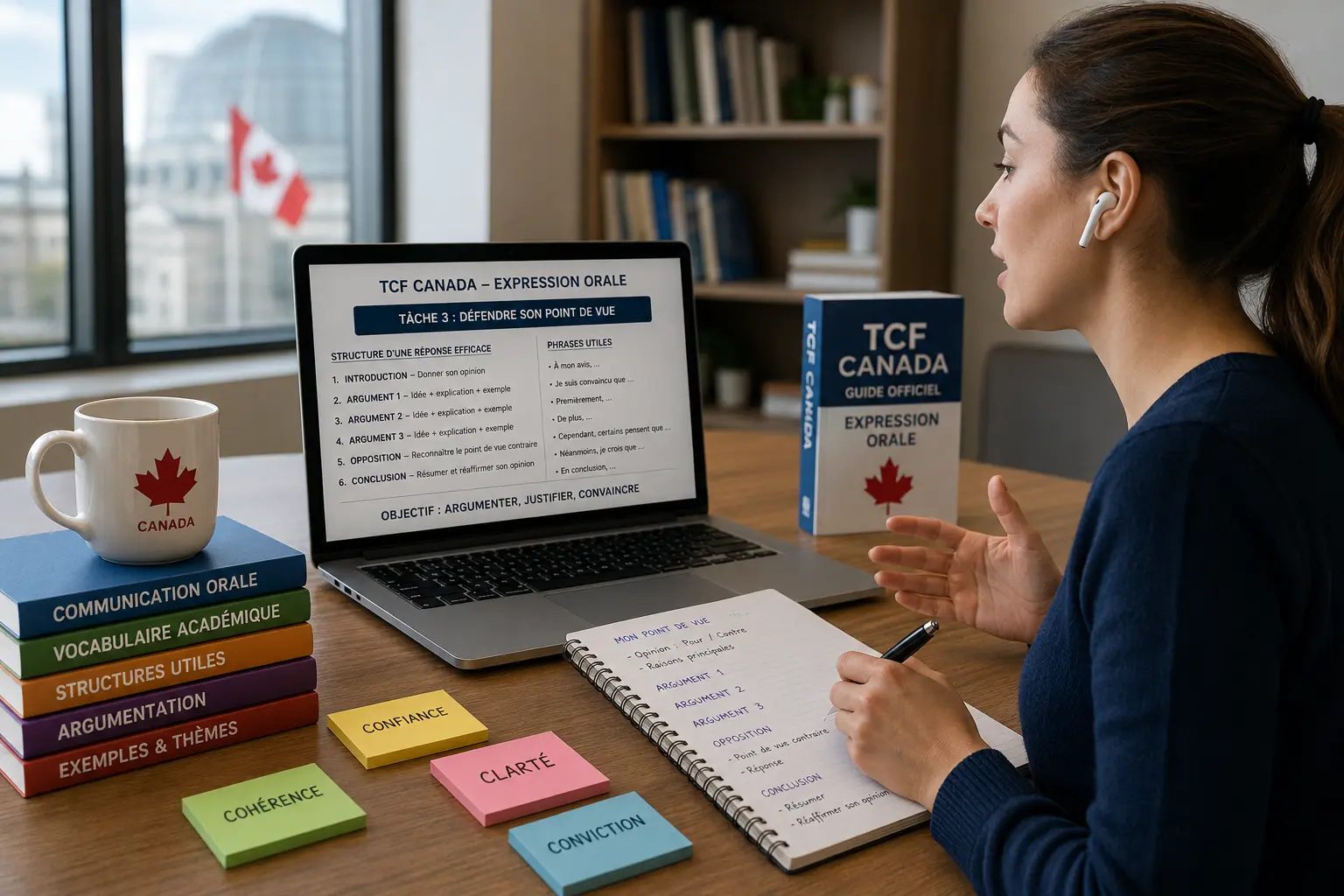
Task 3: Expressing a Viewpoint (4min30) - Excellence or Mediocrity
This often determines the difference between NCLC 8 and NCLC 9. Sophie, a journalist now in Vancouver, explains: "I realized excellent candidates don't just give opinions—they construct nuanced reflections that demonstrate critical thinking and balanced perspective."
Technique #3: The Multiple Prism Method
Analyze the topic from 3 different angles before concluding. Example with "Should phones be banned at school?":
Educational prism: Impact on concentration and learning processes
Social prism: Communication between students and potential isolation
Security prism: Emergency contact with parents and safety considerations
If you want a more advanced playbook for Task 3 (nuance, concessions, and high-level argumentation), continue with: Mastering TCF Canada Speaking: Advanced Techniques and Performance Strategies.
The 15 Secret Techniques of Exceptional Scores
Preparation Techniques (Before the Exam)
Technique #4: Personal Examples Library
Maxime, an architect now in Toronto, confides: "I prepared 20 personal anecdotes adaptable to different subjects. This bank of examples prevented blank moments and made my responses authentic and memorable."
Technique #5: Advanced Shadowing
Émilie, a translator, practiced: "I watched televised debates while simultaneously repeating the speakers' arguments. This technique improves both fluency and argumentation skills at once, training your brain to process and produce simultaneously."
For extra real-condition training resources, you can also explore TV5MONDE’s TCF practice environment: TCF preparation (TV5MONDE).
Execution Techniques (During the Exam)
Technique #6: The Golden 30-Second Rule
Systematically use the 30 seconds of preparation time to structure, not to panic. Sandra, an accountant, explains: "I wrote maximum 3 keywords on my sheet: my response plan in telegraphic mode. This prevented me from getting lost and gave me a clear roadmap."
Technique #7: The Confidence Opener
Always start with a phrase you master perfectly. Laurent testifies: "My standard opening phrase: 'This question raises a fundamental issue I'd like to address from several angles.' It gave me confidence for what followed and established authority immediately."
Stress Management and Optimal Performance
Technique #8: Progressive Positive Visualization
Antoine, a doctor now in Calgary, practiced: "Three weeks before the exam, I visualized my success daily in the smallest details: my clear voice, my fluid arguments, the examiner's smile, my confident posture. This mental preparation was decisive in reducing anxiety."
If you're planning your prep timeline and want a proven roadmap that avoids burnout, follow: Strategic TCF Canada Planning: The Proven 3-Month Method That Delivers Results.
Spectacular Transformation Testimonials
Sylvie's Journey: From 12/20 to 19/20 in 4 Months
Sylvie, a healthcare aide, shares: "My first score was dramatic. I then decided to treat speaking as a technical skill to master systematically. Daily training, analysis of my errors, work with a specialized coach. Four months later, 19/20."
Her method:
- 20 minutes daily of structured oral expression with recording
- Weekly analysis of recordings with detailed notes
- Simulation with a native Francophone speaker every weekend
- Specific work on body language, confidence projection, and vocal variety
Before you book your next test, it’s smart to budget and plan timing (dates, validity, retake strategy). Here’s a complete guide: TCF Canada Costs and Registration: Complete Financial Planning Guide.
TCF Canada speaking isn't a French test but a demonstration of your ability to communicate effectively in a Canadian context. As Fabien summarizes from Toronto: "I stopped trying to speak perfect French and started communicating authentically. The difference was immediate and transformative."
Final message: These techniques aren't magic formulas but proven tools. Your success depends on regular practice and your ability to remain authentic while applying these strategies. TCF Canada rewards effective communication, not artificial performance or robotic responses.
Official reference (IRCC) about accepted language tests and validity rules: Language test results - Express Entry.
Laissez un commentaire
Votreadresse email ne sera pas publie. Les champs obligatoires sont marque avec *



0 Commentaires
aucun commentaire
Soyez le premier a partager votre avis !