
-
Auteur :
 Antoine C.
- Sep 28, 2026
TCF Canada Writing Task 2: The Article Blueprint
Writing Task 2 is the forgotten middle child of the TCF Canada. Candidates spend weeks polishing the formal email of Task 1 and the argumentative essay of Task 3, then improvise Task 2 on test day. That is a costly mistake: Task 2 is where examiners check whether you can move from simple transactional French to a structured, expressive text addressed to a wider audience. It is the bridge between intermediate and advanced writing, and it often decides whether your overall Writing score lands at 11 or 13 out of 20.
This guide gives you a reusable blueprint for Task 2: what the prompt really asks, the four-block structure that works for almost any topic, the language that signals NCLC 8 and above, and a fully annotated model answer.
What Task 2 Actually Asks You to Do
In the TCF Canada Writing section, you have 60 minutes for three tasks of increasing difficulty. Task 2 typically asks you to write a text of 120 to 150 words for several readers: a blog post, an article for a community newsletter, a message on a forum, or a post for a website. The prompt usually requires you to tell an experience, describe something, and share your impressions or feelings, sometimes with a recommendation to readers.
| Feature | Task 1 | Task 2 | Task 3 |
|---|---|---|---|
| Length | 60-120 words | 120-150 words | 120-180 words |
| Audience | One person | Several readers (public) | General readership |
| Main function | Inform, request, invite | Narrate, describe, share impressions | Compare and argue using two documents |
| Suggested time | 10-12 min | 18-20 min | 28-30 min |
| Key tenses | Present, future | Passé composé, imparfait, present | Present, conditional, subjunctive |
The critical difference is the narrative dimension. Task 2 is the only task where the examiner systematically checks your control of past tenses in context, especially the contrast between passé composé (events) and imparfait (background, description, habits). Mixing them up is the single most common reason Task 2 scores stall.
The Four-Block Blueprint
A 120-150 word text is short. You do not have room for a long introduction or a separate conclusion paragraph. The most efficient structure uses four compact blocks, each with a clear job.
Task 2 structure (about 140 words):
- Block 1 – Hook and context (20-25 words): Title or catchy first line, when and where, why you are writing
- Block 2 – The story (45-50 words): What happened, in chronological order, with passé composé and imparfait
- Block 3 – Impressions (35-40 words): Feelings, what surprised you, what you learned
- Block 4 – Message to readers (20-25 words): Recommendation, advice or question to engage readers
This structure answers every element that prompts typically include, which protects your task-completion score. It also forces variety: narration, description, emotion and advice each require different grammatical tools, which lets the examiner see your range.
Block 1: The Hook
Because Task 2 is addressed to several readers, a short title or an engaging first sentence is a strong signal that you understand the genre. Keep it simple and relevant.
Useful hooks:
- Chers membres de l'association, je souhaite partager avec vous…
- Vous hésitez à participer au festival cette année ? Laissez-moi vous raconter…
- Le mois dernier, j'ai vécu une expérience que je n'oublierai pas de sitôt.
Block 2: The Story
This is where the tense contrast matters. Use the imparfait to set the scene and the passé composé for actions that move the story forward. A useful mental trick: imparfait is the "camera panning" over the scene; passé composé is the "click" when something happens.
Tense contrast in action:
- Il faisait très froid et la salle était pleine (background → imparfait)
- quand l'animateur a annoncé une surprise (event → passé composé)
- Nous avons découvert que les bénévoles avaient préparé un repas (plus-que-parfait for an earlier action, a clear NCLC 8+ marker)
Block 3: Impressions
Most candidates write "C'était bien" or "J'ai aimé". That is NCLC 5 language. Replace it with precise emotional vocabulary and a reason.
Upgrade your impressions:
- Instead of "c'était bien": J'ai été agréablement surpris par… / Ce qui m'a le plus marqué, c'est…
- Instead of "j'ai aimé": J'ai particulièrement apprécié l'accueil chaleureux des organisateurs.
- Nuance: Même si l'attente a été un peu longue, l'ambiance valait vraiment le détour.
- Learning: Cette expérience m'a permis de mieux comprendre…
Block 4: Message to Readers
End by addressing your readers directly. This closes the text naturally and demonstrates control of the imperative, the conditional or a rhetorical question.
Effective closings:
- Si vous en avez l'occasion, n'hésitez surtout pas à y participer.
- Je vous conseillerais toutefois de réserver à l'avance.
- Et vous, avez-vous déjà vécu une expérience semblable ? Racontez-la en commentaire !
Annotated Model Answer
Prompt (typical format): Vous avez participé à une activité de bénévolat dans votre ville. Vous écrivez un article pour le site de votre quartier pour raconter cette expérience et donner vos impressions. (120-150 mots)
Une journée solidaire au cœur du quartier
Chers voisins, samedi dernier, j'ai participé pour la première fois à la collecte alimentaire organisée par la banque alimentaire de notre quartier. Il faisait un froid glacial, mais une trentaine de bénévoles étaient déjà réunis devant l'épicerie dès huit heures. Pendant la matinée, nous avons accueilli les clients, trié les dons et préparé des paniers pour les familles. À midi, les organisateurs nous avaient même réservé une soupe chaude !
Ce qui m'a le plus touché, c'est la générosité des habitants : certains sont revenus deux fois avec des sacs pleins. J'ai aussi rencontré des voisins avec qui je n'avais jamais échangé. Même si la journée a été fatigante, je suis rentré chez moi avec le sentiment d'être utile.
Si vous avez quelques heures de libre, n'hésitez pas à rejoindre la prochaine collecte en décembre !
Why this text scores high (about 145 words): the title and greeting fit the genre; imparfait and passé composé are used correctly; the plus-que-parfait (avaient réservé, n'avais jamais échangé) signals advanced control; the impressions are specific and nuanced with même si; the closing addresses readers with an invitation. Every element of the prompt is covered.
The Seven Errors That Cap Task 2 Scores
Avoid these frequent mistakes:
- Writing a letter to one person instead of a text for several readers
- Staying entirely in the present tense and skipping the narrative element
- Confusing passé composé and imparfait for descriptions (il a fait froid vs il faisait froid)
- Forgetting agreement with être verbs (nous sommes allés, elle est arrivée)
- Limiting impressions to "c'était bien" or "c'était intéressant"
- Going under 120 words, which weakens task completion
- Spending 30 minutes on Task 2 and rushing Task 3
Common Task 2 Themes and Ready-to-Adapt Angles
Task 2 prompts draw on everyday life: leisure, travel, local events, work experiences, new technologies, community life. Preparing an angle for each theme lets you start writing in under two minutes.
| Theme | Typical prompt | Prepared angle |
|---|---|---|
| Local event | A festival, a fair, a concert | Atmosphere + one unexpected moment + advice for next year |
| Travel | A trip, a weekend getaway | Arrival problem + discovery + practical tip |
| Work | A training day, a first day at a job | Initial fear + key encounter + what you learned |
| Community | Volunteering, a neighbourhood project | Collective effort + human connection + call to join |
| Technology | Testing a new app or service | Before/after comparison + pros and cons + recommendation |
For more practice topics, the French-language list of TCF Canada writing prompts and the corrected copies for Tasks 1, 2 and 3 on online-tcfcanada.com are excellent training material.
Timing Task 2 Within the 60 Minutes
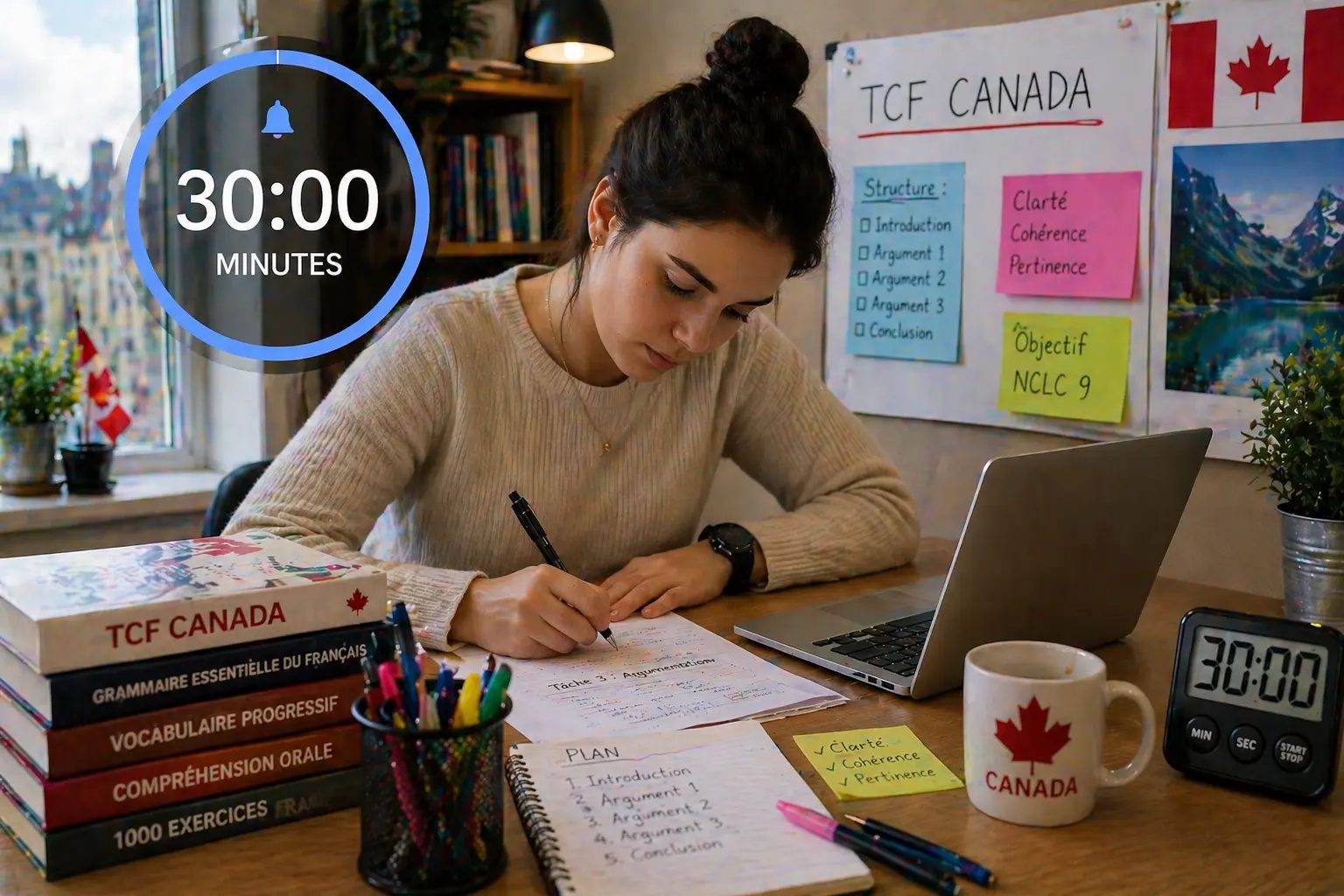
Task 2 should take about 18 to 20 minutes: 2 minutes to plan your four blocks, 13 to 15 minutes to write, and 3 minutes to reread. If you are sitting a computer-based session, practise typing French accents quickly beforehand, since hunting for "é" and "è" can cost several minutes.
A 4-week Task 2 training routine:
- Week 1: Tense contrast drills (imparfait vs passé composé) with 10 short narratives
- Week 2: Two full Task 2 texts per week, untimed, focusing on the four-block structure
- Week 3: Three timed texts per week (20 minutes), external correction
- Week 4: Full Writing simulations (3 tasks in 60 minutes) to lock in timing
To reinforce grammar, see the 20 grammar structures that separate NCLC 7 from NCLC 10, and for the overall Writing strategy, our Written Expression mastery guide. You can also check grammar automatically with BonPatron or look up usage questions on the OQLF Vitrine linguistique, a Quebec-based reference that also familiarises you with Canadian usage.
Your Task 2 Checklist
Before moving on to Task 3, verify:
- Audience: The text addresses several readers, with a title or collective greeting
- Narration: At least one clear sequence in the past with correct tense contrast
- Impressions: At least two precise feelings with reasons
- Closing: A recommendation or question to readers
- Length: Between 120 and 150 words
Treat Task 2 as a scoring opportunity rather than a formality. With a reusable blueprint and solid tense control, it becomes the most predictable part of your Writing section, and a stable 13/20 here makes the NCLC 8 or 9 overall target far more realistic.


0 Commentaires
aucun commentaire
Soyez le premier a partager votre avis !