-
Auteur :
 Antoine C.
- Apr 29, 2026
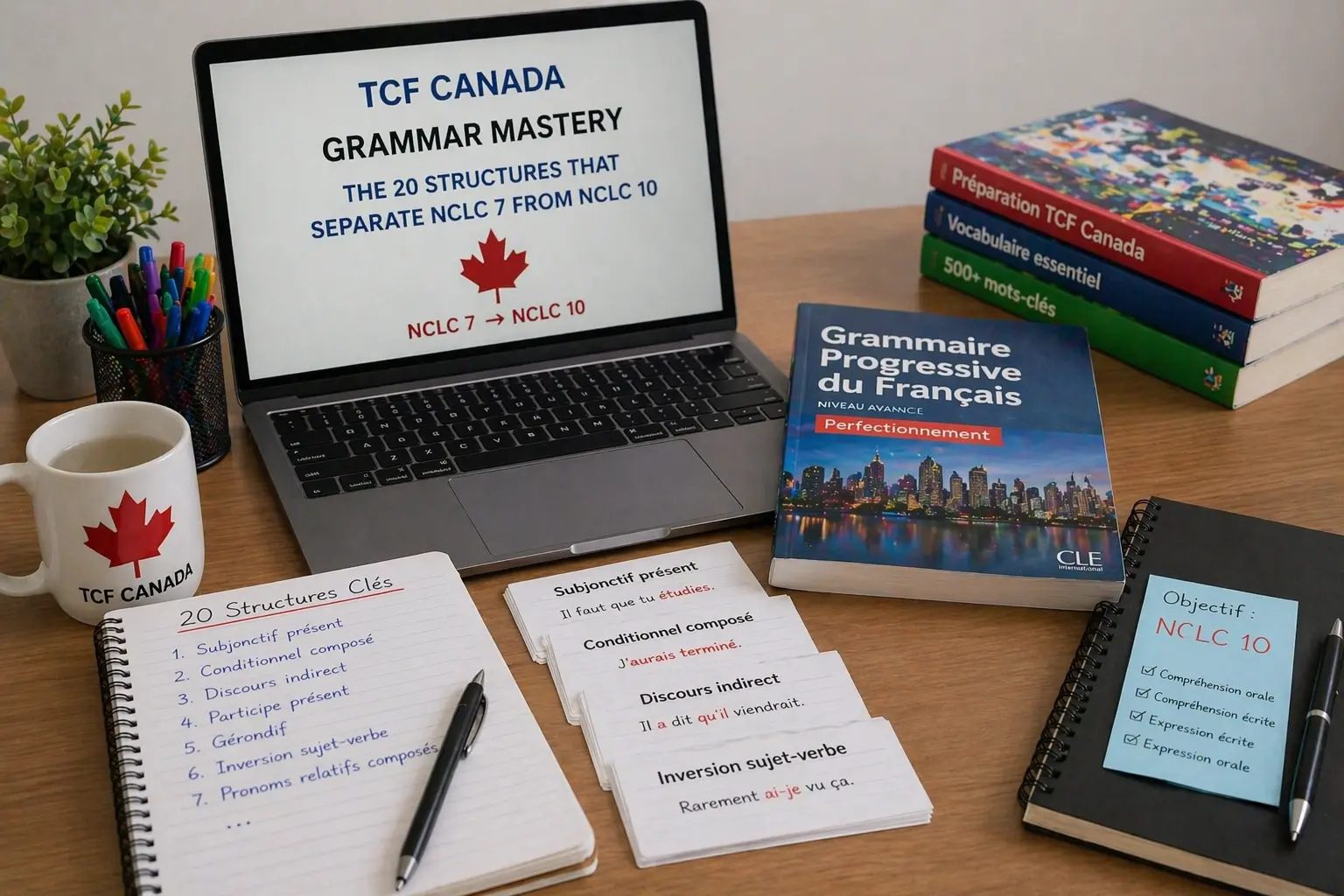
A persistent misconception among TCF Canada candidates is that grammatical perfection is the goal. It isn't — and pursuing it is actually counterproductive. France Éducation International's official marking rubrics for written expression reward range combined with accuracy: the breadth of structures a candidate attempts, not how cautiously they avoid mistakes. A composition with one or two minor slips but rich in nominalisations, concessive clauses and passive constructions consistently outscores a safe, error-free but syntactically flat piece that never ventures beyond simple subject-verb-object sentences.
Our article on TCF Canada Writing: 7 Structures That Guarantee NCLC 9 identifies the structures to deploy. This article provides the complete picture — what to eliminate, what to master, what Canadian French features to recognise in comprehension texts, and how to build a four-week correction plan that moves your production from B2 to C1 in a measurable, structured way.
The examiner's lens: Markers look for evidence that you control complex structures intentionally, not that you avoid them out of uncertainty. A single correctly placed subjunctive after bien que signals NCLC 9. The same subjunctive misplaced — after après que, for instance — signals NCLC 5. Avoidance signals nothing positive at all.
Part 1 — The 7 Eliminating Errors: Fix These Before Everything Else
Error 1 — Passé Composé vs Imparfait: The Single Costliest Confusion
This is statistically the most frequent error in TCF Canada writing scripts, across all candidate nationalities. It is especially common among speakers of Arabic, English and Spanish, whose languages handle past time differently.
| ❌ Common Error | ✅ Correct Form | The Rule |
|---|---|---|
| "Quand j'ai travaillé là-bas, mes collègues ont été sympathiques." | "Quand je travaillais là-bas, mes collègues étaient sympathiques." | Ongoing state or habit = imparfait |
| "Il faisait froid et soudain il neigeait." | "Il faisait froid et soudain il a neigé." | Single completed event = passé composé |
| "Chaque matin, il a bu son café." | "Chaque matin, il buvait son café." | Habitual repetition = imparfait |
Quick test before writing any past-tense verb: Ask "Was this a state or habit that lasted over time, or a single event that happened at a specific moment?" State or habit → imparfait. Single event → passé composé. Apply this question to every past-tense verb during your writing revision phase.
Error 2 — Past Participle Agreement with Avoir
The rule: when avoir is the auxiliary, the past participle agrees with the direct object — but only if the direct object appears before the verb in the sentence.
- ❌ "Les documents que j'ai envoyé..." → ✅ "Les documents que j'ai envoyés..." (COD before verb = agreement)
- ❌ "Je les ai reçu hier." → ✅ "Je les ai reçus." (les is masculine plural and precedes the verb)
- ✅ "J'ai envoyé les documents." (COD after verb = no agreement required)
Error 3 — Wrong Mood after Conjunctions
| Conjunction | Required Mood | Example |
|---|---|---|
| bien que / quoique | Subjunctive | "Bien qu'il soit qualifié, il n'a pas été retenu." |
| pour que / afin que | Subjunctive | "Pour qu'elle comprenne, il faut être clair." |
| avant que | Subjunctive | "Avant qu'il ne parte, prévenez-le." |
| après que | Indicative (frequently misused with subjunctive) | "Après qu'il est parti, nous avons discuté." |
| si (condition) | Indicative — never conditional or subjunctive | "Si tu viens, appelle-moi d'abord." |
Errors 4–7: Four Additional Eliminating Mistakes
Error 4 — Incomplete negation in formal writing: "C'est pas possible" → "Ce n'est pas possible." The ne is mandatory in any written TCF Canada production.
Error 5 — Conditional tense after si: "Si vous viendriez…" is structurally impossible in French. The si clause takes an indicative tense (present, imperfect or pluperfect), never conditional.
Error 6 — Capitalising nationality adjectives: Adjectives of nationality are always lowercase in French — un citoyen canadien. Nouns of nationality take a capital — un Canadien est arrivé. The distinction is systematic and frequently tested in reading comprehension.
Error 7 — Missing politeness conditional in formal emails: "Je veux savoir si..." is too direct for TCF Canada professional correspondence. The expected register uses: "Je souhaiterais savoir si..." or "Je vous serais reconnaissant(e) de bien vouloir m'indiquer..."
Part 2 — The 7 Syntactic Structures That Signal C1 Level
Structure 1 — Nominalisation
Converting verbs and adjectives into nouns is one of the clearest single markers of sophisticated written French. It is characteristic of journalistic, administrative and academic registers — all of which appear in TCF Canada documents.
High-value nominalisations for TCF Canada writing contexts:
- "améliorer" → "l'amélioration de" (housing policy, environmental texts)
- "développer" → "le développement de" (economic and social texts)
- "reconnaître" → "la reconnaissance de" (immigration and rights texts)
- "augmenter" → "une hausse de / une augmentation de" (financial texts)
- "décider" → "la décision de" (administrative texts)
Before: "The government decided to increase the housing budget."
After: "The government's decision to increase the housing budget reflects a significant shift in social policy priorities."
Structures 2–7 — Advanced Syntactic Constructions
| Structure | Example | NCLC Signal |
|---|---|---|
| Participial clause | "Ayant examiné votre dossier avec soin, nous sommes heureux de vous informer..." | C1 |
| Emphatic construction | "C'est précisément la régularité du travail qui explique la réussite." | B2–C1 |
| Argumentative concession | "Si l'on peut admettre que..., il n'en reste pas moins que..." | C1 |
| Complex relative clause | "...les critères auxquels je dois satisfaire" / "...la personne à laquelle j'ai parlé" | C1 |
| Formal causality | "en raison de", "compte tenu de", "par conséquent", "dans l'optique de" | B2–C1 |
| Professional passive voice | "Votre candidature a été examinée avec la plus grande attention." | B2 |
| Double-complement structure | "Il convient à la fois de reconnaître X et de tenir compte de Y." | C1 |
Part 3 — Six Canadian French Features You Must Recognise
As the Life in Canada: Cultural and Linguistic Context article explains, Canadian institutional French has legitimate features that differ from European standard. Misreading these as errors leads directly to wrong answers in reading comprehension questions.
| Canadian Official French | European French Equivalent | Context |
|---|---|---|
| En autant que | Dans la mesure où / Pourvu que | Administrative and legal texts |
| Présentement | Actuellement / En ce moment | All registers |
| Opportunité (broader usage) | Occasion / Possibilité / Chance | Professional texts |
| Bienvenue (in response to merci) | De rien / Il n'y a pas de quoi | Dialogue transcriptions |
| Définitivement | Absolument / Tout à fait | Oral documents |
| Après que + indicatif | Normatively correct but often hypercorrected to subjunctive | Formal written texts |
"The phrase 'En autant que votre dossier soit complet' looked like a grammar error to me. I nearly flagged it as an error in a reading question. Understanding that this is standard Quebec institutional French saved me from a wrong answer — and probably two more like it later in the same session." — Youssef, IT engineer from Tunis, now in Ottawa
Your Four-Week Grammar Mastery Plan
Week 1: Diagnose the 7 eliminating errors using a free-production text. Work one hour daily on your two most frequent errors via targeted exercises on Orthodidacte.com and FLE.fr. Priority: passé composé vs imparfait distinction.
Week 2: Build structures 1–4 (nominalisation, participial clause, emphatic construction, argumentative concession) — write one 80-word paragraph daily integrating at least two of these structures.
Week 3: Build structures 5–7 (complex relatives, formal causality, professional passive) + assimilate the six Canadian French grammatical features. Produce daily writing tasks of 120 words under timed conditions.
Week 4: Full integration — three complete timed writing tasks per week (8 + 15 + 30 minutes) + 7-error checklist applied after each + 7-structure count to verify syntactic range is growing.
For the writing methodology that transforms these grammatical tools into complete exam-ready compositions, see our TCF Canada Writing Methodology and High-Performance Techniques guide and our Effective Techniques for Writing at TCF Canada article.





0 Commentaires
aucun commentaire
Soyez le premier a partager votre avis !