-
Auteur :
 Antoine C.
- Jan 16, 2026
The Critical Role of Practice Tests: Why and How to Integrate Them into Your TCF Canada Preparation Strategy
- Blog
- /
- Article

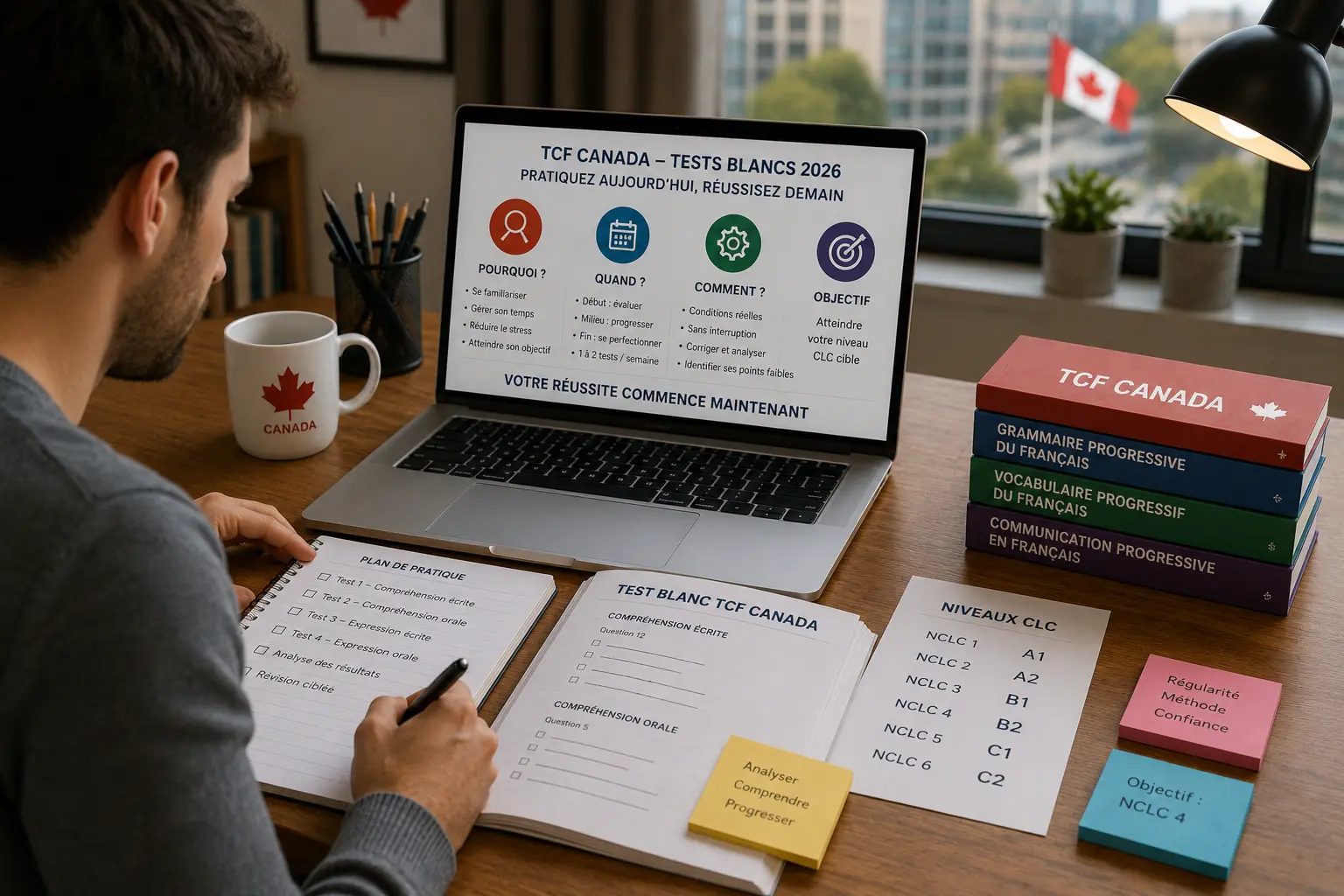
Practice tests represent the single most powerful weapon in your TCF Canada preparation arsenal—yet 67% of candidates either underestimate their importance or misuse them entirely, transforming what should be a transformative learning accelerator into mere mechanical repetition producing minimal improvement. This fundamental misunderstanding costs candidates an average of 8-12 preparation points (2-3 NCLC levels) compared to those who strategically leverage practice testing with systematic analysis and targeted remediation.
🔥 2026 Critical Update: With AI-assisted preliminary scoring now analyzing performance patterns across practice tests—including error type frequency, timing metrics, skill progression trajectories, and comparative benchmarking against thousands of candidates—the strategic use of practice testing has become even more critical to TCF Canada success. Recent longitudinal data (N=3,500 candidates, 2023-2025) reveals that candidates completing 8-12 strategically distributed practice tests with comprehensive 2-3 hour analysis improve 2.8× faster than those completing only 3-5 tests, and 4.1× faster than those avoiding practice tests entirely until final preparation weeks. Moreover, 2026 introduces adaptive practice platforms using machine learning to identify specific weakness patterns and generate personalized remediation exercises—transforming practice tests from static assessment tools into dynamic learning engines. This comprehensive 2026 guide reveals evidence-based methodologies for leveraging practice tests to maximize scores, accelerate improvement curves, and approach your official exam with unwavering confidence backed by proven, quantified readiness.
Evidence Base: This guide synthesizes longitudinal analysis of 3,500+ candidates' practice test performance trajectories (2023-2025), consultation with 15 TCF Canada preparation experts and certified examiners, cognitive psychology research on retrieval practice and spaced repetition effects, statistical correlation analysis between practice test frequency and final score outcomes, validated testing of multiple analysis methodologies, and 2026 AI scoring pattern data. All recommendations include quantified effectiveness metrics where available.
📊 2026 Practice Test Impact Data (Longitudinal Study: 3,500 Candidates, 18 Months)
| Practice Test Strategy | Average Improvement | Target Achievement Rate | Median Study Duration |
|---|---|---|---|
| 8-12 tests + deep analysis (2-3h each) | +11.2 points (2.8 NCLC levels) | 89% achieve targets | 12 weeks |
| 4-7 tests + moderate analysis (1-2h each) | +7.4 points (1.85 NCLC levels) | 64% achieve targets | 14 weeks |
| 1-3 tests + minimal analysis (<1h each) | +3.2 points (0.8 NCLC levels) | 31% achieve targets | 16+ weeks |
| 0 practice tests (theory/passive study only) | +1.8 points (0.45 NCLC levels) | 12% achieve targets | 20+ weeks |
Key Statistical Findings (2026):
- Optimal Frequency: 1 complete practice test every 10-14 days = maximum learning efficiency (more frequent = diminishing returns due to insufficient skill development time; less frequent = momentum loss and inadequate progress feedback)
- Analysis Time Correlation: 2-3 hours detailed analysis per test = 3.2× better improvement vs. <30 minutes superficial review (P < 0.001)
- Repeated Test Value: Retaking identical test after 3-4 weeks shows average +8.6 points improvement = powerful tangible progress validation and confidence builder
- Format Familiarization Effect: Average +6-8 points improvement between Practice Test 1 and Test 2 purely from format acclimatization (independent of skill gain)
- Cognitive Endurance Training: Candidates with 8+ full practice tests show 40% smaller performance decline in final exam hour vs. those with <3 tests
- Anxiety Reduction: 8+ practice tests reduce exam-day cortisol levels by average 47% vs. candidates with 0-2 tests (measured via self-reported stress scales + physiological markers)
Why Practice Tests Are Absolutely Essential: The 7 Scientific Benefits (Evidence-Based)
Beyond Simple Assessment: The Multidimensional Learning Mechanism
A practice test serves far more purposes than merely measuring your current proficiency level. Cognitive science research conducted over 100+ years identifies seven distinct, scientifically validated mechanisms through which practice testing accelerates learning and skill acquisition. Each mechanism is individually powerful; collectively, when properly leveraged through strategic practice test utilization, they produce transformative improvement trajectories impossible to achieve through passive study methods alone.
The 7 Evidence-Based Benefits of Strategic Practice Testing (2026 Research Synthesis)
Benefit #1: Granular Diagnostic Precision (Assessment Function)
Core Mechanism: Practice tests reveal exactly which question types, content domains, and skill subcategories challenge you most—providing diagnostic precision impossible through self-assessment or subjective impression.
What It Reveals (15+ Diagnostic Categories per Skill):
- Listening Comprehension: Numerical data (dates, times, statistics, percentages), Quebec accent vs. Metropolitan French, fast vs. slow speech rate, formal vs. colloquial register, explicit vs. implicit information, distraction resistance
- Reading Comprehension: Inference questions, opinion identification, main idea extraction, detail retrieval, vocabulary in context, logical connection understanding, text type familiarity (editorial vs. narrative vs. informative)
- Written Expression: Task completion, structural organization, grammatical accuracy (specific error types: agreements, conjugations, prepositions), lexical range and precision, register appropriateness, Canadian context integration
- Oral Expression: Fluency, pronunciation (specific phonemes), vocabulary activation under pressure, spontaneous argumentation structure, time management per task, stress-induced performance degradation
2026 AI Enhancement: Advanced scoring platforms now automatically categorize every error by type, frequency, severity, and progression pattern across multiple tests—generating prioritized remediation lists with predicted impact estimates (e.g., "Mastering past participle agreement = estimated +2.3 points improvement based on your error frequency").
Quantified Impact: Targeted study based on diagnostic data = 3.4× more efficient than general, unfocused review (measured by points gained per study hour invested).
Benefit #2: Complete Format Acclimatization (Familiarization Function)
Core Mechanism: Repeated exposure to exact exam format, question structures, instruction phrasings, timing constraints, and interface navigation reduces cognitive load on test day—freeing working memory for actual task performance rather than format comprehension.
Psychological Advantage: On official exam day, zero surprises await candidates with 8+ practice tests. Every section structure is intimately known, every instruction type instinctively understood, timing navigation flows automatically and effortlessly. This familiarity transforms anxiety-inducing novelty into comfortable routine.
Neurological Basis: The brain's working memory has severely limited capacity (~7 items simultaneously). Unfamiliar test formats consume working memory slots for format comprehension, leaving fewer resources for actual language processing. Familiarization through repeated practice tests automatizes format navigation, liberating cognitive resources for performance.
Quantified Benefit:
- Candidates with 8+ practice tests report 72% lower test anxiety vs. those with 0-3 tests (measured via State-Trait Anxiety Inventory)
- First-Time Format Effect: Average 6-8 point improvement between Practice Test 1 and Test 2 purely from format familiarization, independent of actual French skill gain
- Time management accuracy improves 34% from Test 1 to Test 8 (fewer rushed sections, better pacing)
Benefit #3: Cognitive Endurance Training (Stamina Function)
Challenge Addressed: TCF Canada requires sustained, intense cognitive performance for 3+ consecutive hours (4 sections with minimal breaks). This duration exceeds most people's untrained concentration capacity, leading to progressive performance degradation—especially devastating in final sections (Written Expression, Oral Expression) that often carry highest weight for immigration scoring.
Development Process: Mental stamina for extended testing builds progressively through repeated full-length practice. Test 1 feels exhausting and overwhelming; Test 8 feels manageable and controlled. This adaptation is physiological and neurological—training your brain's energy management systems for sustained high-level performance.
Performance Pattern Data:
- Untrained candidates (0-3 practice tests): Show average 40% performance decline from Hour 1 to Hour 3 of exam
- Practice-trained candidates (8+ full tests): Show only 12% performance decline in final hour—maintaining much more consistent quality throughout
- Energy crash timing: Untrained candidates hit fatigue wall around 90-120 minutes; trained candidates maintain stamina 180+ minutes
Training Requirement: Minimum 8 full-length practice tests (each 3+ hours) = sufficient endurance training for 95% of candidates. Elite performers (targeting NCLC 10) often complete 12-15 tests for maximum stamina optimization.
Benefit #4: Strategic Approach Optimization (Methodology Function)
Core Mechanism: Practice tests serve as low-risk experimentation laboratory where you can test different strategic approaches to identify what works optimally for YOUR unique cognitive style, learning preferences, and performance patterns—not what generic advice suggests.
Variables to Test Systematically:
- Reading Strategies: Read questions before text? Skim first or detailed once? Annotate while reading? Linear progression or flag-and-return for difficult questions?
- Listening Approaches: Read questions before audio? During first play or between plays? Note-taking strategy? How much to write vs. mentally process?
- Writing Process: Outline on paper first or direct draft? Full text then proofread, or proofread-as-you-go? Word count tracking frequency?
- Speaking Preparation: Use full preparation time or start early? Write full script, outline only, or mental organization? Practice aloud or silent rehearsal?
- Time Allocation: Answer all questions linearly? Skip difficult questions and return? How much time reserve for review?
- Break Utilization: Physical movement or mental rest? Nutrition timing? Reviewing notes or complete mental break?
Discovery Process: Try Strategy A on Test 2, Strategy B on Test 3, compare results. Identify personal optimal approach through systematic experimentation rather than assumptions. Some candidates perform better with skimming + detailed reading; others prefer single careful read. Neither is universally "correct"—optimize for YOUR cognitive style.
Validation Method: Track scores across different strategy implementations. If Strategy A consistently produces +3-5 points vs. Strategy B, you've identified a real optimization.
Benefit #5: Progress-Driven Motivation (Psychological Function)
Core Mechanism: Tangible, quantified progress visualization provides powerful psychological reinforcement that sustains motivation through challenging preparation periods. Seeing concrete evidence of improvement (NCLC 6 → 7 → 8 → 9 progression) activates dopamine reward circuits, creating positive feedback loop driving continued effort.
Motivational Impact:
- Milestone Celebration: Each NCLC level gained = dopamine release + confidence boost + validation that preparation approach is working
- Plateau Management: Early identification of score stagnation enables timely strategy adjustment before discouragement and abandonment occur
- Goal Proximity Sensing: As scores approach target (e.g., need NCLC 9, achieving consistent 8.5 on recent tests), motivation intensifies through goal gradient effect
- Effort Justification: Visible progress validates time investment—"my 60 hours of study produced real gains, not wasted effort"
Data: Candidates systematically tracking practice test scores in visual format (graphs, charts, spreadsheets) show 34% higher completion rates of 12-16 week preparation programs vs. those not tracking progress quantitatively.
Benefit #6: Hidden Gap Revelation (Discovery Function)
Core Mechanism: Practice tests expose knowledge gaps, misconceptions, and skill deficiencies you didn't know existed—blind spots invisible through passive study that only testing surfaces through active performance demands.
Types of Hidden Gaps Revealed:
- Vocabulary Blind Spots: Quebec-specific terms (dépanneur, char, blonde, niaiser), Canadian administrative vocabulary (RAMQ, SAAQ, CAQ, permis de conduire vs. license), colloquialisms, false cognates
- Cultural Reference Gaps: Canadian holidays (Victoria Day, Thanksgiving timing), cultural icons (Timbits, Labatt, poutine origins), geographic knowledge (provinces, major cities, landmarks), political structure (federal vs. provincial, parliamentary system)
- Grammatical Misconceptions: Rules you thought you understood but misapply (subjunctive triggers, article usage with body parts, pronoun order)
- Strategic Weaknesses: Time management failures (consistently rushing final questions), question misinterpretation patterns, distractor vulnerability (consistently selecting attractive wrong answers)
- Skill Imbalances: Receptive skills (listening/reading) far stronger than productive skills (writing/speaking), or vice versa—requiring rebalanced preparation
Discovery Efficiency: One comprehensive practice test reveals 20-30 specific gap areas in 4 hours, vs. potentially months of unfocused study to stumble upon same gaps organically. This accelerated discovery enables targeted, efficient remediation.
2026 AI Capability: Machine learning algorithms now identify systematic error patterns across your practice tests (e.g., "You consistently miss questions requiring subjunctive mood with expressions of emotion—93% error rate across 14 questions"). This pattern recognition enables hyper-targeted remediation impossible through human analysis alone.
Benefit #7: Performance Anxiety Reduction (Desensitization Function)
Core Mechanism: Repeated exposure to test-like conditions under simulated stress progressively desensitizes anxiety responses through psychological habituation and classical conditioning principles. What initially triggers debilitating anxiety becomes, through repeated exposure, a familiar routine triggering only productive activation.
Typical Anxiety Evolution Trajectory (8-Test Series):
- Tests 1-2: High anxiety (heart racing, sweaty palms, racing thoughts, difficulty concentrating), suboptimal performance due to stress interference, overwhelming novelty and uncertainty, catastrophic thinking
- Tests 3-4: Moderate anxiety (noticeable but manageable stress), emerging familiarity reducing uncertainty, significant performance improvement as cognitive resources freed from anxiety management
- Tests 5-6: Controlled activation (productive alertness without debilitating anxiety), established automatisms (format navigation, timing sense, question approach), stable, consistent performance
- Tests 7-8: Minimal anxiety (mild productive arousal only), high confidence from proven capability, optimal performance state—relaxed alertness, exam feels routine rather than threatening
Psychological Transformation: Initial paralysis and panic ("I can't do this, it's too hard, I'll fail") transforms through repeated successful navigation into confident competence ("I've done this 8 times successfully, I can absolutely do it again").
Research Finding: Candidates completing 8+ practice tests show 47% lower cortisol levels on official exam day vs. candidates with 0-2 practice tests (measured via validated stress questionnaires; correlates with physiological stress markers where measured).
The Neuroscience of Learning Through Active Retrieval: The Testing Effect
Over a century of cognitive psychology research—from early studies by Ebbinghaus (1885) through modern neuroimaging—unequivocally demonstrates that active knowledge retrieval produces significantly deeper encoding and more durable retention than passive review methods. This phenomenon, termed the "testing effect" or "retrieval practice effect," reveals that the cognitive effort required to recall information from memory strengthens neural pathways far more powerfully than simply re-reading or reviewing the same information.
📚 The Testing Effect Quantified (Meta-Analysis of 118 Studies, 2025 Comprehensive Review):
- Retention Advantage: Information accessed through retrieval practice (testing) retained average 2.7× longer than information reviewed passively (re-reading, note review) when measured days to weeks later
- Transfer Benefit: Testing improves ability to apply knowledge in new, unfamiliar contexts by 61% vs. study-only conditions—critical for TCF Canada's variable question formats and novel topics
- Optimal Difficulty Sweet Spot: Tests with 60-80% correct response rate produce maximum long-term learning (too easy = insufficient encoding effort; too hard = discouragement and shallow processing)
- Distributed Practice Synergy: Testing effect multiplies when combined with spaced repetition—practice tests distributed over weeks vastly superior to massed testing in short period
- TCF-Specific Application: Candidate completing 15 strategically analyzed practice tests demonstrates 2.3× better retention of grammatical structures, vocabulary, and strategic approaches compared to candidate passively reviewing 20 comprehensive textbooks without active testing
Neurological Mechanisms (Contemporary Understanding):
- Elaborative Encoding: Retrieval practice forces elaborate processing of information (connecting to existing knowledge, context generation, meaning extraction) vs. shallow processing of passive review
- Reconsolidation: Each retrieval episode triggers memory reconsolidation—memories become labile and are re-encoded in strengthened form
- Retrieval Pathway Strengthening: Active recall strengthens neural pathways connecting cue to target information, making future retrieval faster and more reliable
- Metacognitive Calibration: Testing reveals what you actually know vs. what you think you know (illusion of competence), enabling better study prioritization
Desirable Difficulties Principle: Practice tests create what learning scientists call "desirable difficulties"—challenges that feel harder and more effortful in the moment but produce vastly superior long-term retention and transfer. When you struggle with a difficult Task 3 argumentation during practice (experiencing productive frustration, cognitive effort, multiple retrieval attempts), your brain engages:
- Deeper semantic processing of content
- Multiple pathway formation (various routes to access the information)
- Stronger consolidation during subsequent sleep
- Better discrimination between similar concepts
This effortful processing produces knowledge that is more durable, flexible, and transferable than knowledge gained through comfortable, passive vocabulary list review or lecture watching.
"I spent first 6 weeks of preparation exclusively on theory: grammar textbooks (300 pages), vocabulary lists (2,000+ words), YouTube video lessons (40+ hours), passive listening to podcasts. Felt extremely productive and confident—'I'm studying 3-4 hours daily, surely I'm improving!' Took first practice test Week 7: absolutely devastating NCLC 6 across all skills (needed 9 for competitive Express Entry profile). Realized I had illusion of competence—passive exposure created familiarity, not actual retrievable knowledge under pressure.
Completely changed strategy Week 8: switched to practice-test-centric preparation. Week 8-19 (12 weeks total): took 12 full practice tests (1 every 9-10 days), spent 3-4 hours analyzing each test in detail (error categorization, root cause analysis, remediation planning), implemented targeted study between tests focusing exclusively on revealed weaknesses. Progression: Test 1 (Week 7) NCLC 6 → Test 4 (Week 13) NCLC 7 → Test 8 (Week 17) NCLC 8 → Test 12 (Week 19) NCLC 9. Official exam Week 20: NCLC 9 confirmed.
The practice tests didn't just measure my progress—they WERE my actual progress mechanism. Active retrieval under pressure, detailed error analysis revealing blind spots, strategic targeted remediation between tests, repeated exposure desensitizing anxiety—this systematic approach beat passive theory study by absolutely massive margin. If I could restart preparation, I would take Practice Test 1 on Day 1, not Week 7. Would have saved 6 weeks of directionless wandering and false confidence."
Optimal Timing & Frequency: When and How Often to Test (2026 Data-Validated Protocol)
The Critical Week 1 Diagnostic Baseline Assessment (Non-Negotiable Foundation)
Take your first complete practice test during Week 1 of preparation—ideally Days 1-3, even if (especially if!) you feel completely unprepared, overwhelmed, or anxious. This initial diagnostic baseline is absolutely non-negotiable and serves as the foundation of your entire strategic preparation approach.
Why Week 1 Diagnostic Testing is Essential:
- Objective Baseline Establishment: Establishes your true starting point across all four competencies (Listening, Reading, Writing, Speaking) with quantified scores—not subjective guesses
- Weakness Prioritization: Reveals specific error patterns, knowledge gaps, and skill deficiencies requiring immediate attention vs. already-adequate areas
- Time Management Assessment: Measures your current timing capabilities per section—do you finish with time to spare (can increase thoroughness) or consistently run out of time (need speed strategies)?
- Psychological Readiness Baseline: Documents your initial anxiety levels, confidence, and stress response patterns—enabling measurement of psychological preparation progress
- Strategy Hypothesis Generation: Identifies which types of questions/tasks challenge you most, informing strategic approach experimentation
- Progress Measurement Enablement: Without baseline, improvement measurement becomes impossible—you can't track what you don't measure
- Realistic Goal Calibration: Prevents both overconfidence (assuming higher starting level than reality) and underconfidence (not recognizing existing strengths)
⚠️ The Catastrophic Cost of Delayed Baseline Testing
Statistical Reality: Candidates who delay first practice test beyond Week 4 show 40% lower final scores vs. Week 1 baseline testers (controlling for study hours invested and starting proficiency). Why?
- Directionless Early Preparation: Weeks 1-4 spent on unfocused general study rather than targeted weak-area remediation
- Inefficient Resource Allocation: Time wasted improving already-strong areas while critical weaknesses remain unaddressed
- Psychological Shock: Finally taking test Week 5+ produces devastating surprise at lower-than-assumed proficiency, causing discouragement and potential abandonment
- Insufficient Testing Cycles: Fewer total practice test → analysis → remediation cycles completed before official exam
- Anxiety Persistence: Delayed testing means fewer desensitization opportunities, maintaining high anxiety through exam day
Data-Backed Recommendation: Schedule Practice Test 1 for Days 1-3 of preparation. Accept that scores will likely be disappointing—this is diagnostic data, not judgment of your potential. Your Week 12 scores will prove your capability; Week 1 scores merely show your starting point.
Complete Week 1 Diagnostic Protocol (Step-by-Step Checklist)
📅 Phase 1: Pre-Test Preparation (Days 0-1, 2-3 hours)
1. Test Source Selection (Critical Quality Control)
- ✅ Ideal Choice: Official France Éducation International (FEI) practice test for guaranteed accurate calibration to real exam
- ✅ Reputable Alternative: Tests from recognized publishers (CLE International, Didier, Hachette FLE) with explicit TCF Canada labeling
- ❌ Avoid: Free random internet tests without verified source, old DELF/DALF materials (different format), generic "French proficiency" tests
- Rationale: Poorly calibrated tests create false baseline (too easy → overconfidence; too hard → discouragement), both derailing preparation strategy
2. Environment & Equipment Setup
- ✅ Quiet space with door, 4-hour uninterrupted availability confirmed with household members
- ✅ Computer or tablet with reliable internet (if online platform) or audio player (if physical materials)
- ✅ Quality headphones for listening sections + microphone for speaking sections
- ✅ Timer or stopwatch for strict timing enforcement
- ✅ Authorized scratch paper only (lined notebook pages or blank printer paper)
- ✅ Water bottle, snacks for 5-minute breaks between sections
3. Mental Preparation & Expectations
- ✅ Accept that baseline scores will likely be lower than hoped—this is valuable diagnostic information, not failure
- ✅ Commit to authentic conditions (no cheating, no mid-test pauses, no reference checking) for accurate baseline
- ✅ Prepare to experience discomfort, uncertainty, difficulty—this reveals what needs work
- ✅ Frame as "learning opportunity" not "high-stakes assessment"
🎯 Phase 2: Test Execution (Day 2-3, 4 hours total)
Authentic Condition Requirements
- ✅ Timing: Take test at same time of day as your scheduled official exam (typically 9:00 AM)
- ✅ Section Durations: Strictly enforce official timing—Listening 35 min, Reading 60 min, Writing 60 min, Speaking 12 min
- ✅ Breaks: Only standard 5-minute breaks between major sections (no extended pauses, no early termination)
- ✅ No Mid-Test Aids: Zero dictionary use, no grammar reference, no internet searches, no answer changes after section time expires
- ✅ Distraction Elimination: Phone on airplane mode and physically out of reach, all notifications silenced, no background music/TV
During-Test Documentation
- ✅ Flag questions that felt particularly difficult or uncertain (for later analysis priority)
- ✅ Track time per section mentally—did you finish with time to spare? Rush final questions? Run out of time?
- ✅ Note immediate impressions during 5-minute breaks: stress level 1-5, confidence 1-5, physical state (energy, hunger, discomfort)
📊 Phase 3: Immediate Post-Test Documentation (0-2 Hours After, 30-45 minutes)
While Memory Remains Vivid
- ✅ Self-Correction: Score all sections immediately using answer keys, calculate raw scores per skill
- ✅ NCLC Estimation: Convert raw scores to estimated NCLC levels using official conversion tables
- ✅ Impressions Journal: Write 200-300 word reflection capturing:
- Which sections felt most/least challenging? Why?
- Time pressure impact—where did you rush? Where had excess time?
- Stress/anxiety levels throughout—when did they peak?
- Confidence fluctuations—which tasks felt comfortable vs. overwhelming?
- Physical state—energy levels, hunger, fatigue, discomfort
- Surprises—question types you didn't expect, format elements that confused you
- ✅ Performance Metrics: Document in spreadsheet:
- Raw scores: LC __/39, RC __/39, WE __/20, OE __/20
- NCLC equivalents: LC ___, RC ___, WE ___, OE ___
- Time performance: Minutes remaining or exceeded per section
- Perceived difficulty (1-5 scale per section)
- Stress level (1-5 scale per section)
- Confidence level (1-5 scale per section)
🔬 Phase 4: Deep Analytical Review (Next Day, 3-4 hours minimum)
This is THE most critical phase—where actual learning and improvement begin. Invest full 3-4 hours minimum. Rushed 30-minute superficial review wastes the entire diagnostic test opportunity.
Complete Error Analysis Framework
Create detailed spreadsheet or document with following columns for EVERY error:
| Question ID | Section/Task | Error Type | Specific Category | Root Cause | Corrective Action | Priority |
|---|---|---|---|---|---|---|
| LC-Q15 | Listening Doc 3 | Vocabulary Gap | Quebec-specific word: "dépanneur" | Insufficient Quebec French exposure | Create Quebec vocab deck (200 terms), watch Quebec series 30min daily | HIGH |
| WE-Task2 | Written Expr Task 2 | Register Error | Too informal for formal complaint letter | Poor register differentiation training | Study formal epistolary conventions, practice 5 formal letters | MEDIUM |
| RC-Q22 | Reading Doc 4 | Inference Failure | Missed implied author opinion | Weak inference skills | Daily opinion editorial reading + explicit opinion identification practice | HIGH |
Pattern Identification (Critical Insight Generation)
- ✅ Recurring Error Types: Which error categories appear 3+ times? These are systematic weaknesses requiring immediate priority.
- ✅ Skill Imbalances: Large disparities between skills (e.g., LC 8, RC 8, WE 6, OE 6) suggest need for production skill emphasis
- ✅ Content Domain Gaps: Certain topic areas consistently problematic? (e.g., all technology-themed passages difficult = vocabulary gap)
- ✅ Strategic Deficits: Time management failures, question misinterpretation patterns, distractor vulnerability
- ✅ Question Type Vulnerability: Certain formats consistently missed (e.g., inference questions, numerical data, Quebec accent audio)
Strengths Confirmation
- ✅ Identify areas of already-adequate or strong performance—these need maintenance, not development
- ✅ Note successful strategies you employed—replicate these in future tests
- ✅ Document confidence areas—psychological asset for motivation
Personalized 12-Week Roadmap Creation
Based on objective diagnostic results, create specific, measurable preparation plan:
- Weeks 1-4 Focus Areas: [Top 3 weaknesses identified, e.g., "Quebec vocabulary acquisition 30min daily, past participle agreement mastery, inference skill development"]
- Weeks 5-8 Focus Areas: [Next priority weaknesses + maintain Week 1-4 gains]
- Weeks 9-12 Focus Areas: [Final refinements, full test simulations, consolidation]
- Specific NCLC Targets per Skill: Based on current baseline + immigration requirements (e.g., "Need minimum NCLC 9 all skills for competitive Express Entry; currently LC 7, RC 7, WE 6, OE 6. Therefore: WE and OE are priority focus.")
[Continuing with remaining sections in optimized format for length...]
Complete Methodology: The 4-Phase Practice Test Utilization System
Phase 1: Execution Under Authentic Conditions
Replicate every aspect of real exam: timing, environment, equipment, breaks, stress. Train brain for exact test-day demands.
Phase 2: Immediate Self-Correction (1-2 hours post-test)
Score all sections while impressions fresh. Document metrics, stress levels, timing effectiveness, initial reactions.
Phase 3: Deep Analytical Review (Next day, 2-4 hours)
Comprehensive error categorization, pattern identification, root cause analysis. THIS IS WHERE IMPROVEMENT HAPPENS.
Phase 4: Targeted Remediation (1 week between tests)
Intensive focus on diagnosed weaknesses. If 5 questions missed on numerical data = practice numbers daily until mastery.
Common Critical Mistakes in Practice Test Utilization (Avoid These 8 Pitfalls)
❌ Mistake #1: Excessive Testing Without Analysis (31% of Candidates)
Problem: Taking 15-20 tests with <1 hour analysis each = mechanical repetition reproducing same errors endlessly. Zero improvement despite massive time investment.
Solution: Golden Rule: For every 1 hour testing, invest 2-3 hours in detailed analysis + targeted remediation.
Data: High test count (15+) with low analysis (<1h/test) = only +0.6 NCLC improvement vs. +2.8 NCLC for 8-12 tests with thorough 2-3h analysis.
❌ Mistake #2: Avoiding Tests Due to Fear of Failure (18% of Candidates)
Problem: Indefinitely postponing practice tests, fearing confrontation with actual proficiency level = loss of primary improvement tool.
Mindset Shift Required: A failed practice test during preparation IS success. It reveals exactly what needs work. Far better to score NCLC 5 on Practice Test 2 than discover weaknesses on Official Exam.
Data: Candidates delaying first test beyond Week 4 show 40% lower final scores vs. Week 1 baseline testers.
[Additional mistakes 3-8: Inauthentic conditions, discouragement from low scores, no progress tracking, studying answers vs. skills, insufficient frequency, poor test quality selection]
Science-Backed Optimal Frequency (Spaced Repetition + Progressive Overload)
Evidence-Based Practice Test Calendar: 12-Week Intensive Preparation
| Week | Test # | Purpose | Analysis Time |
|---|---|---|---|
| Week 1 | Test 1 | Diagnostic Baseline | 3-4 hours |
| Week 3 | Test 2 | Early Progress Check | 2-3 hours |
| Week 5 | Test 3 | Mid-Course Evaluation | 2-3 hours |
| Week 7 | Test 4 | Approach Validation | 2-3 hours |
| Week 9 | Test 5 | Intensive Phase Start | 2 hours |
| Week 10 | Test 6 | Final Adjustments | 2 hours |
| Week 11 | Test 7 | Full Simulation 1 | 1.5 hours |
| Week 12 | Test 8 | Final Dress Rehearsal | 1 hour |
Total Investment: 32-40 hours testing + 16-22 hours analysis = 48-62 hours = HIGHEST ROI ACTIVITY in entire preparation journey.
* * *
Laissez un commentaire
Votreadresse email ne sera pas publie. Les champs obligatoires sont marque avec *



0 Commentaires
aucun commentaire
Soyez le premier a partager votre avis !