-
Auteur :
 Antoine C.
- May 15, 2026
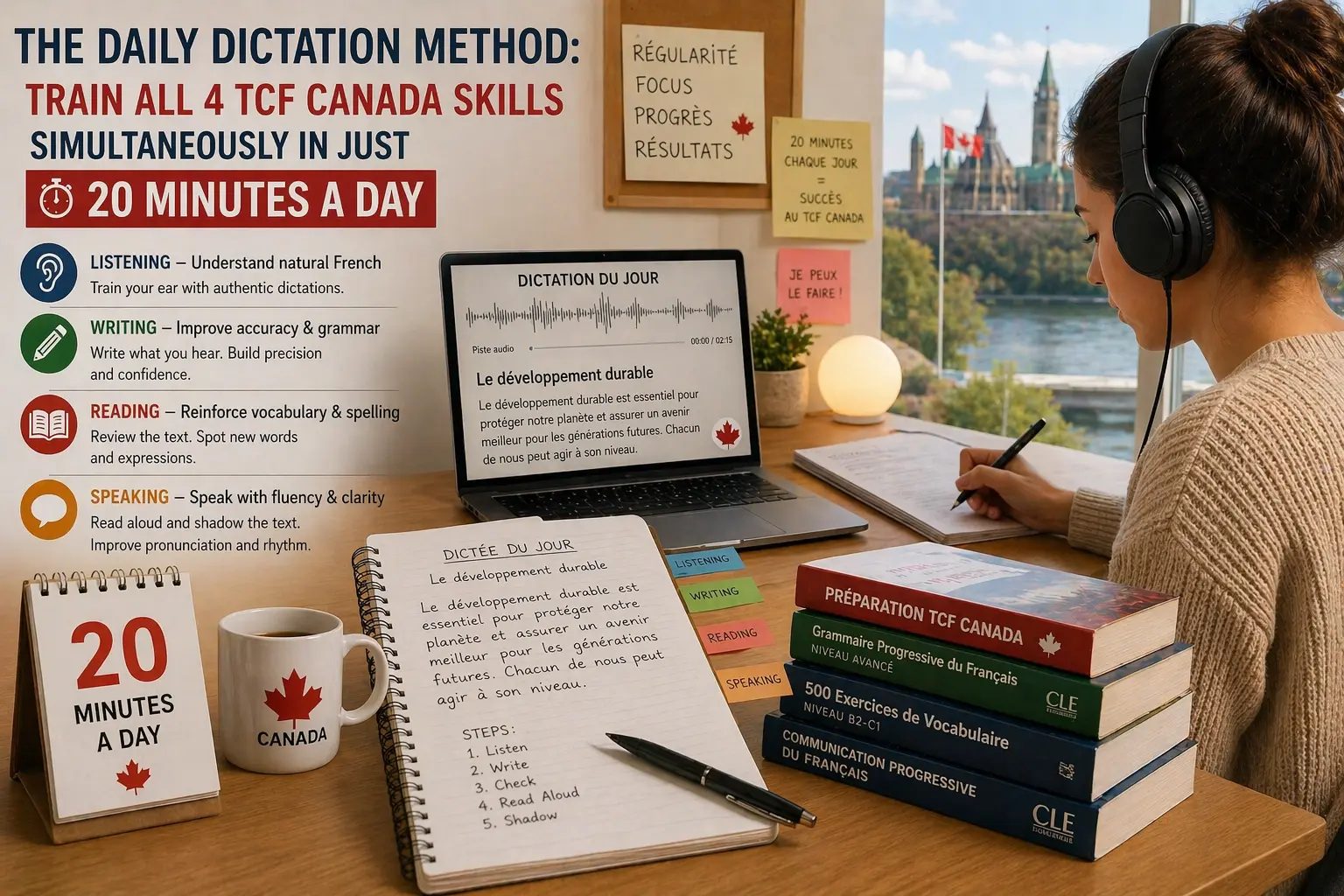
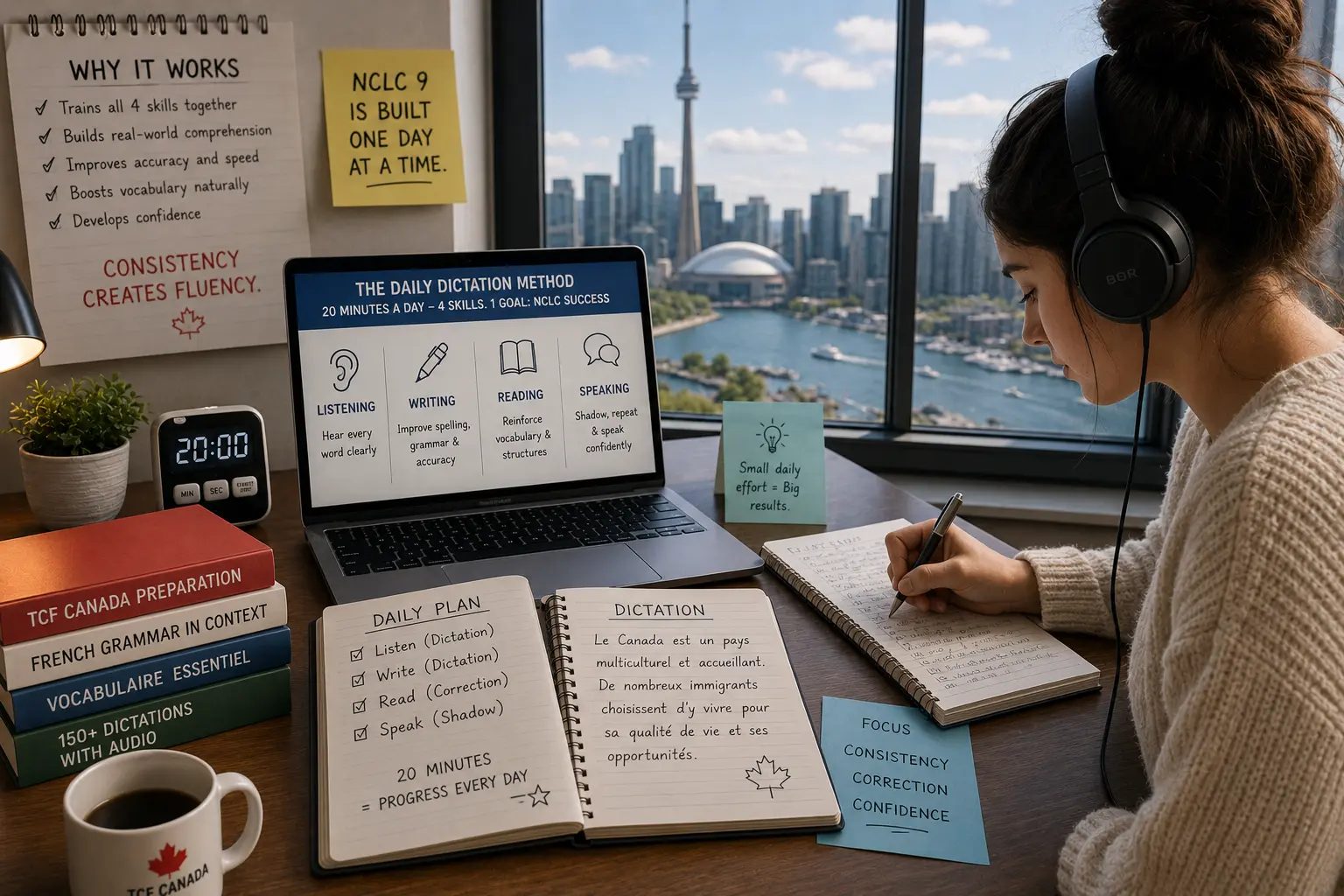
Dictation is one of the oldest exercises in French language education, and paradoxically one of the most powerful for TCF Canada preparation. Rediscovered by applied linguistics researchers in the last decade, "modern dictation" — distinct from the simple transcription exercise most candidates remember from school — is now recognised as a genuinely polyvalent method that trains listening comprehension, spelling, grammar awareness, syntactic recognition and oral prosody simultaneously. That is all four TCF Canada skills in a single 20-minute daily exercise.
Unlike the focused exercises in our Active Listening Strategies article or the writing structures in our NCLC 9 Writing Structures guide, dictation operates at the intersection of all four skills simultaneously — making it uniquely efficient for candidates with limited daily study availability.
Why dictation is the highest-efficiency exercise for time-limited candidates: A candidate who can only study 45 minutes per day gets more cross-skill benefit from 20 minutes of dictation plus 25 minutes of vocabulary review than from 45 minutes of any single-skill exercise. The simultaneous activation of four distinct neural networks in one session creates learning integration that sequential skill work cannot replicate.
The Three Types of Modern Dictation for TCF Canada
Type 1 — Thematic Dictation (Vocabulary + Comprehension + Grammar)
Uses a real Canadian French text from one of TCF Canada's eight thematic domains. The text is authentic, not purpose-built, and trains your ear to decode domain-specific vocabulary in its natural context while simultaneously activating spelling and grammatical awareness.
Best sources for thematic dictation texts:
- Radio-Canada news bulletins — health, society, environment, immigration sections (100–130 words, many transcripts available)
- RFI Savoirs — graded bulletins with audio and corrected transcripts for B1–C1 levels
- Official Canada.ca or Quebec.ca communiqués — authentic administrative register, domain-specific vocabulary
- TV5MONDE Apprendre — specifically designed for French language learners with automated correction
Type 2 — Grammar Dictation (Targeted Structural Correction)
A short text of 60 to 80 words specifically constructed (or selected) to concentrate your identified recurring error types. If your error tracker shows past participle agreements and subjunctive constructions as red-priority items, a grammar dictation packs both into a single short exercise. This type functions as a precision diagnostic and correction tool, not a general exposure exercise.
Sample grammar dictation text with multiple challenge points:
"Les dossiers que la commission a reçus ont été examinés avec soin. Bien que certains candidats aient fourni des documents incomplets, leurs demandes n'ont pas été rejetées. Il aurait cependant été préférable qu'ils transmissent l'ensemble des pièces requises dans les délais impartis."
Grammar challenges packed in: past participle agreement with avoir (reçus), passive voice (ont été examinés), subjunctive past (aient fourni), conditional past (aurait été), imperfect subjunctive — literary register (transmissent). Five high-value grammar points in 47 words.
Type 3 — Prosodic Dictation (Intonation + Oral Fluency)
After transcription and verification, the distinctive step: re-listen to the recording and read your corrected transcription aloud while simultaneously imitating the speaker's intonation, rhythm and stress patterns. This variant bridges dictation and shadowing — a hybrid exercise that trains writing accuracy and oral production quality in the same session.
The 6-Step Daily Protocol — 20 Minutes, Every Session
Step 1 — Global Listen (2 minutes): Listen to the 100–150 word text once without writing or taking notes. Grasp the general meaning, dominant register and main topic. No pausing, no rewinding — just listening.
Step 2 — Dictation (7 minutes): Re-listen phrase by phrase, pausing after each natural speech group. Transcribe each phrase before moving to the next. Write at natural pace — do not rush to guess words you missed; leave a blank and continue.
Step 3 — Self-correction Read-through (3 minutes): Read your transcription before seeing the answer. Check grammatical agreements (participles, adjectives, tenses), punctuation and capitalisation. Correct anything you identify independently — this self-correction step is cognitively different from verification and trains metacognitive accuracy awareness.
Step 4 — Verification Against Transcript (3 minutes): Compare your text word by word against the original. Highlight every discrepancy — even minor punctuation differences — without yet categorising them.
Step 5 — Error Categorisation (3 minutes): For each highlighted discrepancy, assign a category: Phonemic (you misheard the sound — the word was unfamiliar or phonologically ambiguous), Orthographic (you understood the word but spelled it incorrectly), or Grammatical (you heard and spelled correctly but applied the wrong agreement, tense or mood). Record each in your error tracker in the study log. Phonemic errors require listening training. Orthographic errors require spelling drills. Grammatical errors require targeted grammar work.
Step 6 — Imitation Read-aloud (2 minutes): Read the corrected text aloud while simultaneously listening to the original recording, imitating the speaker's intonation, rhythm and stress placements as closely as possible. Record yourself doing this once per week to track prosodic improvement over time.
Free Authentic Dictation Resources
| Resource | URL | Level | Format | Canadian Content? |
|---|---|---|---|---|
| RFI Savoirs Dictées | savoirs.rfi.fr | B1–C1 | Audio + corrected transcript | Partial |
| TV5MONDE Apprendre | apprendre.tv5monde.com | A2–C2 | Video + automated correction | Yes (Canadian segments) |
| Orthodidacte.com | orthodidacte.com | All levels | Interactive spelling exercises | No |
| Radio-Canada OHdio | radio-canada.ca/ohdio | B2–C2 | Authentic Canadian audio + transcripts | Yes — exclusively |
Your 8-Week Dictation Programme
Weeks 1–2: Thematic B1–B2 dictations (100 words, from RFI Savoirs or TV5MONDE) — identify dominant phonemic confusion patterns from 14 sessions of error categorisation
Weeks 3–4: Grammar dictations targeting your top 3 recurring error types — repeat each dictation 3 consecutive days before moving to a new one
Weeks 5–6: Canadian thematic dictations from Radio-Canada audio — authentic Canadian administrative and social vocabulary in natural register
Weeks 7–8: Prosodic dictations with full read-aloud imitation — integrate one session per week into complete exam simulation days
"I did a 20-minute dictation every morning before anything else. In six weeks, my past participle agreement errors had nearly disappeared — not because I studied grammar rules, but because I had transcribed and verified them 42 times. The dictation also trained my ear to hear sounds I was previously confusing: the distinction between 'é', 'è' and mute 'e' became clear through auditory exposure, not phonological study. My listening score improved by 8 TCF points." — Houda, pharmacist from Casablanca, now a permanent resident in Québec

0 Commentaires
aucun commentaire
Soyez le premier a partager votre avis !