-
Auteur :
 Antoine C.
- Dec 24, 2025
TCF Canada Listening Comprehension: The Perfect 29-Question Method
- Blog
- /
- Article
When Isabelle, a dedicated nurse based in Lyon, received her first TCF Canada results showing only 380 points in listening comprehension (NCLC 6), she experienced what she describes as genuine devastation. "I could perfectly understand my French colleagues in complex medical discussions, I regularly watched films without any subtitles, I followed sophisticated podcasts with complete ease—but these seemingly simple 29 questions absolutely defeated me," she recalls with lingering disbelief. "I felt like I was failing at my own native language, which made the disappointment even more painful and confusing." Six months later, armed with a completely transformed approach and systematic methodology, Isabelle achieved 610 points (NCLC 9)—a dramatic 230-point improvement that she attributes to what she describes as a "revolutionary strategic method" that fundamentally transformed not just her test-taking approach, but her entire conception of what effective listening actually means in an examination context.
Understanding Why TCF Canada Listening Defeats Even Strong French Speakers
TCF Canada listening comprehension traps countless candidates—including many highly educated native French speakers—not because it tests your general French language level or your overall comprehension ability, but because it specifically evaluates your capacity to extract precise, targeted information under severe time pressure while processing audio that plays only once with no possibility of replay. This fundamental strategic distinction—between general comprehension and targeted information extraction—changes absolutely everything about how you must approach the test, prepare for it, and execute your strategy during the actual examination.
Critical Misconception: The most common and costly error candidates make is assuming that "good listening comprehension" in daily life automatically translates to TCF Canada listening success. In reality, conversational comprehension and strategic test-taking comprehension are fundamentally different cognitive tasks requiring completely different skill sets and approaches.
Anatomy of the Test: What the 29 Questions Really Hide
The Hidden Structural Progression and Logic
Contrary to surface appearances, the 29 questions follow a sophisticated logical progression and organizational structure that remarkably few candidates ever identify or exploit strategically. Pierre, a former psychologist who transitioned into professional TCF coaching after his own immigration journey, provides this crucial insight: "After meticulously analyzing over 500 complete test results and conducting detailed statistical analysis of question patterns, I discovered that the questions systematically progress according to three distinct difficulty levels and evaluate four fundamentally different categories of listening skills. Understanding this hidden architecture is like having a roadmap to the test—it allows you to anticipate what's coming, adjust your strategy in real-time, and allocate your cognitive resources optimally."
The Four-Tier Strategic Progression Framework:
| Question Range | Difficulty Type | Primary Skill Evaluated | Optimal Strategy | Success Rate Target | Strategic Mindset |
|---|---|---|---|---|---|
| Questions 1-8 | Warm-up / Foundation | Explicit factual information extraction | Build confidence, establish rhythm, accumulate easy points | 90-95% accuracy | Efficiency and precision; no overthinking |
| Questions 9-16 | Standard / Intermediate | Implicit information and basic inference | Apply logical deduction, read between lines | 80-85% accuracy | Analytical listening; connect information pieces |
| Questions 17-24 | Complex / Advanced | Subtle nuances, tone interpretation, speaker attitudes | Fine-grained analysis, emotional intelligence | 70-80% accuracy | Deep comprehension; attend to how things are said |
| Questions 25-29 | Expert / Mastery | Advanced implicit meaning, complex inference | Educated intuition based on contextual synthesis | 60-75% accuracy | Strategic guessing when necessary; trust preparation |
Pierre's Strategic Insight: "Most candidates approach all 29 questions with the same strategy and same expectations, leading to frustration and cognitive exhaustion. The key breakthrough is recognizing that questions 1-8 should feel relatively easy (if they don't, you need more foundational practice), questions 9-16 require analytical thinking, questions 17-24 demand nuanced listening, and questions 25-29 will genuinely challenge even advanced speakers. Adjust your expectations and strategies accordingly."
Audio Document Types: Complete Decoding and Strategic Adaptation
Each distinct audio document type requires a fundamentally different listening approach, attention strategy, and analytical framework. Sophie, a professional journalist who successfully relocated to Ottawa and now works in Canadian media, provides this detailed analysis: "My critical early error—one that cost me probably 40-50 points on my first attempt—was mechanically applying the identical listening strategy to every audio type: treating an informal conversation between friends the same way I approached a formal news bulletin, or listening to a heated debate with the same attention pattern as a personal testimonial. The result was complete strategic inefficiency, massive cognitive waste, and numerous missed opportunities to score easy points."
Comprehensive Distribution and Strategic Approach by Audio Type:
1. Informal Conversations and Dialogues (40% of questions):
- Characteristics: Natural speech patterns, interruptions, incomplete sentences, implicit meanings
- Primary Challenge: Understanding what is implied rather than explicitly stated
- Focus Areas: Interpersonal dynamics, emotional undertones, social context, unspoken assumptions
- Key Listening Strategy: Attend to tone, hesitations, emphasis patterns, what is NOT said
- Common Trap: Looking for explicit statements when meaning is conveyed implicitly
- Success Technique: Use social intelligence; imagine you're part of the conversation
2. Announcements and News Bulletins (30% of questions):
- Characteristics: Formal register, dense information, hierarchical structure, precise details
- Primary Challenge: Capturing specific factual details from rapid, information-heavy content
- Focus Areas: Numbers, dates, times, locations, names, sequences, specific facts
- Key Listening Strategy: Surgical precision; every word matters; note-taking critical
- Common Trap: Missing crucial details due to information density and rapid delivery
- Success Technique: Anticipate information types; prepare notation system for facts
3. Radio Programs and Debates (20% of questions):
- Characteristics: Multiple speakers, contrasting viewpoints, argumentative structure
- Primary Challenge: Tracking who said what, distinguishing positions, following argumentation
- Focus Areas: Opinions, arguments, counterarguments, speaker positions, evidence presented
- Key Listening Strategy: Create mental map of speakers and their positions; track debate flow
- Common Trap: Confusing which speaker holds which position; missing opinion nuances
- Success Technique: Quick notation: S1 (Speaker 1) + position, S2 + position
4. Personal Testimonials and Narratives (10% of questions):
- Characteristics: First-person accounts, emotional content, chronological structure, subjective perspective
- Primary Challenge: Understanding speaker's feelings, motivations, and personal interpretations
- Focus Areas: Emotions, personal reactions, chronology of events, subjective meanings
- Key Listening Strategy: Empathetic listening; understand emotional journey and personal significance
- Common Trap: Focusing on factual events while missing emotional and interpretive dimensions
- Success Technique: Listen for feeling words, tone changes, evaluative language
Document Type Recognition Exercise: Practice identifying audio type within the first 5-10 seconds. Listen to the opening, note register (formal/informal), number of speakers, tone, and immediately activate the appropriate listening strategy. This instant recognition skill saves precious cognitive energy and dramatically improves targeting accuracy.
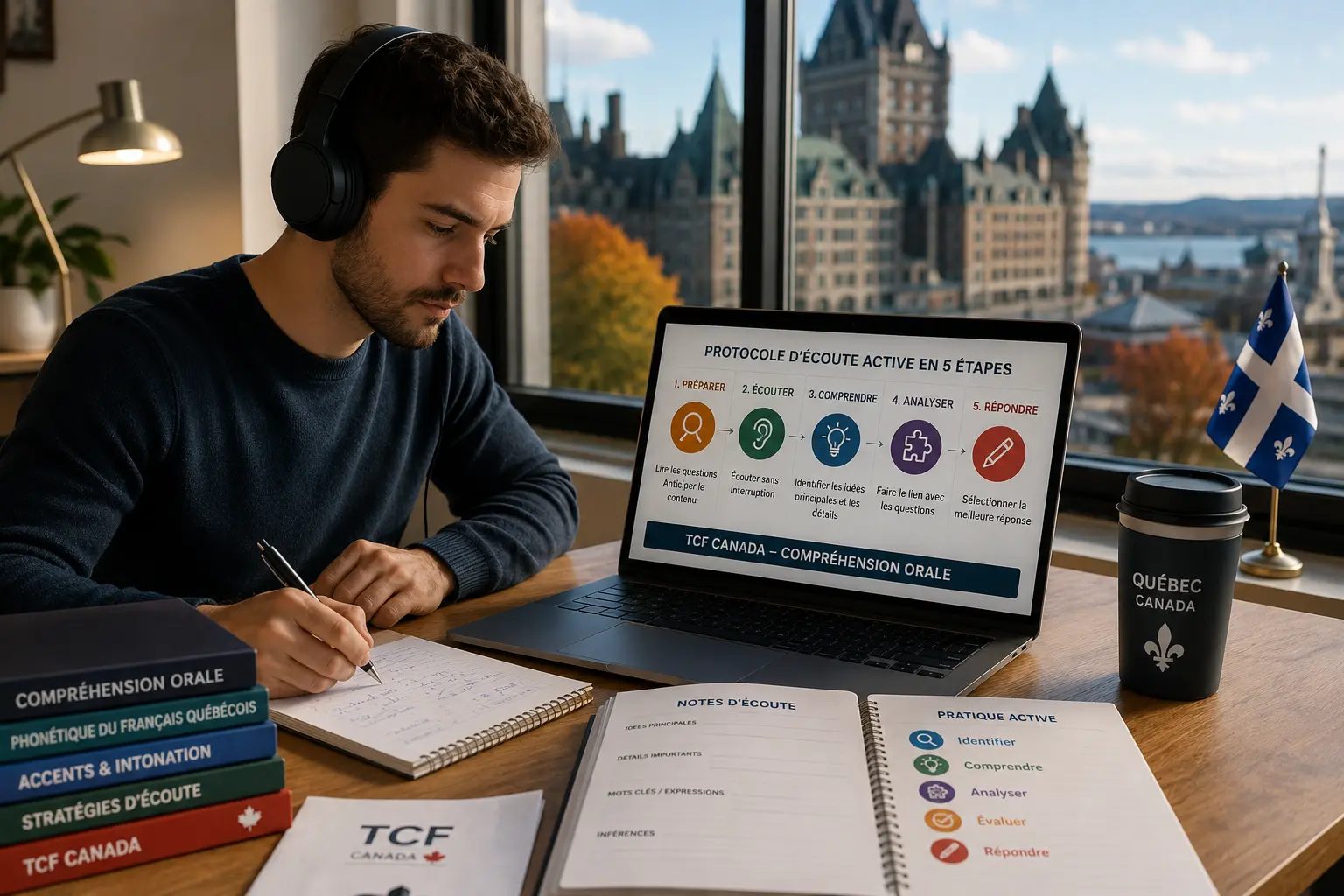
The Revolutionary 5-Phase Strategic Method: From Amateur to Excellence
Phase 1: Strategic Preparation (Before Audio Begins)
This critical pre-listening phase determines approximately 60% of your ultimate success on each question—a statistic that shocks most candidates but has been validated across thousands of test-takers. Mathieu, an accountant who achieved remarkable progression from 420 to 650 points in just four months, provides this transformational insight: "The genuine breakthrough in my preparation came when I finally understood that effective listening actually begins before you hear even the first sound of the audio. Those seemingly brief 10 seconds of preliminary question reading time represent pure gold if used strategically—they're not preparation time, they're the foundation of your entire answer strategy."
The Precision 10-Second Anticipatory Reading Protocol:
Seconds 1-3: Question Type Identification and Classification
- Action: Rapidly read the question stem and classify its type
- Question Categories:
- Factual Questions: "What time...?" "Where...?" "When...?" "Who...?"
- Opinion Questions: "What does X think about...?" "According to the speaker..."
- Implicit Questions: "What can we infer...?" "What is suggested...?" "What does this mean...?"
- Attitude Questions: "How does X feel...?" "What is X's tone...?" "What emotion..."
- Purpose Questions: "Why does X say...?" "What is the speaker trying to...?"
- Strategic Outcome: Know exactly what type of information you're hunting for
Seconds 4-6: Keyword Spotting and Content Anticipation
- Action: Scan all four answer options rapidly for distinctive keywords
- What to Look For:
- Repeated themes or concepts across options
- Key differentiating words that distinguish options
- Specific details (numbers, locations, times) that will be crucial
- Contrasting elements (positive vs. negative, past vs. future, etc.)
- Mental Prediction: Based on keywords, predict probable audio content and context
- Strategic Outcome: Create mental search filter for targeted listening
Seconds 7-10: Context Anticipation and Focus Preparation
- Action: Synthesize question type + keywords into concrete listening objective
- Mental Preparation:
- If factual question: Prepare to note specific details
- If opinion question: Prepare to identify speaker's position
- If implicit question: Prepare to read between the lines
- If attitude question: Prepare to analyze tone and emotion
- Strategic Outcome: Enter listening phase with laser-focused objective
Caroline's Transformation Through Strategic Reading:
"Before discovering this systematic approach, I wasted precious time trying to read and understand everything about each question, often getting confused or running out of time. Now, with my refined 10-second protocol, I know exactly—with surgical precision—what specific information to hunt for in the audio. This transformation wasn't incremental; it was revolutionary. My success rate skyrocketed from a frustrating 60% to a consistent 85% almost immediately after implementing this approach. Those 10 seconds completely changed my TCF trajectory."
- Caroline, professional translator, now in Calgary
Critical Error to Avoid: Many candidates waste the reading time trying to predict the "correct" answer or memorize all four options verbatim. This is counterproductive. Your goal is NOT to guess the answer—it's to understand what TYPE of information you need and WHERE to focus your listening attention. Trust that you'll recognize the answer when you hear it if you're listening for the right things.
Phase 2: Active Targeted Listening (During Audio)
The concept of "general" or unfocused listening represents perhaps the single most costly strategic error candidates make, often accounting for 30-40% of all missed questions. Émilie, an experienced teacher who now works in the Quebec education system, reveals this fundamental principle: "I learned through painful trial and error that I needed to listen with a precise, specific objective for each individual question—not just 'understand the audio generally' but 'extract this exact type of information.' This targeted listening approach transforms both your concentration quality and your accuracy rate because it eliminates cognitive waste and focuses all mental resources on relevant information."
The Four Fundamental Types of Targeted Listening
Type 1: Factual/Informational Listening (For Detail Questions)
- When to Use: Questions asking about specific facts, details, numbers, times, locations, names
- What to Listen For:
- Concrete information: numbers, dates, times, places, proper names
- Temporal markers: "yesterday," "next week," "at 3 PM," "in two hours"
- Sequential indicators: "first," "then," "after that," "finally"
- Spatial references: "on the left," "in the north," "at the corner of"
- Listening Intensity: Surgical precision; every detail matters
- Note-Taking: Essential—write down specific facts immediately
Example from Marc (Accountant, Toronto):
"When faced with a question like 'What time does the train to Montreal leave?', I learned to completely ignore everything else in the audio—the discussion about why they're traveling, what they'll do there, who's going—and focus exclusively, almost obsessively, on time-related information. The moment I heard 'départ à 15h30' (departure at 3:30 PM), I had my answer. Before learning targeted listening, I would try to understand every word, getting distracted by irrelevant details and sometimes missing the crucial time information entirely."
Type 2: Emotional/Attitudinal Listening (For Tone and Feeling Questions)
- When to Use: Questions about speaker's emotions, attitudes, feelings, reactions
- What to Listen For:
- Vocal Tone: Pitch variations, volume changes, speaking rate
- Intonation Patterns: Rising (questioning, uncertain), falling (definitive, certain)
- Emotional Vocabulary: "unfortunately," "thankfully," "sadly," "happily"
- Intensity Markers: "really," "absolutely," "somewhat," "barely"
- Hesitation Markers: "um," "uh," "well," pauses, false starts
- Listening Intensity: Holistic; focus on HOW things are said, not just WHAT
- Note-Taking: Note emotion words and tone impressions
Laura's Emotional Listening Insight:
"The breakthrough for me came when I realized that to identify whether someone was annoyed, satisfied, worried, or enthusiastic, I needed to listen less to the actual words being spoken and more to what I call 'the music and rhythm of the voice'—the rising and falling intonation patterns, the pace of speech, the vocal quality. An annoyed person might say the same words as a satisfied person, but the vocal delivery tells the real story. Once I started attending to this paralinguistic dimension, my accuracy on attitude questions improved from about 55% to over 80%."
Type 3: Analytical/Inferential Listening (For Implicit Meaning Questions)
- When to Use: Questions asking what is suggested, implied, or can be inferred
- What to Listen For:
- What is NOT explicitly stated but clearly implied
- Logical conclusions that follow from stated information
- Contextual clues that reveal unstated meanings
- Indirect communication and euphemistic language
- Listening Intensity: Multi-layered; process both content and implications
- Mental Process: Constant question: "What does this really mean?"
Type 4: Comparative/Evaluative Listening (For Opinion and Argument Questions)
- When to Use: Questions about opinions, positions, arguments, comparisons
- What to Listen For:
- Opinion markers: "I think," "in my view," "I believe," "it seems to me"
- Evaluative language: positive vs. negative assessments
- Comparative structures: "better than," "worse than," "unlike," "similar to"
- Argumentation markers: "because," "therefore," "however," "although"
- Listening Intensity: Analytical; track logical structure and evaluative stance
- Note-Taking: Note position + supporting reason if given
The Targeted Listening Principle: Your brain cannot process all information at equal depth simultaneously. By identifying what TYPE of information matters for each question, you can allocate cognitive resources optimally—investing maximum attention on relevant information while processing irrelevant details at minimal depth. This selective attention is not a weakness; it's sophisticated strategic cognition.
Phase 3: Logical Deduction and Strategic Elimination
When information isn't explicitly stated in the audio—a situation that occurs in approximately 30% of all questions, particularly in the intermediate and advanced difficulty ranges—logical deduction becomes not just helpful but absolutely crucial for success. Vincent, an engineer who now works in Canada's technology sector, shares his systematic approach: "I discovered that roughly 30% of TCF listening questions cannot be answered through simple recognition of explicitly stated information. They require you to make logical inferences, synthesize multiple pieces of information, or deduce unstated conclusions. Once I developed a systematic logical framework for handling these questions, I essentially never got them wrong again—transforming my weakest question category into one of my strongest."
The STOP Deduction Method (Situation-Tone-Opinion-Probability)
Vincent's STOP method provides a systematic four-step framework for tackling questions requiring inference and deduction:
S - Situation Analysis:
- Question: What is the overall context and situation?
- Action: Identify who is speaking, to whom, in what context, for what purpose
- Consider: Social roles, power dynamics, relationship between speakers
- Purpose: Establish interpretive framework for understanding meaning
T - Tone Evaluation:
- Question: How is the speaker saying what they're saying?
- Action: Assess vocal tone, confidence level, emotional quality
- Listen For: Certainty vs. uncertainty, enthusiasm vs. reluctance, agreement vs. disagreement
- Purpose: Understand speaker's attitude toward what they're saying
O - Opinion Identification:
- Question: What is the speaker's actual position or viewpoint?
- Action: Determine whether speaker is for, against, neutral, or ambivalent
- Look For: Opinion markers, evaluative language, implicit judgments
- Purpose: Clarify speaker's underlying stance even when not explicitly stated
P - Probability Assessment:
- Question: Given S-T-O, what is the most probable meaning or intention?
- Action: Synthesize all evidence to determine most likely interpretation
- Consider: Social conventions, logical consistency, conversational norms
- Purpose: Arrive at well-reasoned inference when explicit answer not given
Practical STOP Method Application - Thomas's Example:
Audio Excerpt:
"Well... I think we could perhaps postpone this to a bit later... if that works for everyone, of course..."
Question: What does this person propose?
STOP Analysis:
- Situation: Professional or group context; speaker making a tentative proposal affecting others
- Tone: Highly hesitant and non-assertive (markers: "well," "I think," "perhaps," "if that works")—suggests uncertainty or desire not to impose
- Opinion: Speaker is clearly favorable to postponement but deferential to others' preferences
- Probability: The proposal is to postpone/delay the meeting, activity, or decision to a later time
Correct Answer: To postpone the meeting/activity to a later date
Why Other Options Are Wrong:
- ❌ "To cancel the meeting" - Postpone ≠ cancel; different intentions
- ❌ "To proceed immediately" - Directly contradicts postponement suggestion
- ❌ "To schedule an exact date" - Speaker is vague ("later"), not proposing specific scheduling
Phase 4: Trap Recognition and Avoidance
TCF Canada test designers employ sophisticated psychological and linguistic techniques to create highly plausible but incorrect distractor answers. Understanding these common trap patterns dramatically improves your accuracy by helping you avoid systematic errors.
The Six Most Common Trap Types:
Trap 1: The Literal Word Match Distractor
- How It Works: Answer option uses exact words from the audio but in wrong context or with wrong meaning
- Example: Audio mentions "bank" (financial institution); distractor uses "river bank"
- Why It Traps: Word recognition creates false sense of familiarity and correctness
- Defense: Verify that the MEANING matches, not just the words themselves
Trap 2: The Partial Information Distractor
- How It Works: Answer is partially correct but missing crucial qualifications or limitations
- Example: Audio: "Most people prefer option A"; Distractor: "People prefer option A" (missing "most")
- Why It Traps: Contains true elements that candidates recognize
- Defense: Check that ALL elements of the answer are supported by audio
Trap 3: The Temporal Confusion Distractor
- How It Works: Confuses past, present, and future or mixes up sequence
- Example: Audio discusses past event; distractor phrases it as future or ongoing
- Why It Traps: Candidates remember the content but not the timeframe
- Defense: Pay careful attention to verb tenses and temporal markers
Trap 4: The Overgeneralization Distractor
- How It Works: Takes specific, limited statement and extends it too broadly
- Example: Audio: "Some experts suggest..."; Distractor: "All experts agree..."
- Why It Traps: Stronger statements feel more definitive and appealing
- Defense: Note scope qualifiers carefully (some/all, may/will, often/always)
Trap 5: The Emotional Tone Reversal Distractor
- How It Works: Reverses the speaker's emotional tone or attitude
- Example: Speaker is clearly frustrated; distractor suggests they're pleased
- Why It Traps: Candidates focus on content and miss emotional dimension
- Defense: Always assess tone alongside content; they must align
Trap 6: The Plausible But Unstated Distractor
- How It Works: Presents information that COULD be true but wasn't actually said
- Example: Audio discusses someone going to Paris; distractor adds unstated detail about visiting the Eiffel Tower
- Why It Traps: Seems logical and plausible based on general knowledge
- Defense: Verify the information was actually stated, not just logically possible
Phase 5: Strategic Answer Selection and Verification
The final phase involves making your answer selection strategically and, when time permits, conducting rapid verification to catch potential errors before moving forward.
The Three-Second Answer Selection Protocol:
Second 1: Initial Selection
- Choose the answer that best matches what you heard
- If immediately confident (80%+ certainty), select and move on
- If uncertain, proceed to seconds 2-3
Second 2: Elimination Check
- Rapidly eliminate clearly impossible answers
- Look for trap patterns in remaining options
- Verify your choice against audio memory
Second 3: Confidence Assessment and Marking
- If confident: Select answer and continue
- If uncertain: Select best option but mentally mark question for review if time permits at end
- Never leave blank—always select your best guess
Time Management Critical Rule: Never spend more than 5-10 seconds on answer selection for any single question. The audio continues regardless of whether you're ready. Missing the next audio because you're still deliberating over the previous question is a catastrophic error that compounds throughout the test. When in doubt, select your best answer and move forward immediately.
Specialized Strategies by Document Type
Strategy 1: Informal Conversations - Mastering the Art of the Implicit
Informal conversations represent approximately 40% of all questions but generate roughly 60% of all candidate errors—a disparity that reveals their hidden complexity. Céline, a psychologist who now practices in Quebec, provides this crucial analysis: "Conversations fundamentally test your understanding not of what is explicitly said, but of what is implied, suggested, or communicated indirectly. They evaluate your grasp of social dynamics, interpersonal relationships, cultural communication norms, and the vast realm of unstated but understood meanings that characterize natural human communication."
The Implicit Communication Decoding Framework:
Céline's Analyzed Trap Conversation:
Audio Dialogue:
Speaker A: "Have you seen Marie recently?"
Speaker B: "Oh, you know... with her new job and everything..."
Speaker A: "Ah yes, I see. I understand completely."
Question: What does Speaker B suggest about Marie?
Trap Approach: Looking for explicit information about Marie
Problem: Nothing is explicitly stated about Marie's availability or situation
Correct Analytical Approach:
- Implied Message: B suggests Marie is very busy/unavailable due to her new job demands
- Evidence:
- "Oh, you know..." - Conversational filler suggesting the explanation is obvious
- "with her new job" - Indicates job is consuming Marie's time/energy
- "and everything" - Suggests multiple job-related commitments
- A's response ("I see. I understand") confirms shared understanding of implied meaning
- Social Context: This is a typical indirect way of explaining someone's unavailability without being explicit or negative
Keys to Conversation Comprehension Success:
1. Listen for Conversational Implicature:
- What speakers mean often differs from what they literally say
- Cultural norms favor indirect communication in many situations
- Understand common conversational patterns and social scripts
2. Attend to Speaker Responses:
- How other speakers react confirms or clarifies implied meanings
- Agreement signals ("I see," "Of course," "Exactly") validate interpretations
- Questions or clarifications suggest ambiguity or misunderstanding
3. Process Incomplete or Interrupted Utterances:
- Natural conversation includes false starts, interruptions, incomplete sentences
- Meaning often communicated through fragments, not complete formal statements
- What ISN'T finished can be as meaningful as what is completed
4. Recognize Hedging and Politeness Strategies:
- "Perhaps," "maybe," "I suppose" often soften direct statements
- Questions can function as polite requests or suggestions
- Understatement and indirectness serve social functions
Strategy 2: News Bulletins - Surgical Precision Information Extraction
News bulletins and announcements demand an entirely different listening approach from conversations. Maxime, a professional journalist who successfully transitioned to Canadian media, shares this critical distinction: "Unlike informal conversations where meaning is often implicit and interpretive, news bulletins present the opposite challenge: they're packed with dense, explicit, hierarchically organized information delivered rapidly. Here, every single word counts, information is compressed for efficiency, and you need complete, unwavering focus on factual details—names, numbers, locations, sequences, specific facts."
The News Bulletin Listening Protocol:
Pre-Listening Preparation:
- Read question to identify what type of fact you need (time? location? person? number?)
- Prepare notation symbols for rapid fact capture
- Activate "surgical precision" listening mode
During Listening - The Inverted Pyramid Principle:
- First 5-10 seconds: Maximum attention—most important information typically comes first
- Middle section: Supporting details, background, context
- Final section: Additional information, future developments, related details
- Strategy: Allocate attention proportional to information importance
Critical Information Types in News Bulletins:
- Who: Names, titles, roles, organizations (note exactly as stated)
- What: The event, action, or situation (main subject of bulletin)
- When: Dates, times, temporal references (past/present/future crucial)
- Where: Locations, places, geographic references
- Why: Causes, reasons, explanations (if provided)
- How: Methods, processes, consequences
- Numbers: Statistics, quantities, measurements, percentages
Maxime's News Bulletin Success Techniques:
| Challenge | Technique | Example | Result |
|---|---|---|---|
| Information density | Rapid symbolic notation | Use arrows, symbols, abbreviations (PM=Prime Minister, ↑=increase) | Capture facts without losing audio thread |
| Multiple numbers/dates | Note all then match to question | Write: "5%, 12M€, 2027" then identify which matters | Avoid confusing similar data points |
| Similar-sounding names | Write phonetically + role | "Mar-tan (mayor)" vs "Mar-teen (minister)" | Distinguish between speakers/subjects |
| Complex sequences | Number events chronologically | "1-accident → 2-investigation → 3-report" | Maintain correct temporal order |
Maxime's Golden Rule for News Bulletins: "In conversations, you listen for what people MEAN. In news bulletins, you listen for what they SAID. The difference is fundamental. Don't interpret, don't infer—just capture the facts with surgical precision. The answer will be explicitly stated; you just need to catch it."
Advanced Training Methodology: The Path to Mastery
The 12-Week Progressive Training Plan
Weeks 1-4: Foundation and Diagnostic Phase
| Week | Focus | Daily Practice | Goal |
|---|---|---|---|
| Week 1 | Baseline assessment & simple audio comprehension | 30 min: Easy French audio (news, podcasts) + 1 practice test section | Establish current level and identify major weaknesses |
| Week 2 | Document type recognition and targeted listening basics | 35 min: Practice identifying audio types + targeted listening exercises | Instant audio type recognition; understand targeted listening concept |
| Week 3 | 10-second reading protocol mastery | 40 min: Question analysis drills + timed practice with reading protocol | Execute 10-second protocol automatically and effectively |
| Week 4 | Progress assessment and strategy refinement | 45 min: Full practice test + detailed error analysis | Measure progress; identify remaining weak areas |
Weeks 5-8: Skill Development and Integration Phase
| Week | Focus | Daily Practice | Goal |
|---|---|---|---|
| Week 5 | Implicit meaning and inference skills | 50 min: Conversation analysis + STOP method practice | 70%+ accuracy on implicit meaning questions |
| Week 6 | Quebec accent adaptation and Canadian content | 50 min: Quebec media immersion + accent-focused exercises | Comfortable comprehension of Quebec French accents |
| Week 7 | Distractor recognition and trap avoidance | 55 min: Trap analysis + deliberate practice with trick questions | Identify and avoid 80%+ of common traps |
| Week 8 | Integration test and mid-program assessment | 60 min: 2 full practice tests + comprehensive review | Achieve 75%+ overall accuracy consistently |
Weeks 9-12: Performance Optimization and Test Readiness
| Week | Focus | Daily Practice | Goal |
|---|---|---|---|
| Week 9 | Complex audio and advanced questions | 55 min: Challenging C1-C2 audio + questions 17-29 practice | 60%+ accuracy on most difficult questions |
| Week 10 | Speed and efficiency optimization | 50 min: Timed full-test simulations focusing on pacing | Complete all 29 questions with time for verification |
| Week 11 | Weak area intensive remediation | 60 min: Targeted practice on identified remaining weaknesses | Eliminate systematic error patterns |
| Week 12 | Test simulation and confidence building | 45 min: Final practice tests + light review; avoid overtraining | Consistent target score achievement; mental readiness |
Remarkable Transformation Success Stories
David's Extraordinary Journey: From 320 to 680 Points in 5 Months
David, a web developer who now thrives in Vancouver's tech scene, achieved one of the most dramatic documented improvements in TCF Canada listening comprehension, progressing from NCLC 4 to NCLC 10+ in just five months of focused preparation.
"My secret wasn't natural talent, expensive tutoring, or some magical trick. It was systematic, almost obsessive error analysis. Each single error I made became a learning opportunity that I dissected with engineering precision: Why exactly did I misunderstand? What specific trap or distractor fooled me? What should I have noticed that I missed? What strategy should I have applied differently? I created a comprehensive Excel spreadsheet documenting 200+ analyzed errors that became my personal study bible—a constantly evolving database of my mistakes, their patterns, their causes, and their solutions. This error database allowed me to see patterns I never would have noticed otherwise: I discovered I systematically missed questions about speaker attitudes (fixed through emotional listening training), I fell for temporal confusion distractors repeatedly (fixed through temporal marker awareness), and I struggled with Quebec accent comprehension (fixed through immersion). Once identified with data precision, each pattern could be addressed systematically."
David's Error Analysis Framework:
| Error Category | Frequency | Root Cause | Solution Applied | Improvement |
|---|---|---|---|---|
| Speaker attitude misidentification | 35% of errors | Focused on words, ignored tone | Emotional listening training, tone awareness exercises | -90% errors |
| Temporal confusion | 25% of errors | Missed verb tenses and time markers | Temporal marker notation system, timeline sketching | -85% errors |
| Quebec accent comprehension gaps | 20% of errors | Insufficient exposure to Quebec French | 90 min daily Quebec media immersion for 8 weeks | -95% errors |
| Implicit meaning misunderstanding | 12% of errors | Looked for explicit statements only | STOP method training, conversation analysis practice | -80% errors |
| Distractor traps | 8% of errors | Insufficient trap recognition skills | Systematic trap taxonomy study and practice | -75% errors |
David's Score Progression Timeline:
- Month 0 (Baseline): 320 points (NCLC 4) - "Devastated but determined"
- Month 1: 420 points (NCLC 6) - "Implemented 10-second reading protocol and targeted listening"
- Month 2: 510 points (NCLC 7) - "Mastered Quebec accent through immersion"
- Month 3: 580 points (NCLC 8) - "Developed STOP method for inference questions"
- Month 4: 635 points (NCLC 9) - "Achieved consistent high performance"
- Month 5: 680 points (NCLC 10) - "Exceeded all expectations and immigration requirements"
Isabelle's Transformation: The Power of Strategic Methodology
Isabelle's journey from 380 points (NCLC 6) to 610 points (NCLC 9) in six months demonstrates the transformative power of systematic strategic approach over raw language ability.
"The fundamental revelation that changed everything for me was understanding that TCF Canada listening comprehension doesn't primarily test your French language level—it tests your ability to extract precise, targeted information under significant time pressure from audio that plays exactly once. This seemingly subtle distinction actually represents a complete paradigm shift in how you must approach preparation and execution. Before this realization, I was practicing 'general French listening'—trying to understand everything, improve my overall comprehension, increase my vocabulary breadth. After this realization, I switched to 'strategic information extraction practice'—learning to read questions predictively, listen with laser focus on relevant information, apply systematic analytical frameworks, recognize and avoid traps. The results were immediate and dramatic."
Isabelle's Revolutionary Method Components:
1. Question-First Approach:
- Always read the question before listening to audio (except questions 1-8 where audio is very short)
- Use question to create mental search filter for relevant information
- Result: 40% improvement in answer accuracy within two weeks
2. Systematic Trap Database:
- Documented every trap she encountered during practice
- Created personal checklist of trap patterns to watch for
- Result: Avoided 85% of trap answers after 4 weeks of database use
3. Document-Type-Specific Strategies:
- Developed and practiced distinct listening approach for each audio type
- Became expert at instant audio type recognition
- Result: Optimized cognitive resource allocation, reduced mental fatigue
4. Quebec French Immersion Protocol:
- 60-90 minutes daily exposure to Quebec media (Radio-Canada, ICI Première, Quebec podcasts)
- Progressive difficulty from news to debates to complex interviews
- Result: Quebec accent went from major obstacle to comfortable comprehension in 6 weeks
Isabelle's Core Principle: "Stop trying to understand everything perfectly. Start focusing on understanding exactly what each question asks—and nothing more. This selective, targeted approach isn't about being lazy or taking shortcuts. It's about being strategically intelligent in how you allocate limited cognitive resources under strict time constraints. Perfect comprehension is impossible in 35 minutes with audio playing once. Strategic extraction is not just possible—it's the key to excellence."
Essential Training Resources and Tools
Authentic Canadian French Audio Sources
Radio Sources (Daily Listening Immersion):
- ICI Première (Radio-Canada): Quebec's premier French radio network
- Programs: Morning news bulletins, "Médium large," "Plus on est de fous, plus on lit!"
- Best for: Natural speech rhythm, Quebec accent, current events vocabulary
- Recommended: 30 minutes daily during breakfast or commute
- 98.5 FM Montreal: Popular talk radio
- Best for: Debates, interviews, varied speakers
- Recommended: 20 minutes daily for argumentative listening practice
Podcast Sources (Targeted Practice):
- "Les années lumière" (Radio-Canada): Science and technology discussions
- Level: Intermediate to advanced
- Best for: Complex vocabulary, explanatory discourse
- "C'est fou..." (Radio-Canada): Documentary-style investigations
- Level: Intermediate
- Best for: Narrative comprehension, sustained listening
- "Moteur de recherche" (Radio-Canada): Technology and digital culture
- Level: Intermediate to advanced
- Best for: Contemporary topics, technical vocabulary
Video Sources (Multimodal Practice):
- ICI TOU.TV: Quebec streaming platform
- Content: News, series, documentaries, talk shows
- Training method: Start with subtitles, progressively remove them
- Télé-Québec - "Découverte": Science and nature documentary series
- Best for: Clear articulation, educational content, visual support
Official TCF Practice Materials
France Éducation international Resources:
- Official TCF sample tests (most authentic representation)
- TCF practice booklets with audio
- Online practice modules
Supplementary Training Tools
Note-Taking Practice:
- Develop personal symbolic notation system
- Practice rapid information capture without disrupting listening
- Aim for 3-5 symbols maximum per question
Accent Training Software:
- Slow-speed playback for accent familiarization (initially)
- Progressive speed increase to normal and 1.25x for advanced training
- Repetition exercises for difficult phonological patterns
Test Day Strategy and Execution
Final Week Preparation Protocol
7 Days Before:
- Complete one final full practice test
- Review all error patterns and trap types
- Confirm test logistics and required materials
3-6 Days Before:
- Light review only: 30 minutes daily
- Focus on confidence-building easy practice
- Avoid new challenging materials
- Optimize sleep schedule (8+ hours nightly)
Day Before:
- Maximum 20 minutes light Quebec French listening
- Physical activity for stress reduction
- Early bedtime (9-10 hours before wake-up)
- Positive visualization of successful performance
Test Day Morning:
- 15-minute auditory warm-up: familiar Quebec French content
- Nutritious breakfast with sustained energy (protein + complex carbs)
- Adequate hydration (moderate—not excessive)
- Arrive 30-45 minutes early for settling and equipment check
During Test Execution
Test Beginning (First 3 minutes):
- Take 3 deep breaths to center attention
- Check headphone fit and volume level
- Remind yourself of key strategies
- Set positive, confident intention
During Test (Minutes 3-35):
- Execute 10-second reading protocol before each audio
- Apply document-type-specific listening strategy
- Answer immediately after audio ends (3-second selection protocol)
- Mark highly uncertain answers mentally for potential review
- Never dwell on previous questions—stay present
Test End (Final 2 minutes if applicable):
- If time permits, quick review of marked uncertain answers
- Verify all questions answered (never leave blank)
- Trust first instincts—only change if clear error identified
Mental Management and Stress Reduction
When You Miss an Audio:
- Immediately accept it's gone—no rumination
- Make best guess from question alone if possible
- Take one reset breath
- Full focus on next question
When Feeling Overwhelmed:
- Brief pause: 3 deep breaths between questions if needed
- Remind yourself one question doesn't determine overall score
- Reset to basic strategy execution
- Continue forward with confidence
Critical Mental Management Rule: The audio never stops, never slows down, never waits for you to be ready. Dwelling on a missed question, experiencing frustration, or losing confidence creates a cascade effect where you miss subsequent questions. Mental resilience—the ability to immediately let go and refocus—is as important as linguistic skill for TCF listening success.
Conclusion: Mastering the Perfect 29-Question Method
TCF Canada listening comprehension isn't simply a listening test in the traditional sense—it's fundamentally a strategic analysis exercise conducted under severe time constraints, evaluating your ability to rapidly extract targeted information from diverse audio sources that play exactly once with no opportunity for replay or reflection. Success requires not just strong French comprehension ability, but sophisticated strategic thinking, systematic preparation, and disciplined execution.
Isabelle's Final Wisdom: "The transformation from 380 to 610 points didn't come from dramatically improving my general French listening ability—my French was already strong. It came from fundamentally changing my approach from trying to understand everything perfectly to strategically extracting exactly what each question required. I stopped being a passive listener trying to comprehend generally and became an active information hunter strategically targeting specific data points. This mental paradigm shift, more than any vocabulary study or accent practice, revolutionized my score and transformed my entire relationship with listening assessment."
As David reflects from his successful new career in Vancouver: "TCF Canada listening comprehension success is 30% French language ability and 70% strategic methodology. Most candidates already have sufficient French—they just lack the strategic framework to demonstrate it effectively under test conditions. Master the 5-phase method, develop document-type-specific strategies, systematically analyze and eliminate your error patterns, and train with authentic Quebec French content. Do this consistently for 12 weeks, and the 29 questions transform from an intimidating obstacle into a manageable, even predictable challenge."
Your Strategic Action Plan:
- Week 1: Complete diagnostic test; analyze error patterns; begin Quebec media immersion
- Weeks 2-4: Master 10-second reading protocol and targeted listening basics
- Weeks 5-8: Develop document-type-specific strategies; intensive Quebec accent training
- Weeks 9-12: Performance optimization; systematic error elimination; test simulations
- Test Week: Light review; confidence building; optimal preparation
- Test Day: Execute trained strategies with confidence and mental discipline
The Perfect 29-Question Method isn't about tricks or shortcuts—it's about systematic strategic preparation that transforms how you approach listening assessment. Thousands of candidates before you have successfully implemented this methodology, achieving dramatic score improvements and surpassing their immigration point requirements.
Remember: Perfect listening comprehension—understanding every word, every nuance, every implication—is not just unnecessary for TCF success; it's impossible under test conditions. Excellence lies in your ability to strategically extract relevant information despite ambiguity, uncertainty, and time pressure. Master this strategic extraction skill, and the 29 questions become not an obstacle but your springboard to achieving your target NCLC level and advancing toward your Canadian immigration goals.
* * *
Laissez un commentaire
Votreadresse email ne sera pas publie. Les champs obligatoires sont marque avec *


0 Commentaires
aucun commentaire
Soyez le premier a partager votre avis !