-
Auteur :
 TCF Canada
- Jun 08, 2026
The question "How should I prepare for TCF Canada?" is the first thing every candidate asks and one of the most difficult to answer well. Our 2026 Complete Methodology guide addresses what content to study. Our Preparation Duration guide addresses how long it takes based on your starting level. This article answers the question that precedes both: which learning format actually matches your specific profile?
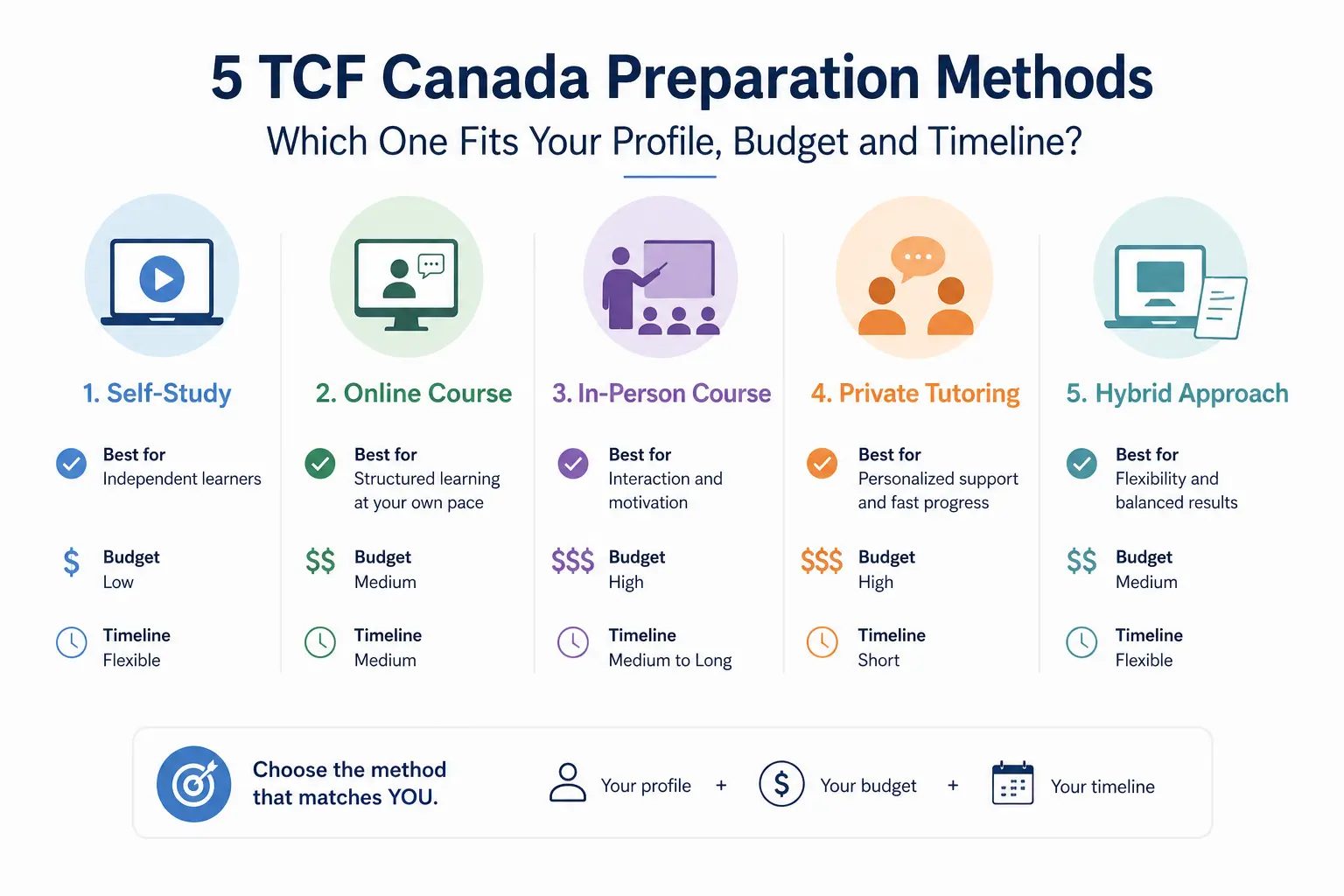
No single method is universally superior. Each has advantages and disadvantages that depend on four candidate-specific variables: learning style, starting level, available budget and time constraints. Here is an objective, rating-based comparison across all five main approaches — followed by a practical framework for building your personalised combination.
Method 1 — Structured Self-Study
Entirely autonomous learning guided by free or affordable digital resources. Our guide on Preparing for TCF Canada on a Zero Budget provides the complete zero-cost framework.
| Criterion | Rating | Detail |
|---|---|---|
| Cost | ★★★★★ Excellent | €0 to €150 for the complete preparation — mostly Anki, practice materials and a potential retake registration |
| Schedule flexibility | ★★★★★ Excellent | Study when, where and as long as you choose — compatible with any professional or family schedule |
| Effectiveness at B2+ starting level | ★★★★☆ Very good | Strong foundation enables efficient autonomous learning; candidates can identify and address gaps independently |
| Effectiveness below B2 | ★★☆☆☆ Limited | Significant risk of ingraining incorrect patterns without external feedback; errors become habits |
| External feedback on production | ★☆☆☆☆ Very weak | No mechanism for correcting errors in speaking or writing that self-review cannot detect |
| Discipline required | ★★★★★ Very high | Without external structure, self-study requires exceptional personal discipline to sustain over 8–12 weeks |
Ideal self-study profile: Solid B2 starting level, proven history of successful autonomous learning in other contexts, NCLC 7–8 target (not NCLC 9–10), tight budget, high personal discipline. Mandatory supplements: the 5-block study log system, weekly practice tests per our practice tests guide, and a study group for oral production feedback.
Method 2 — Individual Coaching with a Certified Instructor
One-on-one sessions with a specialised TCF Canada coach — in person or online. Some coaches hold FEI certifications or have served as TCF Canada examiners, providing access to marking rubric knowledge unavailable to general French teachers.
| Criterion | Rating | Detail |
|---|---|---|
| Cost | ★★☆☆☆ High | €40 to €100 per hour; a 6-session targeted programme costs €240 to €600 |
| Personalisation | ★★★★★ Excellent | Programme adapted entirely to your specific errors, profile and NCLC targets — no time wasted on already-mastered content |
| Production feedback quality | ★★★★★ Excellent | Immediate, precise, rubric-informed corrections that self-review and peers cannot replicate |
| Effectiveness for plateaued candidates | ★★★★★ Optimal | Identifies and eliminates the invisible method and grammar errors that self-study and group work leave undetected |
| Schedule flexibility | ★★★☆☆ Moderate | Constrained by instructor's availability but manageable with advance booking |
| Return on immigration investment | ★★★★★ Exceptional | Each NCLC point gained can reduce waiting time by months and increase CRS positioning — the ROI calculation strongly favours coaching for stuck candidates |
Ideal coaching profile: Candidates plateaued at NCLC 7–8 despite serious self-study where errors have not self-corrected; candidates targeting NCLC 9–10 where small marginal improvements have large CRS impact; professionals with budget and limited preparation time; candidates over 40 (urgency means efficiency of each hour matters more — see our TCF Canada After 40–45 article).
Method 3 — Alliance Française or Institut Français Group Courses
| Criterion | Rating | Detail |
|---|---|---|
| Cost | ★★★★☆ Affordable | €50–200 for a 20–30 hour preparatory cycle — the most cost-effective structured option |
| Teaching quality | ★★★★☆ Good | FEI-certified instructors with access to official FEI materials not available publicly |
| Personalisation | ★★☆☆☆ Limited | Group format — individual adaptation is limited to what the instructor can manage across 6–10 students |
| Social interaction and oral practice | ★★★★★ Excellent | Regular peer oral practice, built-in accountability, collective motivation — impossible to replicate alone |
| Schedule flexibility | ★★☆☆☆ Low | Fixed class times require attendance — incompatible with some professional schedules |
| Access to official materials | ★★★★★ Excellent | Authentic FEI TCF Canada documents, official practice tests, corrected models — significant access advantage |
Method 4 — Mobile Apps and Online Language Platforms
| Application / Platform | TCF Canada Usefulness | Recommended Use |
|---|---|---|
| Anki | ★★★★★ Indispensable | Thematic vocabulary + phrase bank — belongs in every TCF Canada preparation plan without exception |
| Duolingo | ★★☆☆☆ Limited | Useful supplement only at A2–B1 level — never the primary method for any NCLC 7+ target |
| TV5MONDE Apprendre | ★★★★☆ Very good | NCLC-aligned exercises, Francophone content, dictation features — genuine TCF Canada preparation value |
| FLE.fr | ★★★★☆ Good | Free targeted grammar exercises by level — excellent for error-specific correction work |
| Radio-Canada / RFI apps | ★★★★★ Indispensable | Daily authentic listening — the most important media immersion tool in every preparation plan |
| Orthodidacte.com | ★★★★☆ Good | Ranked spelling and agreement exercises — excellent for dictation programme support |
Method 5 — The Personalised Hybrid Approach
The method recommended by the consistent majority of NCLC 9+ candidates who share their strategies is a personalised combination that capitalises on each approach's specific strengths while compensating for each approach's specific weaknesses.
Optimal hybrid combinations by profile:
- B1–B2, 4–6 months, limited budget: Alliance Française (1x/week for structure + official materials) + structured daily self-study (Anki, Radio-Canada, practice tests) + online study group for oral practice
- B2–C1, 2–3 months, budget available, stuck at NCLC 7–8: 4 to 6 targeted coaching sessions to diagnose and eliminate persistent errors + intensive daily self-study + weekly practice tests
- C1, 6–8 weeks, targeting NCLC 9–10: 2 to 3 diagnostic coaching sessions + weekly full practice tests + daily Canadian media immersion + study log + two full exam simulations in the final 2 weeks
- Any level, very limited budget: 100% self-study using exclusively free resources (Radio-Canada, RFI Savoirs, Anki, TV5MONDE, Orthodidacte) + free online study group + free practice tests from FEI website
The 4-Step Method Evaluation Framework
Step 1: Take a complete diagnostic practice test in all 4 skills under timed exam conditions — establish your true starting level, not your estimated level. The diagnostic reveals which obstacles you face and which method type best addresses them.
Step 2: Apply the profile-method matching framework above. Select the primary method with the highest return for your specific profile. Identify any structural gaps your primary method cannot address (e.g. oral feedback if self-studying) and select supplementary elements to fill them.
Step 3: Integrate the 4 non-negotiable components regardless of primary method: weekly practice tests, daily study log, daily Canadian media immersion, and at least one full exam simulation in real conditions in the 2 weeks before the exam.
Step 4: Evaluate after 4 weeks. Compare practice test scores to week-1 baseline. If the weakest skill shows less than 1 NCLC level improvement despite consistent study hours, the method needs adjustment — not necessarily replacement. Use the study log data to diagnose what specifically isn't working before changing anything.
"I tried pure self-study for 2 months — insufficient progress. Then I invested in 6 coaching sessions at €60 each. The instructor identified in one hour errors I had been making for years without realising. I combined weekly coaching with intensive daily self-study for 10 more weeks. I reached NCLC 9 in all four skills. The coaching was my best investment — far better return than the 2 months of unstructured solo work. If I had started with coaching to diagnose my errors and self-studied to apply the corrections, I would have saved those 2 months entirely." — Meryem, pharmacist from Fès, now a permanent resident in Ontario
For additional guidance on the 10 most common preparation mistakes that undermine all methods, see our 10 Errors to Avoid When Preparing for TCF Canada. For inspiring real-candidate preparation stories across all method types, see our TCF Canada Success Testimonials collection.



 TCF Canada Hub
0 Commentaires
aucun commentaire
Soyez le premier a partager votre avis !