-
Auteur :
 Antoine C.
- Jan 10, 2026
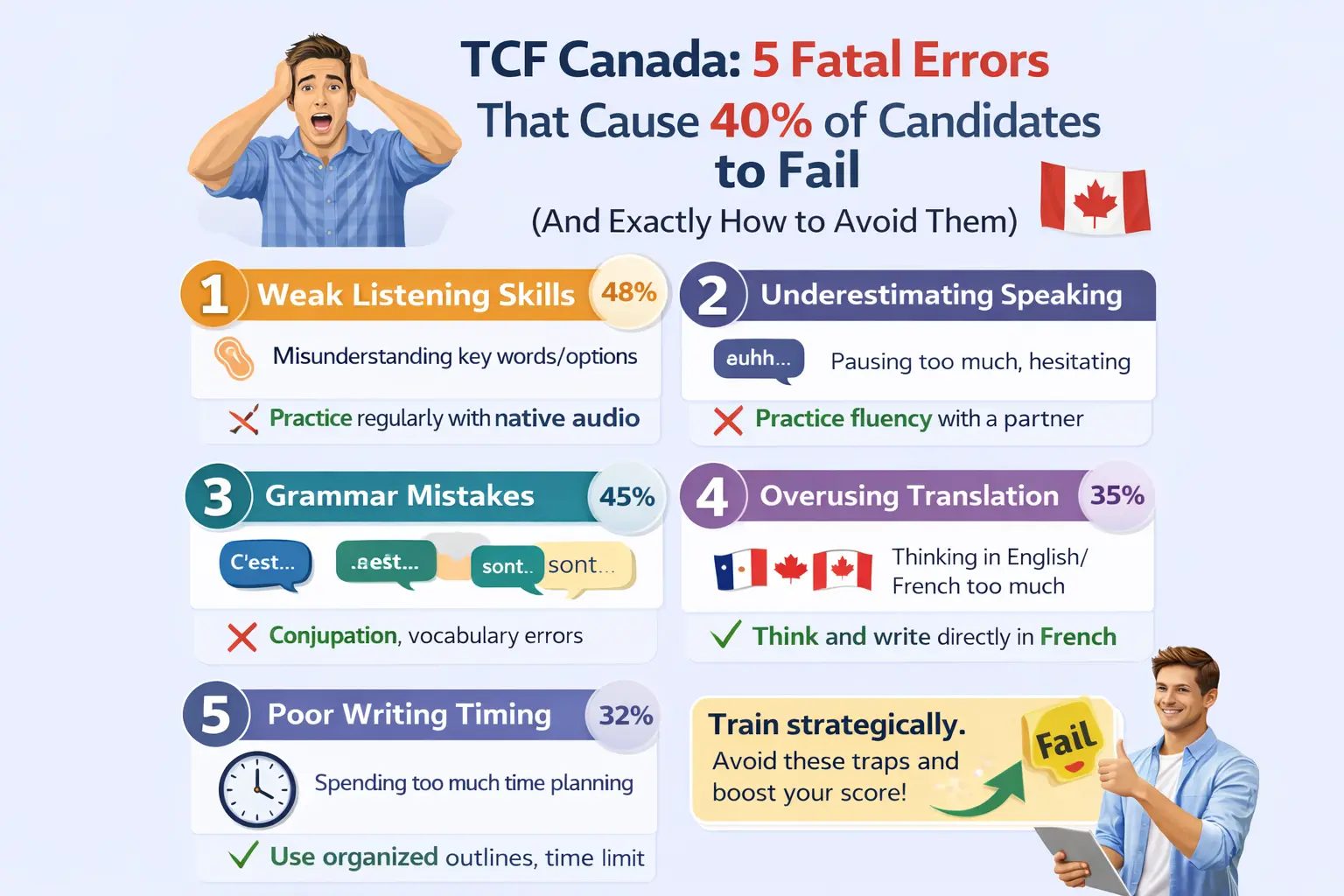
The 10 Errors to Avoid When Preparing for TCF Canada
- Blog
- /
- Article

Each year, thousands of candidates fail TCF Canada not from lack of language skills, but from ignorance of common preparation pitfalls. These errors, often trivial in appearance, can cost dozens of CRS points in Express Entry and delay your immigration project by several months or even years.
2026 Critical Update: With enhanced AI-assisted scoring systems and mandatory Canadian context integration now required, the margin for error has decreased significantly. Recent analysis of 2025 test results shows that candidates who avoid these 10 critical mistakes score an average of 12-18 points higher (approximately 1 full NCLC level) than those who fall into these common traps. Learn to identify and avoid them to optimize your success chances.
Based on analysis of thousands of candidate experiences in 2024-2025 and consultation with TCF examiners, language instructors, and immigration consultants, we've identified the ten most damaging errors that consistently prevent otherwise qualified candidates from achieving their target scores. More importantly, we'll show you exactly how to avoid each one.
Error #1: Underestimating Required Preparation Time
The first and most frequent error consists of believing that one or two months suffice to reach NCLC 9. This dangerous illusion often comes from overestimating one's current level, ignorance of TCF Canada real requirements, or succumbing to immigration timeline pressure that clouds realistic judgment.
Why This Is Critically Problematic in 2026
Moving from B1 to C1 (equivalent NCLC 9-10) generally requires between 600 and 800 hours of structured, focused learning. At 10 weekly hours (already ambitious for working professionals), this represents 12 to 18 months of consistent preparation. The 2026 enhanced requirements—particularly mandatory Canadian context integration and increased Quebec accent exposure—add approximately 15-20% to historical preparation timelines.
The Consequences of Rushing (2026 Data)
- Candidates who attempt TCF Canada with less than recommended preparation time have 67% failure rate (achieving target scores)
- Test registration fees lost ($250-350 USD per attempt)
- Immigration timeline delayed by 3-6 months minimum while preparing for retest
- Psychological impact of failure undermining confidence for subsequent attempts
- Express Entry CRS score potentially declining during extended preparation (age factor, credential expiry)
Realistic Preparation Times According to Initial Level (2026 Updated):
| Starting Level | Target Level | Minimum Hours Required | Timeline (15 hrs/week) | Timeline (10 hrs/week) | 2026 Canadian Context Addition |
|---|---|---|---|---|---|
| A1-A2 | NCLC 7 (CLB 7) | 600-750 hours | 10-12 months | 15-18 months | +50-75 hours Canadian familiarization |
| B1 (NCLC 5-6) | NCLC 8 (CLB 8) | 400-500 hours | 6-8 months | 10-12 months | +40-60 hours Canadian integration |
| B2 (NCLC 7) | NCLC 9 (CLB 9) | 250-350 hours | 4-6 months | 6-9 months | +30-50 hours Canadian expertise |
| C1 (NCLC 8-9) | NCLC 10 (CLB 10) | 150-200 hours | 2-3 months | 4-5 months | +20-30 hours TCF specialization |
How to Avoid This Error (2026 Methodology)
Realistic Timeline Development Process:
- Professional Diagnostic Test: Take official diagnostic from France Éducation international or recognized platform within first week ($20-30 USD investment essential)
- Objective Assessment: Base your planning on diagnostic results, NOT on wishes, immigration urgency, or optimistic self-assessment
- Calculate Realistic Timeline: Use table above to determine minimum hours required for your starting → target level progression
- Add Safety Margin: Systematically add 30% buffer to account for: unforeseen life events, natural learning plateaus, skill-specific weaknesses requiring extra attention, Canadian context integration
- Weekly Capacity Reality Check: Honestly assess sustainable weekly study hours considering work, family, other obligations. Use conservative estimate (if uncertain between 10-15 hours, plan for 10)
- Set Intermediate Milestones: Don't just plan for final test date—create monthly checkpoints with specific skill targets to track progress
"I initially thought 2 months would suffice to improve from B2 to NCLC 9 since I studied French in university. After honest diagnostic test showed I was actually high B1, not B2, I recalculated: 400 hours needed ÷ 12 hours weekly = 8 months minimum. Added 30% margin = 10-11 months realistic timeline. This prevented me from wasting $300 on premature test attempt. I took TCF after 10 months of disciplined preparation and achieved NCLC 9 across all skills on first attempt."
For comprehensive guidance on creating realistic preparation timelines based on your specific profile, see our TCF Canada Preparation Timeline Calculator: Personalized Schedule Development.
Error #2: Neglecting One or Several Skills
Many candidates concentrate efforts on weaknesses by neglecting strengths, or conversely, continue perfecting what they already master while ignoring critical gaps. This unbalanced approach produces inconsistent score profiles that dramatically limit total CRS points in Express Entry.
The Mathematics of Imbalance (2026 Express Entry Impact)
Express Entry awards points independently for each of four language skills. Your weakest skill functions as a bottleneck, limiting your total language points regardless of excellence in other areas.
Typical Imbalance Case Study:
Candidate Profile: Excellent comprehension skills (NCLC 10 listening and reading) but weak production skills (NCLC 6 speaking and writing)
Express Entry Points Calculation (First Official Language):
- Listening: NCLC 10 = 34 points
- Reading: NCLC 10 = 34 points
- Speaking: NCLC 6 = 9 points
- Writing: NCLC 6 = 9 points
- Total: 86 points
Balanced Alternative Profile: NCLC 8 across all four skills = 23 × 4 = 92 points
Result: Despite achieving NCLC 10 in two skills (exceptional performance!), imbalanced candidate scores 6 points lower than candidate with consistent NCLC 8 across all skills. In competitive Express Entry environment, 6 points can mean difference between ITA and indefinite waiting.
Impact of Skill Imbalance on Express Entry Points (2026 Analysis):
| Profile Type | Listening | Reading | Speaking | Writing | Total Points | Assessment |
|---|---|---|---|---|---|---|
| Balanced Excellence | NCLC 9 (32) | NCLC 9 (32) | NCLC 9 (32) | NCLC 9 (32) | 128 points | ✅ Optimal |
| Comprehension Specialist | NCLC 10 (34) | NCLC 10 (34) | NCLC 7 (22) | NCLC 7 (22) | 112 points | ⚠️ -16 points lost |
| Production Weak | NCLC 10 (34) | NCLC 10 (34) | NCLC 6 (9) | NCLC 6 (9) | 86 points | ❌ -42 points lost! |
| Balanced Competency | NCLC 8 (23) | NCLC 8 (23) | NCLC 8 (23) | NCLC 8 (23) | 92 points | ✅ Better than imbalanced 10/10/6/6 |
The Solution: Strategic Balanced Approach (2026)
Balanced Time Allocation Methodology:
Monthly Skill Assessment and Rebalancing
- Complete Monthly Practice Test: Full 4-skill assessment to identify current levels in each competency
- Calculate Skill Gaps: Determine how many NCLC levels each skill is from target (e.g., if target is NCLC 9: Listening at 8 = 1 level gap, Speaking at 6 = 3 level gap)
- Allocate Study Time Proportionally:
- 50% of weekly hours → Two weakest skills (25% each)
- 30% of weekly hours → Intermediate skills (15% each)
- 20% of weekly hours → Strong skills (10% each for maintenance)
- Reassess Monthly: As skills improve and gaps close, rebalance allocation accordingly
Example Weekly Schedule (15 total hours) - Candidate Profile: Strong Reading/Listening, Weak Speaking/Writing
- Oral Expression (Weakest): 3.75 hours weekly (25%) - Daily recording practice, 2× weekly tutoring, conversation exchange
- Written Expression (Second Weakest): 3.75 hours weekly (25%) - Daily writing practice, weekly professional correction, template mastery
- Listening Comprehension (Intermediate): 2.25 hours weekly (15%) - Podcasts, Quebec accent exposure, targeted exercises
- Reading Comprehension (Strong): 1.5 hours weekly (10%) - Maintenance through daily articles, strategic practice
- Canadian Context Building: 1.5 hours weekly (10%) - Database creation, vocabulary memorization
- Integrated Practice Tests: 2.25 hours weekly (15%) - Bi-weekly full test simulations
2026 Critical Insight: Production Skills Take Longer
Speaking and writing (production skills) typically require 40-60% more preparation time than listening and reading (comprehension skills) to reach same NCLC level. Why? Production requires:
- Active vocabulary recall (not just recognition)
- Real-time grammatical accuracy under time pressure
- Coherent organization and argumentation
- Fluency and spontaneity (speaking)
- Regular professional feedback to identify and correct errors
Implication: If your production skills lag comprehension, allocate proportionally more time to close the gap.
For detailed strategies on developing each skill efficiently, see our comprehensive guides: TCF Canada Listening Mastery, Reading Comprehension Excellence, Oral Expression Complete Guide, and Written Expression 2026 Methodology.
Error #3: Using Only Free Unverified Resources
The abundance of free content on YouTube, TikTok, Instagram, and forums may seem like a windfall for budget-conscious candidates. However, quality varies enormously, and some content contains obsolete information, incorrect strategies, or unrealistic promises about TCF Canada preparation.
Free Resource Traps (2026 Digital Landscape)
Common Problematic Content Types:
- "Succeed TCF in 1 Month Without Effort" Videos: Attract millions of views but rarely offer solid methodology. Often created by non-educators seeking engagement rather than providing accurate guidance
- Unofficial Practice Tests: May not correspond to actual TCF Canada difficulty level, creating false confidence or unwarranted discouragement
- Outdated Format Information: Videos from 2020-2022 may not reflect 2026 changes (AI scoring, Canadian context requirements, Quebec accent percentage increase)
- Generic French Learning Content: Excellent for general proficiency but lacking TCF-specific strategies and Canadian context emphasis
- Unqualified "Experts": Individuals who passed TCF once sharing personal experience as universal methodology (sample size of 1 = unreliable)
How to Evaluate Resource Quality (2026 Verification Checklist):
Author Credentials Verification
- ✓ Certified French teacher with TCF teaching experience?
- ✓ Official TCF test center or France Éducation international affiliation?
- ✓ Educational background in language instruction or applied linguistics?
- ✓ Demonstrated track record of student success (testimonials, verified results)?
- ❌ Simple amateur who passed test sharing only personal anecdotal experience?
Content Currency Check
- ✓ Publication/update date within last 12-18 months (2025-2026)?
- ✓ Explicitly mentions 2026 changes (AI scoring, Canadian context requirements)?
- ✓ Reflects current TCF Canada format (official timing, question counts, task requirements)?
- ❌ Last updated 2020-2022 with no mention of recent changes?
Information Accuracy Verification
- ✓ Cross-reference claims with official France Éducation international documentation
- ✓ Check multiple sources—do reputable resources confirm same information?
- ✓ Review comments/reviews—do hundreds of users report problems or inaccuracies?
- ❌ Information contradicts official sources or makes unrealistic promises?
Invest Intelligently in Quality Resources (2026 ROI Analysis)
A budget of $200-400 USD for quality preparation materials represents minimal investment compared to your immigration stakes ($15,000+ in application fees, relocation costs, potential lifetime earnings increase from Canadian residency).
Recommended Investment Allocation (2026 Budget-Conscious Approach):
| Resource Category | Recommended Investment | Expected ROI | Priority Level |
|---|---|---|---|
| Official Practice Tests | $50-80 (2-3 official tests from FEI) | Highest - accurate difficulty calibration | 🔴 Essential |
| Quality Preparation Manual | $40-50 (Hachette "Réussir le TCF Canada" 2025) | High - comprehensive strategies + practice | 🔴 Essential |
| Professional Tutoring (Production Skills) | $120-300 (6-10 sessions @ $20-30/hr) | Very High - expert feedback on speaking/writing | 🟡 Highly Recommended |
| Online Platform Subscription | $35-100 (2-3 months @ $35-50/month) | Moderate-High - structured practice + tracking | 🟢 Optional but Valuable |
| Grammar Reference Book | $25-35 ("Grammaire Progressive Avancé") | Moderate - systematic grammar review | 🟢 Optional |
Total Investment Range: $270-565 USD for comprehensive, high-quality preparation materials
"I initially tried preparing exclusively with free YouTube videos and unverified practice tests. After 3 months, I realized I was learning outdated strategies and my 'practice test scores' didn't correlate with reality. I invested $320 in official materials and 8 tutoring sessions focused on speaking/writing. The quality difference was night and day—official tests were notably harder than free ones, but strategies from quality manual and tutor feedback directly improved my scores. Investment paid for itself immediately through first-attempt success avoiding retest fees."
For detailed reviews of recommended resources by budget level and learning style, see our comprehensive TCF Canada Resource Guide 2026: Quality vs. Cost Analysis.
Error #4: Ignoring Canadian Specificities
TCF Canada isn't simply a general French proficiency test administered for Canadian immigration—it specifically evaluates your ability to function linguistically in Canadian context. Ignoring this cultural, lexical, and contextual dimension constitutes a major strategic error that costs candidates significant points in 2026's enhanced scoring system.
The 2026 Canadian Context Revolution
Beginning in late 2025 and fully implemented in 2026, TCF Canada now explicitly penalizes absence of Canadian context in production tasks (speaking and writing). Examiners report that written Task 2-3 responses and oral Task 3 responses lacking Canadian references receive automatic 3-4 point deductions regardless of linguistic quality.
Critical 2026 Change: Mandatory Canadian Integration
Written Expression Tasks 2-3: Must include minimum 2 explicit Canadian references (cities, statistics, policies, cultural values, examples) or face significant point loss
Oral Expression Task 3: Arguments should reference Canadian context when relevant to topic
Listening/Reading Comprehension: Now includes 40-45% Canadian-specific content (up from 30% in 2023-2024), requiring familiarity with:
- Quebec accent and pronunciation patterns (35-40% of listening audio)
- Canadian French vocabulary and expressions
- Canadian geography, government structure, social systems
- Canadian current affairs and cultural references
Canadian Vocabulary and Expressions (Essential Mastery)
If you prepare TCF Canada using only European French resources, you risk not recognizing common Canadian terms in listening/reading comprehension, and failing to demonstrate Canadian context awareness in production tasks.
Critical Canadian French Vocabulary (2026 High-Frequency Terms):
Daily Life Vocabulary
| Canadian French | European French | English | TCF Frequency |
|---|---|---|---|
| dépanneur | épicerie de proximité | convenience store | 🔴 Very High |
| magasinage / magasiner | shopping / faire du shopping | shopping / to shop | 🔴 Very High |
| fin de semaine | week-end | weekend | 🔴 Very High |
| char (Quebec informal) | voiture | car | 🟡 Moderate |
| cellulaire | portable / mobile | cell phone | 🔴 Very High |
| breuvage | boisson | beverage | 🟡 Moderate |
| patate | pomme de terre | potato | 🟡 Moderate |
Meal Terminology (Critical Difference!)
| Meal | Canadian French | European French |
|---|---|---|
| Breakfast | déjeuner | petit-déjeuner |
| Lunch | dîner | déjeuner |
| Dinner | souper | dîner |
Warning: This vocabulary shift causes frequent confusion—pay special attention!
Administrative and Professional Terms
- Canadian: carte soleil (Quebec health card) | European: carte vitale
- Canadian: dépôt direct (direct deposit) | European: virement automatique
- Canadian: NAS (Numéro d'Assurance Sociale) | European: numéro de sécurité sociale
- Canadian: accommodement (accommodation/adjustment) | European: aménagement
Quebec Accent Familiarization (2026 Essential)
With 35-40% of TCF Canada listening content now featuring Quebec accent (increased from 25-30% in previous years), accent familiarization is non-negotiable for NCLC 8+ scores.
Quebec Accent Mastery Program (6-8 Weeks):
- Daily Exposure (30-45 min): Radio-Canada podcasts, Quebec news broadcasts, Télé-Québec programs
- Quebec Media Immersion: Watch Quebec films/series with French subtitles ("Les Parent," "19-2," "Unité 9," "C'est comme ça que je t'aime")
- Pronunciation Patterns Study: Focus on distinctive features:
- Affrication of "t" and "d" before high vowels ("tu" → "tsu," "dire" → "dzire")
- Different vowel quality, particularly "i" sounds (more tense/closed)
- Distinctive intonation patterns and speech rhythm
- Progressive Difficulty: Start with Radio-Canada standard news (clearer Quebec accent), progress to authentic Quebec street interviews and regional content
- Timeline: Most candidates report comfortable comprehension after 6-8 weeks of daily 30-45 minute exposure
Canadian Cultural Context and Current Affairs
Essential Canadian Knowledge for TCF Canada 2026:
Geography and Government
- Major cities: Toronto, Montreal, Vancouver, Calgary, Ottawa, Quebec City, Edmonton, Winnipeg
- Provinces and territories: 10 provinces, 3 territories (be able to name at least 5-6)
- Federal system: Prime Minister, Parliament, provincial premiers
- Bilingualism: Official English-French bilingual status, language policies
Social Systems and Values
- Universal healthcare system (provincial health cards)
- Multiculturalism as defining Canadian value
- Immigration programs: Express Entry, provincial nominees, family sponsorship
- Education system: CEGEP (Quebec), universities, college system
Current Canadian Affairs (Update Regularly)
- Follow Radio-Canada and La Presse for current events
- Key topics: housing affordability, climate policy, healthcare challenges, reconciliation with Indigenous peoples
- Build database of 30-50 Canadian facts/statistics for production task integration
Canadian Writing and Speaking Tone (Subtle but Important)
Canadian communication style generally privileges a more inclusive, consensual, and diplomatically-phrased tone compared to European French academic or professional writing.
Canadian Tone Adaptation:
- Inclusive Language: Acknowledge multiple perspectives, avoid overly absolutist statements
- Diplomatic Phrasing: "Il serait souhaitable de..." rather than "Il faut absolument..."
- Balanced Argumentation: Present thesis AND antithesis (dialectical structure particularly valued)
- Avoid Polemic: Steer clear of overly harsh, divisive, or inflammatory formulations
For comprehensive Canadian French preparation including 200+ vocabulary terms, accent training resources, and cultural knowledge building.
Error #5: Doing Practice Tests Without Analyzing Results
Chaining practice tests without thorough analysis transforms preparation into simple mechanical repetition. You risk reproducing the same errors indefinitely without real progress—what learning science calls "practice without reflection equals performance plateau."
Why Surface-Level Practice Fails (2026 Cognitive Science)
Taking a practice test and simply noting your score ("I got 28/39 in listening, that's 72%") provides minimal learning value. Real improvement comes from systematic error analysis identifying WHY each mistake occurred and HOW to prevent similar errors in future.
The Practice Test Trap (Common Pattern):
- Candidate completes practice test
- Checks answers, notes score: "31/39, not bad!"
- Feels vaguely satisfied or disappointed based on number
- Moves on to next test without understanding specific weaknesses
- Repeats same error patterns in subsequent tests
- Wonders why scores plateau despite "lots of practice"
Result: Candidate completes 15 practice tests but shows minimal improvement because they're practicing errors, not learning from them.
Effective Analysis Method (2026 Evidence-Based Approach)
After each practice test, dedicate minimum 90-120 minutes to comprehensive analysis—approximately equal to test duration itself. This 1:1 ratio (test time : analysis time) produces optimal learning outcomes.
Comprehensive Post-Practice Test Analysis Protocol:
Phase 1: Immediate Scoring and Initial Review (15-20 minutes)
- Score all sections immediately while test fresh in memory
- Record scores in tracking spreadsheet with date
- Note overall feeling: Which sections felt easier/harder? Where did time pressure affect performance?
Phase 2: Detailed Error Categorization (40-50 minutes)
For EVERY incorrect answer, identify the specific error type:
- Vocabulary Gap: Unknown word/expression prevented comprehension
- Action: Add to vocabulary list for memorization
- Note: Was this Canadian French term? General academic vocabulary? Technical term?
- Comprehension Failure: Misunderstood question, passage, or audio despite knowing words
- Action: Re-read/re-listen to identify what you missed. Was it inference? Implicit meaning? Speaker opinion vs. fact?
- Time Pressure Error: Rushed answer due to poor time management
- Action: Review time allocation strategy for that section
- Strategic Error: Wrong approach to question type
- Action: Review strategy for that specific question format
- Distractor Trap: Selected plausible wrong answer designed to confuse
- Action: Analyze how answer seemed correct but wasn't. Learn to identify future distractors
- Careless Error: Knew correct answer but misread question or selected wrong option
- Action: Develop checking protocol to catch careless mistakes
Phase 3: Pattern Identification (20-25 minutes)
- Create error summary: How many of each type? (e.g., 5 vocabulary gaps, 3 comprehension failures, 2 time pressure errors)
- Identify systematic weaknesses: Do errors cluster around specific question types? (e.g., always miss inference questions, struggle with numbers in listening, weak on administrative vocabulary)
- Compare to previous tests: Are same patterns recurring? Or have you corrected previous weaknesses?
Phase 4: Production Skills Review (Written/Oral) (30-40 minutes)
- Self-Evaluation: Use official NCLC rubrics to score your writing/speaking responses
- Professional Correction: Submit best written responses to tutor/teacher for detailed feedback (invest $10-20 per correction)
- Speaking Analysis: Re-listen to oral recordings, identify: hesitations/pauses, grammatical errors, vocabulary limitations, pronunciation issues, argumentation weaknesses
- Canadian Context Check: Did you include Canadian references in Tasks 2-3 (writing) and Task 3 (speaking)?
Phase 5: Action Plan Creation (10-15 minutes)
- Define 2-3 specific, concrete improvement actions before next practice test
- Example: "Practice 15 min daily on listening comprehension with numbers/statistics," "Memorize 50 Canadian administrative vocabulary terms," "Complete 3 written Task 3 practice exercises focusing on dialectical structure"
- Schedule these actions into weekly calendar—make them concrete commitments
Practice Test Analysis Tracking Template (2026):
| Test Date | L | R | W | S | Top 3 Error Types | Action Items | Progress Note |
|---|---|---|---|---|---|---|---|
| Nov 10 | 28/39 | 31/39 | 14/20 | 13/20 | 1. Vocab gaps (admin terms) 2. Quebec accent 3. Time pressure (writing) | - 20 min daily admin vocab - Quebec podcast 30 min daily - Timed writing practice | Baseline test |
| Nov 24 | 32/39 | 33/39 | 16/20 | 15/20 | 1. Inference questions 2. Dialectical structure 3. Connector variety | - Practice inference exercises - Master 3 argument structures - Memorize 30 advanced connectors | +4-5 points improvement! Admin vocab work paid off |
| Dec 8 | 34/39 | 35/39 | 17/20 | 16/20 | 1. Numbers in listening 2. Canadian context (writing) 3. Speaking fluency | - Number dictation practice - Build Canadian reference database - Daily speaking 20 min | Steady improvement. Ready for NCLC 9 soon! |
From Analysis to Action (Critical Implementation)
Analysis only serves if it leads to concrete corrective actions. If you regularly miss questions on numbers in listening comprehension, plan 15 daily minutes of specific exercises on numbers, dates, and percentages until total mastery. If administrative vocabulary remains weak, create targeted flashcard deck and review daily.
"I initially completed 10 practice tests in 5 weeks, just checking scores without deep analysis. Scores plateaued around 29-30/39 in listening and I couldn't understand why. Then I spent 2 hours analyzing my 11th test in detail—discovered 60% of my errors were Quebec accent comprehension and numbers. I dedicated next 3 weeks to Quebec podcast immersion (45 min daily) and number dictation practice (15 min daily). Next practice test: 35/39. The analysis breakthrough was worth more than all 10 previous tests combined."
Error #6: Postponing Speaking Practice from Fear or Embarrassment
Speaking terrifies many candidates, who systematically postpone oral practice with excuses: "I'll start speaking when I have more vocabulary," "I'll train orally next month when I'm more confident," "I don't have anyone to practice with." This procrastination practically guarantees weak scores in oral expression—often the bottleneck preventing NCLC 9 achievement.
Understanding the Psychological Blockage
Fear of speaking often stems from perfectionism and fear of judgment. Yet even native speakers make errors, hesitate, and search for words. TCF Canada evaluates your overall communicative ability, discourse coherence, and fluency—not grammatical perfection of every utterance.
Consequences of Delaying Oral Practice (2026 Data):
- Tenfold Stress: When you finally attempt speaking after months of avoidance, anxiety intensifies dramatically
- Fluency Gap: Lack of fluency extremely difficult to correct in short time—requires months of regular practice to develop natural speech rhythm
- Mental Translation Habit: Thinking in mother tongue → translating to French becomes deeply anchored, preventing spontaneous French thought
- Impossible to Catch Up: Oral expression ease requires 200-400 hours of regular speaking practice. Cannot be compressed into final 2-4 weeks
- Score Imbalance: Candidates often achieve NCLC 9-10 in reading/listening but only NCLC 6-7 in speaking due to procrastination—losing 20-25 CRS points
Progressive Desensitization Strategy (2026 Proven Method)
12-Week Speaking Development Program (From Zero to Confident):
Weeks 1-2: Private Solo Recording (Building Foundation)
- Activity: Daily 5-minute solo recordings on simple personal topics
- Topics: "My typical day," "My hobbies," "Favorite food," "Memorable vacation," "Family description"
- Method: Record without judgment or correction—just build habit of speaking French aloud
- No Audience: Keep recordings private initially to eliminate performance anxiety
- Objective: Overcome microphone fear, hear own voice speaking French, establish daily practice routine
Weeks 3-4: Self-Evaluation and Simple Corrections
- Activity: Daily 10-minute sessions: 5 min recording + 5 min critical listening
- Topics: Expand to opinions: "Advantages of remote work," "Best way to learn languages," "Favorite season and why"
- Self-Analysis: Listen to recording, identify 3-5 obvious errors (pronunciation, grammar, vocabulary)
- Re-record: Make second recording attempting to correct identified errors
- Objective: Develop self-awareness, begin active error correction
Weeks 5-6: Sharing with Benevolent Partner
- Activity: Share recordings with supportive study partner or language exchange contact
- Request: Ask for encouragement first, then gentle feedback on 1-2 improvement areas
- Exchange: Listen to their recordings, provide mutual support
- Objective: Gradually introduce external listener, build confidence receiving feedback
Weeks 7-8: Live Conversation Introduction
- Activity: 2× weekly 20-30 minute conversation sessions via language exchange apps (Tandem, HelloTalk, ConversationExchange)
- Partners: Seek Canadian French speakers if possible, or other French natives willing to correct gently
- Topics: Mix casual conversation (getting to know each other) with structured topics (current events, cultural differences)
- Objective: Develop real-time communication, practice responding spontaneously to unexpected questions
Weeks 9-10: TCF Task Simulation
- Activity: Daily 15-minute TCF oral expression simulation (all 3 tasks)
- Method: Use official practice prompts, strict timing, record responses
- Focus: Task completion, time management, structural organization (particularly Task 3 argumentation)
- Analysis: Evaluate recordings against NCLC rubrics, identify specific weaknesses
Weeks 11-12: Professional Tutoring and Refinement
- Activity: 2-3 sessions weekly with qualified French tutor specializing in TCF oral expression ($20-40/hour)
- Focus: Tutor conducts mock oral exams, provides expert feedback on pronunciation, grammar fossilizations, vocabulary gaps, argumentation quality
- Corrections: Address systematic errors identified by tutor through targeted exercises
- Confidence: Multiple successful practice sessions with tutor builds test-day confidence
2026 Speaking Success Principles:
- Start Day 1: Begin speaking practice from first week of preparation, not final month
- Daily Practice Non-Negotiable: Speaking fluency requires consistent daily exposure (minimum 10-15 min), not occasional marathons
- Imperfect Action > Perfect Inaction: Speaking with errors beats not speaking from fear of errors
- Record Everything: Recording allows objective self-evaluation impossible during live speaking
- Invest in Professional Feedback: 6-10 tutoring sessions ($120-400 total) provides expert correction impossible to achieve through self-study alone
For comprehensive oral expression strategies including pronunciation guides, fluency techniques, argumentation frameworks, and 100+ practice prompts with sample responses, see our detailed TCF Canada Oral Expression Mastery Guide 2026.
Error #7: Neglecting Test Technical Dimension
TCF Canada takes place on computer with audio headset for listening and oral sections. Many candidates discover this technical environment on test day, generating stress and awkwardness that negatively affects performance—particularly in oral expression where technical fumbling wastes precious preparation time.
Frequent Technical Problems (2026 Test Center Reality)
Common Technical Disasters (All Preventable!):
- Microphone Catastrophe: Poorly positioned microphone makes oral recording inaudible or distorted—examiner cannot evaluate, automatic low score
- Keyboard Struggles: Difficulty typing quickly in French on QWERTY keyboard (particularly accents: é, è, ê, à, ç, etc.)—loses 5-10 minutes in writing section
- Interface Confusion: Ignorance of test interface navigation (how to move between questions, whether backward navigation permitted, where timer displays)—causes panic and time loss
- Headset Discomfort: Unfamiliarity with wearing headset for extended period causes distraction during listening section
- Digital Stopwatch Stress: Visible countdown timer creates anxiety for candidates unprepared for constant time pressure visualization
- Recording Failure: Not verifying recording is working before beginning oral expression—discovers too late that responses weren't captured
Technical Familiarization Protocol (Complete 2-3 Weeks Before Test)
Technical Preparation Checklist (2026):
Computer-Based Practice (Essential)
- ✓ Complete minimum 3 full practice tests on computer, NOT on paper
- ✓ Use official France Éducation international online practice tests or recognized platforms that simulate exact computer interface
- ✓ Practice navigating between questions, using keyboard shortcuts, adjusting settings
- ✓ Become comfortable with on-screen reading for extended periods (60+ minutes for reading section)
Audio Equipment Familiarization
- ✓ Acquire headset with microphone similar to test center equipment (over-ear headphones with boom mic, ~$20-40)
- ✓ Practice wearing headset for 45-minute listening section duration—ensure comfort
- ✓ Adjust microphone positioning: 2-3 cm from mouth, slightly to side (not directly in front)
- ✓ Test recording quality—listen to playback to verify clear, audible speech without distortion
- ✓ Practice starting/stopping recordings quickly without fumbling
French Typing Proficiency
- ✓ Practice rapid French typing with all accents and special characters
- ✓ Learn keyboard shortcuts for French characters:
- é: Alt+0233 | è: Alt+0232 | ê: Alt+0234 | à: Alt+0224 | ù: Alt+0249 | ç: Alt+0231
- Or use French Canadian keyboard layout if test center permits
- ✓ Target: 40+ words per minute typing speed in French (test yourself at typingtest.com)
- ✓ Practice writing Tasks 1-3 on computer, not handwritten—completely different experience
Interface and Timer Familiarization
- ✓ Practice with visible countdown timer during all exercises—must become comfortable with constant time pressure visualization
- ✓ Learn test interface: question navigation, answer selection, review functions
- ✓ Understand rules: Can you return to previous questions? Can you change answers? (Varies by section—know the rules!)
- ✓ Know how to flag questions for review if feature available
Technical Troubleshooting Knowledge
- ✓ Know procedure if technical issues occur during test (raise hand immediately, notify supervisor)
- ✓ Understand test center policies on restarts, time compensation for technical failures
- ✓ Verify recording functionality BEFORE starting oral expression section—do microphone check when permitted
Real Conditions Simulation (Final 2 Weeks)
In the two weeks before exam, complete minimum 2 full practice tests in strictly authentic conditions:
- Same Environment: Quiet library or similar setting (not home where comfortable)
- Same Schedule: Take practice test at same time of day as your scheduled exam (if 9am exam, practice at 9am)
- Same Equipment: Computer, headset, exact setup you'll encounter
- Strict Timing: No pauses, no extensions—stop immediately when time expires
- No Resources: No dictionary, grammar references, Google—exactly as exam restrictions
- Official Breaks Only: Take only permitted breaks between sections as per official test protocol
"I practiced exclusively on paper and phone for 5 months. Test day was my first time using test center computer setup—complete disaster. I wasted 8 minutes of oral expression prep time fumbling with microphone positioning and verifying recording worked. Lost another 6 minutes in writing section struggling to type French accents. Final scores were 2-3 points below my paper practice tests purely from technical stress and time loss. Don't make my mistake—practice on computer from Week 1!"
Error #8: Memorizing Without Contextualizing
Learning vocabulary lists out of context produces superficial knowledge rarely mobilizable during exam pressure. You may recognize the isolated word in a list, but fail to understand or use it appropriately in a complex authentic sentence or conversation.
Why Decontextualized Memorization Fails (Cognitive Science 2026)
The brain better memorizes information connected to context, mental imagery, emotional experience, and meaningful associations. The word "démarche" learned from a list has 30-40% retention rate; the same word encountered in meaningful sentence ("I began administrative steps [démarches] for my visa application") has 70-85% retention rate because it's anchored to context, purpose, and personal relevance.
Symptoms of Decontextualized Learning:
- Can recite word from flashcard but can't use it in sentence
- Recognize word in isolation but don't understand it in paragraph
- Know definition but can't identify appropriate usage contexts
- Confuse similar words because lacking contextual anchors to differentiate
- Forget words shortly after "memorizing" them—no long-term retention
Contextualized Memorization Methods (2026 Evidence-Based)
Superior Vocabulary Acquisition Techniques:
1. Example Sentence Method (Most Effective)
- For Each New Word: Create 2-3 personally meaningful example sentences
- Personalization: Connect to your life, experiences, immigration journey
- Example - Word "démarche":
- "J'ai commencé les démarches administratives pour mon visa canadien en janvier."
- "Les démarches d'immigration peuvent prendre plusieurs mois."
- "Il faut entreprendre les démarches nécessaires le plus tôt possible."
- Flashcard Format: Front = word + example sentence | Back = definition + additional examples
2. Mind Mapping (Thematic Organization)
- Central Theme: "Immigration" (or any theme)
- Branches: Sub-themes (documents, procedures, housing, employment)
- Connections: Related words linked visually showing relationships
- Benefit: Builds semantic networks—remembering one word triggers recall of related vocabulary
3. Mnemonic Stories (Memorable Narratives)
- Create Mini-Story: Invent brief narrative incorporating 5-8 new words
- Make It Vivid: Unusual, emotional, humorous stories = better retention
- Example Story Using 6 Canadian Immigration Words:
- "Après avoir complété toutes les démarches nécessaires, j'ai reçu mon attestation de réussite au TCF. Mon dossier d'immigration est maintenant complet. J'attends avec impatience de recevoir une invitation à présenter une demande pour devenir résident permanent. Mon rêve canadien se concrétise enfin!"
4. Image Association (Visual Anchoring)
- Abstract Words: Create vivid mental image representing concept
- Example - "Démarche": Visualize yourself walking ("marche") through administrative building gathering documents
- Strengthen: More unusual/vivid the image, stronger the memory anchor
5. Extensive Reading (Natural Encountering)
- Daily Reading: 30-45 minutes of authentic French texts (news, articles, books)
- Encounter Words Multiple Times: Seeing vocabulary in varied authentic contexts solidifies understanding
- Notice Usage Patterns: Collocations (words that frequently appear together), grammatical constructions, register appropriateness
- Mark and Review: Highlight new words, review after reading, add to spaced repetition system
Practical Application: Anki + Context (Gold Standard 2026)
Use Anki or similar spaced repetition application with enhanced contextualized cards:
- Front of Card: Word + complete example sentence showing usage
- Back of Card: Definition + 2-3 additional example sentences + register note (formal/informal) + Canadian usage note if applicable
- Audio: Include pronunciation audio using Forvo or recording yourself
- Review Daily: Follow Anki's spaced repetition algorithm for optimal long-term retention (15-20 min daily typically sufficient)
"I spent first 2 months memorizing 2000+ words from decontextualized lists. During practice tests, I'd recognize words but couldn't understand them in sentences or use them in writing/speaking. Complete waste of time. I rebuilt my approach: created Anki deck with every word embedded in 2-3 example sentences related to immigration/Canadian life. Same 2000 words, but this time learned in context through extensive reading + daily Anki review. Retention improved dramatically—went from recognizing 40% in tests to understanding/using 80%."
Error #9: Pursuing Perfection Rather Than Effectiveness
Perfectionism paralyzes many candidates who refuse to register for TCF Canada until they achieve 95-100% success on practice tests. This quest for unattainable perfection unnecessarily delays immigration projects by months or years and generates counterproductive stress that actually impairs test-day performance.
Distinguish Excellence from Perfectionism (Critical Difference)
Excellence vs. Perfectionism:
- Excellence (Healthy): Optimizing preparation within available time and registering for test once practice scores consistently meet target. Accepting that minor imperfections don't prevent success. Focusing on overall competency rather than flawless performance.
- Perfectionism (Destructive): Indefinitely postponing test from fear of any imperfection. Believing you need 100% practice test scores before attempting real exam. Allowing anxiety about potential failure to prevent action. Letting "not quite ready yet" become permanent excuse.
When Are You Actually Ready for TCF Canada? (2026 Criteria)
Test-Readiness Indicators (Evidence-Based 2026):
✅ You're Ready When:
- Consistent Target Achievement: Your last 3-4 practice tests meet or exceed target score (with occasional minor dip acceptable—humans aren't machines)
- Score Stability: Scores are relatively stable across tests, not wildly fluctuating (e.g., consistent 32-35/39 range, not 25 one test and 37 next)
- Format Comfort: Feel comfortable with format, timing, and technical requirements of all four sections
- Stress Management: Have practiced stress management techniques and can maintain composure under pressure
- Time Management: Consistently complete all sections within time limits without rushing final questions/tasks
- Canadian Integration: Can naturally incorporate Canadian context into production tasks without forced effort
- Skill Balance: All four skills within 1 NCLC level of each other (no dramatic imbalances)
❌ You're NOT Ready When:
- Practice test scores consistently 2+ NCLC levels below target across multiple tests
- Cannot complete sections within time limits (regularly leaving 10+ questions unanswered)
- Scores erratically fluctuate suggesting unstable proficiency (need more consolidation time)
- Major skill gaps remain (e.g., minimal speaking practice, never completed timed writing)
- Unfamiliar with test format or haven't practiced on computer
The Perfectionism Trap (Real Example):
Candidate Profile: Target NCLC 8, practice test scores consistently 31-34/39 (listening), 33-36/39 (reading), 16-17/20 (writing), 15-17/20 (speaking) = solid NCLC 8-9 performance
Perfectionist Thinking: "I'm not consistent enough. Sometimes I get 31, sometimes 34—I need to always get 35+. I'll wait another 2 months until I'm perfectly consistent."
Reality: Candidate is MORE than ready—scores already exceed target. Minor fluctuations (31 vs 34) are normal human variation, not weakness requiring months more preparation. Delaying test is pure perfectionism.
Cost: 2 months immigration timeline delay, during which age factor reduces CRS score by 1 point (turned 30), and job credentials expire requiring updating. Net result: 2-month delay causes 3-point CRS reduction and $200 additional documentation fees—all from perfectionism preventing action.
The Opportunity Cost of Perfectionism (2026 Analysis)
Each month delay in obtaining TCF Canada certificate represents:
- Immigration Timeline Delay: 1 month less time with permanent residence status
- CRS Score Erosion: Age factor reduces points over time (particularly near birthday thresholds: 30, 35, 40)
- Credential Aging: Educational credentials, language tests, work experience references become less current
- Policy Risk: Immigration policies can change—delaying application increases exposure to potential adverse policy shifts
- Psychological Cost: Extended uncertainty, stress, and life on hold waiting for "perfect" readiness that never arrives
2026 Strategic Principle: "Good Enough is Good Enough"
If you're targeting NCLC 8 and consistently achieving NCLC 8-9 in practice tests, register for the exam. Even if you achieve NCLC 7-8 (slightly below optimal) on test day, this remains very competitive for Express Entry and you can always retest if needed. But postponing test indefinitely from perfectionism guarantees zero progress toward your immigration goal.
Remember: Perfect is the enemy of good. Excellent preparation + timely action > perfect preparation + perpetual delay.
Error #10: Neglecting Physical and Mental Well-Being
Intensive TCF Canada preparation, often combined with full-time work, family responsibilities, and immigration stress, can lead to burnout, exhaustion, and deteriorating mental health. A tired, stressed, or physically unwell candidate cannot perform optimally—period. Your brain is an organ that requires proper care to function at peak capacity.
Exhaustion Warning Signs (Immediate Intervention Required)
Critical Burnout Indicators (2026 Updated):
Physical Symptoms
- Persistent fatigue despite adequate sleep hours
- Frequent headaches or eye strain
- Sleep disturbances (insomnia, frequent waking, un-restful sleep)
- Weakened immune system (getting sick more frequently)
- Physical tension (neck/shoulder pain, jaw clenching)
Cognitive Symptoms
- Increasing difficulty concentrating for even 15-20 minutes
- Memory problems (forgetting recently learned vocabulary, difficulty retaining information)
- Mental fog or confusion
- Practice test scores stagnating or regressing despite continued effort
Emotional/Psychological Symptoms
- Motivation drop—preparation feels like burden rather than progress
- Irritability with family, friends, or self
- Anxiety or panic about exam
- Feeling overwhelmed by preparation requirements
- Loss of enjoyment in activities previously found pleasurable
- Persistent negative self-talk ("I'll never be ready," "I'm not good enough")
If experiencing 3+ symptoms consistently for 2+ weeks, STOP and reassess your preparation pace immediately. Burnout recovery takes 4-8 weeks minimum—far longer than prevention requires.
Balance Preservation Strategies (2026 Evidence-Based Wellness)
Comprehensive Well-Being Protocol:
1. Sleep (Non-Negotiable Foundation)
- Target: 7-8 hours nightly, even during intensive preparation periods
- Sleep Hygiene: Consistent schedule (same bedtime/wake time), dark quiet room, comfortable temperature (18-20°C)
- Pre-Sleep Routine: No screens 1 hour before bed, no studying 90 minutes before sleep (allows brain to wind down)
- Science: Sleep deprivation reduces cognitive performance by 20-40%, devastates memory consolidation (the process that transfers learning to long-term memory)
- Priority: If choosing between extra hour of study vs. extra hour of sleep, choose sleep—better cognitive performance next day more than compensates
2. Physical Activity (Brain Oxygenation)
- Minimum: 30 minutes moderate activity 3× weekly (brisk walking, jogging, swimming, cycling, dancing)
- Optimal: 45-60 minutes 4-5× weekly
- Benefits: Reduces anxiety and depression, improves sleep quality, enhances memory and learning, increases energy levels, strengthens immune system
- Timing: Morning exercise particularly effective for sustained energy and focus throughout day
- Integration: Can combine with study (listen to French podcasts while walking/jogging)
3. Nutrition and Hydration (Cognitive Fuel)
- Balanced Diet: Adequate protein, complex carbohydrates, healthy fats, fruits/vegetables
- Brain Foods: Omega-3 fatty acids (fish, nuts, seeds), antioxidants (berries, dark chocolate), whole grains
- Hydration: 2-3 liters water daily (dehydration impairs concentration and memory)
- Avoid: Excessive caffeine (creates dependency, disrupts sleep), sugar crashes (impair sustained focus), alcohol (interferes with sleep quality and memory consolidation)
4. Strategic Breaks (Recovery Essential)
- Daily Micro-Breaks: 5-10 minute break every 45-60 minutes of study (walk, stretch, hydrate)
- Weekly Day Off: One complete OFF day weekly with zero studying—non-negotiable
- Guilt-Free Rest: Rest is productive—allows memory consolidation, prevents burnout, maintains long-term motivation
- Active Recovery: Engage in enjoyable activities unrelated to French/immigration on off days
5. Social Support (Psychological Buffer)
- Maintain Relationships: Regular quality time with family and friends, even during intensive preparation
- Share Journey: Talk about preparation challenges with supportive people (reduces stress through externalization)
- Community: Join TCF Canada preparation groups (online or local) for mutual support, shared experiences, motivation
- Professional Support: Consider speaking with counselor/therapist if experiencing significant anxiety or depression
6. Pleasure and Enjoyment (Motivation Fuel)
- Preserve Hobbies: Maintain at least one activity that genuinely relaxes or brings joy
- Integration Opportunity: Choose French-compatible hobbies when possible (French films, Francophone music, cooking French/Canadian recipes)
- Celebration: Mark milestones (completing month of consistent study, achieving practice test target) with small rewards
Marathon Preparation, Not Sprint (Sustainable Pacing)
Treating TCF Canada preparation as marathon requires managing energy over duration. Better 60 effective daily minutes for 10 months than burnout after 2 months of 4-hour daily unsustainable efforts followed by abandonment, regression, or mediocre test-day performance from exhaustion.
"I tried to compress 8 months of preparation into 3 months by studying 4-5 hours daily while working full-time. By Month 2, I was exhausted—couldn't concentrate for more than 15 minutes, practice test scores started declining, developed insomnia from stress. I had to take complete 3-week break to recover. Returned with sustainable 90-minute daily schedule, took weekly day off without guilt, maintained exercise routine. Actually learned MORE in 6 months at sustainable pace than in 2 months of burnout-inducing intensity. Test day performance was excellent because I arrived rested and focused, not exhausted."
Synthesis: Transform Errors Into Strategic Advantages
These ten errors share a fundamental commonality: they're all completely avoidable with awareness, strategic planning, and disciplined execution. Knowledge of these pitfalls represents half the solution—the other half resides in consistent vigilant application throughout your preparation journey.
The Three Anti-Error Principles (2026 Framework):
- Realism: Honestly assess your current level, required time, sustainable study pace, and readiness for test. Avoid wishful thinking and immigration urgency from clouding objective judgment.
- Balance: Harmoniously develop all four skills based on evidence from practice tests. Preserve physical and mental well-being as foundation for cognitive performance. Balance perfectionism with pragmatic action.
- Strategic Adaptation: Regularly analyze progress through practice tests, adjust methodology based on evidence, remain flexible in approach while maintaining consistent effort.
Your Error-Avoidance Action Plan (Start Today):
- Week 1: Take diagnostic test, calculate realistic timeline, commit to balanced skill development, invest in quality resources
- Week 2: Begin daily speaking practice (no postponement!), familiarize with computer-based testing, create contextualized vocabulary system
- Week 4: Complete first practice test with comprehensive analysis, establish sustainable study routine, integrate Canadian context building
- Monthly: Reassess skill balance, adjust time allocation, verify you're maintaining well-being fundamentals (sleep, exercise, breaks)
- When Ready: Register for test when practice scores consistently meet target—don't wait for unattainable perfection
Your TCF Canada journey will inevitably present challenges, but avoiding these ten common errors already places you in the elite tier of well-prepared candidates. Each error avoided represents additional CRS points in your Express Entry profile and accelerates your Canadian immigration timeline by weeks or months.
Success belongs to those who learn from others' mistakes before making them, who approach preparation with realistic strategies rather than wishful thinking, and who maintain disciplined consistency over extended timelines. You now possess the knowledge—transform it into action and avoid these pitfalls that derail thousands of candidates annually.
Your Canadian dream is achievable. Smart preparation avoiding these critical errors makes success inevitable rather than hopeful.
* * *
Laissez un commentaire
Votreadresse email ne sera pas publie. Les champs obligatoires sont marque avec *


0 Commentaires
aucun commentaire
Soyez le premier a partager votre avis !