-
Auteur :
 Antoine C.
- May 18, 2026
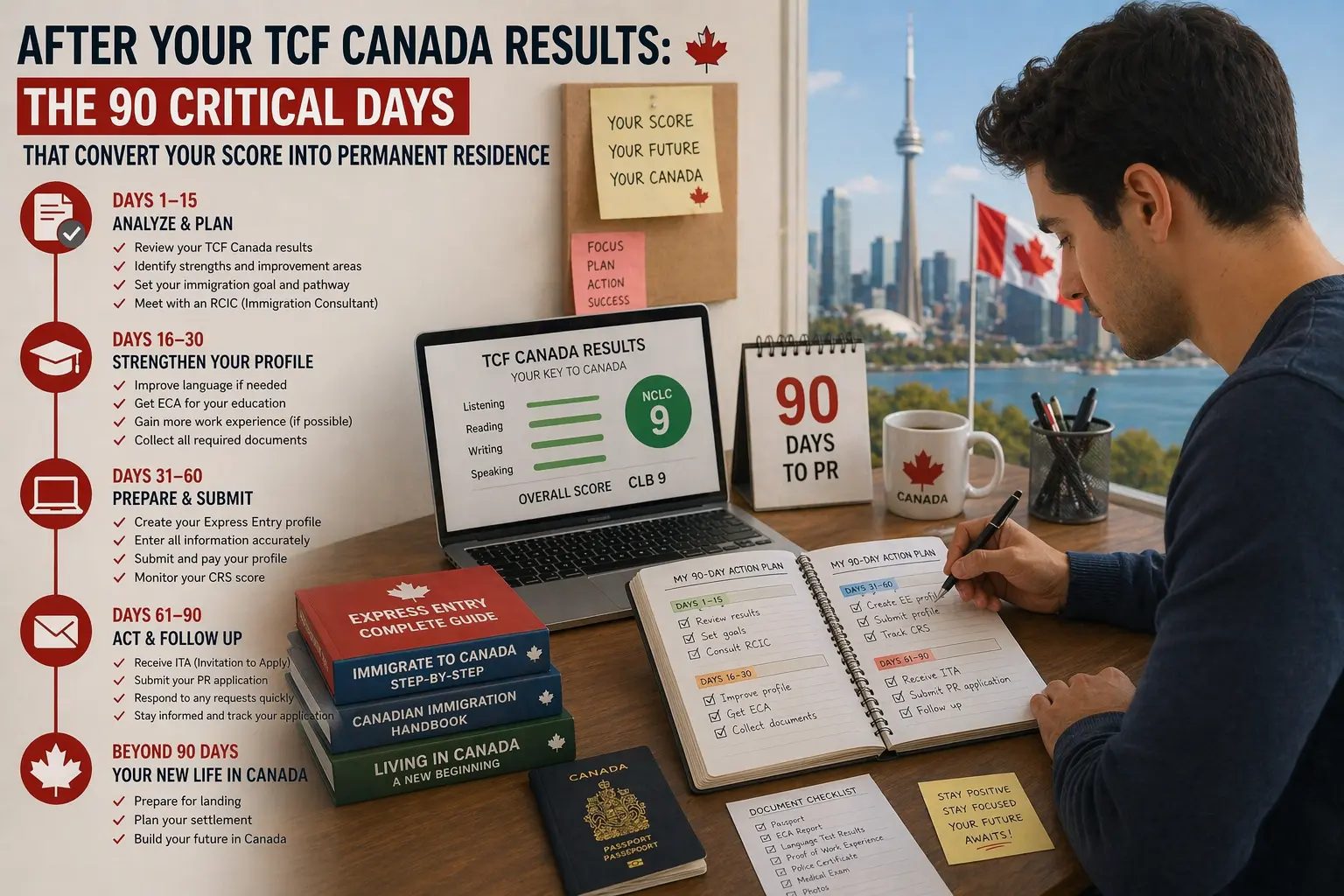
Your TCF Canada results have arrived. That milestone is cleared. But receiving your score is the halfway point of the process — not the finish line. The 90 days that follow are frequently the most consequential of an entire immigration journey. Candidates who treat results day as a moment to celebrate and then gradually build a dossier over several months often lose months of CRS pool positioning to candidates who act within the first 72 hours and pre-position everything else in advance.
Our article on Decoding Your TCF Canada Results: Analysis and Improvement Guide covers how to read and interpret your scores. This article is the sequel: a concrete, day-by-day action plan for the 90 days that determine whether your TCF Canada score becomes a permanent residence or remains a paper qualification.
Days 1–3: The Critical First 72 Hours
Action 1 — Download Your Official Attestation
Your results are available in the France Éducation International candidate portal within 3 to 7 days of your exam date in the new digital format — see our analysis of the TCF Canada 2026 Digital Shift. Download the official attestation immediately. IRCC requires this document in its digital format for Express Entry profiles — not a screenshot, not a photograph. Save it in at least two separate cloud storage locations.
Action 2 — Convert and Calculate
| TCF Canada Score Range | NCLC Level | CRS Points (per skill) |
|---|---|---|
| Listening/Reading: 458–502 | NCLC 7 | 6 |
| Listening/Reading: 503–548 | NCLC 8 | 6 |
| Listening/Reading: 549–579 | NCLC 9 | 7 (6+1 bonus) |
| Listening/Reading: 580–699 | NCLC 10–12 | 7 (6+1 bonus) |
| Speaking/Writing: 10–11/20 | NCLC 7 | 6 |
| Speaking/Writing: 12–13/20 | NCLC 8 | 6 |
| Speaking/Writing: 14–15/20 | NCLC 9 | 7 (6+1 bonus) |
| Speaking/Writing: 16–20/20 | NCLC 10–12 | 7 (6+1 bonus) |
Action 3 — Update Your Express Entry Profile and Activate Draw Alerts
Log into your IRCC portal, navigate to the Language section and enter your four new NCLC levels. Recalculate your CRS score using the IRCC official tool. Compare to recent Francophone draw thresholds (available at CanadaVisa.com). Immediately activate IRCC automatic draw notification emails at canada.ca. Set up third-party alerts via CanadaVisa or ImmigrationDirect for Francophone-specific draw announcements.
The Retake Decision — A Clear Framework
Retake rules every candidate must know:
- Minimum 30 calendar days between sittings — not business days, calendar days
- IRCC uses your most recent score — not your best score across all sittings
- You can retake only expression skills (speaking + writing) OR only comprehension skills (listening + reading) if the other pair is satisfactory
- If you retake two skills and one regresses, IRCC uses the lower new score — calculate the retake risk carefully
Full retake strategy analysis: TCF Canada 2026 Retake Strategies
Post-results decision tree:
- NCLC 9+ in all 4 skills: Create Express Entry profile immediately + begin full dossier assembly (see timeline below)
- NCLC 9 in 3 skills, 1 skill at NCLC 7–8: Light targeted retake in 4–6 weeks on the weak skill only + begin dossier assembly in parallel
- NCLC 7–8 in 2+ skills: Full 2–3 month preparation programme + complete retake — do not rush a partial retake if the underlying preparation gap is significant
- Score within 3 TCF points of NCLC threshold: Targeted correction + retake in the next available session (4–6 weeks) — the marginal correction required is achievable quickly
Weeks 1–2: Dossier Audit and Document Launch
| Document | Lead Time | Action if Missing | Priority |
|---|---|---|---|
| Credential evaluation (WES or equivalent) | 7–11 weeks | Order today — cannot be accelerated | 🔴 Critical |
| Police clearance certificate | 4–8 weeks (varies by country) | Begin application process immediately | 🔴 Critical |
| Immigration medical examination | 2–4 weeks (valid 12 months) | Book with designated IRCC physician | 🟡 Urgent |
| Employer reference letters (HR-signed) | 1–3 weeks | Contact HR departments of all relevant employers | 🟡 Urgent |
| Bank statements (6 consecutive months) | Immediate | Compile complete banking dossier now | 🟢 Soon |
| IRCC-format identity photos | 1 day | Professional photographer recommended | 🟢 Soon |
Weeks 3–8: CRS Acceleration Strategy Activation
Strategy 1 — Monitor and Target Francophone Category Draws
Set up daily monitoring of the IRCC draw announcements page. Francophone category draws with thresholds between 361 and 393 (2024–2025 data) occur approximately once to twice monthly. A candidate with NCLC 9 oral skills and a CRS in the 380–420 range should monitor every draw and be ready to receive an ITA at any time — with a pre-assembled dossier ready to submit within days.
Strategy 2 — Investigate Active Francophone PNPs
| Province | Programme | Min. NCLC | Priority Sectors | Status 2026 |
|---|---|---|---|---|
| Ontario | OINP Francophone Stream | NCLC 7 | Health, education, IT | Active — periodic opens |
| New Brunswick | NBPNP Skilled Workers | NCLC 7 | All sectors — French required | Active — continuous |
| Manitoba | MPNP Francophone pathway | NCLC 7 | Agri-food, construction, health | Active — check current |
| Alberta | AINP Francophone | NCLC 7 | Energy sector, healthcare | Active — sector specific |
| Saskatchewan | SINP Francophone | NCLC 7 | Agriculture, health | Active — periodic opens |
For the complete provincial pathway landscape, see our New Provincial Pathways in 2026 article and our 2026 New Immigration Processing Timelines analysis.
Weeks 9–12: Pre-Assemble the Complete PR Dossier Before the ITA
The pre-assembly principle: The 60-day ITA submission window is not 60 days to prepare your dossier — it is 60 days to finalise and submit what should already be 90% complete. Candidates who treat the ITA as the starting signal for document gathering frequently scramble, miss deadlines or request extensions that complicate processing. Treat the ITA as the final signal to assemble and submit — not to begin.
Pre-assembly checklist for weeks 9–12: Certified copies of all academic credentials — certified translation of any non-French/English documents — employment reference letters with official HR stamps and contact details — police clearances from all countries of residence lasting more than 6 months — immigration medical results — 6 consecutive months of bank statements — IRCC-format photos — proof of relationship for all accompanying family members — certified French translation of any documents in other languages
"I received my ITA exactly 4 months after my TCF Canada results. I spent those 4 months completing my dossier, requesting my WES evaluation, joining neighbourhood Facebook groups in my future city, and reading about my future province's healthcare system and housing market. The day my PR confirmation arrived, I felt ready to land — not just to immigrate. That preparation made the first weeks infinitely easier." — Rania, biomedical researcher from Tunis, now at Université Laval





0 Commentaires
aucun commentaire
Soyez le premier a partager votre avis !