-
Auteur :
 Antoine C.
- May 01, 2026
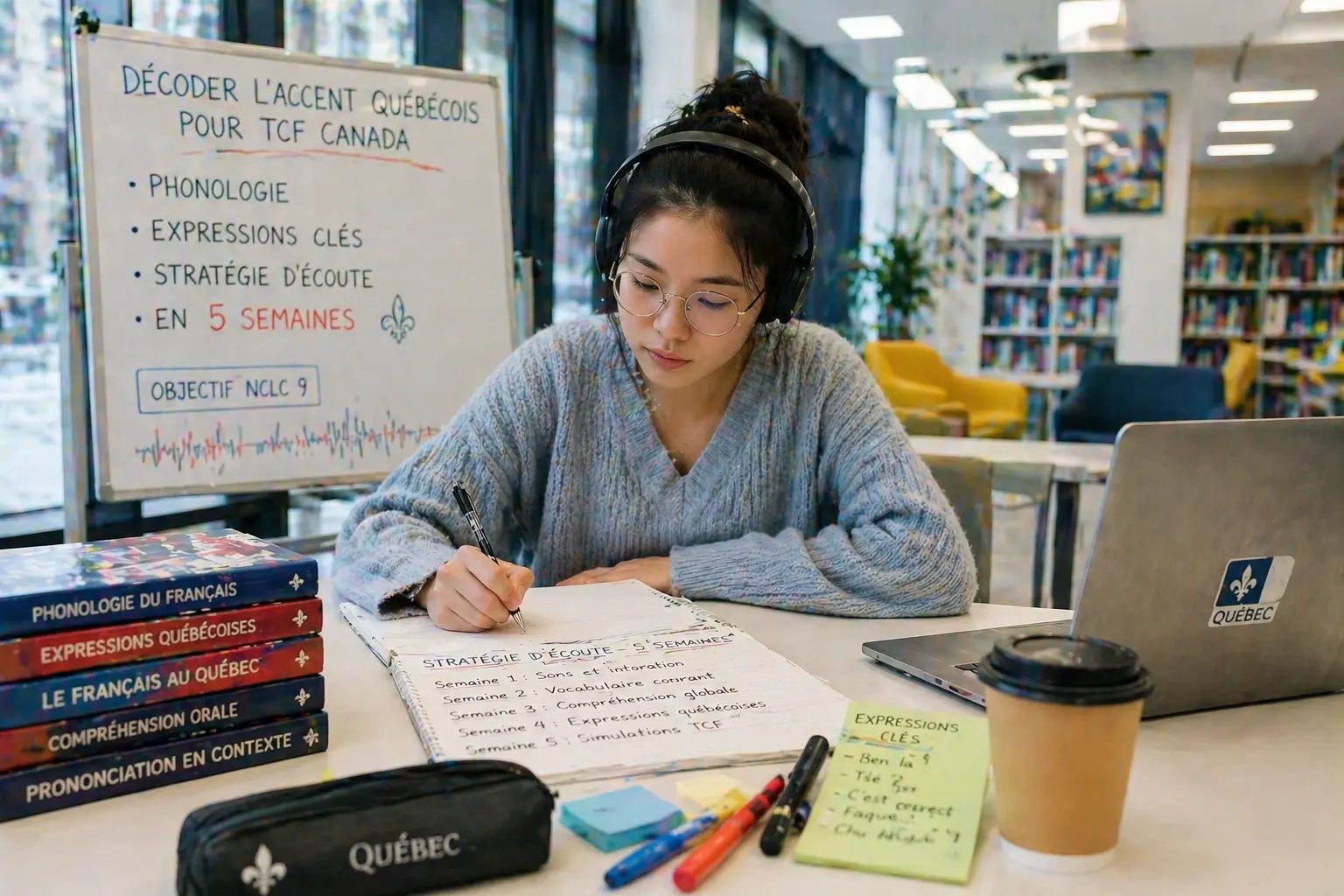
The Quebec accent ranks as the most frequently cited phonological obstacle in post-exam testimonials from TCF Canada candidates. Our Active Listening Strategies and Maximise Your Listening Comprehension Scores articles provide the strategic and tactical framework for the listening section overall. This article focuses on the specific phonological challenge — Quebec phonology — with the rules, the recognition exercises and the weekly programme to master it within 5 weeks.
Here is the most important clarification to make first: the Quebec accent used by professional speakers in TCF Canada audio documents — journalists, government officials, expert interviewees, Radio-Canada presenters — is significantly more neutral and accessible than the popular Quebec accent of street conversations, regional communities or entertainment media. You don't need to understand all Quebec French — you need to understand standard Quebec French, which is a much more manageable target.
The calibration principle: TCF Canada audio documents use the same French heard on Radio-Canada ICI Première news bulletins. Train on Radio-Canada and you are training directly for the exam's actual audio register. Training exclusively on French series, Quebec comedy shows or informal conversation recordings over-prepares you for a more difficult accent than TCF Canada actually uses — while potentially under-preparing you for the institutional vocabulary that exam documents contain.
The 8 Phonological Features of Standard Quebec French
Feature 1 — Affrication of [t] and [d] Before [i] and [y]
The most perceptually striking difference between Quebec French and European French for non-Quebec ears. In Quebec French, [t] and [d] before the vowels [i] and [u] transform into affricate sounds — [ts] and [dz] respectively. This is systematic and rule-governed, not random.
| Word | European French Pronunciation | Standard Quebec French Pronunciation |
|---|---|---|
| tu | [ty] | [tsy] — rhymes with "tsoo" |
| dire | [diʁ] | [dziʁ] — initial consonant is affricated |
| petit | [pəti] | [pətsɪ] — final [t] affricated before [i] |
| attitude | [atityd] | [atsɪtsyd] — all [t]+[i] affricated |
| définitivement | [definitiv(ə)mɑ̃] | [definɪtsɪvmɑ̃] — affrication at [ti] |
The recognition fix — 5 minutes of targeted learning: Learn the rule explicitly (t+i/u → ts, d+i/u → dz). Then listen to 10 words: tu, dire, petit, attitude, idée, défense, outil, routine, différent, distance. For each, identify the underlying word despite the modified consonant. After this explicit practice, affrication ceases to be an obstacle and becomes a recognisable pattern — the transformation of an anxiety into a manageable rule.
Feature 2 — Diphthongisation of Long Stressed Vowels
In Quebec French, historically long vowels in stressed position "glide" toward a second sound — a process called diphthongisation.
| Long Vowel | Example Word | Quebec Pronunciation | Approximate English Rendering |
|---|---|---|---|
| [ɛː] long | fête | [faɪt] | Like "fate" but French |
| [aː] long | pâte | [paɔt] | Glides toward [aɔ] |
| [oː] long | côte | [kɔʊt] | Glides toward [ɔʊ] |
Features 3–8: Additional Key Phonological Characteristics
Feature 3 — Word cluster reductions (most frequent in informal register):
- "il" → often [i] with lateral deletion: "il fait" → "i fait"
- "tu as" → "t'as" (very common in all registers)
- "je suis" → "ch'uis" or "j'uis" (informal to semi-formal)
- "ils ont" → "i z-ont" (liaison with deletion)
Note: These reductions are less frequent in TCF Canada's journalistic register but not absent — recognise them, don't attempt to produce them.
Feature 4 — Vowel raising before certain consonants: [ɛ] raises to [e] before [ʁ] in open syllable: "faire" can sound like "fère" with a raised vowel quality.
Feature 5 — Retention of historically silent word-final consonants: In some Quebec varieties, "ils" retains a pronounced [z] in certain contexts. "Autobus" retains a pronounced final [s].
Feature 6 — Use of "ben" as a discourse marker: "Ben oui" (well yes), "ben non" (well no) appear in informal interview segments and dialogue transcriptions in TCF Canada.
The 50 Quebec French Expressions to Recognise Before Exam Day
| Quebec Expression | Standard French Meaning | TCF Canada Domain | Frequency |
|---|---|---|---|
| Dépanneur | Épicerie de proximité ouverte tard | Housing, neighbourhood | ★★★★★ |
| Magasiner | Faire du shopping | Commerce, leisure | ★★★★★ |
| Courriel | Email (standard in official Canadian French) | All contexts | ★★★★★ |
| Fin de semaine | Week-end | Daily life | ★★★★★ |
| Avant-midi | Matinée / avant midi | Time, planning | ★★★★☆ |
| Clavardage | Chat en ligne / messagerie instantanée | Technology | ★★★★☆ |
| Garderie | Crèche / structure de garde d'enfants | Family, society | ★★★★☆ |
| Caisse populaire | Coopérative de crédit (réseau Desjardins) | Finance | ★★★★☆ |
| Guichet automatique | Distributeur de billets (DAB) | Finance | ★★★★☆ |
| Présentement | Actuellement / en ce moment | All contexts | ★★★★☆ |
| Char | Voiture (informal) | Transport | ★★★☆☆ |
| Jaser | Bavarder informellement | Social relations | ★★★☆☆ |
| Placoter | Cancaner / bavarder de choses futiles | Social relations | ★★☆☆☆ |
| Tuque | Bonnet de laine d'hiver | Weather, daily life | ★★★☆☆ |
| Dépenseuse / dépenseux | Personne qui dépense beaucoup | Finance, lifestyle | ★★☆☆☆ |
The 5-Week Phonological Acclimatisation Programme
Week 1 — Affrication recognition: 20 min/day of Radio-Canada ICI Première news. Active task: count every affrication instance detected (t+i/u, d+i/u). Keep a tally. This active detection task accelerates recognition far faster than passive exposure. By end of week 1, affrication should be recognisable rather than alarming.
Week 2 — Diphthongisation identification: Radio-Canada OHdio podcasts with varied contributors. Focus on long stressed vowels — note every word where the vowel sounds unexpected. Verify by checking Radio-Canada transcripts where available. Begin your 50-item Quebec expression Anki deck (10 new cards daily for 5 days).
Week 3 — Word cluster reductions: Watch 3 episodes of "Tout le monde en parle" on tou.tv with French subtitles enabled. Identify every contraction: "il" → "i", "tu as" → "t'as", "je suis" → "ch'uis", "ils ont" → "i z-ont". This popular talk show uses more reductions than TCF Canada documents but training on it makes the exam register feel effortless by comparison.
Week 4 — Prosody and rhythm: 25 min/day Radio-Canada ICI Première. Begin shadowing once on a 60-second extract per session — imitating rhythm and intonation, not just content. Measure weekly comprehension percentage on Radio-Canada news: target 70–75% by end of week 4.
Week 5 — Full TCF Canada simulation: 30 min/day Radio-Canada without any transcript support. After each 10-minute segment, write 5 main points understood. Complete 2 full TCF Canada-style listening practice tests this week and compare to week-1 baseline. Target 75–80% comprehension on Radio-Canada content and measurable improvement on TCF Canada practice test scores.
"I was terrified of the Quebec accent. I had watched some Quebec TV series and genuinely didn't understand large sections. Then someone told me that TCF Canada uses Radio-Canada journalist French, not street Quebec French. I spent one weekend listening only to Radio-Canada ICI Première news and the difference was striking — it was accessible from the start. After 5 weeks of daily Radio-Canada, I scored NCLC 9 in listening comprehension. The 'difficult' Quebec accent is not the one on TCF Canada." — Asma, teacher from Sousse




0 Commentaires
aucun commentaire
Soyez le premier a partager votre avis !