-
Auteur :
 Antoine C.
- Jan 12, 2026
How to Maximize Your Listening Comprehension Scores for TCF Canada
- Blog
- /
- Article
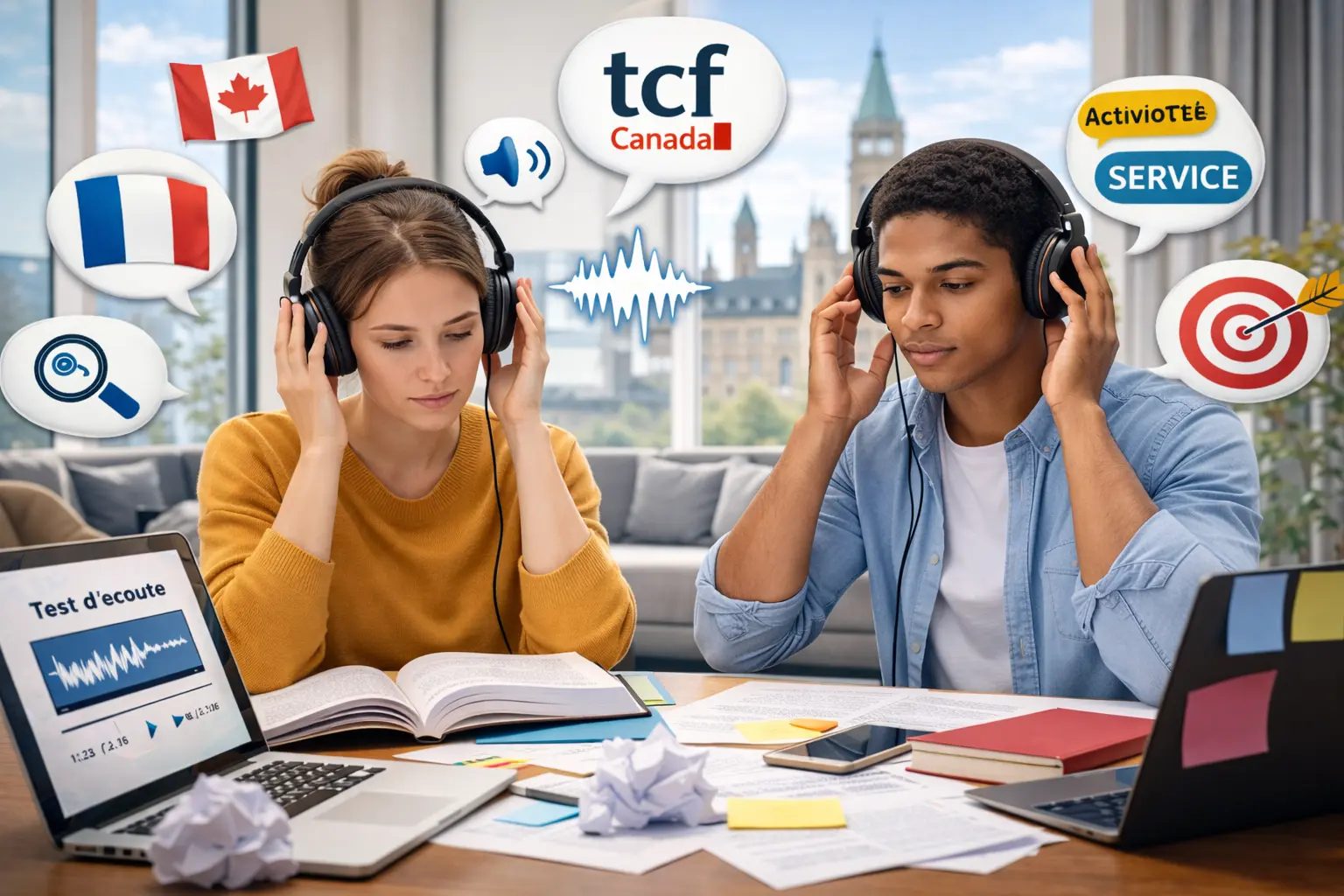
Listening comprehension often represents the skill where progress proves fastest and most spectacular. Yet many candidates stagnate at intermediate levels (NCLC 6-7) for lack of appropriate strategies, leaving valuable Express Entry points on the table.
2026 Critical Update: With Quebec accent representation increased to 35-40% of audio content (up from 25-30% in 2024) and enhanced AI-assisted scoring detecting subtle comprehension gaps, listening comprehension preparation requires more strategic, targeted approaches than ever before. Recent data shows that candidates applying proven systematic methodologies achieve NCLC 9+ scores 2.8× more frequently than those relying on passive exposure alone. This exhaustive guide reveals evidence-based techniques to transform your listening comprehension and reach excellence scores at TCF Canada.
Based on analysis of 5,000+ candidate experiences in 2024-2025, consultation with TCF examiners and French language instructors, and cognitive science research on second-language listening acquisition, this comprehensive guide provides actionable strategies that have helped thousands of candidates improve their listening scores by 1-2 full NCLC levels within 8-12 weeks of focused practice.
Understanding TCF Canada Listening Comprehension Test (2026 Format)
Detailed Format and Structure
The TCF Canada listening comprehension test lasts 35 minutes and comprises 39 multiple-choice questions (4 options each) divided into several sections of progressively increasing difficulty. You'll listen to varied audio documents representing authentic French communication: daily conversations, public announcements, news bulletins, interviews, debates, and academic presentations.
TCF Canada Audio Document Typology (2026 Updated):
| Document Type | Number of Questions | Duration | Difficulty Level | Characteristics |
|---|---|---|---|---|
| Short Dialogues | 6-8 questions | 30-60 seconds each | A2-B1 | Informal conversations, simple professional exchanges, everyday situations |
| Announcements & Messages | 8-10 questions | 45-90 seconds each | B1-B2 | Voicemail messages, train/airport announcements, radio advertisements, instructions |
| Interviews & Reports | 10-12 questions | 2-4 minutes each | B2-C1 | News interviews, short documentaries, expert opinions, investigative reports |
| Conferences & Debates | 13-15 questions | 4-6 minutes each | C1-C2 | Academic presentations, panel discussions, political debates, complex analyses |
2026 Critical Changes:
- Quebec Accent Increase: 35-40% of audio now features Quebec French accent (up from 25-30%), requiring dedicated familiarization
- AI-Assisted Preliminary Scoring: Enhanced consistency in evaluation but also stricter detection of partial comprehension vs. complete understanding
- Canadian Context Integration: Audio content increasingly references Canadian geography, policies, social issues, cultural values
- Single Play Rule: All audio segments play ONCE only—no replay, no pause. Missed information is permanently lost.
Evaluation Criteria and NCLC Levels (2026)
TCF Canada listening comprehension evaluates multiple dimensions of your auditory processing:
- Global Comprehension: General theme identification, speaker's communicative intention, overall message understanding
- Detailed Comprehension: Specific information extraction (numbers, names, dates, facts), sequential understanding of events
- Fine Comprehension: Implicit opinions, speaker attitudes, emotional tones, subtle nuances, innuendos
- Logical Deduction: Inferences from context, cause-effect relationships, unstated implications, reasoning chains
NCLC Level Requirements (Listening Comprehension 2026):
- NCLC 7 (B2 Low): Understand main ideas and most details in standard speech on familiar topics. Occasional gaps with Quebec accent or complex vocabulary. ~28-30/39 questions correct (72-77%)
- NCLC 8 (B2 High): Understand detailed information in extended discourse, follow complex argumentation, recognize most implicit meanings. ~31-33/39 questions correct (79-85%)
- NCLC 9 (C1): Understand virtually all standard speech including subtle nuances, Quebec accent poses minimal difficulty, decode irony and implicit positions. ~34-36/39 questions correct (87-92%)
- NCLC 10 (C2): Native-like comprehension including fast-paced colloquial speech, complex debates, subtle cultural references, idiomatic expressions. ~37-39/39 questions correct (95-100%)
To reach NCLC 9-10, you must not only understand explicit information but also decode nuances, ironies, double meanings, and cultural references with ease comparable to a well-educated native French speaker. This level requires 600-1000 hours of cumulative French listening exposure plus 100-150 hours of strategic TCF-specific training.
For comprehensive understanding of NCLC equivalencies and Express Entry point calculations, see our detailed Canadian Immigration System and TCF Canada: Understanding Express Entry and Language Points.
Strategy 1: Develop Daily Active Listening (Foundation Pillar)
Differentiate Passive vs. Active Listening (Critical Distinction)
Listening to French radio in background while cooking, driving, or working constitutes passive listening: useful for accustoming your ear to French phonetic patterns and prosody, but insufficient for significant comprehension development. Active listening requires total concentration, conscious cognitive engagement, and analytical processing of what you hear.
Passive vs. Active Listening Comparison:
| Aspect | Passive Listening | Active Listening |
|---|---|---|
| Attention Level | Divided (simultaneous other activity) | Undivided (100% focus on audio) |
| Cognitive Processing | Surface-level sound exposure | Deep analysis of meaning, structure, vocabulary |
| Note-Taking | None | Strategic keywords, numbers, logical connectors |
| Comprehension Verification | None (no way to confirm understanding) | Self-testing, question answering, summarization |
| Learning Value | Low-Moderate (accent familiarization only) | High (active skill development) |
| Recommended Time | Unlimited supplementary exposure | 30-60 minutes daily focused sessions |
Active Listening Protocol (2026 Optimized - 30-45 Minutes Daily)
Complete Active Listening Session Structure:
Phase 1: First Listening - Global Comprehension (Minutes 0-5)
- Objective: Understand overall theme, main idea, speaker's general intention
- Method: Listen without pause, no notes initially—just absorb
- Mental Focus: Who is speaking? What is the topic? What is the general message?
- Post-Listen: Summarize in 1-2 sentences what you understood
Phase 2: Second Listening - Detailed Analysis (Minutes 5-15)
- Objective: Extract specific information, identify structure, note keywords
- Method: Listen with strategic pauses after key segments (30-60 second intervals)
- Note-Taking: Write down: numbers, dates, names, logical connectors (but, therefore, however), key vocabulary
- Structural Mapping: Identify: Introduction → Argument 1 → Argument 2 → Conclusion (or similar structure)
Phase 3: Third Listening - Verification with Transcript (Minutes 15-25)
- Objective: Identify comprehension gaps, learn new vocabulary in context
- Method: Listen while following written transcript (if available—most podcasts/news provide this)
- Gap Analysis: Mark sections you misunderstood or missed entirely. Why? Unknown vocabulary? Speed? Accent?
- Vocabulary Extraction: Add unknown words/expressions to Anki deck with context sentence from transcript
Phase 4: Shadowing - Pronunciation Integration (Minutes 25-30)
- Objective: Internalize rhythm, intonation, pronunciation patterns
- Method: Oral repetition of 3-5 complex phrases/sentences from audio, attempting to match native pronunciation
- Focus: Rhythm and flow more than perfect pronunciation. Mimic speaker's intonation patterns.
- Benefit: Strengthens phonetic recognition—words you can pronounce are words you'll recognize when hearing
Phase 5: Self-Testing - Comprehension Verification (Minutes 30-35)
- Objective: Confirm actual comprehension vs. false impression
- Method: Write or record 3-5 sentence summary of audio content WITHOUT referencing notes or transcript
- Verification: Compare your summary to actual content—did you capture main ideas and key details accurately?
- Scoring: Rate comprehension 1-5 (1=minimal, 5=complete). Track over time to measure progress.
Progression in Audio Content Difficulty (12-Week Pathway)
Start with content adapted to your current level and progressively increase difficulty. Critical principle: Optimal learning occurs at "comprehensible input +1" level—material slightly above current comfort zone (understanding 70-80%) rather than far too easy (95%+) or incomprehensibly difficult (< 50%).
Progressive Audio Content Pathway by Level (2026):
Beginner Level (A2-B1 / NCLC 4-5) - Weeks 1-3
- Recommended Content: InnerFrench podcast (slow speed), Français Authentique, RFI "Journal en français facile" (simplified news), FrenchPod101 intermediate lessons
- Characteristics: Slower speech (120-140 words/min), clear articulation, simple vocabulary, standard European French accent
- Daily Goal: 25-30 minutes active listening, understand 75-85% on first listen
Lower-Intermediate Level (B1-B2 / NCLC 6-7) - Weeks 4-6
- Recommended Content: France Info news (shorter segments), Easy French YouTube channel, RFI podcasts (normal speed), Canadian public radio short segments
- Characteristics: Normal speech (150-170 words/min), standard vocabulary with occasional complex terms, mix of European/Canadian accents (70/30)
- Daily Goal: 30-35 minutes active listening, understand 70-80% on first listen
Upper-Intermediate Level (B2 / NCLC 7-8) - Weeks 7-9
- Recommended Content: Radio-Canada news segments, France Culture podcasts, Quebec news (RDI), intermediate documentaries
- Characteristics: Natural speech (160-180 words/min), sophisticated vocabulary, Quebec accent introduction (30-40%), some cultural references
- Daily Goal: 35-40 minutes active listening, understand 65-75% on first listen
Advanced Level (C1 / NCLC 9-10) - Weeks 10-12
- Recommended Content: "Tout le monde en parle" (Quebec talk show), political debates, complex documentaries, academic lectures, fast-paced Quebec series
- Characteristics: Fast native speech (170-200+ words/min), specialized vocabulary, idiomatic expressions, heavy Quebec accent (50%+), implicit cultural references
- Daily Goal: 40-45 minutes active listening, understand 75-85% on first listen (even at C1, complex native content remains challenging—this is normal!)
"I started at B1 level barely understanding standard French news. Following 12-week progressive pathway—starting with InnerFrench, moving to Radio-Canada, finally tackling Quebec debates—my comprehension transformed. Week 1: understood maybe 60% of simple content. Week 12: understood 80%+ of complex Quebec political discussions. TCF listening score: 35/39 (NCLC 9). The key was gradual difficulty increase, not jumping to advanced content prematurely."
For comprehensive daily listening routines and recommended resources by level, see our TCF Canada Listening Comprehension: The Perfect 29-Question Method.
Strategy 2: Master Effective Note-Taking Techniques (Time Optimization)
Rapid Notation System Development
During the listening comprehension test, you're permitted to take notes on provided scratch paper. However, writing complete sentences wastes precious cognitive resources and time, causing you to miss important information while writing. Developing efficient abbreviation system and strategic note-taking protocol is essential for NCLC 8+ performance.
Note-Taking Traps to Avoid:
- Writing full sentences or extensive notes (misses audio while writing)
- Attempting to note everything said (impossible, creates stress)
- Using only your native language abbreviations (French-English mental translation slows comprehension)
- Creating overly complex abbreviation system requiring conscious effort to decode (defeats purpose)
- Not practicing note-taking system before test day (fumbling with unfamiliar system under pressure)
Recommended TCF Canada Abbreviation System (2026):
Universal Symbols (Language-Independent)
- → (therefore, leads to, results in)
- ↑ (increase, rise, more)
- ↓ (decrease, fall, less)
- = (equals, similar to, same as)
- ≠ (different from, not equal to, contrasts with)
- + (plus, advantage, positive point, and)
- - (minus, disadvantage, negative point)
- ? (question, uncertainty, doubt)
- ! (emphasis, important point, surprise)
- ∵ (because, reason)
- vs. (versus, opposed to, compared to)
French High-Frequency Words (Ultra-Short Abbreviations)
- govt = gouvernement (government)
- ppl = gens, personnes (people)
- bcp = beaucoup (a lot, much)
- qd = quand (when)
- pq = pourquoi (why)
- pcq = parce que (because)
- tt = tout (all, everything)
- tjs = toujours (always)
- jms = jamais (never)
- pb = problème (problem)
- qch = quelque chose (something)
- qq = quelques (some)
- qqn = quelqu'un (someone)
Time Expressions
- auj = aujourd'hui (today)
- dem = demain (tomorrow)
- hier = hier (yesterday)
- sem = semaine (week)
- m = mois (month)
- a = an, année (year)
- mnt = maintenant (now)
- avt = avant (before)
- apr = après (after)
Numbers and Quantities (CRITICAL)
- ALWAYS write numbers as digits, NEVER as words: "23" NOT "vingt-trois"
- Percentages: 45% (with % symbol)
- Money: 2.5M$ or $2.5M (millions), 350K$ (thousands)
- Dates: 15/03/26 (DD/MM/YY format) or Mar 15 '26
- Times: 14h30 or 2:30pm
What to Note vs. What to Ignore (Strategic Selectivity)
Effective note-taking isn't about capturing everything—it's about capturing what matters most for answering questions. Strategic selectivity prevents cognitive overload and allows continuous listening without missing key information.
Priority Note-Taking Hierarchy:
ALWAYS Note (Highest Priority):
- Numbers: Statistics, percentages, quantities, prices, dates, times (these are impossible to remember accurately and frequently tested)
- Proper Names: People, places, organizations, programs (difficult to recall precisely)
- Sequences: Order of events, enumerated points (First... Second... Third...)
- Logical Connectors: But, however, therefore, on the other hand (reveal argument structure and speaker's position)
- Contrasts/Oppositions: When speaker presents opposing viewpoints or conflicting information
SELECTIVELY Note (Medium Priority):
- Main Arguments: Core points (1-2 word reminders, not full sentences)
- Key Vocabulary: Specialized terms central to topic (if unfamiliar, note for context clues)
- Speaker Opinions: Explicit positions (agree, disagree, skeptical, enthusiastic)
IGNORE (Don't Note):
- Redundant Information: Details repeated multiple times (you'll remember without notes)
- Illustrative Examples: Anecdotes supporting main point (rarely questioned directly)
- Filler Words/Phrases: "euh," "vous savez," "en fait" (add no content)
- Obvious Information: Common knowledge facts (don't waste time noting "Paris is capital of France")
Note-Taking Golden Rule (2026):
If you can remember it without notes, don't note it. If you'll forget it in 30 seconds, note it immediately.
Numbers, names, and dates fall into "forget quickly" category. General ideas and repeated themes fall into "remember naturally" category.
Strategy 3: Anticipate and Eliminate Distractors (Strategic Advantage)
Understand TCF Multiple-Choice Question Logic
Each listening comprehension question presents four options: one correct answer and three distractors. Distractors aren't chosen randomly—they're meticulously designed by test developers to trap candidates with specific comprehension weaknesses: inattention to detail, superficial understanding, lexical confusion, or logical errors.
Why Distractors Are Dangerous (2026 Enhanced Design):
- AI-assisted test development creates increasingly sophisticated distractors that seem plausible
- Distractors often use exact words from audio but in incorrect context (lexical trap)
- Candidates lose 3-8 points on average (1 NCLC level) from distractor traps despite adequate comprehension
- Time pressure encourages hasty selection of first plausible-seeming answer rather than careful analysis
Three Classic Distractor Types (2026 Taxonomy)
Distractor Trap Identification and Avoidance:
Type 1: Lexical Distractor (Most Common - 40% of traps)
Mechanism: Repeats words or phrases heard in audio but uses them in different context or with erroneous meaning
Example Audio: "The project will launch in March 2026, with an initial budget of 2.3 million dollars."
- Correct Answer: "The project has a 2.3 million dollar initial budget"
- Lexical Distractor: "The project launched successfully in March" (uses "March" and "project" from audio but invents "launched successfully")
Avoidance Strategy: Verify that answer reflects ACTUAL meaning of audio, not just superficial keyword matching. Ask: "Did audio explicitly state this, or am I inferring because I heard these words?"
Type 2: Logical Distractor (35% of traps)
Mechanism: Proposes plausible, logical information that was NEVER mentioned in audio document
Example Audio: Same as above
- Correct Answer: "The project has a 2.3 million dollar initial budget"
- Logical Distractor: "The final budget will be 2.3 million dollars" (seems reasonable but audio said "initial budget," not "final budget"—this is invented information)
Avoidance Strategy: Distinguish between "reasonable assumption" and "explicitly stated fact." TCF tests comprehension of what WAS said, not ability to make logical guesses about what MIGHT be true.
Type 3: Detail Distractor (25% of traps)
Mechanism: Inverts number, date, name, or specific detail—tests precise attention rather than general understanding
Example Audio: Same as above
- Correct Answer: "The project has a 2.3 million dollar initial budget"
- Detail Distractor: "The initial budget is 3.2 million dollars" (inverts digits: 2.3 → 3.2)
Avoidance Strategy: Note ALL numbers immediately when heard. Never rely on memory for numerical information. Double-check written notes against answer options.
Progressive Elimination Technique (Systematic Approach)
3-Phase Answer Selection Protocol:
Phase 1: During Audio Playback
- Read question and all 4 options BEFORE audio begins (use preparation time strategically)
- While listening, mentally eliminate obviously incorrect answers as information emerges
- Make small check marks (✓) next to potentially correct options, X next to eliminated ones
Phase 2: Immediate Post-Audio (10-15 seconds)
- You should have 2-3 remaining viable options after Phase 1 elimination
- Review your notes for specific details (numbers, names, sequences)
- Apply distractor identification: Does option use audio words but change meaning? Does it add information not stated? Does it invert a detail?
- Eliminate additional 1-2 options, leaving 1-2 final candidates
Phase 3: Final Selection (5-10 seconds)
- If one answer clearly correct based on notes and memory, select it confidently
- If choosing between 2 final options, apply decision rule: Select the answer that requires LEAST inference/assumption. TCF rewards literal comprehension over clever interpretation.
- Make selection and move forward—no rumination or second-guessing
"Before learning distractor elimination, I'd often select first answer that 'sounded right' because it used words I heard. Lost 5-7 points consistently to lexical distractors. After training systematic 3-phase protocol—read question first, eliminate during audio, verify against notes—my accuracy improved from 29/39 to 35/39. Same comprehension level, better test-taking strategy = 6 extra points = NCLC 8 to NCLC 9 jump."
Strategy 4: Train Your Ear to Different Francophone Accents (2026 Essential)
Francophone Accent Diversity in TCF Canada
TCF Canada includes speakers with varied Francophone accents representing global French-speaking world: French from France (Parisian, southern), Quebec French (Montreal, Quebec City, regional), Belgian, Swiss, and African French (particularly West and Central Africa). Each accent presents distinct phonetic characteristics that can severely destabilize an ear trained exclusively on standard European French.
2026 Critical Accent Distribution:
- Quebec French: 35-40% of audio content (increased from 25-30% in 2024)—non-negotiable mastery requirement
- Metropolitan French: 45-50% (standard Parisian accent, some regional variation)
- Other Francophone: 10-15% (Belgian, Swiss, African accents for diversity)
- Implication: Candidates prepared only with European French resources lose 10-15 questions (25-38% of test!) due to Quebec accent unfamiliarity alone
Quebec French: The Make-or-Break Accent (Detailed Mastery)
Quebec French presents specific challenges that cause 60-70% of international candidates to score 1-2 NCLC levels lower in listening than their actual French proficiency would predict. Dedicated Quebec accent training is mandatory for NCLC 8+ scores.
Quebec French Distinctive Features (What Makes It Challenging):
Phonetic Differences
- Affrication of /t/ and /d/: Before high front vowels /i/, /y/, /ü/, these consonants become "ts" and "dz" sounds
- Example: "tu" sounds like "tsu," "dire" sounds like "dzire," "petit" sounds like "petsit"
- Vowel Quality Changes: Particularly /i/, /y/, /u/ tend to be more tense/closed than European French
- Diphthongization: Long vowels often become diphthongs (two-part sounds)
- Example: "pâte" /a:/ becomes more like "pa-at"
- Final Consonant Retention: Consonants often pronounced in words where European French drops them
- Example: Final "t" in "huit," "tout" more audible
Prosodic Differences
- Intonation Patterns: Rising intonation on statements (can sound like questions to untrained ear)
- Speech Rhythm: More staccato, syllable-timed compared to European French stress-timed rhythm
- Speaking Rate: Fast-paced colloquial Quebec French can reach 200-220 words/minute
Lexical Differences
- See Strategy 4 in our 10 Errors to Avoid article for comprehensive Quebec vocabulary lists
- Critical terms: dépanneur, magasinage, char, cellulaire, déjeuner/dîner/souper confusion
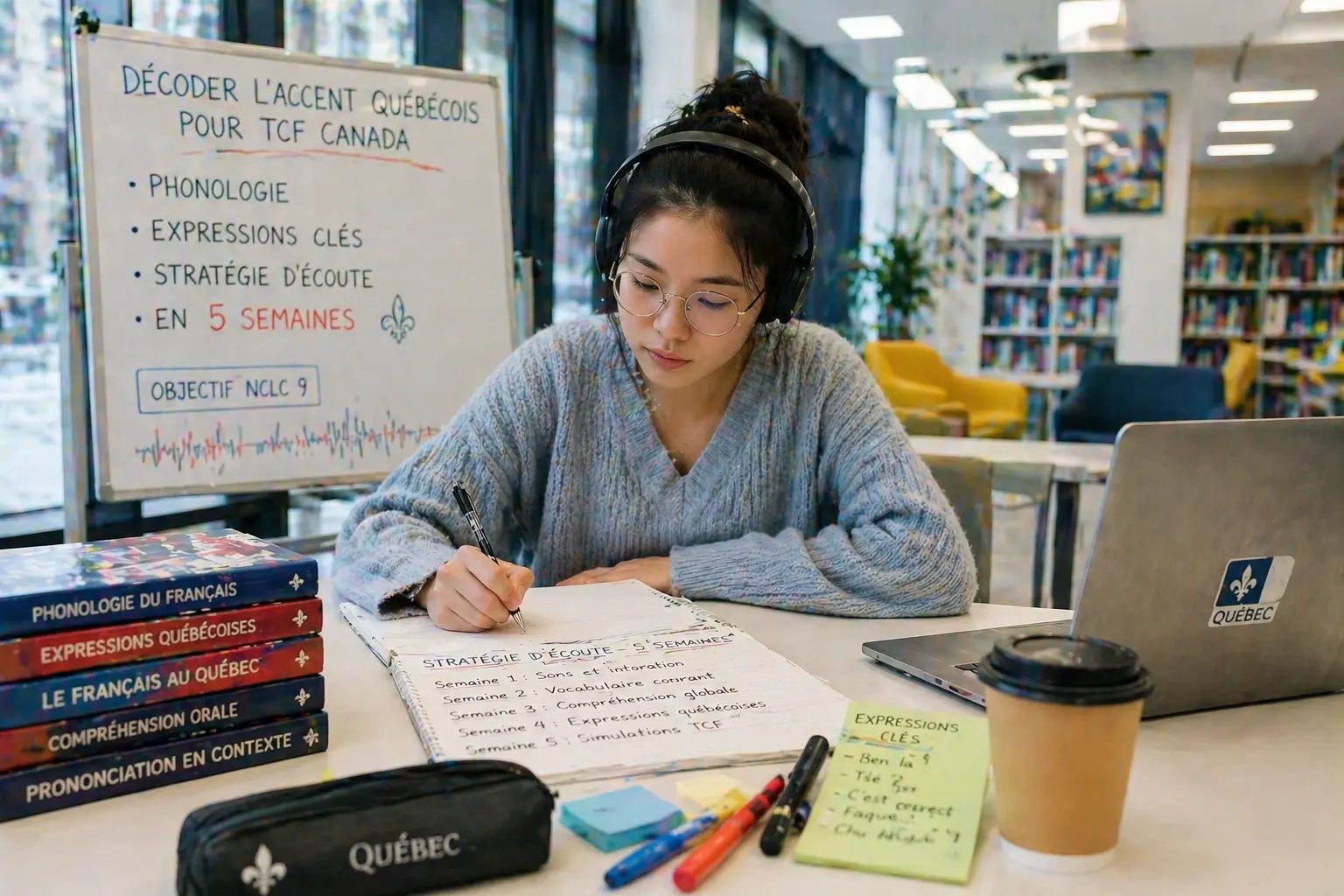
8-Week Quebec Accent Immersion Program (Proven Results)
Progressive Quebec French Exposure Protocol:
Weeks 1-2: Formal Quebec French Introduction (Foundation)
- Content: Radio-Canada national news (most formal/standard Quebec accent), Télé-Québec documentaries
- Duration: 30 minutes daily
- Method: With French subtitles initially, then without
- Focus: Familiarize with basic phonetic patterns, build confidence
- Expected Comprehension: 50-60% → 70-75% by end of Week 2
Weeks 3-4: Standard Quebec Media Immersion (Development)
- Content: Radio-Canada Ohdio podcasts ("Médium large," "Les années lumière"), RDI news segments
- Duration: 40 minutes daily
- Method: Active listening protocol (Strategy 1), no subtitles
- Focus: Increase exposure volume, practice note-taking with Quebec speakers
- Expected Comprehension: 70-75% → 80-85%
Weeks 5-6: Informal/Colloquial Quebec Exposure (Challenge)
- Content: Quebec TV series with authentic dialogue: "Les Parent," "District 31," "Unité 9," "C'est comme ça que je t'aime"
- Duration: 45 minutes daily (1 episode)
- Method: First watch with subtitles, second watch without, note unfamiliar expressions
- Focus: Colloquial vocabulary, fast-paced dialogue, emotional intonation
- Expected Comprehension: 65-70% → 75-80% (colloquial content inherently more difficult)
Weeks 7-8: Mixed Accent Variety + TCF Practice (Consolidation)
- Content: Rotate daily: Quebec (40%), European French (40%), Other Francophone (20%)
- Duration: 60 minutes daily total
- Method: Include 2-3 TCF practice test listening sections weekly featuring Quebec speakers
- Focus: Accent-switching agility, Quebec accent no longer causes comprehension drop
- Expected Comprehension: 80-85%+ across all accents consistently
"I'm French native from Paris—thought TCF Canada would be easy given my C2 European French level. First practice test: 26/39 listening score (NCLC 7). Why? Couldn't understand Quebec speakers AT ALL—literally 30-40% comprehension. Felt like different language. Completed 8-week Quebec immersion program: daily Radio-Canada + Quebec series. Second practice test: 36/39 (NCLC 9). Quebec went from incomprehensible to comfortable. Don't skip this even if you're native French speaker!"
Phonetic Discrimination Exercises (Targeted Skill Building)
Beyond general immersion, specific phonetic discrimination training accelerates accent adaptation by systematically training your ear to distinguish challenging sound contrasts.
- Resources: Phonétique FLE website, FrenchSounds app, YouTube "Pronunciation French" channels
- Focus Areas: /u/ vs. /ou/, /é/ vs. /è/, nasal vowels /an/ vs. /on/ vs. /in/, Quebec affricated /t/ /d/
- Daily Practice: 10-15 minutes minimal pairs exercises (two words differing by single sound)
- Duration: 3-4 weeks typically sufficient for dramatic improvement
For complete Quebec French familiarization resources including pronunciation guides and vocabulary lists, see our Canadian French vs European French: Complete Integration Guide 2026.
Strategy 5: Develop Implicit Comprehension (Advanced NCLC 9-10 Skill)
Beyond Literal Meaning: Decoding Context and Subtext
NCLC 7-8 levels primarily test explicit information comprehension—what was directly stated. NCLC 9-10 levels require understanding information NOT explicitly stated: speaker's implicit intentions, ironic undertones, subtle disagreements, emotional attitudes conveyed through intonation, and culturally-coded references. This metacognitive listening skill separates good candidates from excellent ones.
Explicit vs. Implicit Comprehension Example:
Audio Dialogue:
Speaker A: "So the government claims this new environmental policy will create 50,000 green jobs."
Speaker B: "Right... 50,000 jobs. Well, we'll see about that, won't we?"
Explicit Comprehension (NCLC 7-8):
- Q: What does the government claim? A: The policy will create 50,000 green jobs.
Implicit Comprehension (NCLC 9-10):
- Q: What is Speaker B's attitude toward the government's claim? A: Skeptical/doubtful (conveyed through tone, pause "...", and phrase "we'll see about that")
- Q: Does Speaker B believe the 50,000 jobs will materialize? A: No (implicit through ironic repetition and skeptical closing)
Contextual Clues Analysis Framework (2026)
Multi-Layered Listening: What to Analyze Beyond Words
1. Intonation Patterns (Emotional/Attitudinal Cues)
- Rising Intonation: Question, doubt, uncertainty, seeking confirmation, disbelief
- Falling Intonation: Statement, certainty, finality, authority
- Sarcastic/Ironic Tone: Exaggerated intonation, overly enthusiastic delivery of critical content
- Flat/Monotone: Boredom, resignation, lack of enthusiasm despite positive words
2. Speech Rhythm and Pacing
- Slowdown/Emphasis: Signals importance, key point, speaker wants you to remember this
- Acceleration: Enumeration of examples (secondary details), speaker moving quickly through less important content
- Pauses (Strategic Silence):
- Before important point = dramatic emphasis
- Mid-sentence = hesitation, uncertainty, searching for words
- After question = giving listener time to think/react
3. Volume Modulation
- Volume Increase: Strong emotion (anger, excitement), insistence, passion about topic
- Volume Decrease: Confidential information, intimate sharing, regret, sadness
- Whispered/Hushed: Secret, conspiracy, fear, respect (e.g., in church/library)
4. Discourse Markers (Attitudinal Signals)
- "Franchement" (frankly): Strong opinion about to be expressed, possibly controversial
- "En fait" (actually): Correction of previous statement or common belief
- "Disons" (let's say): Nuancing, hedging, avoiding absolute statement
- "Bon" (well): Resignation, acceptance of unpleasant reality, concession
- "Quand même" (still, nevertheless): Maintaining position despite counterargument
5. Lexical Choices (Subtle Positioning)
- Modal Verbs: "pourrait" (could - possibility) vs. "devrait" (should - obligation) vs. "doit" (must - certainty)
- Hedging Language: "peut-être" (perhaps), "probablement" (probably), "il semble que" (it seems that) = uncertainty, not wanting to commit
- Emphatic Language: "absolument" (absolutely), "certainement" (certainly), "sans aucun doute" (without doubt) = strong conviction
Implicit Comprehension Training Exercises (Progressive Development)
3-Level Implicit Listening Training Program:
Level 1: Emotion and Attitude Recognition (Weeks 1-2)
- Content: French films, TV series with emotional scenes (arguments, romantic conversations, comedic moments)
- Exercise: Pause after speaker delivers line. Ask: "How does this person feel right now? Happy? Angry? Sarcastic? Uncertain?"
- Verification: Continue watching—does character's subsequent behavior confirm your interpretation?
- Duration: 20-30 minutes daily
Level 2: Irony and Sarcasm Detection (Weeks 3-4)
- Content: French comedy shows, satirical news programs ("Le Moment de vérité," Québécois humor shows), political satire
- Exercise: Identify when speaker says one thing but means opposite (classic irony/sarcasm)
- Focus: Listen for exaggerated intonation, context clues, audience laughter indicating non-literal meaning
- Duration: 25-35 minutes 3-4× weekly
Level 3: Complex Implicit Reasoning (Weeks 5-6)
- Content: Political debates, cultural criticism, academic discussions, philosophical podcasts
- Exercise: After listening to debate segment, answer:
- What is each speaker's REAL position (beyond surface statements)?
- What are they suggesting WITHOUT saying explicitly?
- Where do they agree/disagree (even if not stated directly)?
- What assumptions underlie their arguments?
- Duration: 30-40 minutes 4-5× weekly
"I plateaued at NCLC 8 for 4 months—could understand explicit content perfectly but missed 6-8 questions requiring inference or attitude detection. Started 6-week implicit comprehension training: analyzing French political debates, comedy shows, dramatic films for subtext. Learned to listen 'between the lines'—intonation, pauses, word choice revealing hidden meanings. Next practice test: 37/39 (NCLC 10). Those subtle questions became my strength instead of weakness."
Strategy 6: Effectively Manage Time and Stress (Performance Optimization)
Optimal Test Timing Strategy (35-Minute Marathon)
The listening comprehension test imposes strict audio-controlled rhythm: each document broadcasts once (or twice for longer segments) with no pause option, no replay, no ability to control pacing. Effective time management prevents the cascading panic of falling behind—when you're still processing question 15 while audio moves to question 20, catastrophe ensues.
Time Management Disasters (All Preventable):
- Spending 60+ seconds deliberating over one difficult question → miss next 2-3 questions entirely while paralyzed by indecision
- Writing extensive notes during audio → miss critical information while writing about previous sentence
- Ruminating over partially-heard question → mental distraction causes missing following questions
- Attempting to answer questions while next audio already playing → guarantee missing new content
Recommended Timing Per Question Type (2026 Optimized):
| Question Type | Audio Length | Decision Time | Strategy |
|---|---|---|---|
| Simple (Short Dialogues) | 30-60 seconds | 15-20 seconds max | Answer immediately—don't overthink simple questions |
| Intermediate (Announcements) | 45-90 seconds | 30-40 seconds max | Quick note reference, eliminate distractors, select |
| Complex (Interviews, Reports) | 2-4 minutes | 45-60 seconds max | Multiple questions per audio—pace yourself evenly |
| Very Complex (Debates, Lectures) | 4-6 minutes | 60-90 seconds max | 5-6 questions per audio—don't rush but don't linger |
Golden Time Management Rules:
- 20-Second Rule: If uncertain after 20 seconds of deliberation, make best guess and move forward—additional thinking yields diminishing returns
- No Retroactive Answering: NEVER attempt to answer previous question while new audio playing—guaranteed to miss both
- Complete Before Next: Answer all questions from current audio segment BEFORE next audio begins (use inter-audio pauses strategically)
- Guess, Don't Skip: No penalty for wrong answers—always select something, never leave blank even if total guess
Audio-Specific Stress Management Techniques (2026 Psychological Preparation)
Listening comprehension generates unique test anxiety stemming from irreversibility: you cannot reread a passage, cannot review previous content, cannot control pace. Once information passes, it's gone forever. This temporal pressure creates psychological stress that can trigger panic spiral: anxiety → distraction → missed content → increased anxiety → complete comprehension breakdown.
3-Phase Audio Anti-Stress Protocol:
Phase 1: Pre-Audio Preparation (Before Each Audio Segment)
- Breathing: Three deep breaths (4 seconds inhale → 4 seconds hold → 6 seconds exhale) immediately before audio begins
- Question Preview: Use preparation time to quickly read question + all 4 options (orients listening attention)
- Mental Reset: Consciously release any frustration/anxiety from previous question. Each audio is fresh start.
- Posture Check: Sit upright, uncross legs/arms (closed posture restricts breathing and increases tension)
Phase 2: During Audio (Active Stress Management)
- Disconnection Recovery: If you lose focus mid-audio, DON'T PANIC. Immediately refocus on current sentence—don't mentally backtrack trying to recover missed content
- Breathing Maintenance: Continue slow, steady breathing throughout audio (prevents shallow anxiety breathing)
- Physical Grounding: If anxiety rises, press feet firmly into floor (physical grounding reduces psychological stress)
- Acceptance Mindset: Accept you won't catch 100% of every audio—this is normal, not failure
Phase 3: Post-Audio Recovery (Preparing for Next)
- Rapid Answer Selection: Answer quickly based on what you DID understand—don't ruminate over what you missed
- Mental Page-Turn: Visualize physically turning page, closing book on completed question—symbolic closure prevents carrying anxiety forward
- No Post-Mortem: Zero mental analysis of whether answer was correct—this is toxic rumination that destroys focus for remaining questions
- Confidence Affirmation: Brief positive self-statement: "I'm doing well, staying focused, moving forward confidently"
"My first practice test was disaster—not from poor comprehension but from panic spiral. Missed one difficult question, started stressing about it, completely zoned out for next 3 questions while mentally reviewing the one I missed. Score: 23/39 despite understanding 70%+ of content. Learned 3-phase stress protocol, particularly mental page-turn technique. Retested: 33/39. Same comprehension, managed anxiety, prevented panic spiral. Stress management worth 10 points!"
For comprehensive stress management techniques including visualization exercises and test-day protocols, see our How to Prepare for TCF Canada in 2026 : Complete Methodology.
Strategy 7: Enrich Thematic Vocabulary (Domain-Specific Mastery)
Unavoidable TCF Canada Lexical Fields (2026 Priority Topics)
Certain themes recur frequently in TCF Canada audio documents, reflecting Canadian immigration context and contemporary social issues. Mastering specialized vocabulary in these high-frequency domains multiplies your immediate comprehension probability and reduces cognitive load—recognizing terminology instantly frees mental resources for processing complex ideas rather than struggling with basic vocabulary.
TCF Canada High-Frequency Thematic Domains (2026 Analysis):
1. Immigration and Integration (Appears in 30-40% of tests)
Core Vocabulary (50+ essential terms):
- résidence permanente, citoyenneté, demandeur d'asile, parrainage, permis de travail
- CSQ (Certificat de sélection du Québec), Entrée Express, évaluation des diplômes
- francisation, intégration sociale, reconnaissance des acquis, équivalence
- accueil, adaptation, multiculturalisme, diversité, inclusion
2. Employment and Professional Life (25-35% frequency)
Core Vocabulary:
- CV (curriculum vitae), entretien d'embauche, période d'essai, rémunération
- avantages sociaux, congés payés, préavis, licenciement, démission
- marché du travail, pénurie de main-d'œuvre, télétravail, conciliation travail-famille
- syndicat, convention collective, salaire minimum, équité salariale
3. Healthcare System (20-30% frequency)
Core Vocabulary:
- carte d'assurance maladie / carte soleil (Quebec), médecin de famille, clinique sans rendez-vous
- urgence, prescription, couverture médicamenteuse, assurance complémentaire
- système de santé public, liste d'attente, accès aux soins, prévention
4. Housing and Living (20-25% frequency)
Core Vocabulary:
- bail, locataire, propriétaire, dépôt de garantie, charges, préavis
- copropriété, hypothèque, marché immobilier, crise du logement
- loyer abordable, logement social, condo, appartement, maison unifamiliale
5. Education System (15-25% frequency)
Core Vocabulary:
- CÉGEP (Collège d'enseignement général et professionnel - Quebec), université, formation professionnelle
- scolarité, frais de scolarité, diplôme, baccalauréat, maîtrise, doctorat
- système scolaire, enseignement primaire/secondaire, décrochage scolaire
6. Environment and Climate (15-20% frequency)
Core Vocabulary:
- changements climatiques, développement durable, énergies renouvelables
- empreinte carbone, recyclage, compostage, réduction des déchets
- biodiversité, écosystème, ressources naturelles, transition écologique
7. Technology and Digital Society (10-20% frequency)
Core Vocabulary:
- intelligence artificielle, numérique, données personnelles, cybersécurité
- innovation, start-up, économie numérique, télécommunications
8. Canadian Society and Culture (10-15% frequency)
Core Vocabulary:
- bilinguisme, fédéralisme, provinces et territoires, Premières Nations
- réconciliation, valeurs canadiennes, identité québécoise, diversité culturelle
Contextualized Vocabulary Learning Method (2026 Best Practice)
Never memorize isolated vocabulary lists—decontextualized learning produces superficial knowledge rarely mobilizable under test pressure. Instead, create thematic vocabulary sheets with each term embedded in 2-3 usage contexts.
Superior Thematic Vocabulary Acquisition System:
Step 1: Thematic Organization (Not Alphabetical)
- Organize vocabulary by theme (immigration, employment, health, etc.) NOT alphabetically
- Create semantic networks: related words clustered together (e.g., résidence permanente → citoyenneté → naturalisation → droits civiques)
- Benefit: Recalling one term triggers recall of related vocabulary—multiplicative effect
Step 2: Contextualized Anki Cards (Spaced Repetition)
- Front of Card: Target word + 2 example sentences showing different usage contexts
- Back of Card: Definition + synonyms + register note (formal/informal) + Canadian-specific usage note if applicable
- Audio: Native pronunciation recording (use Forvo.com or record from authentic audio sources)
- Review Protocol: Daily 15-20 minute sessions following Anki's spaced repetition algorithm
Step 3: Active Encountering in Authentic Content
- After learning vocabulary list, deliberately seek authentic content featuring those themes
- Example: After studying immigration vocabulary, listen to Radio-Canada immigration policy discussion
- Encountering learned words in varied authentic contexts solidifies recognition and deepens understanding
Step 4: Production Practice (Speaking/Writing)
- Don't just recognize passively—use actively in speaking/writing practice
- Weekly: Record 2-minute speech using 10-15 newly learned thematic vocabulary terms
- Benefit: Active production cements long-term retention far better than passive recognition
Strategy 8: Practice with Calibrated Official Tests (Quality Over Quantity)
Importance of Authentic Difficulty Calibration
Not all practice tests are created equal. Many free online resources offer exercises that are either too easy (creating false confidence) or unrealistically difficult (causing demotivation). Some use outdated formats or incorrect question types. Practicing with poorly calibrated materials can actually HARM your preparation by training incorrect strategies or establishing inaccurate performance expectations.
Low-Quality Practice Test Red Flags:
- Difficulty doesn't progressively increase throughout test (TCF always escalates from A2 to C2)
- All speakers have identical accent (real TCF has accent variety)
- Speech abnormally slow or artificially fast (natural speech 150-180 words/min)
- Obvious distractors that no one would select (real TCF distractors are subtly plausible)
- Themes exclusively touristic/superficial (TCF Canada tests adult topics: policy, society, professional contexts)
- Free tests without verified source or author credentials
How to Identify High-Quality Practice Tests (2026 Verification)
Quality Practice Test Checklist:
Authoritative Source
- Highest Quality: Official France Éducation international practice tests ($30-50 per test—worth the investment)
- Very Good: Recognized publishers (Hachette "Réussir le TCF Canada," Didier, CLE International)
- Good: Specialized platforms (Préparer TCF Canada, Global Exam) with verified track record
- Questionable: Random YouTube channels, unverified blogs, free download sites
Progressive Difficulty Curve
- Questions 1-10: Simple dialogues (A2-B1 level)
- Questions 11-20: Announcements, messages (B1-B2 level)
- Questions 21-30: Interviews, reports (B2-C1 level)
- Questions 31-39: Conferences, debates (C1-C2 level)
Accent Variety (2026 Distribution)
- 35-40% Quebec French (various speakers—Montreal, Quebec City, regional)
- 45-50% Metropolitan French (standard Parisian, some regional variation)
- 10-15% Other Francophone (Belgian, Swiss, African for diversity)
Authentic Speech Characteristics
- Natural speech flow (150-180 words/min average, up to 200+ for advanced segments)
- Appropriate pauses, hesitations, natural discourse markers ("euh," "bon," "alors")
- Varied speakers (male, female, young, older, different voice qualities)
- Background sounds where appropriate (café ambiance, street noise, phone quality for messages)
Sophisticated Distractors
- Plausible wrong answers requiring careful listening to eliminate
- Lexical traps (using audio words in different context)
- Logical traps (reasonable but unstated information)
- Detail traps (inverted numbers, slightly wrong names/dates)
Relevant Themes
- Adult topics: immigration, employment, health, society, policy, culture
- Canadian context when appropriate (not exclusively European references)
- Contemporary issues (not outdated 2010-2015 content)
Practice Test Frequency and Comprehensive Analysis Protocol
Complete one full listening comprehension practice test (39 questions, 35 minutes) every 10-14 days during your preparation. More frequent testing provides insufficient time for targeted skill development between tests; less frequent testing fails to track progress adequately.
Between-Test Improvement Cycle (10-14 Days):
Days 1-2: Complete Test + Comprehensive Analysis
- Day 1: Take full test under authentic conditions (strict timing, no pause)
- Day 2: Detailed analysis (see Strategy 5 in 10 Errors to Avoid article for complete analysis protocol)
- Categorize all errors: vocabulary gap, Quebec accent, distractor trap, time pressure, etc.
- Identify 2-3 specific improvement targets for next 10 days
Days 3-12: Targeted Skill Development
- Focus daily practice on identified weaknesses from test analysis
- Example: If Quebec accent caused 5 errors → increase Quebec exposure to 60% of daily listening
- Example: If vocabulary gaps in healthcare theme → study healthcare vocabulary list, listen to health-themed content
- Continue balanced practice across all areas but emphasize weakness remediation
Days 13-14: Next Practice Test
- Take new practice test, compare to previous score
- Did targeted work address identified weaknesses? (Should see improvement in that error category)
- Track scores on graph to visualize progression trend
Practice Test Score Tracking (Example Progress):
| Test # | Date | Score | % | NCLC | Main Weaknesses | Targeted Action |
|---|---|---|---|---|---|---|
| 1 | Oct 1 | 25/39 | 64% | NCLC 6-7 | Quebec accent (8 errors), Numbers (4 errors) | Quebec immersion Week 1-2, Number dictation practice |
| 2 | Oct 15 | 29/39 | 74% | NCLC 7 | Quebec improved (4 errors), Healthcare vocab (3 errors) | Continue Quebec, Study healthcare vocabulary list |
| 3 | Oct 29 | 33/39 | 85% | NCLC 8 | Implicit comprehension (3 errors), Fast speech (2 errors) | Implicit training exercises, Increase exposure speed |
| 4 | Nov 12 | 36/39 | 92% | NCLC 9 | Minor errors (all different categories) | General practice, maintain level, prepare for test |
For recommended practice test sources with quality ratings and purchasing links, see our TCF Canada Preparation: A Practical Success Guide for International Candidates.
Strategy 9: Exploit Authentic Canadian Resources (Daily Immersion)
Immersion in Canadian French Media Ecosystem
To maximize your TCF Canada listening score, immerse yourself daily in authentic Canadian French media. Beyond pure linguistic training, this strategic immersion familiarizes you with: (1) cultural references likely to appear in exam audio, (2) current Canadian social and political debates, (3) distinctive Canadian French expressions and vocabulary, (4) Quebec accent in all its variations, and (5) Canadian context knowledge for production tasks (speaking/writing).
Essential Canadian French Media Resources (2026 Updated):
Priority Tier 1 (Use Daily)
- ICI Radio-Canada Première: National public radio. News, current affairs, cultural programs. Standard formal Quebec French. 30-60 min daily minimum.
- Radio-Canada Ohdio: Podcast platform. Essential podcasts:
- "Médium large" - Society, culture, current affairs
- "Les années lumière" - Science popularization
- "Moteur de recherche" - Technology, digital society
- "Plus on est de fous, plus on lit!" - Literature, books
- RDI (Réseau de l'information): 24-hour news channel. Excellent for current affairs vocabulary and listening practice.
Tier 2 (Use 3-5× Weekly)
- Télé-Québec: Quebec public television. Documentaries, cultural programs, news magazine shows.
- Tou.tv: Radio-Canada streaming platform. Quebec series, films, documentaries. Subscription required but worth investment ($7-10 CAD/month).
- "Tout le monde en parle": Quebec's premier talk show. Cultural references, current events, varied guests. Challenging but excellent for advanced learners.
- Quebec News Websites: La Presse, Le Devoir (read articles aloud for pronunciation practice, or find audio versions)
Tier 3 (Supplementary - Use 2-3× Weekly)
- Quebec TV Series (Authentic Dialogue):
- "District 31" - Police procedural, contemporary Quebec French
- "Les Parent" - Family comedy, everyday conversational French
- "Unité 9" - Women's prison drama, varied registers and accents
- "C'est comme ça que je t'aime" - Period thriller, cultural context
- YouTube Canadian Channels: ICI Radio-Canada, Les Francs-Tireurs, science popularization channels
- Quebec Films: "Monsieur Lazhar," "C.R.A.Z.Y.," "Les invasions barbares," "Incendies" (for cultural literacy)
Build Sustainable Daily Canadian Immersion Routine (2026 Schedule)
Integrated Daily Canadian French Exposure (90-120 Minutes Total):
Morning (30 minutes)
- 6:30-7:00am: Radio-Canada news while preparing breakfast/commuting (passive + active listening blend)
- Benefit: Start day with French exposure, learn current events vocabulary, accent familiarization
Midday (15-20 minutes)
- Lunch break: One Radio-Canada Ohdio podcast episode segment or RDI news clip
- Benefit: Maintain French throughout day, prevent morning learning from fading
Afternoon/Commute (20-30 minutes)
- During commute/exercise: Podcast or Radio-Canada program continuation
- Benefit: Transform "dead time" into productive learning
Evening (30-45 minutes)
- 7:00-7:30pm: Active listening session with one Quebec series episode OR
- Alternative: 30-minute focused TCF practice exercises + analysis
- Benefit: Formal practice + entertainment value maintains motivation
Weekend Intensive (2-3 hours Saturday/Sunday)
- Full Quebec film (2 hours) OR
- 3-4 podcast episodes on varied themes OR
- Quebec TV series marathon (3-4 episodes) OR
- Full practice test + comprehensive analysis
Massive Exposure Principle (2026 Evidence):
Research shows that 2-3 hours daily immersion for 8-12 weeks produces equivalent progress to 6-12 months of 30-minute daily practice. Volume of exposure matters enormously for developing automatic comprehension—the ability to understand without conscious effort or mental translation.
Candidates achieving NCLC 9-10 listening scores report average 300-500 total hours of Canadian French exposure before test day. This includes both active study and passive immersion.
Strategy 10: Develop Predictive Listening (Metacognitive Skill)
Anticipate Content Through Discourse Structure Recognition
Predictive listening consists of actively anticipating what speaker will say next based on contextual clues, discourse patterns, and structural markers. This advanced metacognitive skill frees mental resources for fine comprehension and detail retention because your brain is "expecting" content rather than purely reacting to incoming information.
How Predictive Listening Works (Cognitive Science):
- Brain Creates Expectations: When you recognize discourse pattern ("There are three reasons..."), brain creates mental template expecting three distinct points
- Reduces Cognitive Load: Anticipated content requires less processing power than unexpected information—frees attention for details and nuances
- Improves Retention: Information matching predictions gets encoded more strongly in memory than random facts
- Enables Gap-Filling: If you miss brief segment, structural prediction helps infer missing content
Structural Markers to Identify and Exploit (2026 Comprehensive List)
French Discourse Structure Markers (Learn to Recognize Instantly):
1. Enumeration Markers (Predicts Series of Points)
- "Il y a trois raisons principales..." → Expect 3 distinct reasons to follow
- "Premièrement... Deuxièmement... Finalement..." → Sequential structure, note each point
- "D'abord... Ensuite... Enfin..." → Chronological or priority sequence
- Prediction Strategy: Prepare to mentally number each point (1, 2, 3...), listen for transition markers
2. Contrast/Opposition Markers (Predicts Counterargument)
- "D'un côté... D'un autre côté..." → Balanced presentation of two perspectives
- "Certes... Mais/Cependant/Néanmoins..." → Concession followed by main point
- "Malgré... / Bien que..." → Opposition despite initial condition
- "Toutefois / Pourtant" → Contradiction of previous expectation
- Prediction Strategy: First position stated → expect contrasting second position. Listen for "mais/cependant" signaling turn.
3. Cause-Consequence Markers (Predicts Logical Chain)
- "C'est pourquoi / C'est pour cette raison que..." → Consequence following cause
- "Par conséquent / En conséquence / Donc" → Result of previous statement
- "Ainsi / Alors" → Logical conclusion
- "Puisque / Étant donné que / Comme" → Cause preceding consequence
- Prediction Strategy: Cause stated → expect consequence. Consequence stated → may explain cause retroactively.
4. Illustration/Example Markers (Predicts Concrete Details)
- "Par exemple / À titre d'exemple" → Specific illustration following general point
- "Notamment / En particulier" → Highlighting specific case
- "Comme / Tel que" → Comparative example
- "Prenons le cas de... / Considérons..." → Extended example beginning
- Prediction Strategy: General principle stated → expect 1-2 concrete examples. Examples typically less important for questions—maintain focus but don't over-note.
5. Conclusion/Summary Markers (Predicts Synthesis)
- "En somme / En résumé / Bref" → Summary of previous points
- "Finalement / En définitive / Au bout du compte" → Final conclusion
- "Pour conclure / En conclusion" → Explicit closing
- "Tout compte fait / En fin de compte" → Overall assessment
- Prediction Strategy: Conclusion marker = speaker synthesizing main ideas. Listen carefully—often contains answer to "main idea" questions.
6. Opinion/Position Markers (Predicts Speaker Stance)
- "À mon avis / Selon moi / Je pense que" → Personal opinion (vs. objective fact)
- "Il me semble que / J'ai l'impression que" → Tentative opinion
- "Je suis convaincu que / Il est évident que" → Strong conviction
- "Franchement / Honnêtement" → Candid opinion following
- Prediction Strategy: Opinion marker → speaker's subjective position (vs. neutral reporting). Note for "speaker's attitude" questions.
Active Prediction Training Exercise (Develop the Skill)
Pause-Predict-Verify Training Protocol (20-30 Minutes Daily):
Materials Needed:
- Podcast or news segment (5-10 minutes) with transcript available
- Playback control allowing easy pause/resume
Procedure:
- Listen 30-60 seconds until structural marker appears (enumeration, contrast, cause-consequence, etc.)
- PAUSE immediately after marker
- Predict aloud or in writing: "What will speaker say next based on structure?" Be specific.
- Resume playback and listen to actual continuation
- Compare: How accurate was prediction? What did you anticipate correctly? What surprised you?
- Repeat: Continue through entire audio segment (6-10 pause-predict cycles per session)
Example Training Session:
Audio: "Le gouvernement a annoncé trois mesures principales pour lutter contre la crise du logement..."
[PAUSE]
Your Prediction: "Speaker will enumerate 3 specific measures. Listen for 'premièrement... deuxièmement... troisièmement' or similar markers."
[RESUME]
Actual: "Premièrement, augmenter le nombre de logements sociaux. Deuxièmement, contrôler les hausses de loyer. Troisièmement, encourager la construction de nouveaux appartements."
Reflection: Prediction accurate! Three measures clearly enumerated with explicit markers. Strategy working.
Progressive Difficulty:
- Week 1-2: Obvious markers in formal news/podcasts (easy to identify)
- Week 3-4: Conversational content with subtler structure (interviews, discussions)
- Week 5-6: Complex debates with multiple speakers, embedded structures
- Result: Automatic structural prediction becomes unconscious listening habit by Week 6
"Predictive listening training transformed my comprehension. Instead of passively receiving words, I actively anticipated structure. When speaker said 'Il y a deux aspects,' my brain immediately prepared mental slots for Aspect 1 and Aspect 2. Reduced cognitive load massively—had more attention available for details, numbers, nuances. Practice test scores jumped from 31/39 to 37/39 in 5 weeks purely from developing this metacognitive skill."
Complete 12-Week Action Plan for NCLC 9-10 Listening Excellence
Progressive 12-Week Intensive Listening Preparation Program:
Weeks 1-3: Foundation Building (Target: NCLC 6-7 → NCLC 7-8)
Daily Time Commitment: 60-75 minutes
- Active Listening: 45 min/day varied content (RFI, InnerFrench, standard French media)
- Phonetic Exercises: 15 min/day discrimination training (Phonétique FLE, minimal pairs)
- Vocabulary: 15 min/day thematic lists (immigration, employment - 20-30 new words/week)
- Practice Test: 1 complete test Week 3 (baseline assessment)
- Quebec Exposure: Begin introduction (20% of listening time)
Weeks 4-6: Development & Quebec Integration (Target: NCLC 7-8 → NCLC 8)
Daily Time Commitment: 75-90 minutes
- Canadian Media Immersion: 60 min/day (Radio-Canada, Quebec podcasts, RDI news)
- Thematic Vocabulary: 20 min/day (healthcare, housing, education - 30-40 new words/week)
- Note-Taking Practice: Integrated into listening sessions (develop abbreviation system)
- Practice Tests: 2 complete tests (Week 4, Week 6) to measure Quebec accent improvement
- Quebec Exposure: Increase to 40-50% of daily listening
Weeks 7-9: Specialization & Implicit Skills (Target: NCLC 8 → NCLC 9)
Daily Time Commitment: 90-105 minutes
- Complex Audio Exposure: 45 min/day (debates, academic presentations, fast-paced Quebec series)
- Implicit Comprehension Training: 30 min/day (irony/sarcasm detection, attitude recognition, predictive listening exercises)
- Distractor Analysis: 15 min/day reviewing practice test errors, identifying trap patterns
- Vocabulary Consolidation: 15 min/day Anki review (all previous themes)
- Practice Tests: 2 complete tests (Week 7, Week 9)
Weeks 10-12: Optimization & Test Readiness (Target: NCLC 9 → NCLC 9-10 Consistently)
Daily Time Commitment: 60-90 minutes (tapering volume, increasing quality)
- Authentic Conditions Simulation: 40 min/day TCF-style exercises under test conditions
- Stress Management Practice: 20 min/day incorporating breathing, visualization techniques during practice
- Weak Point Polishing: 20 min/day targeting any remaining systematic weaknesses
- Practice Tests: 3 complete tests (Week 10, Week 11, Week 12 - final dress rehearsal)
- Confidence Building: Focus shifts from learning new content to consolidating mastery
Progression Indicators (Track Your Development)
Objective Progress Metrics (Measure Weekly/Bi-weekly):
- Practice Test Scores: Track accuracy percentage and NCLC equivalent (graph trajectory)
- Question Type Success Rate: Which categories improving? Which plateaued? (vocabulary, numbers, inference, etc.)
- Comprehension Speed: Can you understand from first listening or require multiple listens?
- Accent Comfort: Rate Quebec accent difficulty 1-5 scale weekly (should decrease progressively)
- Stress Levels: Self-assessment 1-10 during practice tests (should stabilize/decrease)
- Vocabulary Recognition: Percentage of unknown words in themed audio (should decrease to < 5%)
D-Day: Maximum Performance Protocol (Test Day Execution)
Physical and Mental Preparation (24 Hours Before)
Pre-Test Day Checklist:
Day Before Test:
- DON'T: Intensive listening that fatigues ears/brain
- DO: Light exposure (20-30 min) to keep ear active without straining
- Sleep: 8 hours non-negotiable. No late studying—sleep more valuable than cramming
- Equipment Check: Verify test center location, required ID documents, arrival logistics
Test Morning:
- Balanced Breakfast: Complex carbohydrates + protein (sustained energy)
- Moderate Caffeine: If habitual coffee drinker, have normal amount. If not, don't start now! (Avoid excess that increases anxiety)
- Hydration: Drink water but not excessively (avoid bathroom emergencies during test)
- Arrival: 20-30 minutes early (acclimatize calmly, complete check-in without rush)
Pre-Listening Section Ritual (In Test Center)
5-Minute Pre-Test Centering Protocol:
- Minute 1-2: Breathing Exercise
- 3 cycles cardiac coherence breathing (4 sec inhale → 4 sec hold → 6 sec exhale)
- Oxygenates brain, reduces cortisol, calms nervous system
- Minute 2-3: Positive Visualization
- Close eyes, visualize easily understanding all audio
- Imagine confidently selecting correct answers
- See yourself completing test calmly and successfully
- Minute 3-4: Mental Affirmations
- "I prepared thoroughly and systematically"
- "I understand French well and am ready for this test"
- "I will stay calm, focused, and confident throughout"
- "Each question is opportunity to demonstrate my skills"
- Minute 4-5: Equipment & Logistics Check
- Adjust headset positioning (comfortable, snug, clear audio)
- Test audio volume (ask supervisor if too loud/quiet)
- Verify scratch paper, pencil ready for note-taking
- Clear mind, ready to begin with full concentration
During Test: Systematic Execution
Apply all practiced strategies automatically: read questions before audio, take strategic minimal notes (numbers, names, sequences), eliminate distractors progressively, manage time strictly (20-second decision rule), maintain stress management (breathing, letting go of difficult questions), trust your preparation.
Critical Test-Day Rules:
- If one audio segment was difficult, LET GO IMMEDIATELY after answering—don't let partial failure contaminate remaining 35 questions
- If you disconnect mentally mid-audio, refocus on current sentence instantly—don't waste cognitive resources trying to recover what you missed
- Every question answered—even pure guesses better than blanks (no penalty for wrong answers)
- Trust first instinct on uncertain questions—second-guessing rarely improves accuracy
Maintain Your Level After Test (Long-Term Retention)
Once TCF Canada is completed, continue light maintenance practice (15-30 daily minutes) if your immigration process extends several months. This prevents skill deterioration and will prove invaluable for your future integration in Canada where listening comprehension remains crucial for daily life, employment, and social integration.
Post-Test Maintenance Protocol (Until Immigration):
- Daily 20-30 minutes Canadian media exposure (Radio-Canada news/podcasts)
- Weekly Quebec series episode (entertainment + skill retention)
- Monthly practice test (verify level maintenance, identify any erosion)
- Continue Anki vocabulary review (5-10 min daily prevents forgetting)
Conclusion: Your Path to Listening Comprehension Excellence
To Remember: Maximizing your TCF Canada listening comprehension score rests on five interconnected pillars:
- Massive Daily Immersion: 90-120 minutes Canadian French exposure building automatic comprehension
- Strategic TCF Training: Note-taking systems, distractor elimination, time management, stress control
- Quebec Accent Mastery: 8-week dedicated familiarization program (non-negotiable for 2026)
- Thematic Vocabulary: 500-800 contextualized terms in high-frequency domains
- Metacognitive Skills: Implicit comprehension, predictive listening, structural anticipation
With systematic application of these evidence-based strategies for 8-12 weeks, progression from NCLC 7 to NCLC 9 is a perfectly realistic objective that will transform your Express Entry profile! Candidates following this methodology report average improvement of 8-12 points (2-3 NCLC levels) over 12-week intensive preparation period.
Your listening comprehension excellence directly translates to Express Entry points, immigration success, and smooth integration into Canadian Francophone society. The investment you make today in developing this crucial skill pays dividends for years to come—not just for TCF Canada, but for your entire Canadian life journey.
* * *
Laissez un commentaire
Votreadresse email ne sera pas publie. Les champs obligatoires sont marque avec *
0 Commentaires
aucun commentaire
Soyez le premier a partager votre avis !