-
Auteur :
 Antoine C.
- Apr 27, 2026
Ask any TCF Canada examiner what separates a NCLC 7 candidate from a NCLC 9 candidate in reading and listening, and the answer is almost always the same: lexical depth and domain coverage. Not grammar. Not speed. Not luck. The candidate who recognises dépanneur without hesitation, understands the difference between RAMQ and CLSC, and knows that magasiner simply means shopping — that candidate earns the point before the question is even finished. The one who doesn't knows what it feels like to guess.
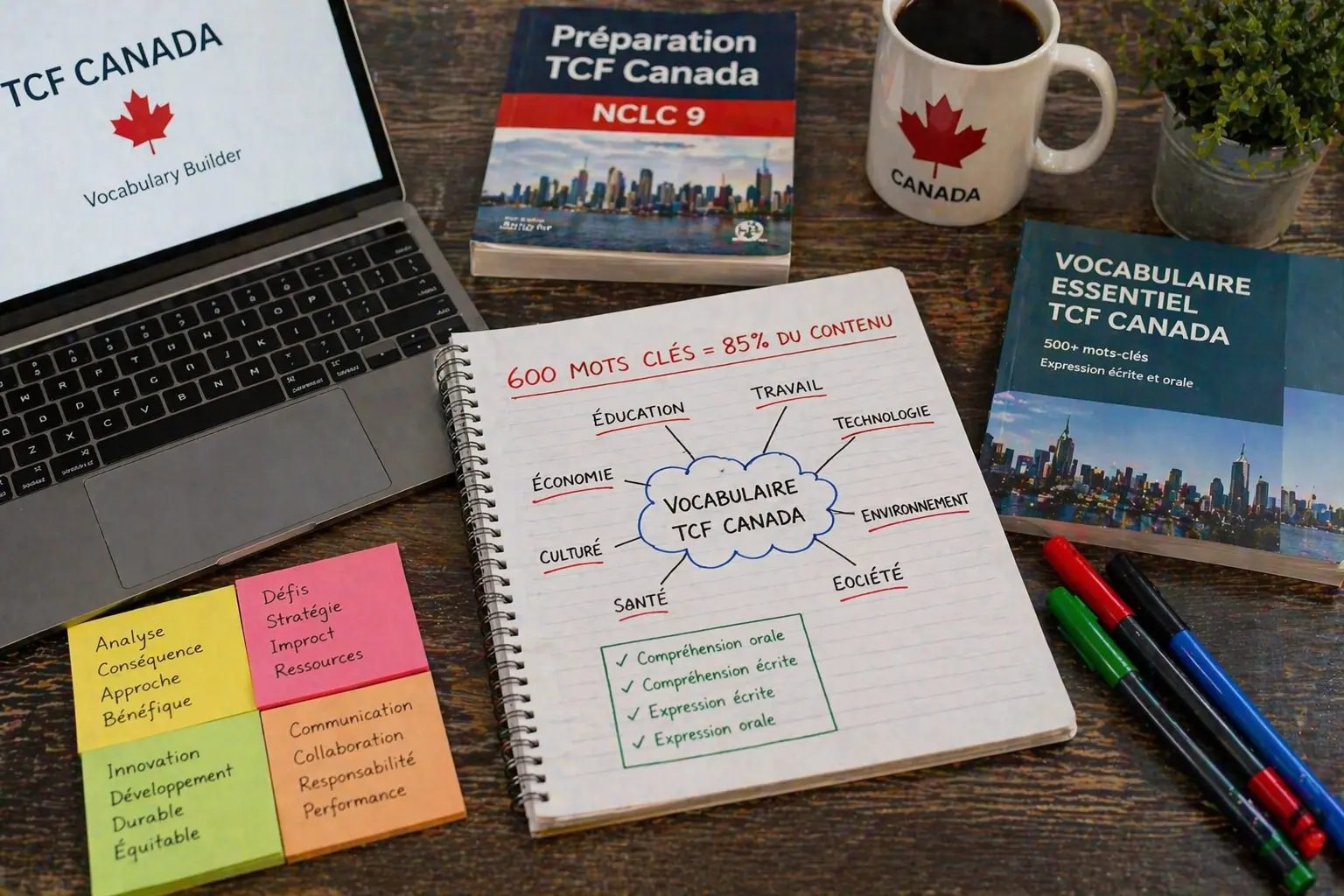
Building a powerful TCF Canada vocabulary is not about memorising dictionaries. It is about mapping the precise terrain the exam covers — eight recurring thematic domains — and developing deep, contextual fluency within each one. Our Complete TCF Canada Ultimate Guide 2026 outlines the full exam structure. This article gives you the vocabulary engine that powers performance within it.
The fundamental insight: TCF Canada does not test your French in the abstract. It tests your ability to navigate Canadian daily life through language — housing markets, public health systems, immigration paperwork, workplaces and environmental policy. Master the vocabulary of those worlds and you master the exam's raw material. Every point in reading and listening traces back to a word you either knew or didn't.
Why Domain-Based Learning Outperforms Every Other Vocabulary Method
Neurolinguistic research consistently demonstrates that adults retain vocabulary most durably when words are acquired within semantic clusters — coherent groups of related terms that mutually activate each other in long-term memory. Learning logement, loyer, bail, locataire, propriétaire, charges, déménagement together creates a web of mutual retrieval cues. Learning those same seven words scattered alphabetically across a general list creates seven isolated fragments that rarely survive past Thursday.
Beyond pure retention, domain clustering builds the inferential competence that TCF Canada actually rewards. When you encounter an unfamiliar word inside a known domain, surrounding familiar terms allow you to reconstruct meaning — a skill the exam exploits repeatedly in its longer reading texts.
"I stopped learning words and started learning worlds. I spent one full week inside the housing world — reading rental ads on Kijiji, listening to Radio-Canada tenant rights segments, writing fake emails to fictional landlords. By the end of that week, 47 words had stuck without a single flashcard session." — Amira, dentist from Casablanca, NCLC 9 in all four skills
The Eight Core Domains of TCF Canada
Domain 1 — Housing and Urban Life
Housing vocabulary appears in virtually every TCF Canada session, across both reading and listening. Texts discuss tenant rights, lease agreements, co-ownership buildings and Quebec's distinctive rental calendar — including the famous journée du déménagement on July 1st, when an enormous proportion of the province changes address simultaneously.
| Canadian Term | Meaning / Context | TCF Frequency |
|---|---|---|
| Condo | Privately owned apartment in a shared building | ★★★★★ |
| Plex (duplex, triplex) | Two or three-unit stacked residential building | ★★★★☆ |
| Régie du logement | Quebec housing tribunal (landlord-tenant disputes) | ★★★☆☆ |
| Chauffage inclus | Heating included in rent — critical in cold provinces | ★★★★☆ |
| Logement subventionné | Subsidised housing (social housing equivalent) | ★★★★☆ |
| Déménagement | Moving house — culturally tied to July 1 in Québec | ★★★★★ |
| Bungalow | Single-storey detached house | ★★★☆☆ |
Authentic practice source: Browse rental listings on Kijiji.ca or Centris.ca for 10 minutes daily. Every ad is live Canadian vocabulary in its natural habitat. Note every unfamiliar compound noun or administrative term and add it to your Anki deck with the original sentence as context.
Domain 2 — Health and the Canadian Medical System
The Canadian healthcare system differs structurally from European and North African models in ways that TCF Canada texts exploit heavily. Candidates who arrive without knowing what a CLSC is, or who confuse the Carte Soleil with a French social security card, regularly miss entire question blocks based on comprehension failures that have nothing to do with their French level.
Non-negotiable health vocabulary:
- RAMQ — Régie de l'assurance maladie du Québec (Quebec's public health insurer)
- Carte Soleil — Quebec health insurance card (different from France's Carte Vitale)
- CLSC — Community health and social services centre (neighbourhood health hub)
- Clinique sans rendez-vous — Walk-in clinic; no appointment required
- Médecin de famille — Family doctor; waiting lists are long, many Canadians don't have one
- Pharmacien prescripteur — In Canada, pharmacists can prescribe certain medications
- Régime d'assurance médicaments — Prescription drug insurance; coverage varies by province
Domain 3 — Employment and the Canadian Workplace
Canadian professional culture operates on its own linguistic codes. Employment vocabulary appears in nearly every session, spanning job applications, workplace rights, collective agreements and the specifics of the Canadian labour market.
| Professional Term | Canadian Context |
|---|---|
| Lettre de présentation | Cover letter — preferred over "lettre de motivation" in Canadian French |
| Références professionnelles | Verifiable employment references — standard practice |
| Assurance-emploi (AE) | Federal unemployment insurance programme |
| Taux horaire | Hourly wage — dominant compensation model outside executive roles |
| CNESST | Québec workplace health and safety commission |
| Travailleur autonome | Self-employed or freelance worker |
| Période d'essai | Probationary period — typically three months |
Domain 4 — Immigration and Administrative Procedures
This is the domain where candidates most frequently score below their general French level. Canadian administrative vocabulary is technically precise, and confusing a permis de travail fermé with a permis ouvert — or misunderstanding what an ITA actually triggers — can mean misreading an entire passage.
Critical distinctions to master before exam day:
- ITA — Invitation to Apply: formal trigger to submit a permanent residence application via Express Entry
- PNP — Provincial Nominee Program: province-specific immigration stream with separate selection criteria
- Résidence permanente ≠ citoyenneté — different rights, different timelines, different processes
- Permis de travail fermé — tied to one specific employer; cannot be transferred
- Permis de travail ouvert — valid for any employer in Canada; far more flexible
- Parrainage — family sponsorship to help a relative immigrate
Domain 5 — Education, from Preschool to Graduate School
| Canadian Level | Approximate Equivalent | Age Range |
|---|---|---|
| Maternelle / Prématernelle | Kindergarten / Preschool | 4–5 years |
| École secondaire | Secondary school (middle + high combined) | 12–17 years |
| CÉGEP (Québec only) | Pre-university or technical college | 17–19 years |
| Baccalauréat universitaire | Bachelor's degree (3–4 years) | 17–22 years |
| DEP | Diplôme d'études professionnelles — vocational qualification | Variable |
| Maîtrise | Master's degree | Post-bachelor |
Domains 6–8 — Transport, Environment and Finance
Transport: STM (Montreal transit authority), OPUS (rechargeable transit card), verglas (black ice — critical safety term), poudrerie (blowing snow reducing visibility), stationnement incitatif (park-and-ride facility), GO Transit (Ontario regional rail).
Environment: bilan carbone (carbon footprint), matières résiduelles (waste and garbage), collecte sélective (recycling collection), tarification du carbone (carbon pricing policy), feux de forêt (wildfires — increasingly frequent in TCF texts), pergélisol (permafrost).
Finance: REER (registered retirement savings plan), CELI (tax-free savings account), TPS/TVQ (federal and Quebec taxes applied at checkout), cote de crédit (credit score — crucial for housing applications), virement Interac (instant bank transfer), caisse populaire / Desjardins (credit union network).
Four Active Memorisation Methods That Actually Work
Method 1 — Semantic Constellation Mapping
Choose a pivot word from one domain. Build its constellation by listing every related term you already know, then researching the gaps. A pivot like logement generates: loyer, bail, locataire, propriétaire, colocation, meublé, charges, rénovation, déménagement, condo, plex, Régie du logement — eleven words organised in one cognitive network, each reinforcing the others.
Method 2 — Scenario Card System
Replace traditional definition cards with scenario cards: one side presents a gap-fill sentence extracted from a real Canadian source; the other provides the missing word plus a Canadian cultural note. This forces contextual encoding rather than isolated word-translation.
Sample scenario card:
Front: "After three months without repairs, the tenant filed a complaint with the __________ against her landlord."
Back: Régie du logement — Québec's administrative housing tribunal. Accepts complaints about lease violations, rent disputes and maintenance failures. Renamed Tribunal administratif du logement (TAL) in 2020 but the old name still appears in texts.
Front: "After three months without repairs, the tenant filed a complaint with the __________ against her landlord."
Back: Régie du logement — Québec's administrative housing tribunal. Accepts complaints about lease violations, rent disputes and maintenance failures. Renamed Tribunal administratif du logement (TAL) in 2020 but the old name still appears in texts.
Method 3 — The Anki Canadian Deck
Build a single Anki deck organised by domain, with each card including: the target word, a complete sentence from an authentic Canadian source, the domain label, and a cultural note where relevant. Review 20 minutes every morning using the SM-2 spaced repetition algorithm. Consistency over 10 weeks will cover all eight domains solidly.
Method 4 — Weekly Immersive Thematic Exposure
Weekly reading schedule for vocabulary acquisition:
- Monday: Two La Presse articles (economy or society section) — note 8 new terms
- Tuesday: 20 min of Radio-Canada evening news — note all unfamiliar vocabulary
- Wednesday: One Le Devoir opinion column — focus on formal register constructions
- Thursday: Two Radio-Canada OHdio podcast episodes in the week's theme domain
- Friday: Vocabulary integration — write a 100-word paragraph using 6 new words from the week
- Weekend: Full 39-question reading practice test with domain-vocabulary self-assessment
50 Quebec French Expressions to Recognise in TCF Canada Audio Documents
As the TCF Canada Listening: Active Listening Strategies article explains, tolerance for lexical variation is essential in the audio section. You do not need to produce Quebec expressions — you need to recognise them when they appear in comprehension documents.
| Quebec Expression | Standard French Equivalent | Likely TCF Domain |
|---|---|---|
| Magasiner | Faire du shopping | Commerce, leisure |
| Dépanneur | Épicerie de proximité ouverte tard | Housing, neighbourhood |
| Courriel | Email (standard in all Canadian French) | Work, administration |
| Fin de semaine | Week-end | Daily life |
| Avant-midi | Matinée / avant midi | Time, planning |
| Clavardage | Chat en ligne | Technology |
| Jaser | Bavarder informellement | Social relations |
| Char | Voiture (informal) | Transport |
| Garderie | Crèche / structure de garde | Family, society |
| Présentement | Actuellement / en ce moment | All contexts |
| Guichet automatique | Distributeur de billets / DAB | Finance |
| Caisse populaire | Coopérative de crédit (réseau Desjardins) | Finance |
Your 12-Week Domain Vocabulary Programme
Weeks 1–2: Housing domain (60 words) — daily Kijiji and Centris reading + scenario cards + Anki integration
Weeks 3–4: Health domain (60 words) — Radio-Canada Santé articles + medical podcast listening
Weeks 5–6: Employment domain (50 words) — Indeed.ca listings + career articles from La Presse
Week 7: Immigration and administration (50 words) — Canada.ca and IRCC official pages
Week 8: Education domain (40 words) — Canadian university and CÉGEP websites
Week 9: Transport domain (35 words) — STM, GO Transit, provincial road authority announcements
Week 10: Environment domain (40 words) — Radio-Canada Science + Le Devoir Environnement
Week 11: Finance domain (40 words) — Desjardins.com + bank websites
Week 12: Global revision + two complete practice tests + error-driven vocabulary gaps addressed
For the full ecosystem of digital resources to power this programme, see our TCF Canada Resources Ecosystem guide and our in-depth article on Canadian French digital resources for authentic preparation.



0 Commentaires
aucun commentaire
Soyez le premier a partager votre avis !