-
Auteur :
 TCF Canada
- Apr 02, 2026
TCF Canada in Brazil 2026: São Paulo/Rio Test Centres, Portuguese-French Similarities, and IT/Healthcare Immigration Pathways
- Blog
- /
- Article
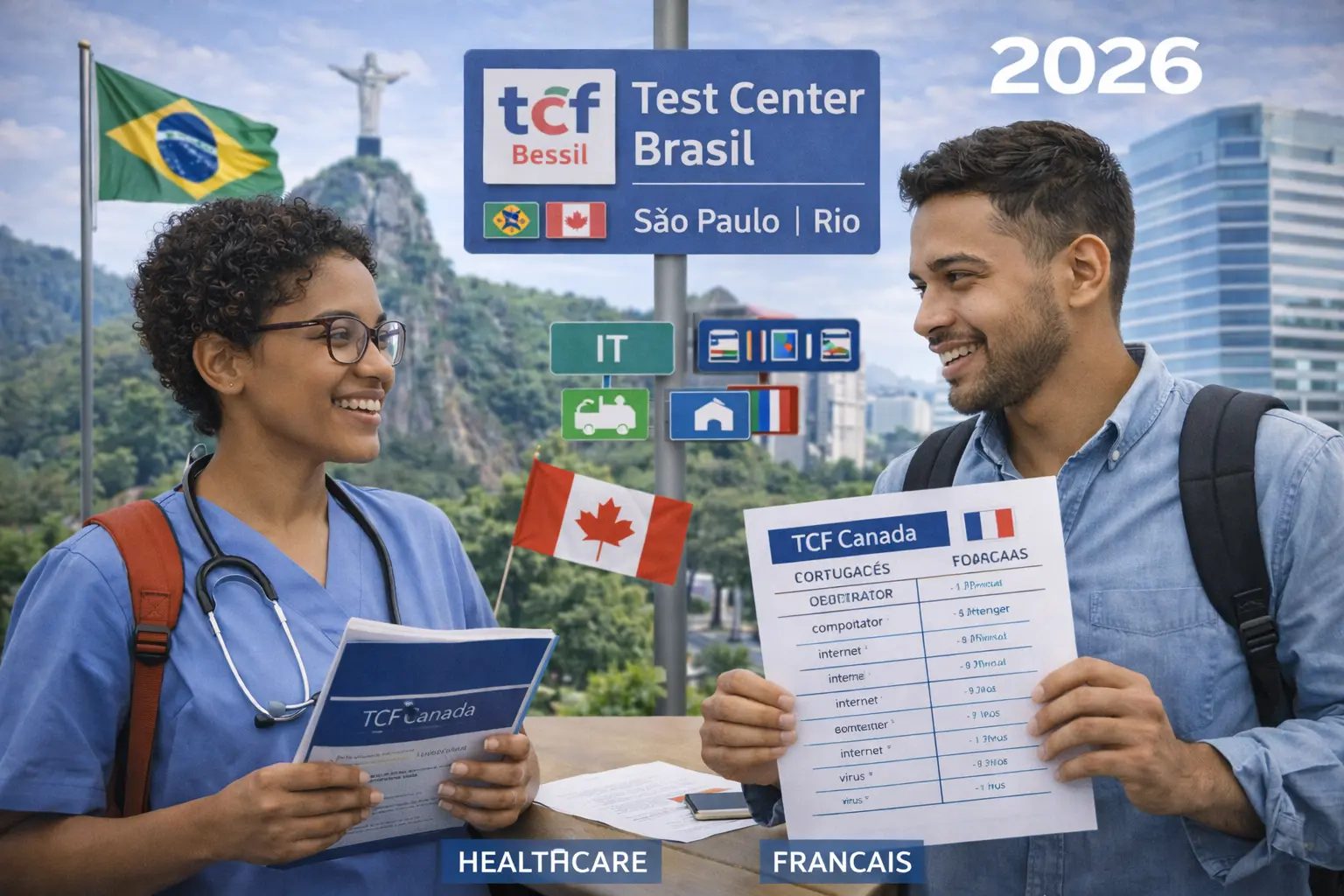
TCF Canada in Brazil 2026: São Paulo/Rio Test Centres, Portuguese–French Similarities, and IT/Healthcare Immigration Pathways
When Gabriela, a 35-year-old general practitioner in São Paulo (USP graduate – Universidade de São Paulo, earning 18,000 BRL/month ≈ €3,270), chose the francophone pathway for Canadian immigration in 2024, her hospital colleagues doubted her strategy: “Why French, Gabi? Portugal is culturally closer to us, the language is almost identical to Portuguese, and you can get EU nationality after 5 years! Canada is cold, far away, and French is hard!” Her answer today—from Toronto, where she works in a Family Health Team clinic (salary 185,000 CAD/year ≈ €125,000) after obtaining her Ontario medical licence (MCCQE exams passed)—is clear: “Portugal = doctors’ salaries €3,000–€4,500/month gross (€36,000–€54,000/year). Canada = 150,000–250,000 CAD for family physicians (€101,000–€169,000). Canada vs Portugal salary gain = 3–4x. Portugal has faced chronic economic stagnation since 2008, youth unemployment above 20%, paralyzing bureaucracy, and limited opportunities. Canada has a dynamic economy, unlimited opportunities, a higher quality of life, and spectacular nature (Rockies, Great Lakes vs Portugal you already saw on vacation). Portuguese–French proximity is a HUGE learning advantage: 15 intensive months (vs 24–36 months for Chinese, 18–24 for Spanish) = TCF NCLC 8-8-7-8 in March 2026. Investing 15 months + 18,500 BRL (€3,360) = permanent residence in a G7 country instead of a stagnant economy. With hindsight, it was an obvious choice,” she says from her Mississauga apartment (2-bedroom at 2,400 CAD/month vs an equivalent São Paulo neighbourhood at 4,500 BRL ≈ €820, but with daily safety concerns). This guide covers Brazil’s test centres, the unique advantage of Portuguese–French proximity (sister Latin languages, ~85% structural similarities = accelerated learning), typical Brazilian profiles (São Paulo as Latin America’s tech hub, highly trained healthcare professionals seeking stability, entrepreneurs), and ROI calculations for a francophone strategy that bypasses heavy anglophone competition—alongside Brazil’s growing Canadian diaspora.
TCF Canada Test Centres in Brazil (2026)
Major Metropolitan Areas
| City | Centre | Session Frequency | Fee BRL (EUR) | Notes |
|---|---|---|---|---|
| São Paulo | Alliance Française São Paulo | 6–8 sessions/month | 2,200 (≈400) | Largest centre in Brazil, easy booking |
| São Paulo | Centre Culturel França-Brasil | 4 sessions/month | 2,200 | French consulate partnership, Saturday sessions |
| Rio de Janeiro | Alliance Française Rio de Janeiro | 5–6 sessions/month | 2,200 | Mixed audience: students and professionals |
| Brasília | Alliance Française Brasília | 3 sessions/month | 2,200 | Many civil servants and diplomats |
| Belo Horizonte | Alliance Française Belo Horizonte | 2–3 sessions/month | 2,200 | University city, many students |
| Porto Alegre | Alliance Française Porto Alegre | 2–3 sessions/month | 2,200 | Southern Brazil, stronger European influence |
| Curitiba | Alliance Française Curitiba | 2 sessions/month | 2,300 | Modern city, high quality of life in Brazil |
| Recife, Salvador, Fortaleza | 1–2 sessions/month | 2,200–2,300 | North-East: booking ahead recommended |
Official resources:
The Unique Portuguese → French Advantage (Maximum Proximity Among Latin Languages)
Exceptional Structural Similarities
Comparative table of linguistic proximity:
| Linguistic Aspect | Similarity % | Concrete Examples | Learning Advantage |
|---|---|---|---|
| Shared vocabulary | 85% | PT “Universidade” = FR “Université”, PT “Importante” = FR “Important”, PT “Problema” = FR “Problème” | Immediate reading comprehension of ~70% of French texts |
| Grammar structures | 80% | Gender (masc/fem), similar conjugations (present, imperfect, future), adjective agreement | Intuitive grammar, direct rule transfer |
| Vowel pronunciation | 75% | PT/FR share nasal vowels (PT “não” ≈ FR “non”, PT “pão” ≈ FR “pain”) | French nasal vowels are easier (vs a nightmare for many Spanish/English speakers) |
| Verb system | 85% | Subjunctive exists in both Portuguese and French (absent in English), similar sequence of tenses | Advanced grammar concepts already familiar |
| Alphabet/spelling | 90% | Same Latin script, similar accents (ê, â, ç, ã) | No “writing system” learning required |
Comparison with other Latin languages:
| Native Language | Similarity with French | Ease Ranking |
|---|---|---|
| Portuguese | 85% | 🥇 #1 Easiest |
| Italian | 82% | 🥈 #2 |
| Spanish | 65% | 🥉 #3 |
| Romanian | 55% | #4 |
| English | 30% | #8 (Germanic languages) |
Lusophone-Specific Challenges (Despite the Proximity)
1. Portuguese–French false friends (vocabulary traps)
| Word | Meaning in Portuguese | Meaning in French | Typical Confusion |
|---|---|---|---|
| Exquisito | Weird, strange | Exquis (delicious) | Opposite meanings! PT “comida exquisita” = weird vs FR = delicious |
| Propina | Bribe (corruption) | Tip (service) | Very different legal/social context |
| Contestar | To answer (neutral) | To contest (oppose) | Negative connotation in French vs neutral in Portuguese |
| Estação | Station/season | Station (season = “saison”) | Double meaning in Portuguese vs single meaning in French |
| Puxar | To pull | To push | Opposite actions! |
2. Subtle pronunciation issues (Brazilian accent is recognizable)
- “R” sound: Brazilian Portuguese “R” is often a soft aspirated sound (like English “h” in “house”), while French “R” is a guttural sound that requires throat muscle training
- Rhythm/intonation: Brazilian Portuguese has a pronounced rising/falling melody, while French is more syllable-timed and flatter
- Vowel reduction: French reduces unstressed vowels (e.g., “petit” → “p’tit”), while Portuguese keeps vowels more fully articulated
A Realistic Timeline to Reach NCLC 7–8 for Brazilians (Fastest in Latin America)
Gabriela’s learning timeline (an optimal but representative case):
| Period | Level Reached | Study Hours/Week | Detailed Activities |
|---|---|---|---|
| Months 1–5 | A1–A2 (Survival) | 10h | Alliance Française SP intensive classes 3×/week (9h) + Duolingo/Babbel apps (1h/day = 7h/week) = fast fundamentals thanks to similarities |
| Months 6–10 | B1–B2 (Independent) | 12h | Advanced classes (9h) + daily immersion in French media: France 24 live on YouTube in the morning (1h), RFI podcasts during commutes (30 min × 5 = 2.5h), Netflix French series with Portuguese then French subtitles (“Dix Pour Cent”, “Lupin”) in the evening (3h) = ~14.5h total |
| Months 11–15 | B2–C1 (NCLC 7–8) | 14h | Advanced conversation classes (6h) + French–Brazilian tandem video calls on HelloTalk (3h) + daily reading (Le Monde articles + books) (2h) + essay writing with teacher corrections (2h) + francophone meetups in São Paulo on weekends (1h) |
| TOTAL | NCLC 7–8 Achievable | 15 months | Average 12h/week = 780h total (record speed vs other native languages) |
French learning timelines by native language:
| Native Language | Time to NCLC 7–8 | Total Hours | Reason |
|---|---|---|---|
| Native French | 6 weeks | 60h | Native language: only format familiarization needed |
| Portuguese (Brazil/Portugal) | 15–20 months | 780–960h | Maximum proximity (~85%) — fastest among non-native speakers |
| Italian | 16–22 months | 800–1,000h | Similarity ~82% |
| Spanish | 18–24 months | 900–1,200h | Similarity ~65%, many false friends |
| English | 20–26 months | 1,000–1,300h | Similarity ~30%, different structures |
| Mandarin/Arabic | 30–36 months | 1,500–2,000h | No structural similarity |
Typical Brazilian Immigration Profiles for Canada (2026)
Profile #1: IT/Tech in São Paulo (Latin America’s Tech Hub)
São Paulo tech hub context:
- São Paulo = the largest city in Latin America (12M in the metro city, 22M in the urban area)
- #1 startup ecosystem in LatAm: Nubank (fintech unicorn, ~$30B valuation), iFood (delivery), QuintoAndar (proptech), Loggi (logistics)
- Multinationals present: Google, Microsoft, IBM, Oracle R&D centres
- São Paulo developer salaries (2026): 8,000–18,000 BRL/month (€1,450–€3,270)
- Equivalent salaries in Canada: 80,000–120,000 CAD/year (€54,000–€81,000) = 3–5x gain
Typical São Paulo developer profile:
| Characteristic | Details |
|---|---|
| Age | 25–33 (digital-native generation) |
| Education | Computer Science at USP/UNICAMP/ITA (top tech universities) OR intensive bootcamp (Le Wagon SP, Tera, Ironhack) |
| Tech stack | Full-stack: React/Node.js, Python/Django, Java/Spring, DevOps (AWS/Azure), Mobile (React Native) |
| Experience | 3–7 years in Brazilian startups (Nubank, iFood) or multinationals (Google, Microsoft) |
| English | B2–C1 (tech work = daily English for documentation, code, international meetings) |
| Motivations | (1) Salaries 3–5x, (2) economic stability (vs recurring crises/inflation/BRL devaluation), (3) quality of life (security, infrastructure) |
Typical CRS for São Paulo IT candidates (English-only vs bilingual):
| Configuration | Point Components | Total CRS | Eligibility |
|---|---|---|---|
| English only | Age 29 (105) + Master’s (126) + IELTS 8.0 (128) + 5 years experience (50) | 409 | ❌ Stuck (general cut-offs 485–495) |
| French + English (bilingual) | Same profile + TCF NCLC 8 (bilingual bonus +32 points) | 441 | ✅ ITA in Francophone draws (cut-off 365–380) |
Profile #2: Healthcare Professionals (Doctors, Dentists, Nurses)
Brazilian healthcare context:
- Brazilian medical training is excellent (USP, UNICAMP, UFRJ are internationally recognized)
- BUT public-sector salaries are low (SUS: 8,000–15,000 BRL/month for doctors = €1,450–€2,730)
- Private-sector salaries are higher (15,000–35,000 BRL) but economic instability and chronic BRL devaluation remain major risks
- Canada has a chronic physician shortage (active international recruitment in Ontario, Alberta, Saskatchewan)
Gabriela’s pathway (USP family doctor → Canada):
- 2013–2018: Medicine at USP São Paulo (6 years, graduated 2018)
- 2019–2024: General practitioner at a UBS clinic in São Paulo’s outskirts (18,000 BRL/month ≈ €3,270; heavy workload)
- 2024–2025: Decision to immigrate; 15 months of intensive French (see timeline above)
- March 2026: TCF Canada NCLC 8-8-7-8
- April 2026: Express Entry profile CRS 438 (age 35, medical master’s, IELTS 7.5, TCF NCLC 8, 7 years experience)
- May 2026: ITA received in a francophone draw (cut-off 372)
- September 2026: Arrives in Toronto; begins medical licensing (MCCQE Part 1–2, estimated 18–24 months)
- 2027–2028: Temporary work as a medical assistant in clinics (45,000–60,000 CAD) while preparing for licensing
- 2028: Ontario licence obtained (CPSO); family physician job in a Family Health Team (185,000 CAD/year ≈ €125,000)
Long-term career gain:
- Brazil 30-year career: 18,000 BRL × 12 × 30 = 6,480,000 BRL (≈ €1,177,000 lifetime, not counting BRL devaluation)
- Canada 25-year career (post-licensing): 185,000 CAD × 25 = 4,625,000 CAD (≈ €3,125,000 lifetime)
- Lifetime gain: +€1,948,000 (2.7× career earnings)
Profile #3: Entrepreneurs (E-commerce, Bilingual Services)
Opportunities: Brazil’s e-commerce market is growing fast, but logistics and banking infrastructure can be complex and bureaucracy heavy (World Bank Doing Business rank: Brazil #124 vs Canada #23). Brazilian tech-savvy entrepreneurs move to Canada for: (1) business-friendly infrastructure, (2) access to the US/Canada market of 400M consumers, (3) the federal Start-Up Visa program.
Brazilian Degrees in Canada (ECA Equivalencies)
| Brazilian Degree | Canadian Equivalency (WES) | CRS Points |
|---|---|---|
| Ensino Médio (Brazilian high school) | Secondary School Diploma | Up to 28 points |
| Bacharelado/Licenciatura (4-year degree) | Bachelor’s Degree (four years) | 120 points |
| Mestrado (Master’s, Bac+6) | Master’s Degree | 126 points |
| Doutorado (Doctorate) | Doctorate (PhD) | 140 points |
Top Brazilian universities (excellent WES recognition):
- USP (Universidade de São Paulo): #1 in Latin America, top 100 worldwide, excellent recognition across fields
- UNICAMP (Universidade Estadual de Campinas): top engineering/science, excellent recognition
- ITA (Instituto Tecnológico de Aeronáutica): “Brazil’s MIT”, strong aerospace/tech prestige, excellent recognition
- Federal universities (UFRJ, UFMG, UFRGS): very strong recognition
- Top private universities (PUC-SP, PUC-RJ, FGV): good recognition
WES ECA process (Brazil):
- Order histórico escolar (transcripts) + diploma from your Brazilian university (online portals, 50–150 BRL)
- Apostilles are not always required for Brazil (check the WES checklist), which simplifies the process
- Submit documents + pay WES fees (267 CAD ≈ 1,400 BRL)
- Processing time: 5–7 weeks standard, 2–3 weeks express (+100 CAD)
Resource: WES Canada – Brazilian Credential Evaluation
Total Immigration Budget: Brazil → Canada (Detailed)
Candidate with 15 Months of French Training (Gabriela Case)
| Expense Item | Cost (BRL) | EUR Equivalent | Notes |
|---|---|---|---|
| French training (15 months) | 6,000 | 1,090 | Alliance Française SP: ~40 BRL/hour × 150 hours |
| Materials (books, apps) | 800 | 145 | Official FEI books, premium Babbel/Busuu |
| TCF Canada (exam) | 2,200 | 400 | Brazil standard price (2026) |
| ECA (WES) | 1,400 | 255 | Converted from 267 CAD |
| Brazil police certificate | 100 | 18 | Online issuance (Polícia Federal) |
| Document translations | 600 | 109 | Birth/marriage certificates (sworn translator) |
| IRCC fees (PR + right of PR) | 8,900 | 1,618 | ~1,700 CAD ≈ 8,900 BRL |
| Immigration medical exam | 1,500 | 273 | IRCC panel physician (São Paulo, Rio) |
| Travel (if tests outside your city) | 0–1,000 | 0–182 | Optional depending on location |
| MINIMUM TOTAL | 21,500 | €3,908 | Excluding travel |
| REALISTIC TOTAL | 22,500 | €4,090 | Including contingencies |
Brazil Economic Context (2026)
Average salaries (reference):
- National minimum wage: 1,412 BRL/month (€257) → immigration budget = ~16 months of wages (unreachable for lower-income households)
- Median urban salary: 3,000–5,000 BRL/month (€545–€909)
- Middle-class professionals: 8,000–18,000 BRL/month (€1,455–€3,273)
- 22,500 BRL budget: ~1.25 to 2.8 months of middle-class professional income — significant but manageable
Brazil’s economic instability (a key immigration driver):
- Chronic inflation: 2015–2025 cumulative inflation +80% (real purchasing power roughly halved)
- BRL devaluation: 2010 rate 1.7 BRL/USD → 2026 rate 5.5 BRL/USD = -69% value
- Structural unemployment: 10–12% (youth 20–25%)
- Urban violence: São Paulo homicide rate ~10/100k (moderate for Brazil), Rio ~25/100k, some North-East cities 60+/100k
Brazilian Diaspora in Canada: A Dynamic Community Growing Fast
2026 statistics:
- Brazilian population in Canada: 120,000+ (2021 census: 95,000; estimated +25% growth 2021–2026)
- Growth: +200% since 2015 (easier tourism visas + francophone immigration programs)
- Geographic concentration: Toronto 50% (60,000+), Vancouver 20% (24,000), Montréal 15% (18,000), Calgary/others 15%
Toronto = Canada’s “Little Brazil”:
- Little Brazil area: Bloor West Village, Dundas West (restaurants, shops, Portuguese/Brazilian services)
- Brazilian restaurants: 150+ in Toronto (rodízio churrascarias, feijoada, acarajé, tapioca)
- Brazilian evangelical churches: 30+ (large evangelical diaspora community)
- Associations: Brazilian Canadian Cultural Centre, Brasil Summerfest (annual festival at Trinity Bellwoods Park), Capoeira Toronto (10+ schools)
- Media: Brazilian Times Toronto (community newspaper), Rádio Tropical Toronto
Brazil Resources
Conclusion
Brazilian candidates have a unique linguistic advantage worldwide: Portuguese–French proximity (~85%) enables record-fast learning (15–20 months to NCLC 7–8 vs 24–36 months for many Asian languages, 18–24 months for Spanish). Gabriela proves the strategy is viable: Portuguese → French in 15 intensive months makes NCLC 8 achievable, leading to Canadian immigration instead of being blocked by the anglophone CRS ceiling (CRS 409 is typically insufficient when general cut-offs are 485+).
Brazilian motivations for immigrating are multiple: (1) economic opportunities (IT salaries 3–5x, doctors 3–4x), (2) stability (vs chronic inflation/BRL devaluation and recurring crises), (3) safety (Brazil urban violence ~10–60/100k vs Canada ~2/100k), (4) quality of life (infrastructure, nature, functional public services vs systemic failures in Brazil).
A budget of 22,500 BRL (€4,090) is a serious investment but accessible for the urban middle class (roughly 1.5–3 months of salary). The ROI is massive: 15 months + €4,090 = permanent residence in a G7 country + a lifetime career gain of €2–3M (doctors/IT). A Brazilian community of 120,000+ in Canada (Toronto “Little Brazil” 60,000+) makes integration exceptionally easier. The francophone strategy is the key to bypassing the CRS system for Brazilians—and Portuguese–French proximity is your accelerated-learning superpower. 🇧🇷🇫🇷🇨🇦
* * *
Frequently Asked Questions
TCF Canada is available mainly through Alliance Française centres in major cities such as São Paulo, Rio de Janeiro, Brasília, Belo Horizonte, Porto Alegre, Curitiba, and several North-East capitals. São Paulo offers the highest frequency (6–8 sessions per month), with an average fee of around 2,200 BRL.
Yes. Portuguese and French share approximately 80–85% structural similarities, including vocabulary, verb systems, gender rules, and even nasal vowels. This proximity allows many Brazilian learners to reach NCLC 7–8 in about 15–20 months with consistent study—faster than most other non-native language backgrounds.
Yes. For many Brazilian professionals, English-only CRS scores (around 400–420) are often below general cut-offs. Adding French at NCLC 7–8 can provide bilingual bonus points and eligibility for francophone draws, making permanent residence much more attainable.
Laissez un commentaire
Votreadresse email ne sera pas publie. Les champs obligatoires sont marque avec *


 TCF Canada Hub
0 Commentaires
aucun commentaire
Soyez le premier a partager votre avis !