-
Auteur :
 Antoine C.
- Mar 26, 2026
TCF Canada in Vietnam 2026: Hanoi & Ho Chi Minh City Centers, Colonial Francophone Legacy, and the Massive Advantage of French Lycées
- Blog
- /
- Article
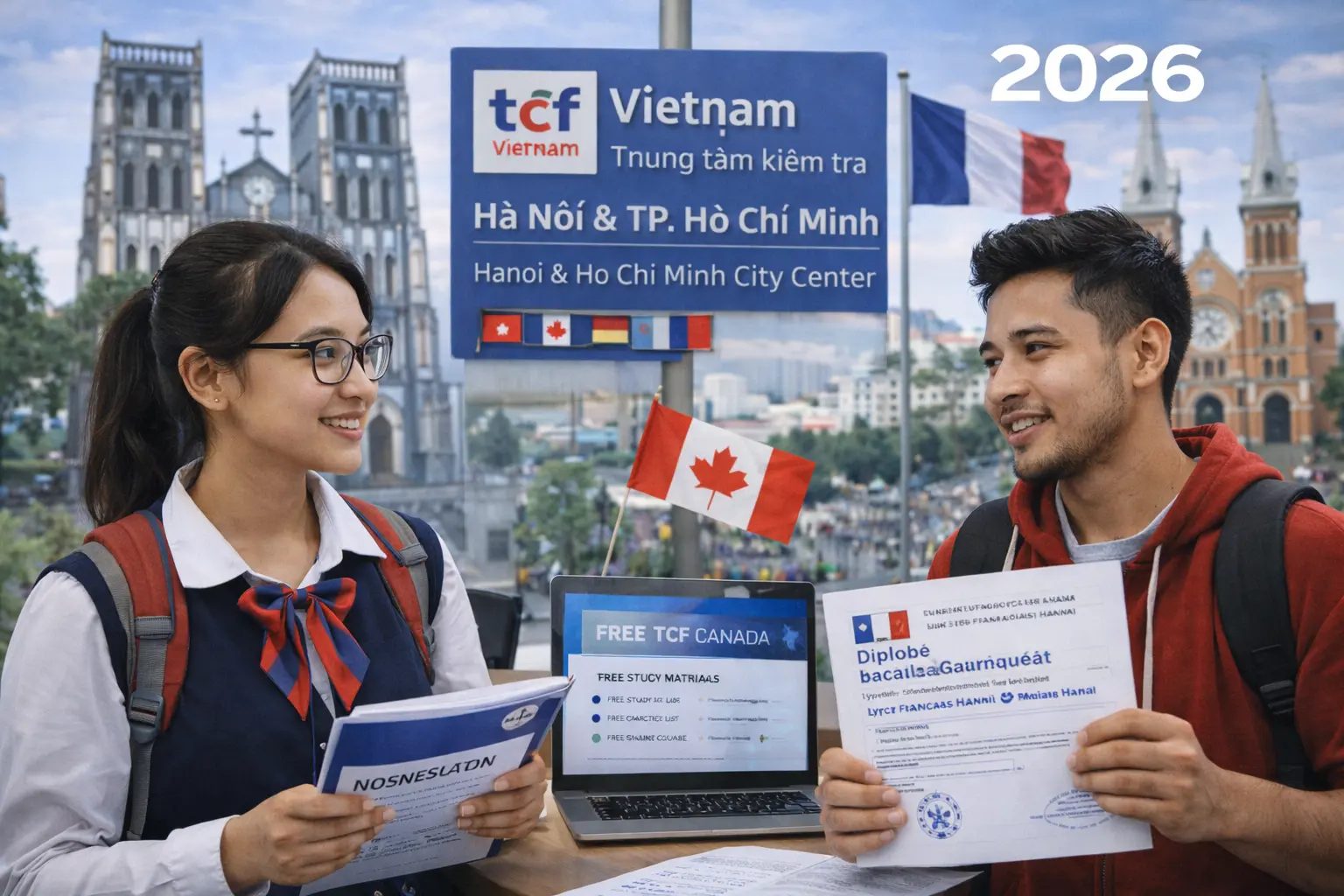
TCF Canada in Vietnam 2026: Hanoi & Ho Chi Minh City Centers, Colonial Francophone Legacy, and the Massive Advantage of French Lycées
When Nguyen Minh, a 26-year-old graduate of the Lycée Français International Marguerite Duras in Ho Chi Minh City (LFIHCMV), took the TCF Canada in February 2026, the outcome was predictable: NCLC 10-10-9-10—near-perfect scores achieved after only two weeks of format familiarization (versus the 18–36 months typically required for non-francophone candidates). “I grew up speaking Vietnamese at home, French at school (from kindergarten to grade 12), and English with expatriate friends. Natural trilingualism. The TCF Canada was a simple administrative formality rather than a real linguistic challenge. My resulting CRS score was 512 points (Master’s degree from a French university in Paris, age 26, IELTS 7.5, TCF NCLC 10). I received an ITA in the March 2026 francophone draw (cutoff 370), with a surplus of +142 points. Total immigration cost: 85 million VND (≈3,300 EUR)—less than four months’ salary in Saigon. The ROI is massive: a developer salary in HCMC is about 25 million VND/month (≈970 EUR), versus 9,000 CAD/month (≈8,100 EUR) in Toronto—an increase of +835%,” he explains from Waterloo, Ontario, where he now works at a fintech startup. This guide explores Vietnam’s dual reality: (1) graduates of French lycées are essentially native-level francophones with an enormous immigration advantage, and (2) candidates from the standard Vietnamese system do need to learn French, but benefit from the country’s francophone heritage (many grandparents still speak French, and Alliance Française infrastructure is excellent).
TCF Canada Test Centers in Vietnam (2026)
Major Cities
| City | Center | Frequency | Fee VND (EUR) |
|---|---|---|---|
| Hanoi | L’Espace (Institut Français Hanoi) | 4 sessions/month | 9,500,000 (≈370) |
| Hanoi | Alliance Française Hanoi | 3 sessions/month | 9,500,000 |
| Ho Chi Minh City (Saigon) | IDECAF (France–Asia Cultural Exchange Institute) | 4–5 sessions/month | 9,500,000 |
| Da Nang | Alliance Française Da Nang | 1 session/month | 9,500,000 |
| Hue | Alliance Française Hue | 1 session/month | 9,500,000 |
Resources: Institut Français Vietnam
Vietnam’s Francophone Heritage (A Unique Historical Advantage)
French Indochina (1887–1954): A Lasting Linguistic Impact
Historical context:
- Vietnam was a French colony for 67 years (vs. 15–20 years typical in many African colonies)
- Administration, education, and the justice system were modeled on French systems
- Vietnamese elites were educated in French schools (Lycée Albert Sarraut in Hanoi founded in 1919)
- The 70+ generation (born before 1954) is often naturally bilingual in Vietnamese and French
Current French Presence in Vietnam:
| Indicator | Statistic | Regional Comparison |
|---|---|---|
| French lycées | 6 (2 in Hanoi, 2 in HCMC, Vung Tau, Da Nang) | Highest concentration in Southeast Asia |
| Students in French lycées | 7,500+ (2026) | +8% annual growth |
| Alliances Françaises | 8 cities (dense network) | Top 3 worldwide |
| Vietnamese students in France | 8,000+ per year | #6 foreign nationality in France |
Profile #1: Graduates of French Lycées in Vietnam (Francophone Elite)
Major French Lycées:
- LFIHCMV (Lycée Français International Marguerite Duras, Saigon): 2,500 students, full French curriculum, French Baccalauréat with international options
- LFAY (Lycée Français Alexandre Yersin, Hanoi): 1,800 students, equivalent prestige
- Tuition fees: USD 15,000–25,000/year (350–600 million VND) — accessible only to Vietnam’s economic elite
Graduate Characteristics:
| Aspect | Profile |
|---|---|
| French level | C2 (academic native level) — education entirely in French |
| TCF Canada | NCLC 9–10 guaranteed (2–3 weeks of format familiarization) |
| Higher education | 80% continue in France/Canada/Belgium (francophone universities) |
| Careers | Finance, consulting, tech, entrepreneurship (multinationals/startups) |
| Vietnam salaries | 30–60M VND/month (≈1,170–2,340 EUR) — top 5% nationally |
Canadian Immigration Advantage:
- Natural trilingualism (Vietnamese + French C2 + English B2–C1)
- French degrees (if studied in France) = excellent WES recognition
- Typical CRS: 480–520 points → guaranteed ITA in francophone draws (cutoff 365–380)
Profile #2: Candidates from the Standard Vietnamese System (French Required)
Typical French Level:
- In the standard Vietnamese system, French is an optional second foreign language (after mandatory English)
- End of high school: A2–B1 at best (if French chosen; ~20% of students)
- About 80% of candidates are complete beginners in French
Timeline to Reach NCLC 7–8 (from Beginner Level):
| Base Profile | Time to NCLC 7–8 | Reason |
|---|---|---|
| Vietnamese with English B2+ | 18–22 months | Latin alphabet already familiar via English |
| Vietnamese with limited English | 24–30 months | Double learning curve (alphabet + language) |
| French lycée graduate | 2–4 weeks | Native-level francophone |
Typical Vietnamese Profiles for Canadian Immigration
Profile A: IT / Tech (Hanoi, HCMC)
Context:
- Vietnam is a fast-growing Southeast Asian tech hub (Samsung, Intel, Microsoft R&D centers)
- Developer salaries in Vietnam: 15–35M VND/month (≈585–1,365 EUR)
- Canadian salaries: 80,000–120,000 CAD/year (≈54,000–81,000 EUR) = +400–600% increase
Profile B: Chefs / Restaurant Workers (High Demand in Canada)
Vietnamese Diaspora in Canada:
- 300,000+ Vietnamese Canadians (immigration waves 1975–1995 + recent)
- Restaurant sector is a core economic pillar (pho, bánh mì, popular Vietnamese cuisine)
- PNP programs in Alberta and Saskatchewan actively seek Vietnamese chefs (facilitated LMIA)
Typical Pathway:
- 3–5 years of chef experience in Vietnam (high-end restaurants in HCMC/Hanoi)
- French learning for 12–18 months (NCLC 6–7 sufficient for chefs)
- LMIA obtained from a Canadian employer (Vietnamese restaurant in Alberta/Saskatchewan)
- Immigration via PNP + Express Entry (CRS boosted by job offer + French)
Vietnamese Degree Equivalency in Canada
| Vietnamese Degree | Canadian Equivalency (WES) | CRS Points |
|---|---|---|
| Tú tài (Vietnamese high school diploma) | Secondary School Diploma | 28 pts |
| Cử nhân (4-year Bachelor’s) | Bachelor’s Degree | 112–120 pts |
| Thạc sĩ (Master’s) | Master’s Degree | 126 pts |
| French Baccalauréat (French lycées in Vietnam) | Secondary Diploma + prestige bonus | 28 pts (plus easier university admission) |
| French university degree earned in Vietnam | Direct equivalency (French system) | Depends on level |
Prestigious Vietnamese Universities:
- Vietnam National University (Hanoi, HCMC): moderate WES recognition
- University of Science and Technology of Hanoi (USTH – French partnership): excellent recognition
Total Immigration Budget: Vietnam → Canada
Candidate: French Lycée Graduate (Nguyen Minh)
| Item | VND | EUR |
|---|---|---|
| TCF Canada (minimal prep: 2 weeks) | 10,000,000 | 390 |
| Degree ECA | 6,800,000 | 265 |
| Vietnam Police Certificate | 200,000 | 8 |
| IRCC Fees | 43,000,000 | 1,677 |
| Medical Exam | 3,000,000 | 117 |
| TOTAL | 63,000,000 | 2,457 EUR |
Candidate: Standard System (20-Month French Learning)
| Item | VND | EUR |
|---|---|---|
| French training (20 months) | 45,000,000 | 1,755 |
| TCF Canada | 9,500,000 | 370 |
| ECA + IRCC + Police + Medical | 53,000,000 | 2,067 |
| TOTAL | 107,500,000 | 4,192 EUR |
Vietnam Salary Context (2026):
- Urban median salary: 10–15M VND/month (≈390–585 EUR)
- 107.5M VND ≈ 7–11 months of salary — a major family investment (often pooled savings)
Vietnam Resources
Conclusion
Vietnam presents a unique duality for francophone immigration: (1) French-lycée elites are C2-level francophones with a massive immigration advantage (NCLC 10, CRS 500+, ≈2,500 EUR total cost); (2) standard-system candidates require a 20-month investment and ≈4,200 EUR, but Vietnam’s francophone heritage (Alliance Française network, francophone older generations, strong infrastructure) makes learning French easier than in most Asian countries. Both pathways are viable. A 300,000-strong Vietnamese diaspora in Canada further facilitates integration. 🇻🇳🇨🇦
Frequently Asked Questions
You can take the TCF Canada at approved centers in Hanoi (L’Espace – Institut Français and Alliance Française), Ho Chi Minh City (IDECAF), Da Nang, and Hue (Alliance Française). Fees are approximately 9,500,000 VND per session, and major cities typically offer multiple sessions per month.
Yes. Graduates of French lycées such as LFIHCMV or LFAY usually have C2-level French. Most can reach NCLC 9–10 after only 2–4 weeks of exam-format preparation, which significantly boosts their CRS score in Express Entry, especially in francophone draws.
For candidates educated in the standard Vietnamese system, reaching NCLC 7–8 typically requires 18–24 months of structured French learning (if they already have good English) or up to 30 months for complete beginners.
Laissez un commentaire
Votreadresse email ne sera pas publie. Les champs obligatoires sont marque avec *




0 Commentaires
aucun commentaire
Soyez le premier a partager votre avis !