-
Auteur :
 Antoine C.
- Jan 03, 2026
TCF Canada Reading Comprehension: Strategic Reading for 39 Perfect Questions
- Blog
- /
- Article
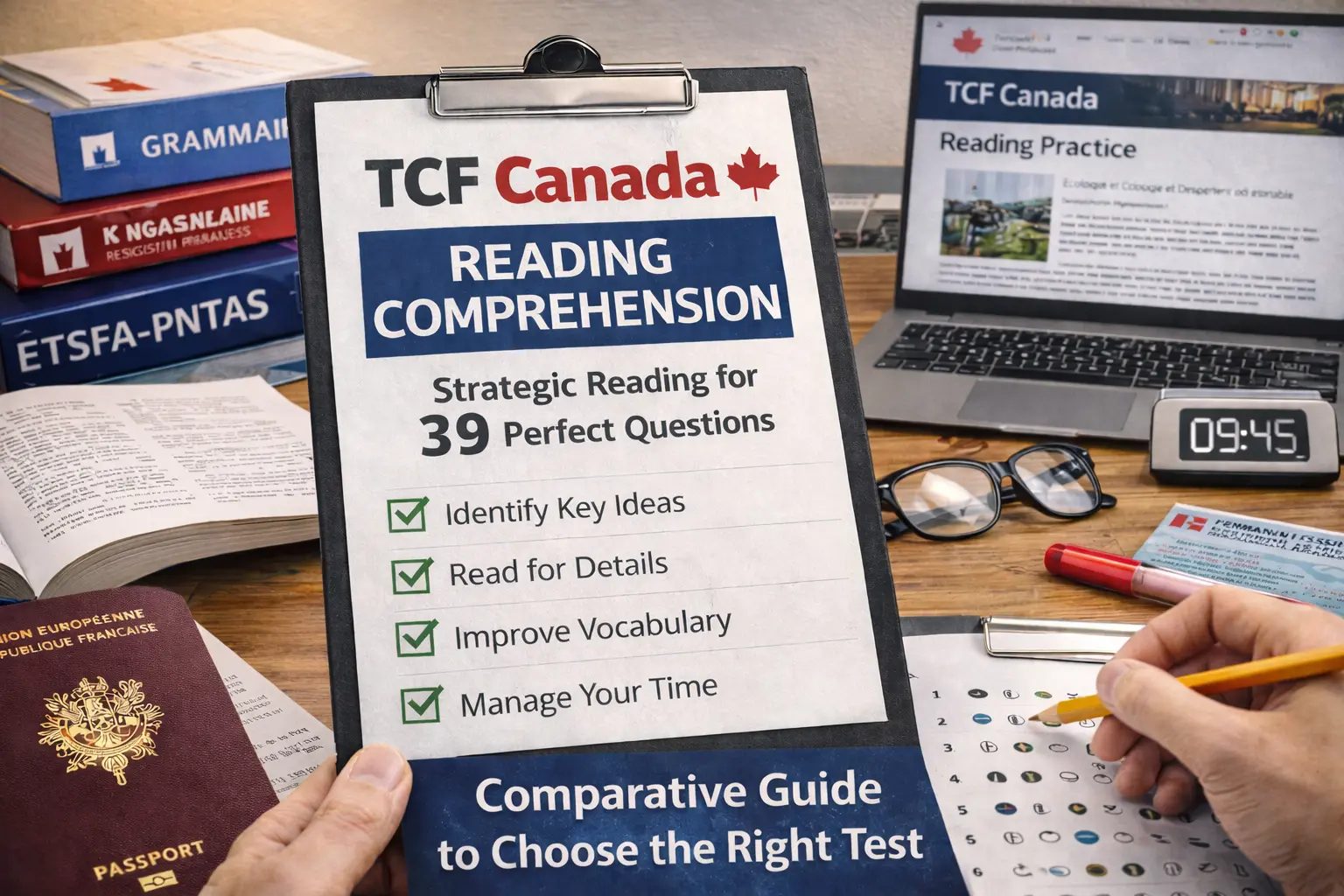
Sarah Martinez, a 34-year-old librarian from Lyon with a genuine passion for French literature, confidently approached her first TCF Canada reading comprehension test believing her lifelong love of reading would provide a decisive competitive advantage. The devastating reality: 420 points, barely achieving NCLC 7—far below her ambitious NCLC 9 target required for optimal Express Entry CRS points.
"I was absolutely shocked and demoralized," Sarah recalls from her current position at Quebec City's municipal library system where she now thrives professionally. "I regularly read three complete novels monthly, analyze complex literary texts, and possess sophisticated reading comprehension skills. Yet I utterly failed when confronted with six seemingly straightforward texts comprising just a few paragraphs each under timed examination conditions. The cognitive dissonance was profound and devastating to my immigration timeline."
Six months later, after completely revolutionizing her strategic approach, Sarah triumphantly achieved 650 points (NCLC 9), substantially boosting her Express Entry profile. Her transformation methodology, which she describes as "genuinely revolutionary in its counterintuitive logic": Stop reading to understand and appreciate content; start reading exclusively to identify and extract answers efficiently.
TCF Canada's reading comprehension section (Compréhension écrite) intimidates candidates with its substantial volume and intense time pressure: 6-8 diverse texts spanning multiple genres and complexity levels, 39 precisely crafted multiple-choice questions, and an unforgiving 60-minute time constraint. The fatal strategic error that destroys countless otherwise qualified candidates? Treating this standardized assessment as a traditional leisurely reading comprehension exercise focused on thorough text understanding and appreciation.
The critical paradigm shift required for success: TCF Canada reading comprehension fundamentally constitutes a rapid information extraction exercise conducted under extreme time constraint, demanding strategic thinking, tactical prioritization, and systematic question-answering methodology rather than comprehensive textual analysis and literary appreciation.
Comprehensive Anatomy of the Reading Comprehension Test: Understanding the 60-Minute Challenge
The Secret Distribution Pattern of 39 Questions
Contrary to superficial appearances suggesting uniform question difficulty, the 39 questions follow a carefully calibrated progressive difficulty structure with three distinct categories, each demanding specialized strategic approaches and differentiated time allocation. Michel Beauregard, a veteran French language instructor who transitioned to become a specialized TCF coach after analyzing over 400 complete examination results, reveals his empirically-derived classification system: "After meticulously analyzing hundreds of actual test performances across diverse candidate profiles, I identified three fundamental difficulty categories with statistically significant performance variations, each requiring distinct tactical strategies and optimized time investments."
| Question Category | Question Range | Difficulty Level | Optimal Time Investment | Primary Strategy | Success Rate |
|---|---|---|---|---|---|
| Explicit Information | Questions 1-13 | Easy to Moderate | 1-2 minutes each | Linear scanning, direct fact extraction | 85-95% accuracy |
| Implicit Information | Questions 14-26 | Moderate to Challenging | 2-3 minutes each | Contextual deduction, inference analysis | 70-85% accuracy |
| Complex Analysis | Questions 27-39 | Challenging to Difficult | 3-4 minutes each | Comparative analysis, nuanced interpretation | 60-75% accuracy |
Critical Strategic Insight: The progressive difficulty structure means early questions (1-13) represent your "guaranteed point bank" requiring rapid, efficient completion to maximize time available for challenging later questions where careful analysis provides competitive advantage. Spending excessive time on easy questions constitutes a catastrophic strategic error that destroys overall performance potential.
The 5 Text Types Decoded: Genre-Specific Strategic Approaches
Each text genre appearing in TCF Canada reading comprehension possesses distinctive structural characteristics, predictable information organization patterns, and optimal reading strategies. Sophie Durand, a professional translator now successfully established in Montreal, candidly acknowledges her initial strategic failure: "My fundamental error was mechanically applying an identical reading methodology to all text types regardless of their structural characteristics. The result was complete inefficiency, massive time waste, and catastrophically poor performance despite strong underlying French competency."
Empirically Observed Text Distribution (Based on 100+ Test Analysis):
1. Informative Articles and News Reports (30% of texts, ~12 questions)
- Structural Pattern: Inverted pyramid structure with essential information concentrated in opening paragraphs, supporting details following hierarchically
- Optimal Strategy: Intensive focus on first two paragraphs for main ideas, skim remaining content for specific supporting details only when questions require
- Common Topics: Current events, scientific discoveries, social trends, cultural phenomena, technological innovations
- Question Focus: Main idea identification, factual details, causal relationships, chronological sequencing
2. Testimonials and Personal Narratives (25% of texts, ~10 questions)
- Structural Pattern: Chronological progression with emotional arc, personal perspective, subjective interpretations interwoven with factual events
- Optimal Strategy: Identify narrative timeline, distinguish factual events from emotional reactions and personal opinions, track attitude evolution
- Common Topics: Immigration experiences, career transitions, life challenges, personal achievements, relationship dynamics
- Question Focus: Emotional state identification, opinion attribution, chronological sequencing, motivation analysis
3. Argumentative Texts and Opinion Pieces (20% of texts, ~8 questions)
- Structural Pattern: Clear thesis statement, supporting arguments structured hierarchically, counterargument consideration, conclusion reinforcing position
- Optimal Strategy: Identify author's central thesis immediately, map supporting arguments systematically, distinguish author's position from reported opposing viewpoints
- Common Topics: Social policies, environmental issues, educational reforms, technological impacts, cultural debates
- Question Focus: Thesis identification, argument structure, opinion attribution, logical relationship analysis
4. Instructions and Procedural Texts (15% of texts, ~6 questions)
- Structural Pattern: Sequential step-by-step organization, conditional requirements, temporal constraints, hierarchical procedure levels
- Optimal Strategy: Identify procedure sequence, note conditional requirements and exceptions, recognize temporal/sequential connectors
- Common Topics: Administrative procedures, registration processes, technical instructions, safety guidelines, usage protocols
- Question Focus: Sequence ordering, condition identification, requirement specification, exception recognition
5. Announcements and Classified Advertisements (10% of texts, ~3 questions)
- Structural Pattern: Condensed factual information, abbreviated format, essential details prioritized, implicit contextual information
- Optimal Strategy: Rapid factual scanning, systematic detail extraction, careful attention to numerical data, dates, locations, contact information
- Common Topics: Job postings, housing rentals, event announcements, service advertisements, course offerings
- Question Focus: Specific detail extraction, factual accuracy, condition identification, eligibility requirements
The Revolutionary 6-Phase Strategic Method: From Amateur Reading to NCLC 9 Excellence
Phase 1: Lightning Initial Recognition and Text Mapping (30 seconds per text)
This critical preparatory phase determines your entire strategic approach for each text, enabling optimized time allocation and targeted information extraction. Thomas Leblanc, an accountant who dramatically progressed from 380 to 620 points through systematic methodology refinement, emphasizes: "I religiously dedicate exactly 30 seconds to 'mentally photographing' each text's structural organization and content hierarchy before even glancing at the first associated question. This investment yields exponential returns through dramatically improved efficiency."
Comprehensive 30-Second Visual Scan Protocol:
- Seconds 1-10 - Structural Architecture Analysis:
- Rapidly scan title, subtitles, section headings for topic identification
- Note bolded words, italicized terms, capitalized proper nouns
- Identify visual elements: bullet points, numbered lists, tables, quotes
- Assess overall text length and paragraph count for time planning
- Seconds 11-20 - Content Framework Establishment:
- Read opening paragraph completely for main topic and thesis
- Read concluding paragraph completely for summary and conclusion
- Note topic sentences of intermediate paragraphs (first sentence only)
- Seconds 21-30 - Visual Information Markers:
- Systematically locate and mentally note all dates mentioned
- Identify all numerical data, statistics, percentages, quantities
- Note proper nouns: names of people, places, organizations, brands
- Recognize temporal and sequential connectors indicating structure
"This systematic 30-second scan technique revolutionized my entire test performance, ultimately saving me approximately 15 crucial minutes across the complete examination. Those recovered minutes proved absolutely decisive—I invested them in carefully reviewing doubtful answers and conducting verification checks that directly enabled my achievement of NCLC 9 rather than settling for NCLC 8. The marginal time investment in structured scanning yielded disproportionate performance returns."
Phase 2: Revolutionary Question-First Reading Strategy (The Game-Changing 3-2-1 Technique)
The counterintuitive strategic innovation that transforms performance: systematically read all associated questions before engaging with the text content itself. Émilie Rousseau, a high school French teacher with 12 years of classroom experience, reveals her epiphany: "This complete inversion of traditional reading methodology changes everything fundamentally. You transition from passive content discovery to active targeted answer hunting, which proves exponentially more efficient under severe time constraints. You're no longer reading to comprehend; you're strategically searching to extract specific required information."
Émilie's Proven 3-2-1 Systematic Method:
3 Minutes - Comprehensive Question Analysis Phase
- Read all questions associated with this text slowly and carefully
- Underline or mentally note key information required: dates, names, quantities, opinions, reasons
- Identify question types: factual extraction, inference, opinion identification, chronological ordering
- Anticipate where in text structure answers likely appear based on question type
- Flag particularly complex or ambiguous questions requiring extra attention
2 Readings - Dual-Pass Text Engagement Strategy
- First Reading (Rapid Overview): Skim entire text quickly (45-60 seconds) to establish general content framework, identify main themes, understand overall structure and argument flow
- Second Reading (Targeted Extraction): Systematically search text with specific questions in mind, pause at relevant passages containing answer information, extract precise details required for each question
1 Verification - Answer Coherence and Logic Check
- Review all selected answers for this text before advancing to next text
- Verify logical consistency across related questions
- Check that selected answers don't contradict explicit text information
- Confirm all questions answered (no blanks left accidentally)
- Flag any remaining doubts for final verification phase
Common Strategic Error to Avoid: Many candidates read questions too superficially during this phase, focusing only on question stems while neglecting careful analysis of all four answer options. This creates a false sense of preparation. Invest adequate time to genuinely understand what each question seeks and mentally categorize the type of information required. This deeper question analysis directly translates to faster, more accurate answer identification during text reading.
Phase 3: Specialized Advanced Strategies by Question Type Classification
Different question categories demand fundamentally different information search strategies and analytical approaches. Vincent Morel, a senior sales engineer with background in technical communication, shares his systematically developed methodology: "Through extensive practice analysis, I developed five completely distinct tactical approaches corresponding to the five primary question types consistently appearing in TCF Canada reading comprehension. Matching strategy to question type dramatically improved both my accuracy and speed."
Question Type 1: Factual Information Extraction - The Precision Laser Technique
Typical Question Formats:
- "When will the conference take place?"
- "How many participants registered for the program?"
- "Where is the organization's headquarters located?"
- "What is the registration deadline?"
Optimal Search Strategy:
- Visual Pattern Recognition: Conduct rapid visual scan for distinctive numerical or temporal markers (dates, times, quantities, locations)
- Contextual Verification: Don't select first matching number encountered—verify it corresponds to question's specific context
- Units and Precision: Pay meticulous attention to measurement units, currency symbols, time zones, exact versus approximate values
Common Traps and Defensive Tactics:
- Trap: Multiple dates/numbers mentioned in different contexts throughout text
- Defense: Carefully read surrounding sentence to confirm context matches question requirement precisely
- Trap: Similar numbers with different units or scopes (15 participants vs. 15,000 euros vs. 15th of the month)
- Defense: Verify units and contextual meaning systematically before selecting answer
Question Type 2: Author Opinion and Attitude - The Analytical Detective Technique
Typical Question Formats:
- "What does the author think about this proposed measure?"
- "What is the writer's attitude toward this phenomenon?"
- "How does the author evaluate this initiative?"
- "What impression does the author convey about this situation?"
Linguistic Clues for Opinion Identification:
- Qualifying Adjectives: excellent, problematic, disappointing, promising, concerning, beneficial, harmful
- Manner Adverbs: unfortunately, happily, surprisingly, regrettably, inevitably
- Evaluative Verbs: appreciate, criticize, praise, condemn, support, question, doubt
- Modal Expressions: it's essential that, it would be preferable, one must, one should
- Tone Markers: ironic punctuation, rhetorical questions, emphatic structures
Critical Traps and Defense Strategies:
- Trap: Confusion between reported third-party opinions and author's personal viewpoint
- Defense: Identify clear attribution markers: "according to," "experts claim," "critics argue" versus unmarked statements representing author's view
- Trap: Nuanced positions confused with opposing extremes (author expressing measured concern misinterpreted as complete opposition)
- Defense: Carefully evaluate qualifier intensity—distinguish "somewhat problematic" from "completely unacceptable"
Question Type 3: Inference and Implicit Information - The Logical Deduction Technique
Typical Question Formats:
- "What can we deduce about the protagonist's situation?"
- "What does this information suggest about future developments?"
- "Why did the person likely make this decision?"
- "What implicit assumption underlies this argument?"
Deductive Analysis Strategy:
- Locate all explicit statements directly relevant to question topic
- Identify logical connections and causal relationships implied but not stated
- Eliminate answer options contradicting any explicit text information
- Select option most strongly supported by textual evidence even if not explicitly stated
- Avoid extreme extrapolations beyond reasonable logical inference from text
Question Type 4: Main Idea and Purpose - The Synthesis Technique
Typical Question Formats:
- "What is the main purpose of this text?"
- "What is the author's primary objective?"
- "What best summarizes the central theme?"
- "This text primarily aims to..."
Synthesis Strategy:
- Focus primary attention on opening and closing paragraphs containing thesis and conclusion
- Identify recurring themes and concepts emphasized throughout text
- Distinguish primary purpose from secondary supporting points
- Recognize text type indicators: inform, persuade, narrate, describe, instruct
- Eliminate overly specific options focusing on minor details rather than overarching purpose
Question Type 5: Vocabulary in Context - The Contextual Meaning Technique
Typical Question Formats:
- "In this context, the word 'X' means..."
- "What does the expression 'Y' refer to?"
- "The term 'Z' is used here to indicate..."
Contextual Analysis Strategy:
- Never rely on isolated dictionary definitions—context determines meaning
- Read complete sentence containing the word plus preceding and following sentences
- Mentally substitute each answer option into original sentence to test logical coherence
- Consider connotative meaning and register (formal/informal, positive/negative) appropriate to context
- Recognize that common words often have specialized contextual meanings
Mastering Time Management: The Difference Between NCLC 7 and NCLC 9 Performance
Optimal Strategic Distribution of 60 Minutes
Marie Fontaine, a licensed pharmacist now successfully practicing in Montreal, shares her meticulously refined time management framework: "Exceptional time management represents the single most significant differentiator between candidates achieving merely good scores (NCLC 7) and those attaining genuinely excellent performance (NCLC 9). Superior French comprehension competency proves insufficient without disciplined strategic time allocation."
| Test Phase | Time Allocation | Specific Activities | Strategic Objective | Success Markers |
|---|---|---|---|---|
| Initial Recognition | 5 minutes total | Rapid scan of all 6-8 texts; structural mapping; question counting; difficulty assessment | Comprehensive overview and strategic sequencing plan | Clear mental roadmap of entire section before detailed engagement |
| Primary Execution | 45 minutes total | Systematic question-answering for all 39 questions using phase-appropriate strategies | Maximized correct answers through optimized strategy application | All 39 questions attempted with initial answers selected |
| Verification Review | 10 minutes total | Review flagged doubtful answers; logic consistency checks; error correction | Score security through error elimination and confidence validation | Peace of mind from systematic verification; improved accuracy 5-10% |
Advanced Time Management Techniques:
- Progressive Time Pressure Adaptation: Practice under increasingly strict time constraints (start at 75 minutes, reduce progressively to 55 minutes to build speed resilience and pressure tolerance)
- Question-Level Timing: Internalize approximate time limits per question category (1.5 min for easy, 2.5 min for moderate, 3.5 min for difficult) enabling real-time pacing awareness
- Strategic Question Flagging: Immediately flag questions requiring >4 minutes, move forward, return during verification phase rather than becoming trapped in time-consuming problem questions
- Clock Checkpoint System: Establish mental checkpoints: "By minute 15, complete first 10 questions; by minute 30, complete 20 questions; by minute 45, complete 30 questions" enabling real-time pacing adjustment
Revolutionary Prioritization Strategy: The Anti-Chronological Difficulty-Based Approach
Contrary to natural intuition suggesting linear progression through questions in presented order, strategically beginning with more challenging questions while mental energy peaks proves substantially more effective. Laurent Mercier, a secondary school teacher now thriving in Ottawa's francophone education system, explains his counterintuitive but empirically validated approach: "When your mind is completely fresh and cognitive resources are maximum, strategically attack the most complex analytical questions requiring sustained concentration. Reserve obvious straightforward factual questions for later phases when inevitable fatigue sets in but simple information extraction remains achievable—this energy-aligned strategic sequencing optimizes overall performance across varying cognitive states."
Laurent's Proven Anti-Chronological Prioritization Protocol:
Minutes 0-5: Strategic Overview and Sequencing Decision
- Rapidly scan all texts and question sets to identify difficulty distribution
- Classify texts as "easy" (straightforward factual), "moderate" (some inference), "difficult" (complex analysis required)
- Make conscious decision about optimal sequence for your profile
Minutes 5-25: High-Difficulty Questions While Fresh
- Tackle 2-3 most challenging texts first when concentration maximal
- Apply intensive analytical strategies to complex questions (27-39 range)
- Invest adequate time without rushing—these questions yield highest marginal returns
Minutes 25-45: Moderate Difficulty Progression
- Transition to moderately challenging texts and questions (14-26 range)
- Maintain good pace while applying appropriate inference strategies
- Build momentum and confidence through successful completion
Minutes 45-50: Easy Questions Rapid Completion
- Complete remaining straightforward factual questions (1-13 range)
- Leverage accumulated fatigue resistance—these require minimal analytical depth
- Rapid execution capitalizing on simple information extraction
Minutes 50-60: Comprehensive Verification Phase
- Systematic review of flagged uncertain answers
- Logic consistency verification across related questions
- Final error correction and confidence validation
Important Personalization Note: While Laurent's anti-chronological approach proves optimal for many candidates, some individuals perform better with confidence-building linear progression starting with easier questions. During preparation, experiment with both approaches under timed conditions to empirically determine which sequencing strategy maximizes YOUR specific performance based on your cognitive profile, anxiety patterns, and confidence dynamics.
Comprehensive Catalog of Recurring Traps and Infallible Defensive Tactics
Trap Category 1: Repeated Information with Subtle Variation
Manifestation Example: The text mentions "15 participants" in the opening paragraph when describing initial registration, then later references "approximately fifteen people" when discussing actual attendance, and finally notes "a dozen individuals" when describing active engagement in activities. Question asks for precise number of registered participants.
Trap Mechanism: Multiple similar numerical references create confusion about which figure answers the specific question asked. Candidates frequently select the most recently encountered number or the most prominently positioned reference regardless of contextual accuracy.
Defense Protocol:
- Carefully read the exact question requirement—what specific number is being requested?
- Identify the precise context: registration vs. attendance vs. participation vs. completion
- Prioritize exact numerical data ("15 participants") over approximations ("about fifteen people")
- Verify that selected number corresponds exactly to question's specified context
- When precision differs, choose more specific/official figure over casual approximation
Trap Category 2: False Synonym and Register Confusion
Real Candidate Experience - Julie's Costly Mistake:
"The text described a community event as having been 'satisfaisant' (satisfactory), and I confidently selected 'excellent' from the answer options, assuming they were essentially equivalent positive evaluations. This proved catastrophically wrong. In Canadian French professional and administrative contexts, 'satisfaisant' specifically indicates acceptable, adequate, meeting minimum requirements—decidedly NOT exceptional or excellent. This subtle but crucial semantic distinction cost me multiple points across several questions where I misinterpreted evaluative terminology."
Common False Synonym Pairs Creating Confusion:
- satisfaisant ≠ excellent: satisfactory/adequate vs. outstanding/exceptional
- important ≠ essentiel: significant/substantial vs. absolutely necessary/indispensable
- plusieurs ≠ nombreux: several/some vs. many/numerous
- possible ≠ probable: potential/conceivable vs. likely/expected
- intéressant ≠ passionnant: interesting/noteworthy vs. fascinating/captivating
Defense Strategy:
- Never assume synonymy based on general similarity—context and register matter critically
- Consider intensity gradations: satisfactory < good < very good < excellent
- Recognize formal/administrative register where terms carry precise technical meanings
- When uncertain, select more conservative/moderate option over extreme interpretation
Trap Category 3: Inverted or Non-Linear Chronological Order
Manifestation Example: Text begins with current situation description, then provides historical background explaining origins, finally discusses future implications. Question asks: "What initially motivated this initiative?" The answer appears mid-text in the historical background section, not in the opening paragraphs despite temporal primacy.
Defense Technique - Mental Timeline Construction:
- As you read, actively construct mental chronological timeline of mentioned events regardless of presentation order
- Distinguish narrative/presentation sequence from actual chronological sequence
- Use temporal markers: "originally," "initially," "subsequently," "currently," "eventually," "in the future"
- Question about "first" event requires identifying chronologically first occurrence, which may appear anywhere in text structure
- Create brief margin notes with sequence numbers if text contains complex timeline
Trap Category 4: Partial Truth and Incomplete Answer Options
Manifestation Example: Text states: "The program accepts applicants with a bachelor's degree in any field AND at least two years of relevant professional experience." Answer option states: "Applicants need a bachelor's degree." This is technically true but incomplete—missing the essential professional experience requirement.
Defense Strategy - Complete Requirements Verification:
- Read questions containing "required," "necessary," "must have," "conditions" with extreme care
- Verify that selected answer includes ALL stated requirements, not just some
- Be suspicious of answers that are partially true but omit crucial conditions
- Look for comprehensive answer options using "and" to combine multiple requirements
- Eliminate options that add unstated requirements or omit stated ones
Trap Category 5: Negation and Exception Confusion
Common Negative Construction Traps:
- Double negatives creating affirmative meaning: "ne...pas sans" = necessary
- Restrictive negatives: "ne...que" = only
- Exception phrases: "sauf," "à l'exception de," "hormis" = except
- Conditional negatives: "à moins que," "sans que" = unless/without
Defense Protocol:
- Slow down substantially when encountering negative constructions
- Mentally convert to positive equivalent to verify logical meaning
- Pay special attention to "ne...que" (only/just) frequently misinterpreted
- Carefully track scope of exceptions—what exactly is excluded?
Comprehensive Systematic Training Program: The Transformative 100-Text Methodology
Weeks 1-4: Diagnostic Analysis and Foundation Building Phase
Begin your preparation journey by precisely diagnosing your specific weaknesses through systematic performance analysis across diverse text types and question categories. Pauline Levesque, a professional French-English translator, shares her revelatory diagnostic experience: "I initially assumed my translation background meant uniform strength across all text types. Comprehensive diagnostic testing revealed I excelled with narrative and testimonial texts but struggled significantly with technical procedural texts and complex argumentative pieces. This specific weakness identification completely oriented my subsequent targeted training focus, enabling dramatically more efficient preparation."
Pauline's Comprehensive 4-Week Diagnostic Program:
Week 1: Broad-Spectrum Exposure and Baseline Establishment
- Daily Practice: 5 texts from different categories (1 informative, 1 narrative, 1 argumentative, 1 procedural, 1 advertisement/announcement)
- Time Tracking: Record completion time for each text type separately
- Accuracy Recording: Document correct/incorrect answers by text type and question category
- Difficulty Rating: Subjectively rate each text's difficulty (1-5 scale) to identify perceived challenges
- Weekly Target: 35 diverse texts completed with comprehensive performance data
Week 2: Statistical Error Pattern Analysis
- Data Compilation: Aggregate Week 1 performance data into structured analysis spreadsheet
- Accuracy by Text Type: Calculate success percentage for each of 5 text categories
- Accuracy by Question Type: Calculate success percentage for factual, inference, opinion, main idea, vocabulary questions
- Time Efficiency Analysis: Identify which text types consume disproportionate time relative to question count
- Weakness Prioritization: Rank your 2-3 weakest areas demanding intensive focus
- Continue Practice: Additional 35 texts maintaining diagnostic tracking
Week 3: Intensive Focus on Identified Weakness Areas
- Targeted Practice Distribution: 70% practice time dedicated to your 2 weakest text types, 30% distributed across others for maintenance
- Strategy Experimentation: Try different reading approaches specifically for challenging text types
- Expert Resources: Seek specialized preparation materials focusing on your weakness areas
- Analytical Review: For each error, write brief explanation of why correct answer is right and your selection was wrong
- Weekly Volume: 40+ texts with heavy concentration in weakness categories
Week 4: Progress Assessment and Strategy Refinement
- Formal Progress Test: Complete full-length practice test under strict timed conditions
- Comparative Analysis: Compare Week 4 performance metrics to Week 1 baseline
- Improvement Quantification: Calculate improvement percentages by text type and question category
- Strategy Evaluation: Assess which techniques produced measurable improvement
- Phase 2 Planning: Design Weeks 5-8 program based on remaining weaknesses and proven effective strategies
Diagnostic Phase Success Metrics: By end of Week 4, successful candidates typically achieve: (1) Clear identification of 2-3 specific weakness areas, (2) 15-25% improvement in previously weakest text type accuracy, (3) Established baseline timing benchmarks for each text category, (4) Proven personal strategy repertoire with documented effectiveness, (5) Realistic assessment of current NCLC level and remaining gap to target.
Weeks 5-8: Technical Perfection and Advanced Skill Refinement Phase
The intensive advancement phase focusing laser-targeted effort on persistent weakness areas while maintaining achieved proficiency levels. David Gagnon, a senior sales professional, testifies to his strategic time allocation: "I devoted approximately 70% of my daily practice time to argumentative and technical texts that continued challenging me despite initial progress, while investing remaining 30% across other text types to prevent skill erosion and maintain confidence. This asymmetric focus proved essential for breakthrough to NCLC 9 performance level."
Advanced Training Strategies for Weeks 5-8:
Intensive Deliberate Practice Protocol
- Difficulty Progression: Systematically increase text complexity and question difficulty within weakness areas
- Time Pressure Intensification: Gradually reduce time allowance (start 75 min, progress to 60 min, challenge with 55 min)
- Error Analysis Depth: For every mistake, conduct comprehensive analysis: Why was this difficult? What specific skill gap did this expose? What strategy would have prevented this error?
- Strategy Refinement Iteration: Continuously adjust techniques based on performance feedback
Simulated Test Conditions Practice
- Weekly Full Tests: Complete full 39-question practice test every Sunday under authentic examination conditions
- Environmental Simulation: Quiet room, no interruptions, strict 60-minute limit, no reference materials
- Physical Preparation: Practice at same time of day as planned actual test to optimize circadian rhythm
- Performance Tracking: Graph score progression week-over-week to visualize improvement trajectory
Advanced Technique Development
- Speed Reading Training: Develop rapid scanning capability for factual information extraction
- Inference Practice: Specific exercises strengthening logical deduction from implicit information
- Vocabulary Context Training: Build ability to deduce word meaning from contextual clues without dictionary dependency
- Complex Syntax Navigation: Practice with texts containing sophisticated sentence structures and embedded clauses
Inspiring Success Stories: Remarkable Score Transformations
Nicolas's Extraordinary Journey: 350 to 670 Points in 4 Months
"My transformation secret? Absolutely obsessive chronometric discipline and systematic data analysis. I meticulously timed every single question during practice, every complete text, every distinct exercise type. I maintained detailed spreadsheets tracking time investment versus accuracy yield for each question category and text type combination."
"This comprehensive performance data enabled me to identify with precision exactly which question types I answered most efficiently (factual extraction averaging 1.2 minutes with 94% accuracy) versus those consuming disproportionate time (complex inference averaging 4.1 minutes with only 68% accuracy). Armed with this empirical insight, I strategically restructured my entire test-taking approach, front-loading my available time toward high-difficulty inference questions while streamlining rapid completion of straightforward factual questions."
"Beyond time optimization, the data revealed my tendency to overthink moderately difficult questions, consuming 3+ minutes on questions where my first instinct proved correct 87% of the time. Recognizing this pattern, I implemented a strict 2.5-minute limit on moderate questions with immediate answer commitment rather than second-guessing paralysis."
"This systematic, data-driven approach to continuous optimization elevated my performance from discouragingly low 350 points to exceptional 670 points—a 91% improvement representing advancement from NCLC 5 to NCLC 9. The transformation fundamentally resulted not from dramatically improved French competency but from radically optimized strategic execution and time management discipline."
Isabelle's Strategic Evolution: NCLC 6 to NCLC 9 Transformation
"My breakthrough required completely reconceptualizing what 'reading well' means within the TCF Canada context. I had to consciously unlearn decades of academic training emphasizing deep textual appreciation, nuanced interpretation, and comprehensive understanding. For TCF success, I needed to fundamentally redefine 'reading well' as rapid, targeted information extraction optimized for question-answering efficiency rather than holistic comprehension or intellectual enjoyment."
"This mental paradigm shift proved genuinely revolutionary. I stopped attempting to fully understand and appreciate every text's complete message, nuanced arguments, and stylistic qualities. Instead, I trained myself to become an efficient information hunter—scanning strategically, extracting precisely, answering accurately, moving forward without attachment to comprehensive textual mastery."
"My disciplined daily practice routine consisted of 30 minutes of strategic reading comprehension practice every single morning immediately upon waking when mental acuity peaked. I maintained strict timing discipline for every practice session, tracking performance metrics obsessively. Weekly, I conducted comprehensive statistical analysis of error patterns, identifying systematic weaknesses and strategic gaps. Bi-weekly, I completed full-length practice tests under authentic examination conditions to maintain pressure resilience and pacing discipline."
"This sustained systematic approach, maintained consistently over 5 months without breaks or compromises, elevated me from marginally adequate NCLC 6 performance to excellent NCLC 9 achievement. The transformation didn't require miraculous improvement in underlying French proficiency—it demanded disciplined strategic execution, relentless time management optimization, and complete mental reframing of the reading task's fundamental nature."
Sarah's Complete Strategic Revolution: 420 to 650 Points
"Reflecting on my complete journey from initial devastating failure to ultimate triumphant success, the most critical lesson learned: TCF Canada reading comprehension fundamentally constitutes NOT a test of your ability to read and appreciate French texts with sophistication and depth, but rather a ruthlessly efficient information extraction exercise conducted under severe time pressure demanding strategic thinking far more than linguistic elegance."
"I stopped being a literary reader savoring language and became an analytical information hunter pursuing specific data points. This complete mental transformation—from passive comprehension to active extraction, from holistic appreciation to targeted scanning, from leisurely understanding to rapid answering—revolutionized my performance and transformed the previously overwhelming test into a genuinely manageable, even enjoyable strategic challenge."
"My advice to future candidates: Abandon all romanticized notions of 'good reading' developed through academic literature courses. TCF reading comprehension rewards speed, precision, strategic thinking, and tactical execution—not depth, nuance, aesthetic appreciation, or comprehensive understanding. Master the game's actual rules rather than playing by imagined literary standards, and your performance will transform dramatically."
Advanced Training Resources and Preparation Materials
Recommended Practice Resources (Prioritized by Effectiveness):
Official TCF Preparation Materials (Highest Priority)
- France Éducation international Official Website: Free sample questions and practice exercises demonstrating authentic question formats and difficulty levels
- TCF Canada Official Preparation Manual: Published guidebook with comprehensive format explanation and practice tests (€25-35)
- TCF Entraînement Digital Platform: Subscription-based online practice with adaptive difficulty and performance tracking (€15-30/month)
Quality Third-Party Preparation Resources
- TV5Monde "Apprendre le français": Free interactive exercises with diverse text types and authentic French content (apprendre.tv5monde.com)
- RFI Savoirs "Le français facile": Graded reading materials with comprehension questions suitable for B1-C1 levels (savoirs.rfi.fr)
- Hachette TCF Preparation Series: Comprehensive textbooks with extensive practice materials organized by competency level
- CLE International "Réussir le TCF": Targeted preparation manual with test-taking strategies and practice questions
Authentic French Reading Sources for Skill Building
- Le Monde / Le Figaro: Quality journalism providing informative article practice with sophisticated vocabulary
- L'Express / Le Point: News magazines offering argumentative texts and opinion pieces
- Radio-Canada / RFI: Canadian and international French news specifically relevant for Canadian context
- Short French Narratives: Contemporary short stories and testimonials for narrative text practice
Resource Selection Caution: Prioritize quality over quantity. Working thoroughly through 100 well-chosen texts with comprehensive analysis proves far more effective than superficially skimming 500 random texts. Focus on materials closely matching actual TCF format, difficulty level, and question types rather than generic French reading practice that may not align with test-specific requirements.
Final Strategic Recommendations for Test Day Success
Pre-Test Preparation (24-48 Hours Before Examination):
- Complete one final full-length practice test to activate strategic mindset
- Review your personalized error pattern notes and defensive strategies
- Ensure adequate sleep (7-8 hours) night before examination
- Avoid intensive last-minute cramming—trust your preparation
- Prepare all required documents: passport/ID, registration confirmation, approved materials
Test Day Execution Protocol:
- Arrive 30 minutes early to minimize stress and complete check-in calmly
- Bring water bottle and light snack if permitted (verify center rules)
- During test instructions, take deep breaths and center your focus
- Execute your practiced strategic approach methodically without improvisation
- If encountering unexpected difficulty, maintain composure—one difficult text doesn't determine overall score
- Use your full 60 minutes including verification phase
- Trust your preparation and strategic training
Conclusion: Your Path to Reading Comprehension Mastery
TCF Canada reading comprehension mastery requires fundamental reconceptualization of reading as strategic information extraction rather than traditional literary comprehension. Success depends not primarily on sophisticated French reading ability cultivated through years of education, but rather on disciplined strategic execution, systematic time management, targeted practice focusing on weakness areas, and complete mental reframing of the reading task's essential nature.
As Sarah Martinez eloquently summarizes from her current successful position in Quebec City's francophone library system: "I stopped being a passive reader appreciating textual beauty and became an active information hunter pursuing specific answers with tactical precision. This complete mental transformation revolutionized my performance, elevated my score by 230 points, and transformed a previously overwhelming impossible challenge into a genuinely manageable strategic exercise yielding predictable success through disciplined preparation and systematic execution."
Remember: NCLC 7 represents competency; NCLC 9 represents strategic excellence.
The difference isn't reading ability—it's strategic execution.
The difference isn't reading ability—it's strategic execution.
* * *
Laissez un commentaire
Votreadresse email ne sera pas publie. Les champs obligatoires sont marque avec *





0 Commentaires
aucun commentaire
Soyez le premier a partager votre avis !