-
Auteur :
 Antoine C.
- Feb 21, 2026
TCF Canada 2026: The Complete Guide to Canadian French Digital Resources for Truly Authentic Preparation
- Blog
- /
- Article

When Elena, a 31-year-old software engineer living in Amsterdam, started preparing for the TCF Canada in early 2025, she did what many strong French speakers do: she trained almost entirely with France-based media. Every day, she read major French newspapers, listened to Paris-focused radio shows, and drilled vocabulary from European textbooks. On her practice tests, she consistently landed the equivalent of high NCLC scores. Then came the real exam—and the surprise.
The listening section felt “faster” than expected, the speakers sounded unfamiliar, and several reading texts used Canadian references and everyday Québec expressions she had never truly internalized. Her results were still good, but not aligned with her immigration target. A tutor later explained the problem in one sentence: Elena hadn’t prepared for the French she would actually hear and read in a Canadian context.
For her second attempt, she switched to a Canada-first strategy: public broadcasters, Québec newspapers, Franco-Canadian podcasts, and government content written in Canadian administrative French. Within two months, her comprehension improved dramatically—especially for accent variation, local vocabulary, and context. The lesson is simple: in 2026, “good French” is not enough; you need Canada-relevant French input.
2026 reality check: The fastest way to boost performance is not “studying harder,” but studying smarter—by feeding your brain the same kind of French the exam now includes more often: Canadian topics, Canadian voices, and Canadian phrasing.
Why Canadian Resources Became Non-Negotiable in 2026
The 2026 TCF Canada landscape rewards candidates who can understand French as it is used in Canada—especially in media, public services, and daily life. That means you must be comfortable with: accent variation (Québec, Franco-Ontario, Acadian), Canadian vocabulary (e.g., “fin de semaine,” “magasiner,” “stationnement”), and Canadian cultural references (institutions, geography, social debates, immigration realities).
What this means for your score: If your preparation is 90% “France French,” you may still do well—but you risk losing points in listening and reading simply because the content sounds or feels unfamiliar. In a competitive immigration context, a small drop in comprehension can translate into a big difference in outcomes.
Four Practical Differences: France French vs Canadian French (and Why You Care)
| Dimension | France French (typical prep) | Canadian French (what you must add) | Impact on TCF Canada |
|---|---|---|---|
| 1) Accent & Speed | More familiar to European learners; standard broadcast style | Affrication (t/d), different rhythm, regional variation | Listening accuracy drops if you haven’t trained your ear on Canadian voices. |
| 2) Everyday Vocabulary | “week-end,” “shopping,” “parking” | “fin de semaine,” “magasinage,” “stationnement” | Reading texts and dialogues may include these naturally; missing them = partial comprehension. |
| 3) Cultural References | France-centric institutions and context | Provinces, federal institutions, bilingualism, immigration services | Understanding “what’s going on” helps you answer faster and more accurately. |
| 4) Register & Tone | Often more formal and “textbook professional” | Professional but sometimes more direct/neutral in style | Speaking/writing can sound unnatural if you copy a tone that doesn’t match Canadian norms. |
The “60/30/10” Input Rule for 2026
- 60% Canadian French sources (Radio-Canada, Québec/Canadian newspapers, Franco-Canadian podcasts, .gc.ca pages)
- 30% general francophone sources (international French content for broader vocabulary)
- 10% official TCF-style practice (timed drills, sample items, exam simulation)
This ratio works because listening adaptation and vocabulary acquisition require repeated exposure. You can’t “cram” an accent—you build familiarity through daily contact.
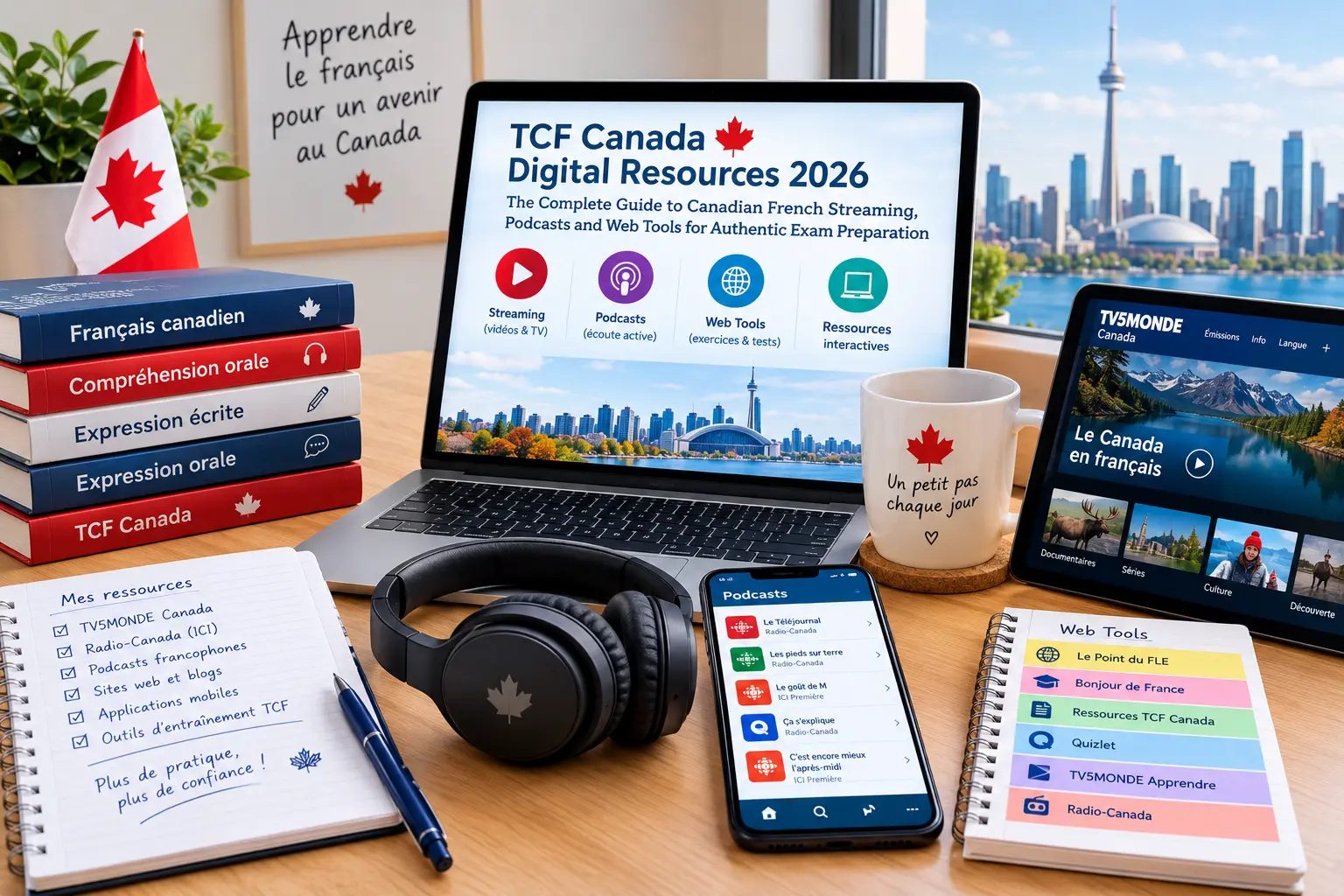
The Full Ecosystem of Canadian French Digital Resources
CATEGORY 1: News & Information Media (Reading + Listening)
Radio-Canada — The Essential Foundation
If you choose only one platform, choose Radio-Canada. It provides the widest variety of Canadian French: news, interviews, documentaries, short video segments, and podcasts—exactly the kind of content that builds high-level comprehension.
URL: https://ici.radio-canada.ca
- Short news articles (perfect for daily reading speed)
- Video reports (multi-speaker listening practice)
- Podcasts & radio shows (pure audio = exam-like training)
- Topic dossiers (health, education, climate, immigration)
| Goal | What to use | How to use it | Frequency |
|---|---|---|---|
| Reading | 400–700 word articles | 1) 5-minute skim 2) Mark unknown terms 3) Check meaning 4) Re-read once 5) Summarize in 2–3 sentences | 1–2/day |
| Listening | 3–6 minute video segments | 1) Listen without subtitles 2) Take quick notes 3) Listen with French subtitles 4) Listen again without subtitles | 2–3/day |
| Canadian vocab | Any content | Create a glossary: term → meaning → example sentence | 5–10 terms/day |
| Accent training | Audio-only podcasts | 30 minutes of focused listening during commute/chores | Daily |
La Presse — Modern Québec Journalism for Strong Reading Skills
La Presse is ideal for candidates aiming at advanced reading performance: longer articles, structured argumentation, and real Québec phrasing in a professional register.
- Excellent for opinion pieces (helps writing structure)
- Great for timed reading (longer formats)
- Natural Québec vocabulary in context
Le Devoir — Deep Analysis (Use Strategically)
Le Devoir is a strong “advanced boost” resource. Use it if you are already comfortable at B2+ and want richer vocabulary and complex argumentation.
Smart tip: Don’t overdo ultra-intellectual content. For most candidates, your “core diet” should stay closer to Radio-Canada and La Presse, then add Le Devoir in smaller doses.
CATEGORY 2: TV & Series (Authentic Oral Immersion)
ICI Tou.tv — “Canadian French Netflix” (Often Free)
Watching series is not just entertainment: it teaches you natural rhythm, conversation patterns, and everyday vocabulary—especially helpful for listening confidence and speaking spontaneity.
URL: https://ici.tou.tv
- Drama/series for daily-life vocabulary
- Documentaries for formal listening
- Talk shows for multi-speaker comprehension
| Weeks | What to watch | Subtitles | Goal |
|---|---|---|---|
| 1–2 | Series episodes (30–45 min) | French ON | Accent familiarization + core vocabulary |
| 3–4 | Same series | French ON (read less) | Shift from reading subtitles to listening |
| 5–8 | Documentaries + interviews | French OFF (challenge) | Higher-level comprehension & endurance |
TV5Unis — Franco-Canadian TV Selection
TV5Unis complements Tou.tv with a mix of Canadian and broader francophone content.
CATEGORY 3: YouTube Franco-Canadian (Maximum Variety)
YouTube is unbeatable for one reason: you can train with many voices and topics quickly. Use it to build a “Canadian ear” and learn informal-but-appropriate speaking patterns.
| Daily moment | Video type | Time | Goal |
|---|---|---|---|
| Morning | News recap | 8–12 min | Contemporary vocabulary + speed |
| Lunch break | Lifestyle / society | 8–12 min | Natural oral French + common phrasing |
| Evening | Science / documentary | 10–15 min | Advanced listening + topic diversity |
Pro move: Create one playlist called “TCF Canada Daily” with 10–12 channels. Remove distractions. Let the algorithm work for you—every day becomes effortless exposure.
CATEGORY 4: Podcasts (Audio-Only = Exam-Like Listening Training)
Podcasts are the closest thing to the listening exam environment: no visuals, just meaning. They also let you accumulate hours of exposure without needing extra “study time.”
- Use 20–30 minutes/day minimum for steady progress.
- Choose short segments if long episodes feel overwhelming.
- Repeat episodes: the second listen often reveals 2× more vocabulary.
| Level | What to pick | Target |
|---|---|---|
| B1–B2 | Slower, structured shows | Understand 70% without transcript |
| B2–C1 | Interviews, debates, culture | Understand 80–90% with note-taking |
| C1–C2 | Long-form analysis | Endurance + nuance |
CATEGORY 5: Government & Institutional French (Canadian Administrative Style)
Many candidates underestimate this category. But administrative French (forms, instructions, official notices) has its own patterns—and it appears often in real-life immigration and settlement situations.
| Site | What to read | Why it helps |
|---|---|---|
| Canada.ca Link | Service pages, official explanations | Administrative vocabulary + formal clarity |
| IRCC Link | Immigration guides and updates | Topic familiarity + key terms you’ll reuse |
| Québec.ca Link | Provincial services and procedures | Québec-specific vocabulary & context |
| Statistics Canada Link | Reports, summaries, charts | Complex reading formats + data vocabulary |
A Practical 8-Week “Canada-First” Immersion Plan
Weeks 1–2: Build the Ear
- Daily: 15 min Radio-Canada reading + 15 min video
- Daily: 20 min podcast (audio only)
- 3×/week: 1 episode of a Canadian series with French subtitles
Weeks 3–5: Build Speed and Vocabulary
- Daily: 1 long article (La Presse) + 1 short article (Radio-Canada)
- Daily: glossary (5–8 Canadian terms) + 10 min review
- 2×/week: government pages (IRCC / Canada.ca) with note-taking
Weeks 6–8: Simulate Exam Conditions
- Listening: practice “one-play only” sessions (no replay)
- Reading: timed sessions (set a strict limit)
- Speaking: record yourself summarizing a Canadian news story in 60–90 seconds
Expected outcome: stronger listening confidence with Canadian voices, faster reading on Canada-related topics, and more natural vocabulary for speaking and writing.
Common Mistakes That Quietly Destroy Scores
Mistake #1: “French is French—sources don’t matter”
In 2026, source choice matters because familiarity matters. If you don’t train with Canadian input, you spend exam time decoding the accent or context instead of answering efficiently.
Mistake #2: Avoiding Québec accent because it feels uncomfortable
Discomfort is the training signal. If you feel it, you’re targeting the right skill. Daily exposure makes the accent feel normal within a few weeks.
Mistake #3: Passive consumption without vocabulary capture
Watching or listening is helpful—but capturing vocabulary is what makes it permanent. A small daily glossary beats a massive weekend study session.
Conclusion: Authentic Canadian Immersion Is the Shortcut to NCLC 9–10
The candidates who break through to top-level performance often aren’t the ones who “study the most.” They are the ones who train with the right inputs: Canadian topics, Canadian voices, and Canadian phrasing—until it becomes automatic.
Your action plan for this week:
- Bookmark Radio-Canada + La Presse + Tou.tv.
- Create one “TCF Canada Daily” YouTube playlist.
- Install one podcast app and choose 2 Canadian shows.
- Start a glossary today (even 5 words is a win).
* * *
Frequently Asked Questions
Because the exam increasingly reflects Canadian French usage: Canadian topics, Canadian media style, accent variation (Quebec, Franco-Ontarian, Acadian), and everyday Canadian vocabulary. If you prepare only with France-based content, listening and reading can feel unfamiliar and cost you points.
Daily exposure to Canadian voices with a simple cycle: listen once without subtitles, take quick notes, listen again with French subtitles, then one final listen without subtitles. Add one audio-only podcast session per day to mimic exam conditions.
Radio-Canada for broad listening/reading practice, La Presse for strong reading and argumentation, Tou.tv for natural spoken French immersion, Canadian podcasts for audio-only comprehension training, and Canada.ca/IRCC for administrative French vocabulary and style.
No. You are not graded on copying an accent. The key is understanding Canadian accents comfortably and using natural, accurate French. Canadian vocabulary in context helps, but pronunciation imitation is not required.
Use the 60/30/10 rule: 60% Canadian French sources, 30% general francophone sources, and 10% official TCF-style timed practice. This builds familiarity while keeping exam skills sharp.
Passive consumption without vocabulary capture or timing practice. Watching and listening helps, but progress accelerates when you extract Canadian terms into a glossary and regularly do timed listening/reading sessions.
Most candidates notice clearer accent comprehension and faster reading within 6 to 8 weeks if they are consistent (around 45 to 60 minutes per day) and include weekly exam-condition simulations.
Laissez un commentaire
Votreadresse email ne sera pas publie. Les champs obligatoires sont marque avec *

0 Commentaires
aucun commentaire
Soyez le premier a partager votre avis !