-
Auteur :
 Antoine C.
- Jul 03, 2026
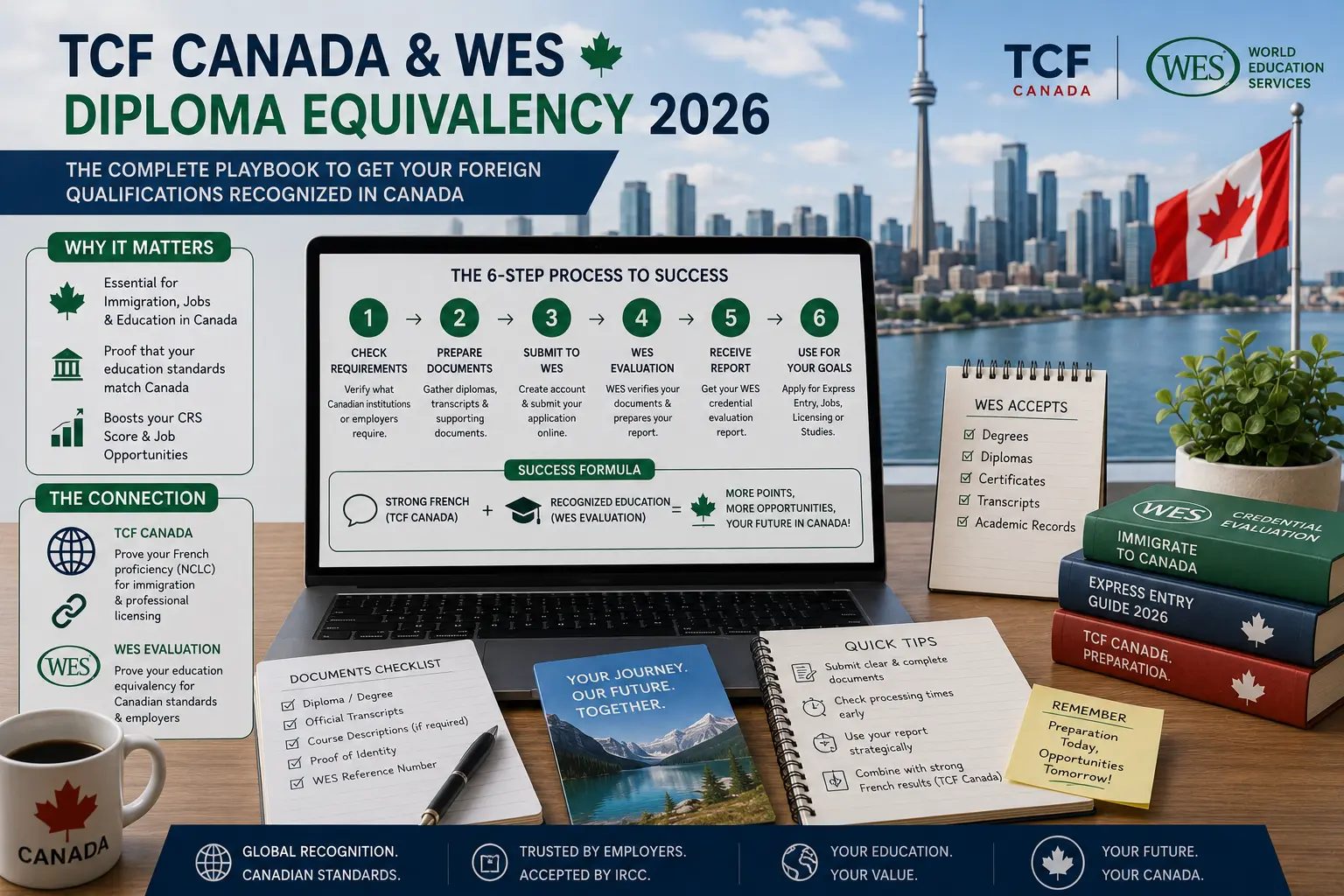
The TCF Canada score is one of two essential pillars of a competitive Express Entry profile. The second pillar — often underestimated in its complexity and timeline — is the Educational Credential Assessment (ECA). Understanding how WES Canada evaluates your foreign degree, how long the process takes from your country, and how to avoid the most costly procedural mistakes can save you months and significantly impact your CRS score. This guide covers the complete WES process with country-specific timelines and common mistakes for francophone candidates.
Why the ECA Matters as Much as Your TCF Canada Score
The education factor in your CRS score:
- Bachelor's degree (3-year): 120 CRS points
- Bachelor's degree (4-year): 120 CRS points
- Two or more post-secondary credentials (one 3-year+): 128 CRS points
- Master's degree or professional degree: 135 CRS points
- PhD: 150 CRS points
- Difference between Bachelor's and Master's recognition: 15 CRS points — equivalent to going from NCLC 8 to NCLC 9 in one skill
Understanding WES Canada: What It Evaluates and How
WES Canada offers two main evaluation types for Express Entry:
- Document-by-Document (Basic): Confirms your credential exists and is equivalent to a Canadian credential at a specific level. Sufficient for Express Entry profile submission in most cases. Cost: CAD $235. Processing: 7-10 business days (standard) or 5 days (expedited).
- Course-by-Course (Detailed): Evaluates each course in your transcript against Canadian curriculum standards. Required by some regulated professions (engineers, teachers) and some PNPs. Cost: CAD $315. Processing: 10-15 business days standard.
- Important: WES does not evaluate professional credentials (medical licenses, law bar membership) — only academic degrees. Professional licensing is separate and handled by provincial regulatory bodies.
Document Submission by Country: Timelines and Pitfalls
| Country/Region | Document Transit Time | Special Requirements | Common Problems |
|---|---|---|---|
| France, Belgium, Switzerland | 2–4 weeks (courier) | Diplôme + relevé de notes official | Apostille required for older documents |
| Morocco | 4–8 weeks | Université must send directly to WES | University delays in responding to WES requests — start early |
| Algeria | 6–12 weeks | MESRS attestation sometimes required | Bureaucratic delays — plan 3-4 months minimum |
| Tunisia | 4–8 weeks | University attestation + transcripts | Private university degrees sometimes contested |
| Senegal, Ivory Coast | 6–14 weeks | Notarized copies + university seal | Mail transit delays; DHL courier recommended |
| Lebanon | 4–10 weeks | LAU, AUB, USJ direct submission possible | Infrastructure challenges — digital submission preferred where available |
| India | 4–8 weeks | University verification of transcripts | Private universities vary in recognition quality |
| China | 6–12 weeks | CHESICC verification for public universities | Additional verification layer adds time |
The #1 ECA mistake that delays immigration by 3-6 months:
Starting the WES process AFTER passing the TCF Canada exam. Both should be launched on the same day — Day 1 of your immigration journey. The WES process takes 6-16 weeks depending on your country. Your TCF Canada preparation takes 8-16 weeks. Running them in parallel means both are ready simultaneously. Starting WES after TCF Canada means waiting an additional 2-4 months before submitting your Express Entry profile.
WES Recognition Outcomes for Common Francophone Degrees
| Degree | Country | Typical WES Outcome | CRS Education Points |
|---|---|---|---|
| Ingénieur d'État (5-year) | Morocco, Algeria | Canadian Master's level | 135 points |
| Master (5-year Bologna) | France, Belgium, Tunisia | Canadian Master's level | 135 points |
| Licence (3-year) | France, Maghreb | Canadian Bachelor's (3-year) | 120 points |
| DCEM/Medical degree (7-year) | France, Maghreb | Canadian professional/doctoral level | 150 points |
| Grande École diploma (3+2 years) | France | Canadian Master's level | 135 points |
| BTS/DUT (2-year) | France, Maghreb | Diploma below Bachelor's (less than 1-year university) | 64 points only |
BTS/DUT holders — critical warning: A 2-year BTS or DUT without a subsequent Licence or Master's will receive significantly lower CRS education points (64 vs 120+). If you hold a BTS or DUT plus several years of professional experience but no higher degree, consider whether completing a Licence (in France, Belgium, online) before applying for Canadian immigration would justify the additional CRS education points it would generate.
Regulated Professions: When WES Alone Is Not Enough
Professions requiring additional licensing beyond WES — for francophone immigrants:
- Physicians: MCCQE Part 1 + CaRMS residency matching + provincial college registration — WES used for immigration points only
- Nurses: NNAS assessment + NCLEX-RN (or provincial exam) + provincial college registration — WES for immigration points
- Engineers: Engineering Canada assessment + provincial P.Eng application — WES used for immigration points
- Teachers: Provincial teacher certification bodies (OCT in Ontario, etc.) — WES for immigration points
- Architects: CACB (Canadian Architectural Certification Board) — WES for immigration points
- Lawyers: NCA (National Committee on Accreditation) + provincial bar admission — WES has limited applicability
For the complete credential equivalency guide covering all professions and provincial licensing bodies, read TCF Canada and Credential Equivalency 2026. The diploma equivalency playbook guide in English is at TCF Canada and Diploma Equivalency 2026: The Complete Playbook. For the French-language guide on diploma equivalency from North Africa, see TCF Canada et Équivalence de Diplômes 2026. For the CRS education points calculation combined with language scores, use the CRS Score Simulator for TCF Canada. For the WES Canada official website and current processing times, visit wes.org/ca directly. For the post-TCF action plan that coordinates WES and profile submission, see After Your TCF Canada Results: 90 Critical Days. For the category-based draws that favor specific professional credentials, see IRCC Category-Based Draws 2026. For healthcare professional credential recognition specifically, see the TCF Canada and Priority Employment Sectors 2026. The French companion guide covering WES for Moroccan candidates is at La Préparation du TCF Canada au Maroc.





0 Commentaires
aucun commentaire
Soyez le premier a partager votre avis !