
-
Auteur :
 Antoine C.
- Jul 17, 2026
Language Skills
TCF Canada Domain Vocabulary 2026: The Strategic 600-Word Arsenal That Covers 85% of Exam Content Across All Four Skills
Vocabulary acquisition for TCF Canada is not about knowing 10,000 words. Analysis of hundreds of TCF Canada exam documents across all four skills reveals a clear pattern: approximately 600 carefully selected domain-specific words account for 85% of the lexical content that determines your score. This is not guesswork — it is corpus linguistics applied to immigration exam preparation. This guide gives you the strategic vocabulary framework and the 12-domain classification system that top-scoring candidates use.
How TCF Canada Vocabulary Differs from General French
Standard French vocabulary learning (Duolingo, Rosetta Stone, general textbooks) prepares you for everyday conversation. TCF Canada requires something different: formal register vocabulary in specific thematic domains that mirror Canadian social, professional and institutional contexts. The overlap between general French and TCF Canada vocabulary is only about 40% at the critical NCLC 8-9 level.
What makes TCF Canada vocabulary distinct:
- Canadian French specifics: Words like courriel, magasinage, fin de semaine, dépanneur, guichet automatique, stationnement appear regularly and have no equivalent in European French without adaptation
- Administrative and immigration register: Terms from the IRCC lexicon, provincial services and Canadian institutions appear across all four skills
- Social and cultural Canadian context: References to francophone communities outside Quebec, Indigenous issues, multicultural policy and provincial governance are culturally embedded in TCF Canada content
- Formal professional register: The vocabulary of formal Canadian workplaces, professional correspondence and public reporting dominates the written expression tasks
The 12 Core Domain Classification for TCF Canada Vocabulary
Based on analysis of TCF Canada exam documents, the following 12 domains generate the highest density of relevant vocabulary. Master these domains first, then fill gaps as they appear in practice tests.
| Domain | Priority | Key Vocabulary Sample | Skills Where It Appears |
|---|---|---|---|
| Immigration & Administration | ⭐⭐⭐⭐⭐ | résidence permanente, demandeur, dossier, attestation, IRCC, tirage, invitation | All 4 skills |
| Work & Employment | ⭐⭐⭐⭐⭐ | employeur, postuler, candidature, contrat, avantages sociaux, syndicat, conciliation travail-famille | Listening, Reading, Writing |
| Health & Wellbeing | ⭐⭐⭐⭐⭐ | régime d'assurance, médecin de famille, RAMQ, ordonnance, salle d'urgence, santé mentale | All 4 skills |
| Education & Training | ⭐⭐⭐⭐ | cégep, formation professionnelle, diplôme d'études, équivalence, programme d'études, bourses | Reading, Writing, Speaking |
| Environment & Society | ⭐⭐⭐⭐ | développement durable, empreinte carbone, transport en commun, bac de recyclage, collectivité | Reading, Listening, Speaking |
| Technology & Digital | ⭐⭐⭐⭐ | courriel, clavardage, télécharger, intelligence artificielle, données personnelles, cybersécurité | Reading, Writing, Speaking |
| Housing & Daily Life | ⭐⭐⭐⭐ | logement, loyer, bail, dépanneur, épicerie, stationnement, fin de semaine, avant-midi | Listening, Reading |
| Economy & Finance | ⭐⭐⭐ | taux d'intérêt, REER, RRQ, prêt hypothécaire, caisse populaire, budget, salaire brut | Reading, Writing |
| Culture & Media | ⭐⭐⭐ | identité culturelle, patrimoine, médias, réseaux sociaux, droit d'auteur, industrie créative | Listening, Reading, Speaking |
| Family & Social Services | ⭐⭐⭐ | garde d'enfants, CPE, allocation familiale, service social, réunification familiale, paternité | Listening, Reading, Writing |
| Transportation & Urban Life | ⭐⭐ | réseau de transport, STM, correspondance, navetteur, voie réservée, covoiturage | Listening, Reading |
| Legal & Civic | ⭐⭐ | charte des droits, tribunal, plainte, recours, représentant élu, élections fédérales, municipalité | Reading, Writing, Speaking |
The 80 Most Critical Canadian French Words for TCF Canada
Within the 600-word arsenal, these 80 words appear most frequently across TCF Canada documents and have the highest probability of affecting your score in any given exam session. Memorise these first.
Group 1 — Canadianisms (words not used or used differently in European French):
- Courriel (n.m.) = email — official Quebec term used in all formal documents
- Magasinage (n.m.) = shopping — "aller magasiner" = to go shopping
- Fin de semaine (n.f.) = weekend — never "week-end" in formal Quebec French
- Dépanneur (n.m.) = convenience store — neighborhood staple referenced in social contexts
- Avant-midi (n.m.) = morning — "je serai disponible en avant-midi"
- Stationnement (n.m.) = parking — "parking" is an anglicism to avoid
- Guichet automatique = ATM — official Canadian term vs "distributeur"
- Clavardage (n.m.) = live chat — digital communication term
- Commandite (n.f.) = sponsorship — "commanditaire" = sponsor
- Achalandage (n.m.) = foot traffic, customer volume — business/retail contexts
Group 2 — Immigration Administration Vocabulary:
- Résidence permanente (RP) = permanent residence
- Invitation à présenter une demande (ITA) = Invitation to Apply
- Entrée Express = Express Entry (the federal immigration pool)
- Score de classement complet (SCC) = Comprehensive Ranking System score (CRS)
- Niveaux de Compétence Linguistique Canadiens (NCLC) = Canadian Language Benchmarks equivalent
- Candidats des provinces (PNP) = Provincial Nominee Program
- Évaluation des diplômes étrangers (EDE) = Foreign Credential Recognition
- Tirage catégoriel = category-based draw
- Fonds de subsistance = settlement funds
Group 3 — High-Frequency Formal Connectors (TCF Speaking and Writing):
- Force est de constater que = it must be acknowledged that (strong assertion)
- Il convient de souligner = it is important to note
- Dans la mesure où = insofar as / to the extent that
- À cet égard = in this regard
- En définitive = ultimately / in the final analysis
- De surcroît = moreover / furthermore
- À titre d'exemple = by way of example
- Il s'ensuit que = it follows that
The 12-Week Vocabulary Acquisition Programme
| Weeks | Domain Focus | Daily Method | Weekly Target |
|---|---|---|---|
| 1-2 | Immigration + Work | Anki flashcards (15 min) + 1 IRCC page read in French | 80 words active mastery |
| 3-4 | Health + Education | Anki review + 1 Radio-Canada article per day (these domains) | 80 words + contextual usage |
| 5-6 | Environment + Technology | Anki + Writing task using 10+ new words per task | 80 words + active production |
| 7-8 | Housing + Economy | Anki + OHdio podcast (these themes) + vocabulary journal | 80 words + listening recognition |
| 9-10 | Culture + Family + Legal | Anki + Speaking task (use 5+ new domain words per task) | 80 words + oral production |
| 11-12 | Full integration + Canadianisms | Mock tests + targeted vocabulary review from errors | Complete 600-word arsenal activated |
The most effective vocabulary memorisation method for adults:
Spaced repetition with contextualised sentences. Do NOT learn words in isolated lists. Each Anki flashcard should show: the word → a sentence from an authentic Canadian French source using it → the English meaning. Review intervals: day 1, day 3, day 7, day 14, day 30. Words that have been seen 5 times in authentic contexts (reading, listening) and produced 3 times (writing, speaking) are considered actively mastered.
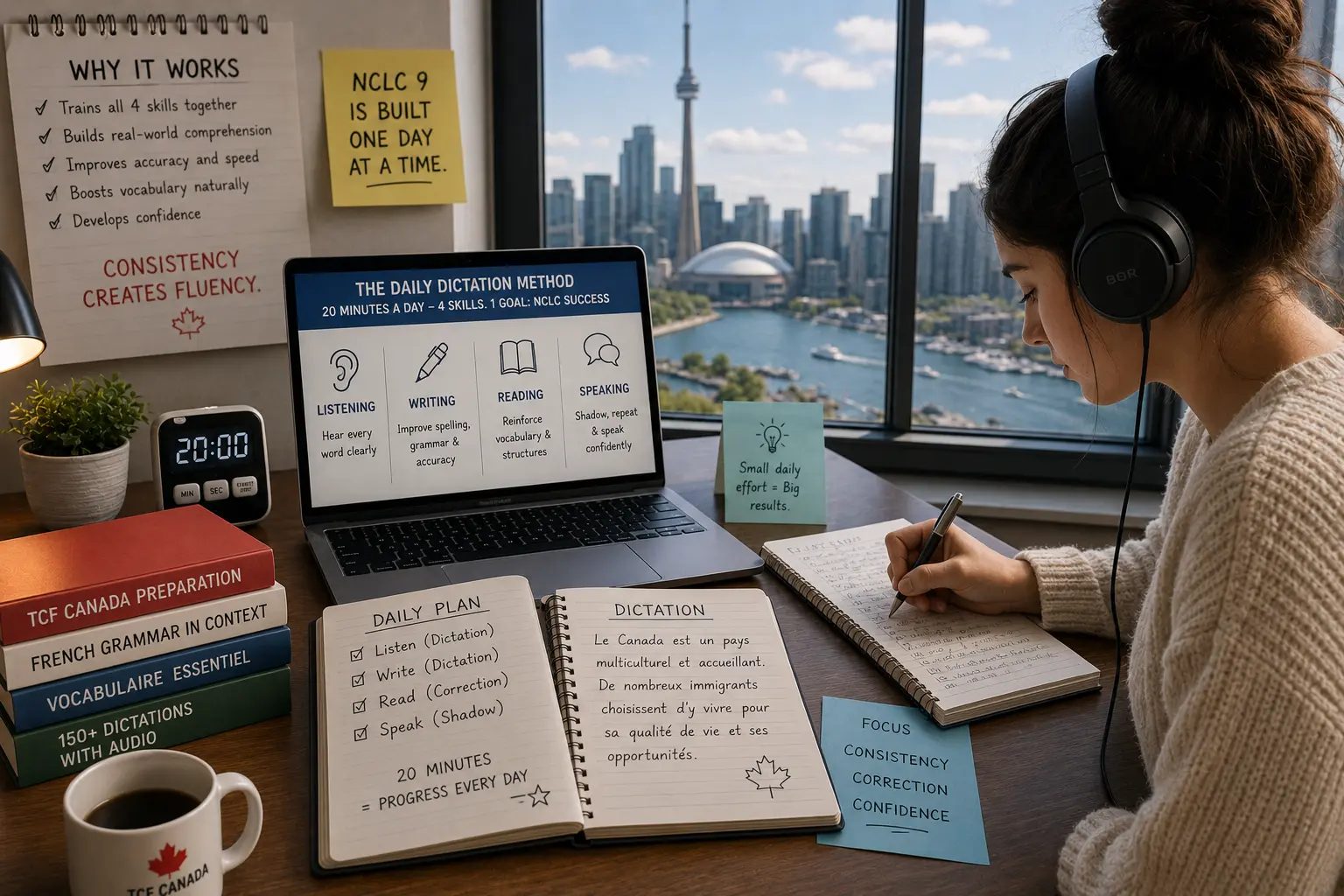
For the complete French-language vocabulary guide covering 500 essential TCF Canada words organized by domain, visit the French resource at Vocabulaire Thématique TCF Canada : Les 500 Mots Indispensables. To understand how vocabulary intersects with the 20 grammatical structures that separate NCLC 7 from NCLC 10, read TCF Canada Grammar Mastery: The 20 Structures. For the digital Canadian French resources that provide the most authentic vocabulary exposure, the full guide is at Canadian French Digital Resources for Authentic Preparation. The daily dictation method that simultaneously builds vocabulary, grammar and listening skills is explained in The Daily Dictation Method. The French companion La Dictée Quotidienne provides additional exercises in French.

0 Commentaires
aucun commentaire
Soyez le premier a partager votre avis !