-
Auteur :
 Antoine C.
- May 04, 2026
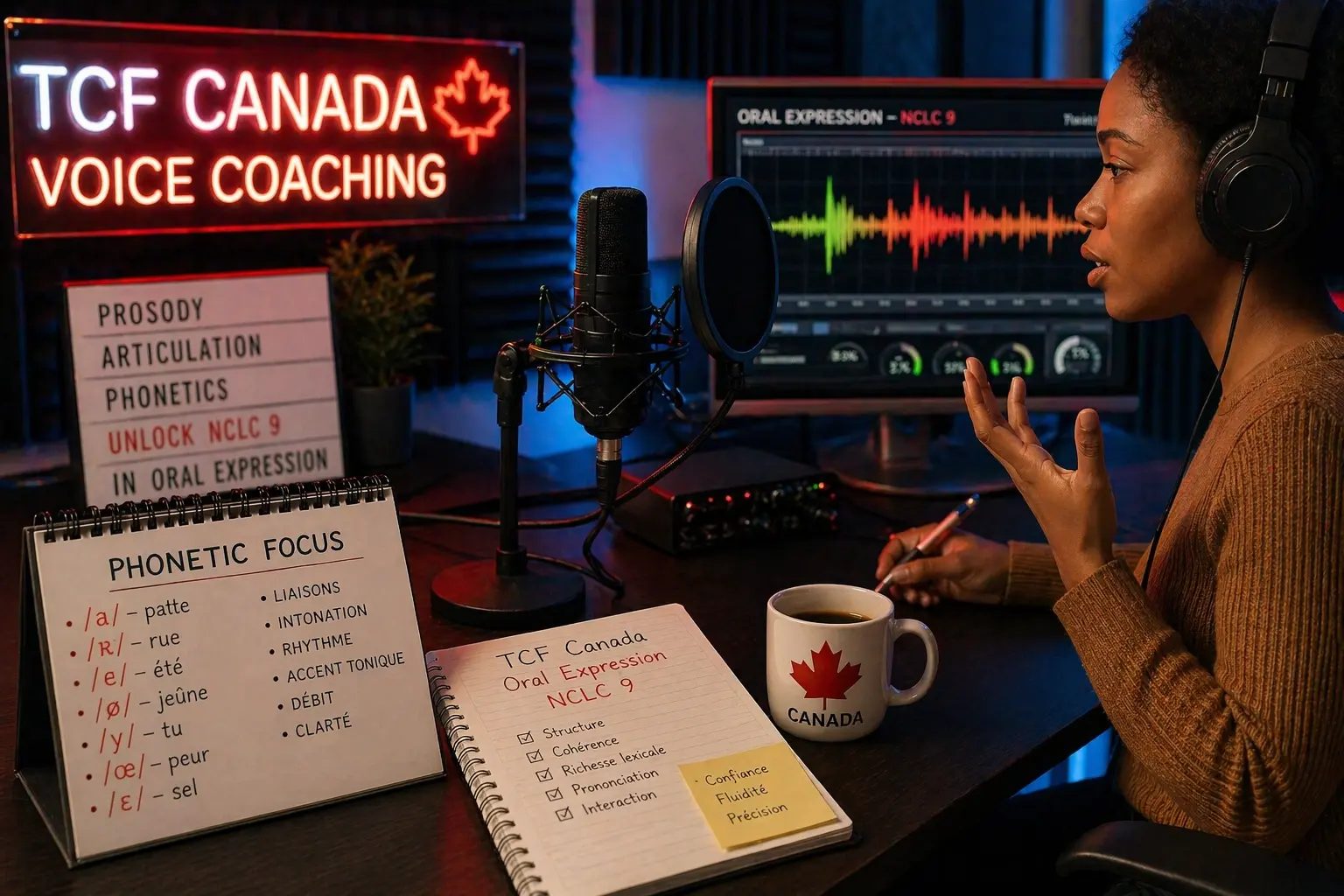
The vast majority of TCF Canada preparation resources focus on what you say — the content, structure and grammar of your oral productions. Far fewer address something equally important and frequently neglected: the physical quality of your voice. In TCF Canada oral expression, how you produce sound matters almost as much as what you say — because the official FEI marking rubric includes a dedicated phonological criterion, explicitly scored at every NCLC level.
This article builds on the strategic frameworks in our TCF Canada Speaking: 15 Proven Techniques from Top Scorers and Strategies for Speaking with Confidence articles. Where those guides address structure and content, this one addresses the vocal instrument itself — phoneme accuracy, prosodic naturalness and the specific techniques that transform a comprehensible production into an NCLC 9 one.
What the FEI phonological criterion evaluates: Intelligibility (can an examiner understand you without effort?), phonemic control (do you confuse sounds that carry distinct meanings?), intonation naturalness (does your voice rise and fall appropriately for the language?), speech rate (neither laboured nor rushed?), and fluency (do you block repeatedly or restart mid-sentence?).
Official NCLC Phonological Descriptors — The Complete Scale
| NCLC Level | Official Phonological Descriptor | Immigration Context |
|---|---|---|
| 5–6 | Strong accent that sometimes impedes comprehension; regular phonemic errors affecting communication | Minimum for some provincial nominations |
| 7–8 | Perceptible accent that does not hinder comprehension; adequate phonemic control; some intonation errors | Standard Express Entry eligibility |
| 9–10 | Generally correct pronunciation; accent has no impact on intelligibility; natural intonation patterns | Optimal for Francophone category draws |
| 11–12 | Near-native pronunciation; very natural rhythm and intonation; accent minimal or absent | Maximum points available |
The reassuring takeaway: NCLC 9 does not require you to sound Canadian or eliminate your accent. It requires your accent to be non-obstructive — meaning a trained examiner can understand every word without effort or inference. A strong but clearly intelligible Moroccan, Algerian or Senegalese accent is entirely compatible with NCLC 9.
The 8 Most Challenging French Phonemes for Non-Native Speakers
Phoneme 1 — The Uvular [ʁ]: The French "R"
The French R is produced at the back of the throat (uvular position), unlike the rolled R of Spanish, Arabic, Portuguese or Berber. It is one of the strongest phonological identification markers for trained examiners.
Progressive production technique:
1. Produce the [x] sound of German "Bach" or Arabic "kh" (guttural friction at the back of the throat)
2. Add gentle uvular vibration to transform [x] into [ʁ]
3. Integrate into simple isolated words: "rouge", "rue", "regarder", "réunion"
4. Progress to consonant clusters: "très", "proche", "grande", "froid"
5. Practise 10 minutes daily with self-recording and weekly comparison for 4 consecutive weeks
1. Produce the [x] sound of German "Bach" or Arabic "kh" (guttural friction at the back of the throat)
2. Add gentle uvular vibration to transform [x] into [ʁ]
3. Integrate into simple isolated words: "rouge", "rue", "regarder", "réunion"
4. Progress to consonant clusters: "très", "proche", "grande", "froid"
5. Practise 10 minutes daily with self-recording and weekly comparison for 4 consecutive weeks
Phoneme 2 — Nasal Vowels [ã], [ɛ̃], [ɔ̃]
These vowels do not exist in Arabic, English or Spanish. Air must resonate simultaneously in the mouth and nasal cavities without closing the mouth or producing a following nasal consonant. The critical distinctions for TCF Canada:
- "on" [ɔ̃] vs "an" [ã]: "bon" ≠ "banque" — different vowel quality and resonance cavity
- "in" [ɛ̃] vs "an" [ã]: "pain" ≠ "pan" — systematically distinct sounds despite seeming similar
- Diagnostic sentence to practise all three: "Le peintre peint un pont brun en plein air sous un vent indécis."
Phoneme 3 — The [y]: French "U"
The [y] of lune, rue, pur, sur does not exist in English, Arabic or Spanish. Lips must be rounded as for [u] ("oo") while the tongue maintains the high-front position of [i] ("ee"). Production technique: say a sustained [i] while gradually rounding your lips into a kissing position without moving the tongue. The resulting sound is [y].
Phoneme 4 — The [e] / [ɛ] / [ə] Triangle
Why this distinction carries grammatical consequences:
- "J'ai chanté" [ʃɑ̃te] — passé composé (closed e): action is completed
- "Je chantais" [ʃɑ̃tɛ] — imparfait (open e): ongoing or habitual past
- "Je chante" [ʃɑ̃tə] — présent (mute e): current action
If these three forms are phonologically identical in your production, the examiner loses the tense information from your speech — which scores the grammatical criterion negatively in addition to the phonological one.
Prosody — The Hidden Factor That Separates NCLC 8 from NCLC 9
The French End-Stress Rule
Unlike English, where stress falls on a particular syllable within each word, French places stress on the last syllable of each rhythmic group. Individual words have no inherent stress when spoken in connected speech.
Rhythmic grouping with correct stress placement:
"Je voudrais / vous informer / que ma candidature / a finalement été retenue."
Stressed syllables: "vouDRAIS" — "forMER" — "reteNUE"
Common English-speaker transfer error:
"JE voudrais VOUS inFormer QUE ma candiDATure a éTÉ retenue." (individual word stress)
"Je voudrais / vous informer / que ma candidature / a finalement été retenue."
Stressed syllables: "vouDRAIS" — "forMER" — "reteNUE"
Common English-speaker transfer error:
"JE voudrais VOUS inFormer QUE ma candiDATure a éTÉ retenue." (individual word stress)
Intonation Patterns by Sentence Type
| Sentence Type | Intonation Contour | Example |
|---|---|---|
| Declarative / Affirmative | Falling ↘ at end | "Vous souhaitez immigrer au Canada." ↘ |
| Yes/No Question | Rising ↗ at end | "Vous souhaitez immigrer au Canada ?" ↗ |
| Wh-Question | Falling ↘ at end | "Quand souhaitez-vous déposer votre demande ?" ↘ |
| Enumeration | Rising ↗ on each item, final ↘ | "Il faut préparer les documents ↗, remplir les formulaires ↗, puis soumettre." ↘ |
Three Essential Daily Voice Coaching Exercises
Exercise 1 — Annotated Read-Aloud (15 minutes/day)
- Select a 200-word article from La Presse or Le Devoir
- Mark rhythmic groups with "/" and stressed syllables with an underline
- Record yourself reading the annotated version once
- Listen back immediately and note phonological issues without stopping the recording
- Re-read with targeted corrections — save both recordings to compare weekly progress
Exercise 2 — Shadowing with Radio-Canada (20 minutes/day)
Shadowing means repeating a native speaker in near-real time, imitating their intonation, rhythm and phonemes simultaneously. It is the most evidence-based technique for internalising a language's prosodic patterns — far more effective than studying phonological rules in isolation.
Daily shadowing protocol:
1. Select a 60 to 90-second clip from Radio-Canada OHdio
2. Listen once for comprehension
3. Re-listen while simultaneously repeating, voice to voice, every phrase — imitating intonation and rhythm
4. Record yourself throughout the entire exercise
5. Compare your recording to the original on three criteria: rhythm, intonation contour, target phonemes
6. Repeat the same clip three times per day for three consecutive days before moving to a new one
1. Select a 60 to 90-second clip from Radio-Canada OHdio
2. Listen once for comprehension
3. Re-listen while simultaneously repeating, voice to voice, every phrase — imitating intonation and rhythm
4. Record yourself throughout the entire exercise
5. Compare your recording to the original on three criteria: rhythm, intonation contour, target phonemes
6. Repeat the same clip three times per day for three consecutive days before moving to a new one
Exercise 3 — Phonetic Tongue Twisters (5 minutes/day)
- For [ʁ]: "Les chaussettes de l'archiduchesse sont-elles sèches ? Archi-sèches !"
- For nasal vowels [ã/ɛ̃/ɔ̃]: "Un bon bain brun dans un bain brun bien bon"
- For [y]: "Lu, Lu, Lulu, une bulle bleue brûlée sur une dune"
- For consonant clusters: "Trois gros rats gris dans trois gros trous ronds creusés récemment"
"Shadowing with Radio-Canada transformed my speaking in five weeks. My Moroccan accent was strong and I had assumed it was permanent. After 35 days of 20-minute daily shadowing sessions, I understood French rhythm from the inside for the first time. My accent didn't disappear but it stopped interfering with intelligibility. I scored 16/20 in oral expression." — Zakaria, electrical engineer from Rabat, now in Gatineau
Your 8-Week Voice Coaching Programme:
Weeks 1–2: Phonological diagnosis + targeted work on your 3 most problematic phonemes + daily tongue twisters
Weeks 3–4: Daily 20-minute shadowing (Radio-Canada) + annotated read-alouds (15 min) + speech rate calibration
Weeks 5–6: Full prosodic integration + intonation pattern drilling by sentence type
Weeks 7–8: Complete TCF Canada speaking simulations + critical self-analysis + final phonological corrections
Weeks 1–2: Phonological diagnosis + targeted work on your 3 most problematic phonemes + daily tongue twisters
Weeks 3–4: Daily 20-minute shadowing (Radio-Canada) + annotated read-alouds (15 min) + speech rate calibration
Weeks 5–6: Full prosodic integration + intonation pattern drilling by sentence type
Weeks 7–8: Complete TCF Canada speaking simulations + critical self-analysis + final phonological corrections





0 Commentaires
aucun commentaire
Soyez le premier a partager votre avis !