-
Auteur :
 Antoine C.
- Jul 08, 2026
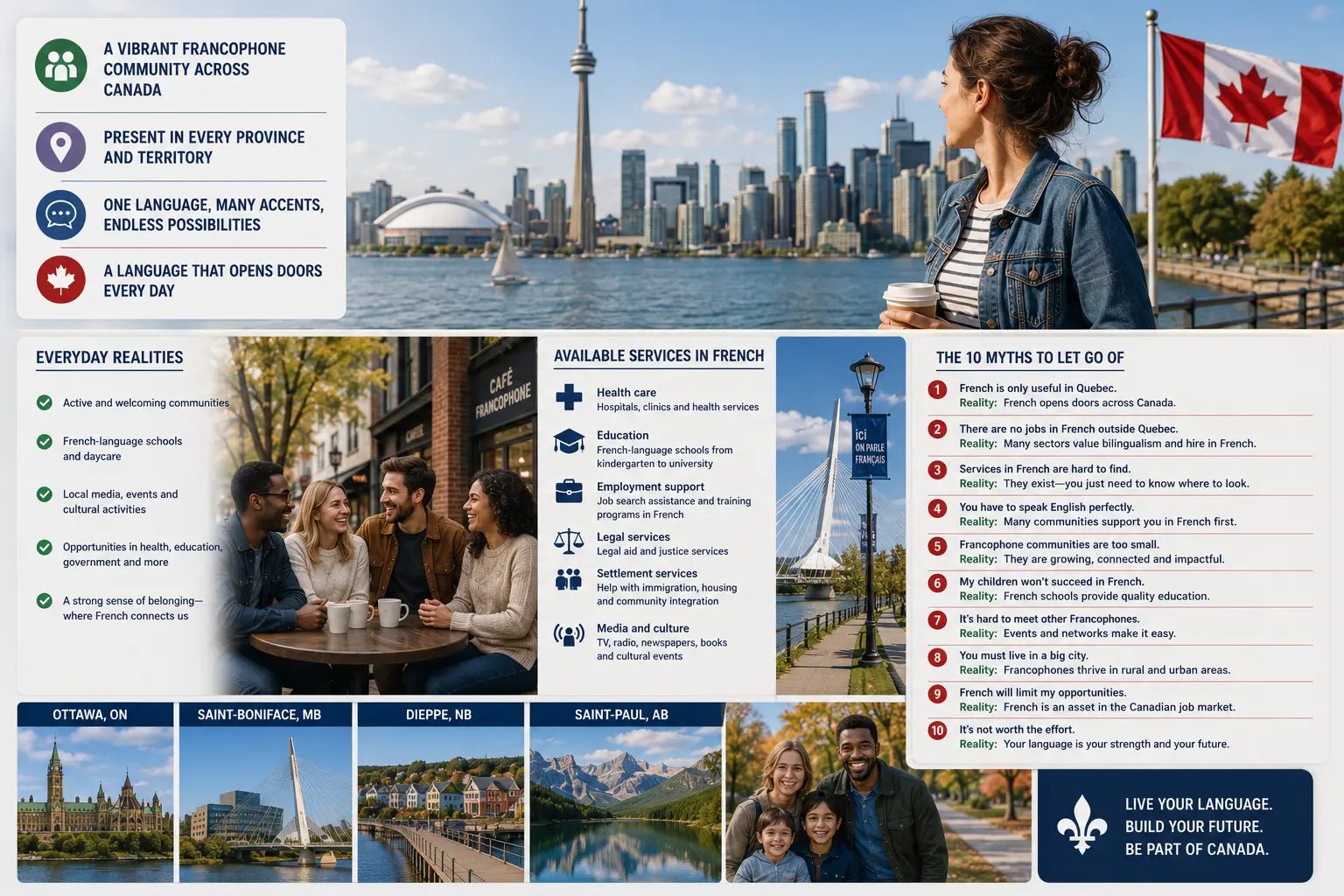
"You can only live in French in Quebec." This is the most pervasive myth in francophone immigration to Canada — and it is comprehensively false. Canada outside Quebec is home to 1.2 million francophones living, working, studying and raising children in French. From the Acadian communities of New Brunswick to the Franco-Ontarian community of Ottawa, from the Métis communities of Manitoba to the francophone enclaves of British Columbia, francophone life outside Quebec is vibrant, diverse and increasingly supported by federal investment. This guide is your reality check before you choose your province.
The 10 Myths About Francophone Life Outside Quebec
Myth 1: "You need English to survive outside Quebec."
Reality: In New Brunswick (the only officially bilingual province), many professionals live and work exclusively in French. In Ottawa, the federal public service is constitutionally bilingual — thousands work in French every day. In Sudbury, Hearst, Hawkesbury (Ontario) and Saint-Boniface (Winnipeg), French is the dominant community language. Survival in French is possible in these communities; English is a plus, not a requirement.
Myth 2: "French schools outside Quebec are low quality."
Reality: Francophone schools outside Quebec are provincially funded and provincially accredited — same curriculum standards as anglophone schools. Many francophone graduates proceed to top Canadian universities (University of Ottawa, Laurentian University, Université de Moncton). Some research shows minority-language school graduates score higher on bilingual tests than peers in either unilingual system.
Myth 3: "There are no French hospitals outside Quebec."
Reality: Moncton has the Dr. George-L.-Dumont University Hospital — a fully French-language regional hospital. Ottawa has designated French-language healthcare services at multiple hospitals. Manitoba, Ontario and New Brunswick all have formal French-language health services legislation requiring French service provision where demand exists.
Myth 4: "French has no value in the job market outside Quebec."
Reality: Federal government bilingualism requirements mean that French-English bilingualism commands a measurable salary premium for public servants in Ottawa and Hull. For positions designated bilingual, candidates with French proficiency access a separate competition with fewer candidates and often faster promotion tracks.
Myth 5: "French culture doesn't exist outside Quebec."
Reality: Acadian culture (New Brunswick, Nova Scotia, PEI) predates Confederation and has its own literature, music, festivals (Tintamarre) and identity distinct from Quebec. Franco-Ontarian culture has produced major artists, writers and institutions. The FCFA (Fédération des communautés francophones et acadienne du Canada) represents a living, active francophone civil society spanning every province.
Province-by-Province: What Francophone Life Actually Looks Like
| Province | Francophone Population | Key French Communities | French Services Available |
|---|---|---|---|
| New Brunswick | ~270,000 (33%) | Moncton, Bathurst, Edmundston, Campbellton | Full bilingual services — schools, hospitals, courts, government |
| Ontario | ~600,000 (5%) | Ottawa-Gatineau, Sudbury, Timmins, Hearst, Hawkesbury | Loi de 1986 sur les services en français — designated services in 25+ areas |
| Manitoba | ~45,000 (4%) | Saint-Boniface (Winnipeg), Saint-Pierre-Jolys | French schools, community organizations, some municipal services |
| Nova Scotia | ~30,000 (3%) | Chéticamp, Argyle, Clare | French first-language schools, community health centres |
| British Columbia | ~65,000 (2%) | Vancouver, Victoria, Prince George | French schools, Alliance Française, federal services in French |
| Alberta | ~70,000 (2%) | Edmonton (Saint-Albert), Calgary | French schools, ACFA (Association canadienne-française de l'Alberta) |
| Prince Edward Island | ~5,000 (3%) | Évangéline region | French schools, Collège de l'Île |
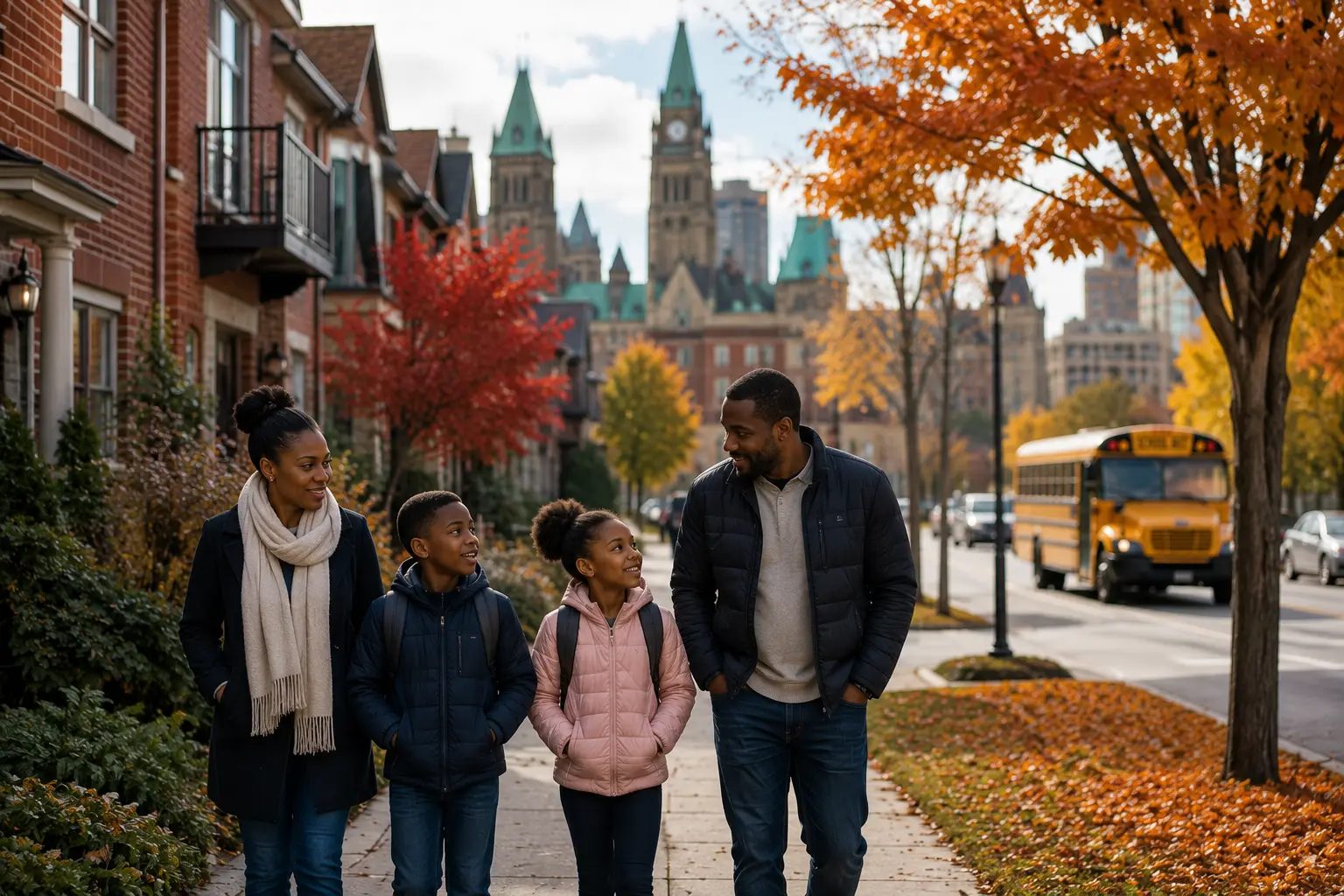
Ottawa: The Hidden Capital of Bilingual Canada
Why Ottawa-Gatineau is the ideal destination for francophone immigrants outside Quebec:
- French on both sides of the river: Gatineau (Quebec) and Ottawa (Ontario) are functionally one metropolitan area — 1.4 million people where French and English coexist at the highest institutional level in North America
- Federal employment: 100,000+ federal public servants — 30% work primarily in French; another 40% need operational bilingualism. French proficiency = federal job premium.
- University of Ottawa: Canada's largest bilingual university — all programs available in both languages. World-class research institution attracting international francophone students and researchers.
- Full French daily life: French schools (15+), French hospitals (Montfort Hospital), French radio (CJFO 90.7 FM), French newspapers (Le Droit), French cultural centres — everything you need to live in French is present
- Lower cost than Montreal: Average 3-bedroom apartment in Ottawa: CAD $2,200/month vs Montreal: CAD $2,000/month — comparable, but Ottawa salaries are consistently higher in public service
Moncton: The Acadian Metropolis
Why Moncton is the francophone immigrant's hidden gem:
- New Brunswick's largest city — genuinely bilingual at the street level, not just institutionally
- Université de Moncton: Canada's largest French-language university outside Quebec — major employer and community anchor
- Housing: average 3-bedroom house price CAD $380,000 (2025) — dramatically cheaper than Montreal or Ottawa
- Employment: RBC Insurance, Assumption Life, Medavie BlueCross, ICT sector — all large bilingual employers
- Immigration-friendly: New Brunswick actively recruits internationally, with settlement services in French available on arrival
- Quality of life: low crime, excellent schools, accessible outdoor recreation, tight-knit community
"I'm a civil engineer from Dakar. I chose Moncton over Montreal for practical reasons: my NB employer offered to sponsor my immigration, the housing was affordable, and the Acadian community reminded me of Senegal's communal culture. Three years later, I cannot imagine having made a different choice. My children attend École Mathieu-Martin, my wife works at Université de Moncton, and I lead French-language engineering projects for the province. We live entirely in French except when collaborating with anglophone colleagues." — Ibrahima, 38, Civil Engineer, Moncton NB
For the complete francophone life outside Quebec guide including province-by-province details, read Francophone Life Outside Quebec 2026. For maintaining and developing French after arriving in Canada, see Maintaining and Improving French After Immigration 2026. The cost of living planning guide for all francophone provinces is at Cost of Living in Francophone Canadian Provinces 2026. For the provincial immigration pathways that best connect you to specific francophone communities, see TCF Canada and New Provincial Pathways 2026. The French companion life-in-Canada guide is at Vie au Canada : Contexte Culturel et Linguistique. For Quebec's specific francophone context including francisation courses, see Quebec's Free Francisation Courses. For children's French education options outside Quebec, see the companion article on Children's Bilingualism in Francophone Canada. For integrating professionally in francophone Canada, the French guide is at Intégration Professionnelle Canada Francophone 2026. For the Atlantic Immigration Program connecting you to francophone Atlantic communities, see TCF Canada and New Provincial Pathways 2026. For the 90-day post-TCF action plan that includes community integration steps, see After Your TCF Canada Results: 90 Critical Days.

0 Commentaires
aucun commentaire
Soyez le premier a partager votre avis !