-
Auteur :
 Antoine C.
- Jul 06, 2026
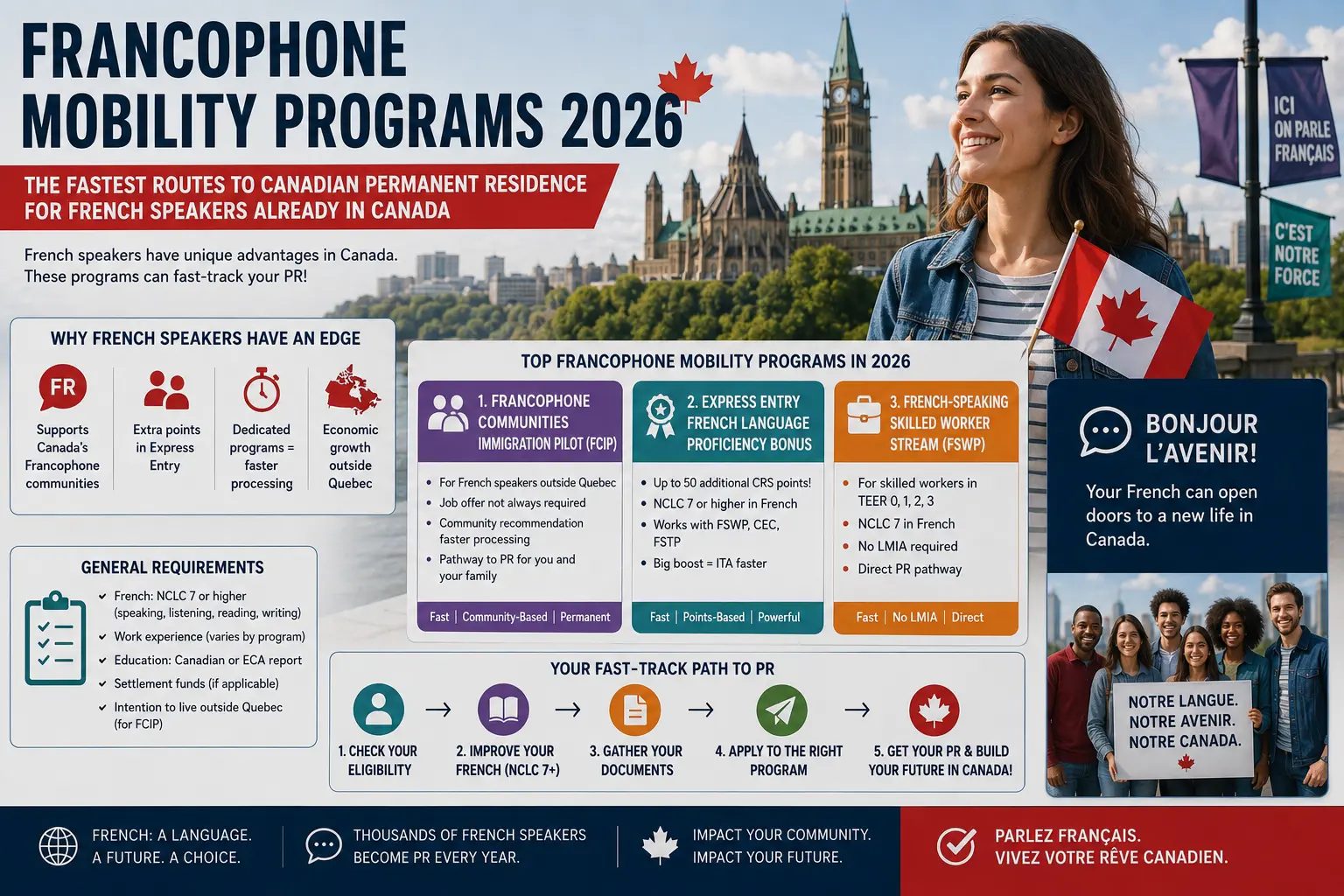
The traditional immigration path — TCF Canada exam, Express Entry profile, wait for a draw — takes 12-36 months from first step to permanent residence. But for French-speaking professionals who can first enter Canada on a work permit, several accelerated pathways can reduce total time to permanent residence by 6-18 months. These francophone mobility programs are among the least publicized but most valuable tools in the Canadian immigration system. This guide maps all of them for 2026.
Why "Work in Canada First" Is Often the Fastest Path
How working in Canada first accelerates permanent residence:
- CEC eligibility: 1 year of skilled work experience in Canada = eligibility for the Canadian Experience Class (CEC) — which consistently receives draws at lower CRS thresholds than FSWP
- Language points maintained: Your TCF Canada score continues earning points while you accumulate Canadian experience — dual pathway building
- PNP employer-linked nomination: A Canadian employer can nominate you for a provincial nomination after 6-12 months — nomination adds 600 CRS points instantly
- Settlement head start: 12-24 months in Canada before PR means you arrive as a permanent resident with an established network, job and community — dramatically easing integration
The Key Francophone Mobility Programs 2026
| Program | Who Qualifies | Work Permit Duration | Path to PR | NCLC Required |
|---|---|---|---|---|
| International Mobility Program (IMP) — LMIA-exempt | Significant benefit to Canada profiles, intra-company transfers, reciprocal agreements | 1-3 years | CEC after 1 year + Express Entry | No requirement for permit, NCLC 7 for CEC |
| Working Holiday / PVT (France, Belgium, Switzerland) | 18-35 year olds from eligible countries | 12-24 months | CEC after 12 months skilled work | No requirement for permit |
| Post-Graduation Work Permit (PGWP) | Graduates of Canadian universities (incl. francophone institutions) | Up to 3 years | CEC after 12 months of skilled work | NCLC 7 for CEC |
| Francophone Significant Benefit category | French speakers in shortage occupations — employer letter | 2 years (renewable) | CEC or PNP employer after 1 year | NCLC 7 recommended |
| Atlantic Immigration Pilot — work permit stream | Designated employer in Atlantic province + job offer | 1-2 years | AIP PR application after 12 months | NCLC 6-7 |
| Rural and Northern Immigration Pilot (RNIP) | Employer offer in participating rural community | 1-2 years | PR application after 12 months | NCLC 6 |
The PVT (Programme Vacances-Travail): France, Belgium, Switzerland Advantage
Countries with PVT agreements with Canada (2026):
- France (18-35 years, up to 24 months, no income/job requirements)
- Belgium (18-30 years, 12 months)
- Switzerland (18-35 years, 12 months)
- Australia, New Zealand, Chile, Taiwan, Germany, Netherlands, Austria, Denmark and several others
PVT + TCF Canada = optimal 24-month path:
- Pass TCF Canada NCLC 7-9 before departing (3-4 months preparation)
- Enter Canada on PVT work permit
- Find skilled employment in Canada (1-3 months)
- After 12 months skilled work: eligible for CEC Express Entry
- Submit Express Entry profile with CEC + TCF Canada scores
- ITA + PR application
- Total: approximately 18-24 months from TCF Canada exam to PR
The Study Permit to PR Pipeline: Francophone Universities
Francophone university study → PGWP → CEC → PR — the academic pipeline:
- Apply to Université de Moncton, Université d'Ottawa, Université de Hearst, or any Quebec university
- Complete 1-2 year program (Master's, college diploma, bridging certificate)
- Graduate: receive PGWP up to 3 years (length tied to program duration)
- Work 12 months in skilled occupation in Canada
- Apply for CEC PR — NCLC 7 + 1 year Canadian experience = strong CEC profile
- Additional benefit: Canadian degree adds 135 CRS education points + Canadian connections + language maintenance in immersive environment
"I used the PVT Belgium→Canada route. Passed TCF Canada NCLC 8 in Brussels, left for Montreal 4 months later. Within 3 months I had a bilingual product manager role at a Montreal tech company. Exactly 12 months of skilled work later, I submitted my CEC profile. No more draws to wait for — CEC has 6-week draws from submission to ITA on average. My PR was granted 10 months after my profile was submitted. Total time from TCF Canada exam to PR: 25 months. Much faster than the standard FSWP route would have been for my CRS score." — Thomas, 29, Product Manager, Montreal QC
For the complete international mobility and TCF Canada strategy guide, read TCF Canada and International Mobility: Work in Canada First. For the francophone mobility programs overview in English, see Francophone Mobility Programs 2026: Faster Routes to PR. The French companion guide is at Programmes de Mobilité Francophone 2026. For the French international mobility guide (travail au Canada avant immigration définitive), see TCF Canada et Programme de Mobilité Internationale. For the IRCC official information on the International Mobility Program, visit canada.ca — International Mobility Program. For understanding how CEC differs from FSWP in terms of draw thresholds, see Canadian Immigration System and TCF Canada. For the cost of living guide helping PVT holders plan their initial Canadian budget, see Cost of Living in Francophone Canadian Provinces 2026. For the 90-day action plan after your TCF Canada results including work permit strategy, see After Your TCF Canada Results: 90 Critical Days. For the Quebec preparation guide relevant to those using the study permit pipeline, see Preparing for TCF Canada from Quebec. For the new provincial pathways that complement mobility program immigration, see TCF Canada and New Provincial Pathways 2026.





0 Commentaires
aucun commentaire
Soyez le premier a partager votre avis !