-
Auteur :
 TCF Canada
- Aug 13, 2026
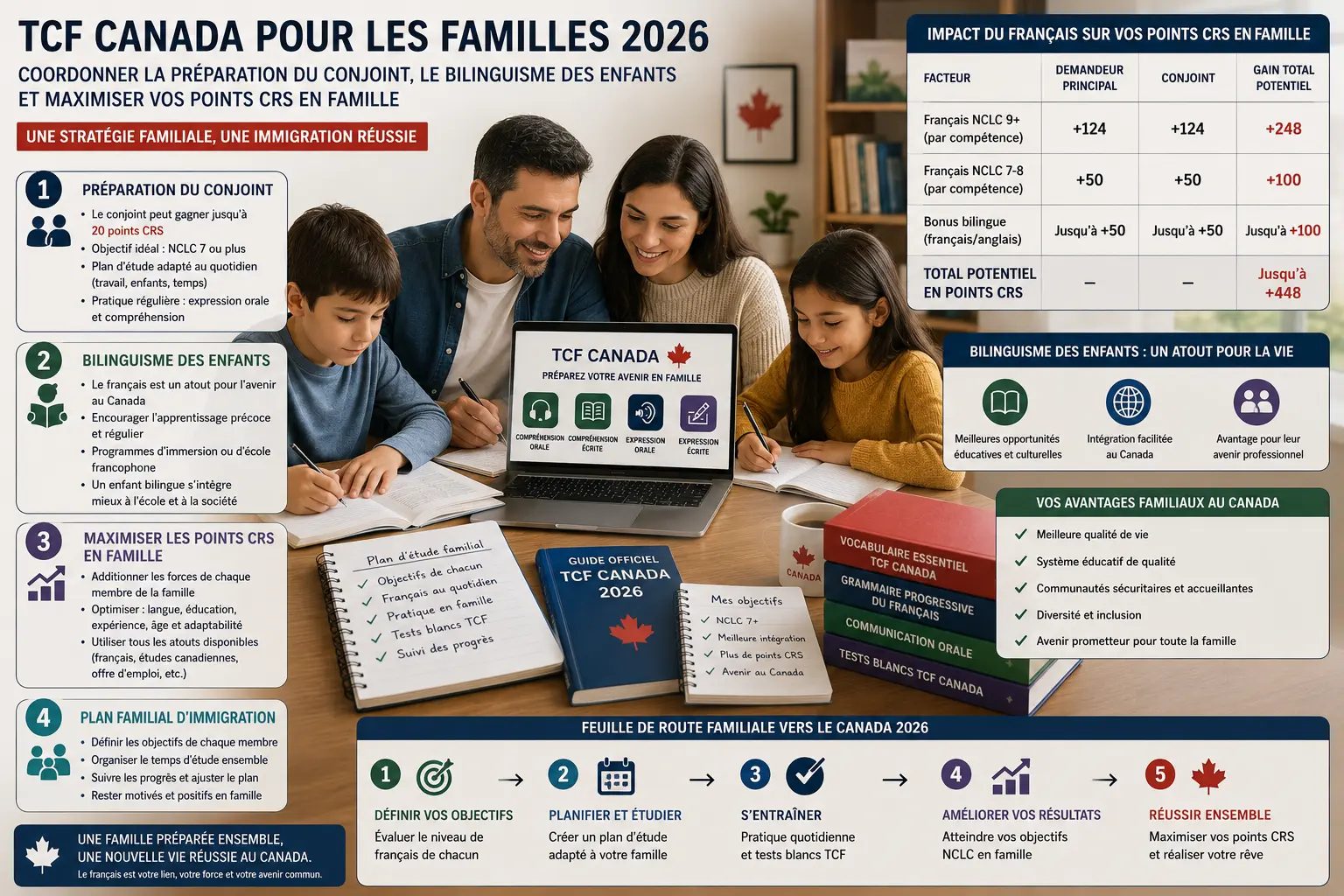
Most TCF Canada preparation guides focus on the individual candidate. But for the majority of immigrants, the Canadian immigration journey is a family project — one that involves a spouse's language proficiency, children's bilingual education prospects, and the complex mathematics of family CRS point optimisation. This guide addresses the full family dimension of TCF Canada and Canadian francophone immigration in 2026.
How Spousal Language Scores Impact the CRS
In Express Entry, the principal applicant's French proficiency generates the largest CRS language score (up to 136 points). But the spouse's French proficiency — even when they are not the principal applicant — generates additional CRS points through the adaptability and spousal language factors.
| Factor | Points (Principal) | Points (With Spouse) |
|---|---|---|
| French first official language NCLC 9 (all 4 skills) | 136 | 120 (slightly reduced with accompanying spouse) |
| English second official language CLB 9+ | 24 | 20 |
| Spouse French language (NCLC 5+) | N/A | +15 adaptability points |
| Spouse French language (NCLC 7+) | N/A | +22 adaptability points (varies by program) |
The family CRS maths: A family where BOTH spouses achieve NCLC 7+ in TCF Canada can generate significantly higher combined CRS scores than a single-earner language investment. In competitive immigration environments where 10-15 CRS points determine whether you receive an ITA in months or years, the spousal TCF Canada investment has a measurable ROI.
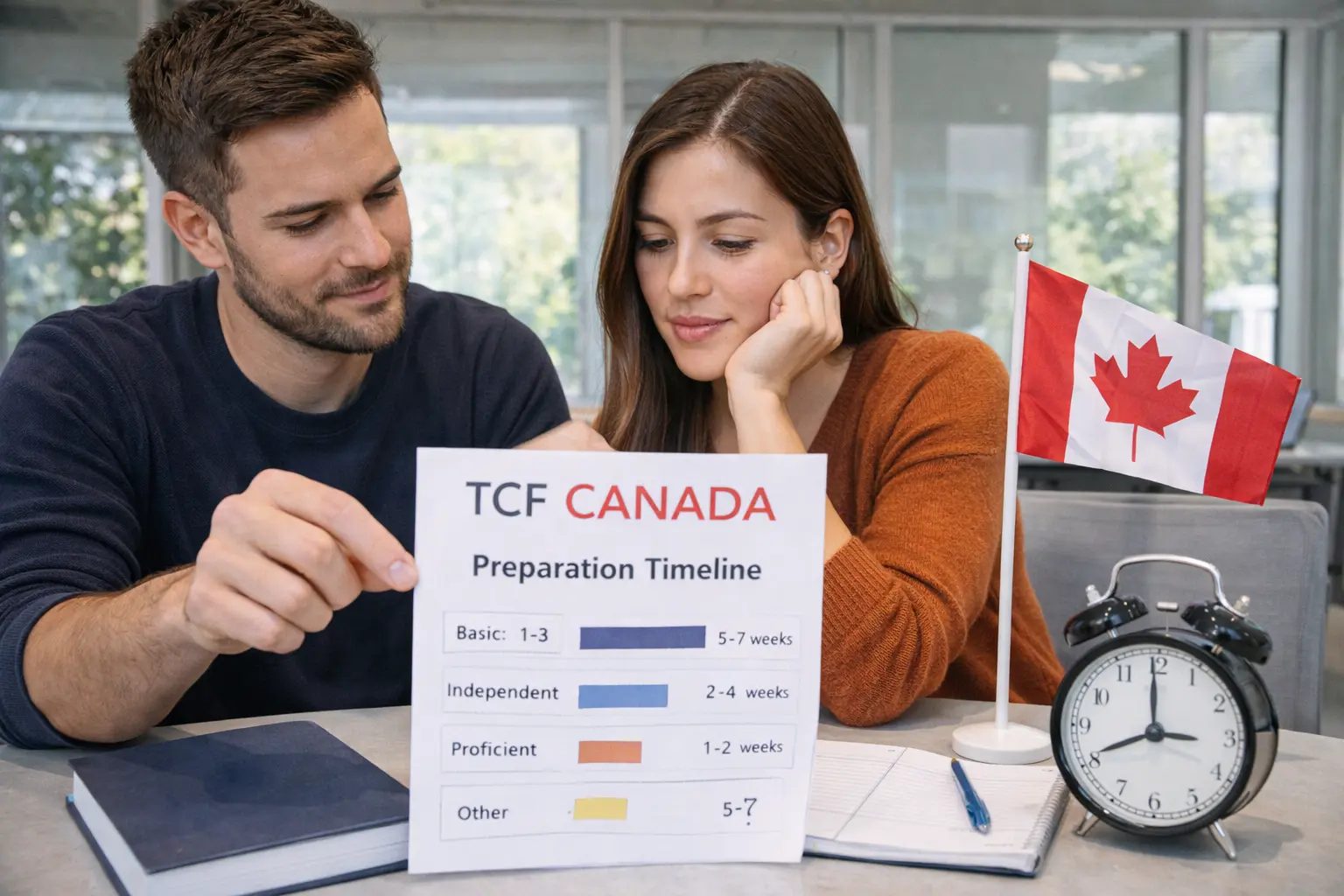
Coordinating Two TCF Canada Preparations: Practical Framework
6 strategies for couples preparing TCF Canada together:
- Staggered start dates: If one spouse is at B2 and the other at B1, stagger by 6-8 weeks so both are at peak readiness simultaneously
- Shared immersion sessions: Watch Quebec French TV together — immersion is collaborative. Dinner conversations in French. Weekend French-only rules.
- Divided resource responsibilities: One partner researches listening resources, the other writing tasks — each teaches the other what they find
- Mutual oral practice: Use each other as practice interlocutors for Task 3 opinion defence — defend opposing positions on the same topic
- Separate exam dates: Avoid exam day logistics stress by booking different sessions — one spouse supporting the other on exam day
- Cross-correction of writing: Each correct the other's written tasks using the NCLC criteria — builds evaluator perspective and reduces blind spots
Children and Bilingualism: What Canada Offers
French education options for children of francophone immigrant families:
- French first-language schools (écoles de langue française): Available in every province through the official minority school system (protected by Section 23 of the Canadian Charter) — instruction entirely in French from kindergarten
- French immersion schools: English-track schools where 50-100% of instruction is in French — excellent for bilingual development of children from French-heritage families
- CÉGEP (Quebec): Quebec's unique pre-university college system — francophone instruction, producing genuinely bilingual graduates for the Canadian job market
- Francisation for children: Quebec offers free intensive French courses for school-age children of immigrants not educated in French — your children don't need to be fluent before arriving
"My husband and I both prepared the TCF Canada together. We studied every evening after the kids were in bed — 45 minutes each. We practiced oral tasks with each other and corrected each other's writing. My husband got NCLC 9, I got NCLC 8. Together our CRS was strong enough for the next francophone draw. We arrived in Moncton with our two children. They now attend the École Mathieu-Martin — entirely in French. Within 6 months, they were speaking better Quebec French than us." — Amal, 34, Accounting Manager, Moncton NB
CRS Optimisation: The Complete Family Scoring Simulation
CRS simulation — Couple, principal applicant age 32, accompanying spouse age 30:
- Principal: Age (32): 100 + Education Master's: 135 + Foreign experience (6 years): 69 = 304 base
- Principal: TCF Canada NCLC 9 = 120 (with accompanying spouse)
- Principal: IELTS CLB 9 (English 2nd language) = 20
- Spousal language bonus (NCLC 7+ TCF Canada): +15
- Spouse education bonus (Bachelor's): +10
- Total: ~469 CRS — strong for francophone draws
- Without spousal TCF Canada: ~454 — 15 points less, potentially 6-12 months longer wait
For the complete family immigration strategy including CRS maximisation for couples, read TCF Canada for Families 2026. For the cost-of-living guide helping families plan their Canadian settlement budget, see Cost of Living in Francophone Canadian Provinces 2026. For the life in francophone Canada outside Quebec guide covering children's education and community life, read Francophone Life Outside Quebec 2026. The French companion for family immigration strategy is at TCF Canada en Famille 2026. For the CRS score simulator allowing you to model family CRS scenarios, visit CRS Score Simulator for TCF Canada. For the maintaining French after immigration guide — keeping the whole family's French strong after landing — see Maintaining French After Immigration to Canada 2026. The French version covering anti-language attrition strategies is at Maintien et Amélioration du Français après Immigration Canada 2026. For the mental health dimension of preparing as a couple with family pressures, see Mental Health and TCF Canada 2026 Preparation. For building a study group that includes your spouse and peers, see Building a TCF Canada Study Group. And for the post-TCF action plan for the whole family, see After Your TCF Canada Results: 90 Critical Days.



 TCF Canada Hub
0 Commentaires
aucun commentaire
Soyez le premier a partager votre avis !