
-
Auteur :
 Antoine C.
- Sep 14, 2026
The single most common cause of wasted TCF Canada preparation time is inaccurate self-assessment. Candidates who believe they are B2 when they are actually B1 under-prepare and fail to reach their NCLC target. Candidates who believe they are B1 when they are actually C1 over-prepare, waste months of effort, and delay their immigration by a year. Before investing a single day in structured preparation, you need an accurate, honest diagnosis of your real French proficiency across all four TCF Canada skills. This guide gives you the diagnostic framework and the tools to achieve it.
Why Self-Assessment Fails: The 4 Cognitive Biases
The biases that systematically distort your self-assessment:
- The fluency illusion: Candidates who speak French daily often perceive themselves as more proficient than they are because social conversation requires far less precision than TCF Canada formal register. "I talk to my French colleagues every day" → may not translate to NCLC 8.
- The academic overestimate: Candidates with strong formal French education often overestimate their oral production and listening comprehension skills because schools develop written skills more than oral. An A in written French at university ≠ NCLC 9 in speaking.
- The skill averaging fallacy: "My French is B2 overall" obscures the fact that one might be C1 in reading but B1 in listening — and in TCF Canada, each skill is scored independently. A B1 listening score is devastating regardless of other skill levels.
- The Quebec accent blindspot: Almost universally, candidates who have studied European French dramatically underestimate how unfamiliar Quebec phonology will feel on exam day. "I speak French well" does not translate to "I understand Radio-Canada at natural speed."
The 4-Step Accurate Diagnostic Protocol
Step 1 — The Baseline Test (2 hours 47 minutes)
How to conduct a true baseline diagnostic:
- Take one complete TCF Canada practice exam under exact exam conditions: no dictionary, no pauses, exact time limits per section
- Use official FEI preparation materials (Hachette FLE) or tcfonline.com — not adapted exercises
- Complete all 4 skills in sequence with no breaks longer than those allowed in the real exam
- Record your oral tasks — do not skip the recording component, which is where most candidates discover unexpected weaknesses
- Score your listening and reading against the answer key immediately after completion
- Score your writing and oral tasks using the official NCLC criteria grid (available on the FEI website)
What invalidates a diagnostic test:
- Using a dictionary during reading or writing — real exam forbids it
- Pausing the audio to replay — real TCF Canada audio plays once only
- Extending time limits — "just a few more minutes" produces false scores
- Skipping the oral recording because "I know I'm good at speaking" — oral is where the most surprises occur
- Taking the test in two sessions across different days — fatigue is part of the real exam challenge
Step 2 — The 4-Skill Gap Map
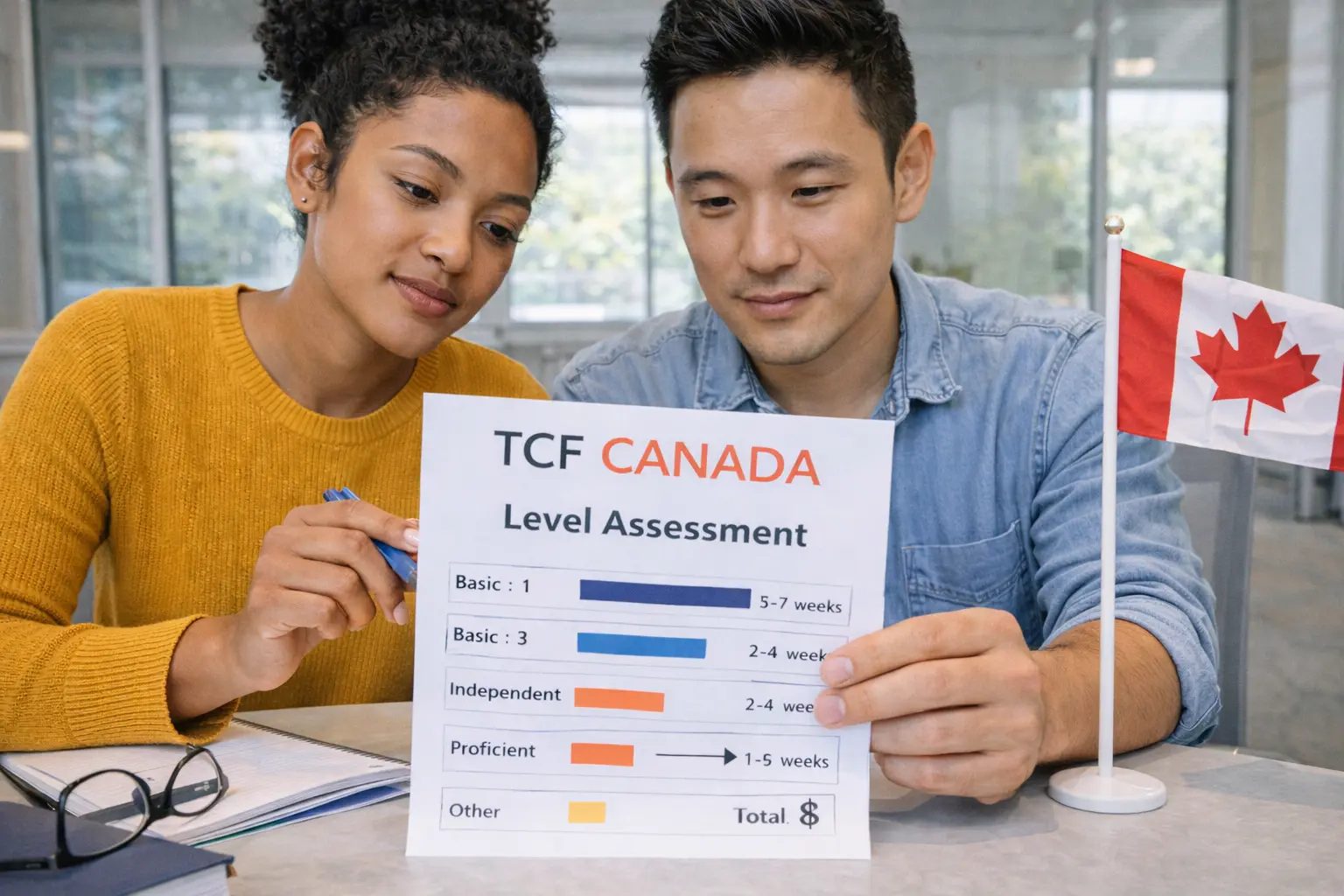
Once you have diagnostic scores, map them against the NCLC conversion table to establish your current level per skill and your gap from your immigration target.
| Skill | Your Raw Score | Your NCLC | Target NCLC | Gap | Priority |
|---|---|---|---|---|---|
| Listening (CO) | ___/699 | NCLC ___ | NCLC ___ | ___ levels | Highest / Medium / Low |
| Reading (CE) | ___/699 | NCLC ___ | NCLC ___ | ___ levels | Highest / Medium / Low |
| Speaking (EO) | ___/20 | NCLC ___ | NCLC ___ | ___ levels | Highest / Medium / Low |
| Writing (EE) | ___/20 | NCLC ___ | NCLC ___ | ___ levels | Highest / Medium / Low |
The 40-30-20-10 preparation allocation rule:
Allocate your daily preparation time in inverse proportion to your current skill level:
— Your weakest skill (largest gap): 40% of daily time
— Second weakest skill: 30% of daily time
— Third skill: 20% of daily time
— Your strongest skill: 10% of daily time (maintenance only)
This allocation maximizes CRS point generation per hour of preparation invested.
Step 3 — The Error Pattern Analysis
Raw scores tell you where you are. Error pattern analysis tells you why — and therefore what to fix. After scoring your diagnostic, categorize each error in a log.
Error categorization for each skill:
- Listening errors: Was the error because: (a) you didn't understand the Quebec accent phonologically? (b) you didn't know the vocabulary? (c) you missed the information because of the single-play format? (d) you misidentified which speaker said what?
- Reading errors: Was the error because: (a) you didn't read the question before the text? (b) you fell for the "true but not relevant" trap? (c) you ran out of time? (d) you confused the author's view with cited views?
- Writing errors: Were errors: (a) grammatical (which structure)? (b) register (which register shift)? (c) structural (PADE missing or incomplete)? (d) word count (too short/long)?
- Speaking errors: Were issues: (a) structural (no PADE framework)? (b) phonological (pronunciation)? (c) fluency (hesitation markers, long pauses)? (d) register (too informal)?
Step 4 — The Realistic Timeline Calculation
| Starting Level → Target | Listening | Reading | Speaking | Writing |
|---|---|---|---|---|
| NCLC 5 → NCLC 7 | 8-12 weeks | 6-10 weeks | 10-14 weeks | 8-12 weeks |
| NCLC 6 → NCLC 8 | 6-10 weeks | 5-8 weeks | 8-12 weeks | 6-10 weeks |
| NCLC 7 → NCLC 9 | 4-8 weeks | 4-6 weeks | 6-10 weeks | 5-8 weeks |
| NCLC 8 → NCLC 9 | 3-5 weeks | 2-4 weeks | 4-6 weeks | 3-5 weeks |
"I was convinced I was at B2 French after 3 years in a French company in Casablanca. My diagnostic mock test showed: NCLC 8 reading, NCLC 7 writing, NCLC 6 speaking, NCLC 5 listening. That listening score shocked me. Without the diagnostic, I would have prepared generically and probably passed with NCLC 7 listening, failing to reach my NCLC 8 target across all 4 skills. Instead, I targeted 60% of my preparation on listening for 7 weeks. Final TCF Canada: NCLC 8 everywhere. The diagnostic saved me a retake and 6 months of waiting." — Mehdi, 32, Financial Controller, Ottawa ON
Free Diagnostic Resources for Each Skill
Where to get a genuine diagnostic before investing in paid preparation:
- Official FEI self-test: tcfonline.com offers limited free practice — the most accurate gauge of real TCF Canada difficulty
- Hachette FLE TCF Canada prep book: Contains 1 full practice exam with scoring guide — €18-22, one-time cost, most accurate diagnostic tool available in print
- CECRL online placement tests (DELF/DALF level): tv5monde.com/apprendre-le-francais/tests/ — free, gives CECRL level estimate translatable to NCLC
- Alliance Française placement test: If you are near an Alliance Française, their free placement test (required for course enrollment) provides a reliable CECRL estimate
- BonPatron writing diagnostic: Write a 200-word text on any topic and submit to BonPatron — error density and type give a rough grammar/writing level indication
For the complete level assessment guide with official NCLC conversion tables, read TCF Canada Level Assessment: How to Accurately Measure Your Current Skills. For the preparation duration guide showing realistic timelines by starting level for each skill, see TCF Canada Preparation Duration: How Much Time You Really Need. For the 3-month preparation plan that builds on your diagnostic results, read Strategic TCF Canada Planning: The 3-Month Method. The study log system for tracking progress from your diagnostic baseline is at Your TCF Canada Study Log. For targeted improvement strategies matched to your specific diagnostic gaps, read Targeted Improvement: Transform Your Weaknesses into Strengths. The French-language assessment guide is at Évaluation de Niveau TCF Canada. For the mock test protocol that follows your initial diagnostic, read The Critical Role of Practice Tests. The decoding results guide helps interpret diagnostic outcomes at Decoding Your TCF Canada Results. For the 5 preparation methods to choose based on your diagnostic gaps, see 5 TCF Canada Preparation Methods Compared. The French companion assessment guide is at Durée de Préparation TCF Canada.

0 Commentaires
aucun commentaire
Soyez le premier a partager votre avis !